1.1 A and P Outer Ear
 Call Kai
 Learn
Learn Practice Test
 Spaced Repetition
 Match
Match Flashcards
 Knowt Play
1/83

There's no tags or description
Looks like no tags are added yet.
Name | Mastery | Learn | Test | Matching | Spaced | Call with Kai |
|---|
No analytics yet
Send a link to your students to track their progress
84 Terms
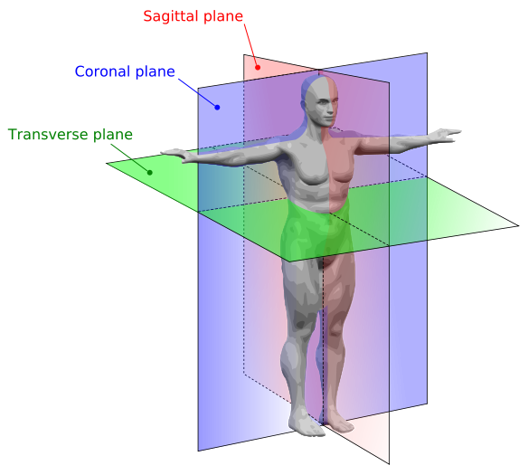
what are the different planes?
sagittal (separates left and right), coronal (separates front and back) and transverse (separates top and bottom)
anterior
toward the front
posterior
toward the back
superior
above
inferior
below
cranial
above
ventral
toward the front
dorsal
toward the back
caudal
below
lateral
toward the side
medial
toward the middle
ipsilateral vs contralateral
on the same side vs on the opposite side
superficial
toward or near the outside
deep
toward or near the middle
proximal
nearest to the point of origin
distal
farther from the point of origin
what are the 3 divisions of the peripheral auditory system?
outer ear, middle ear and inner ear
what is the fourth part of the auditory system in addition to the 3 other parts?
central auditory pathway
outer middle and inner ear have what mechanism
conductive.
Outer and middle ear are conducting sound from the environment and transmitting it into the inner ear and central auditory system.
central auditory pathway has what mechanism
sensorineural.
From inner ear to the central auditory system sound is conducted via sensorineural mechanism.
what part of the ear does CHL affect?
outer and/or middle ear
what are the key functions of the outer ear?
protection from foreign agents.
amplification and localisation of sound.
what are the key functions of the middle ear?
impedance matching.
pressure equalisation.
selective stimulation.
what are the key functions of inner ear?
filtering and transduction
what is the key function of different sound centres in the brain?
information processing
SNHL affects what part of the ear?
The inner ear and/or hair cells and neurons in the 8th nerve (auditory nerve).
what is the temporal bone and what does it contain?
organs of hearing and balance.
Also contains vasculature:
Internal carotid and jugular
And contains the facial nerve
what is another fancy way of saying ear canal?
external auditory meatus
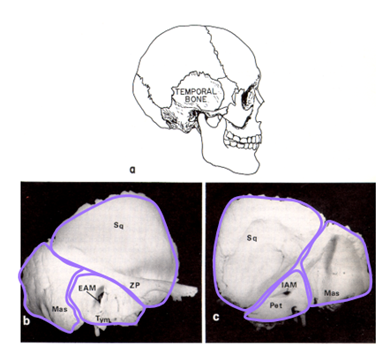
what are the 4 different parts of the temporal bone?
squamous
mastoid
tympanic
petrous
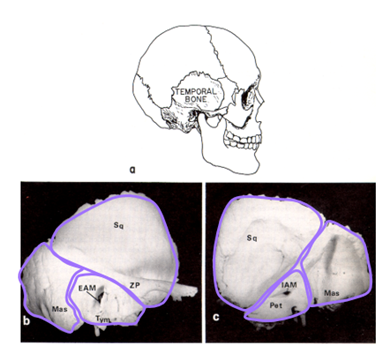
what view is image b and c looking at?
lateral view (outside looking in) for b and medial view (looking outwards) for c
what is the largest part of the temporal bone?
squamous
mastoid is the ___ and ___ part of temporal bone
thickest and lightest
what does petrous part of temporal bone contain?
organs of hearing and balance
what is the IAM?
internal auditory meatus, an internal orifice.
contains vestibular and cochlea projects into the brain (8th nerve into brain).
what is the outer ear also called?
pinna or auricle
pinna is made out of
cartilage for support and flexibility.
covered in skin.
pinna contains facial muscles which have which over the course of evolution has become what?
vestigial in humans and used in sound localisation in animals.
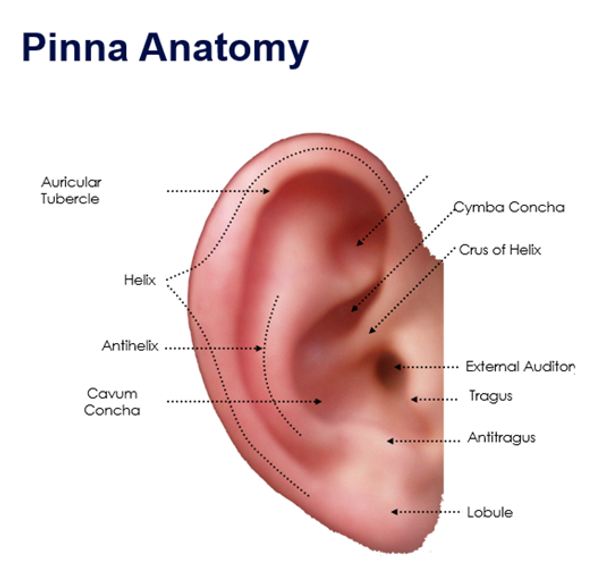
label missing part
triangular fossa
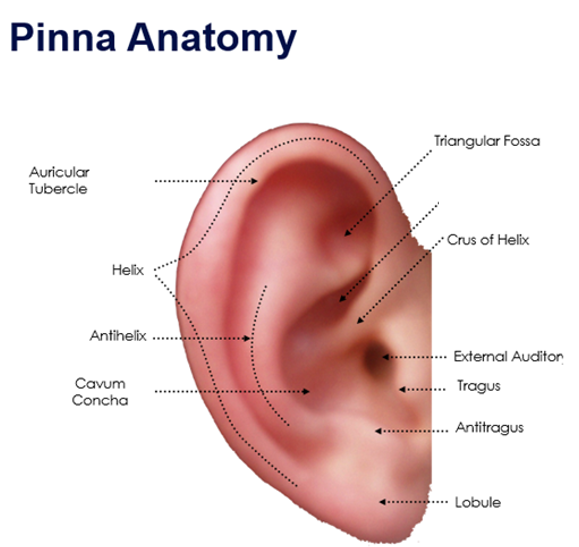
label missing part
cymba concha
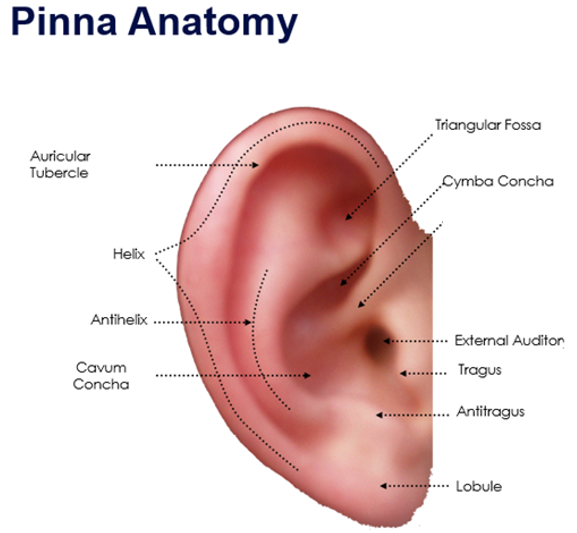
label missing part
crus of helix
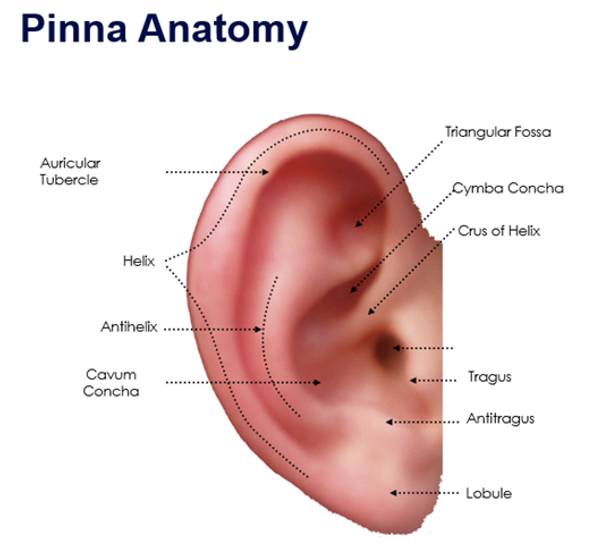
label missing part
EAM
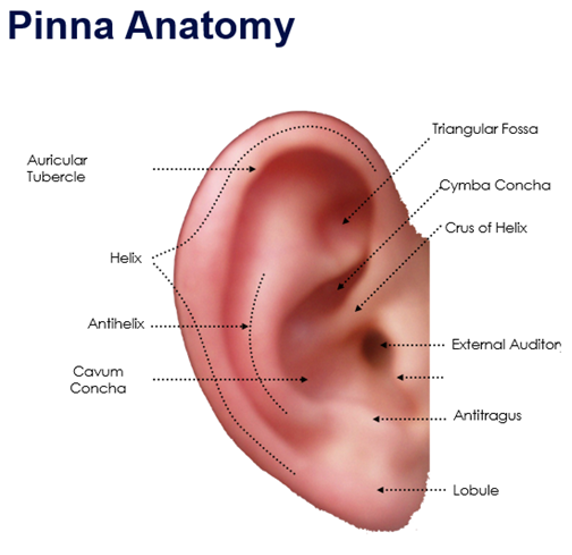
label missing part
tragus
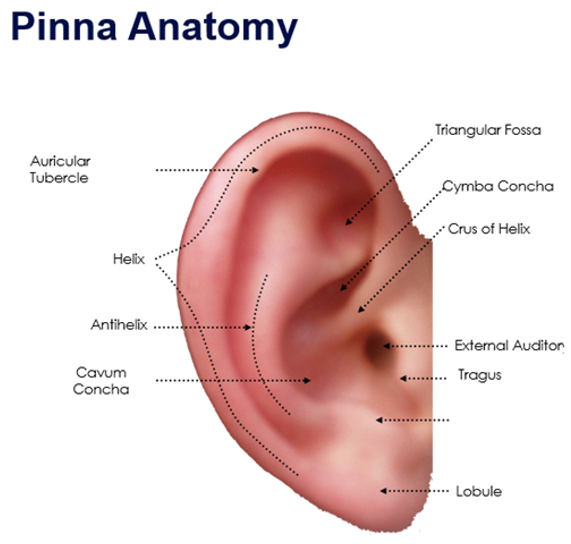
label missing part
anti-tragus
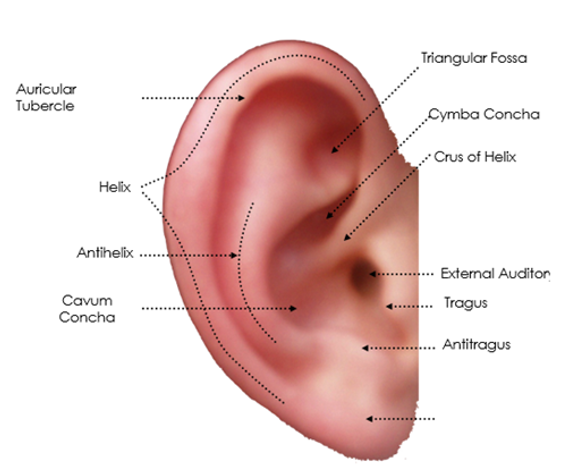
label missing part
lobule
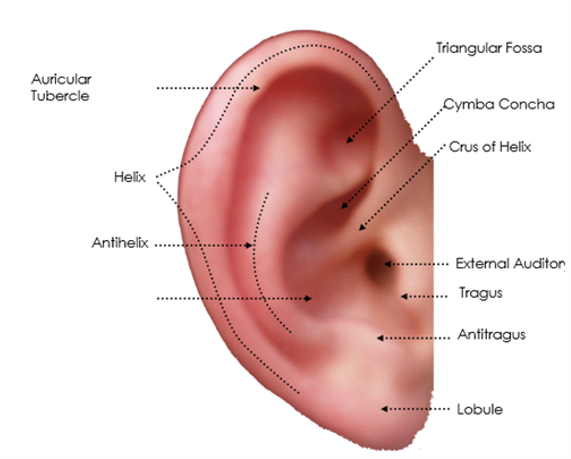
label missing part
cavum concha
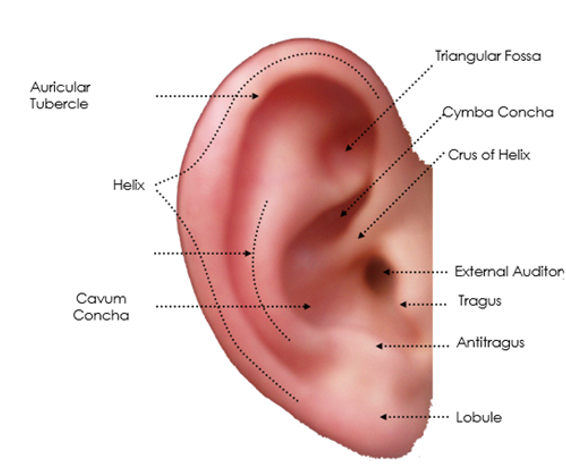
label missing part
anti-helix
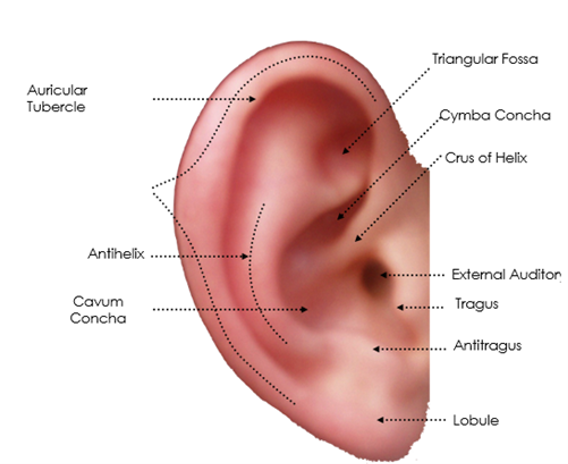
label missing part
helix
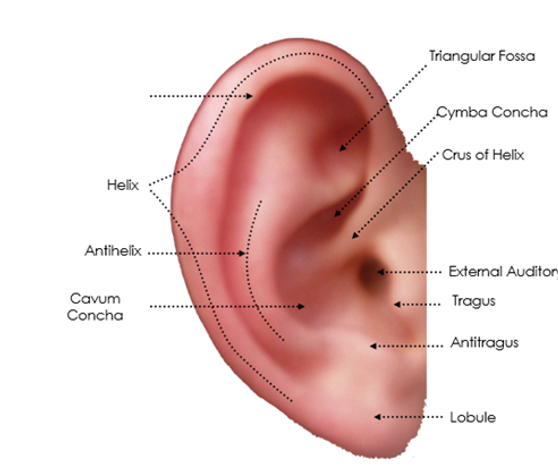
label missing part
auricular tubercle
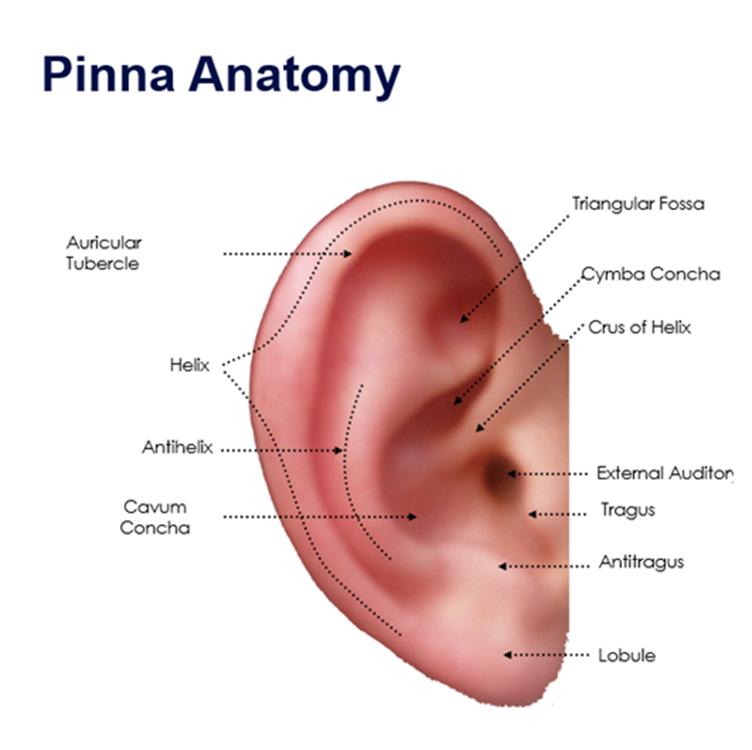
what view of the pinna is this?
anterior
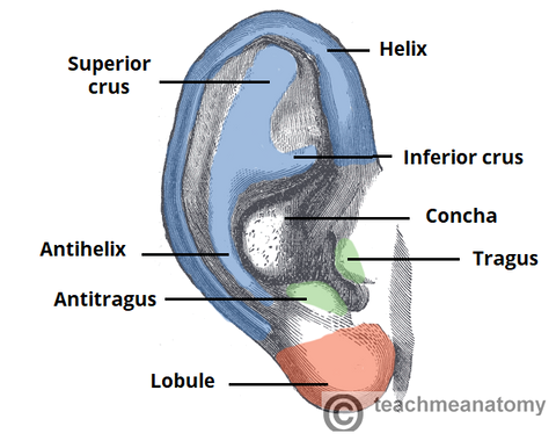
what view of the pinna is this?
anterior
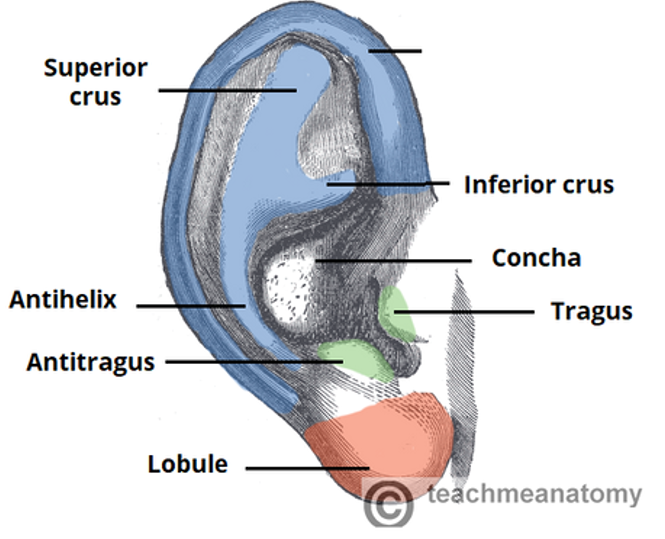
label missing part
helix
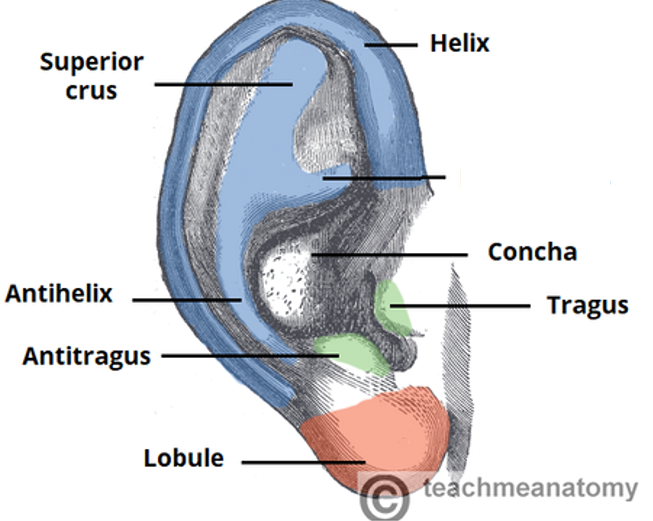
label missing part
inferior crus
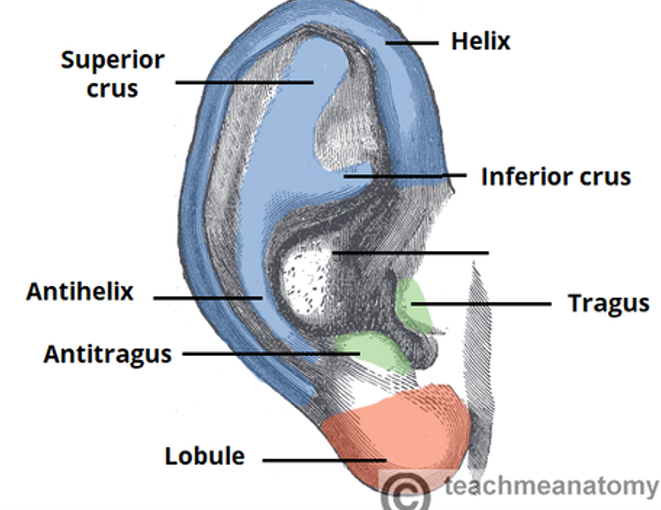
label missing part
concha
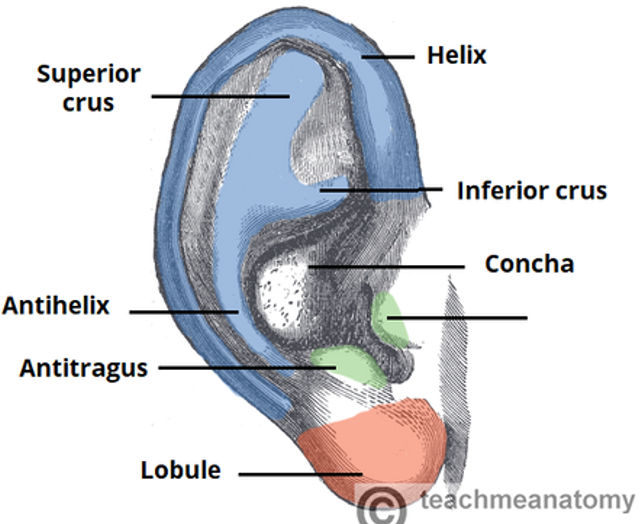
label missing part
tragus
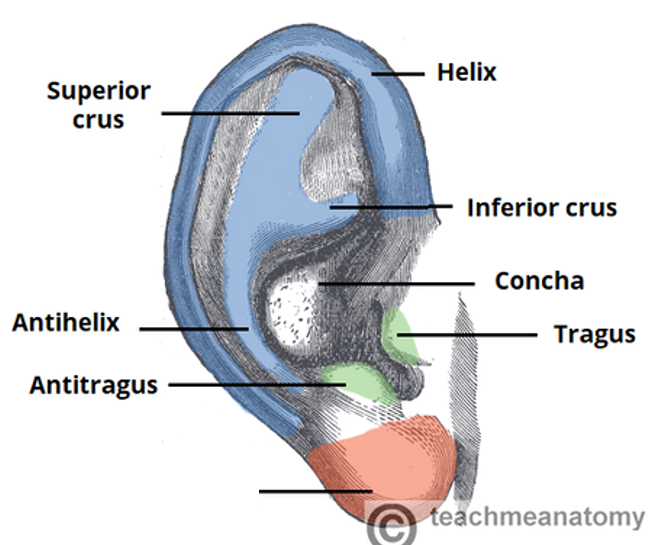
label missing part
lobule
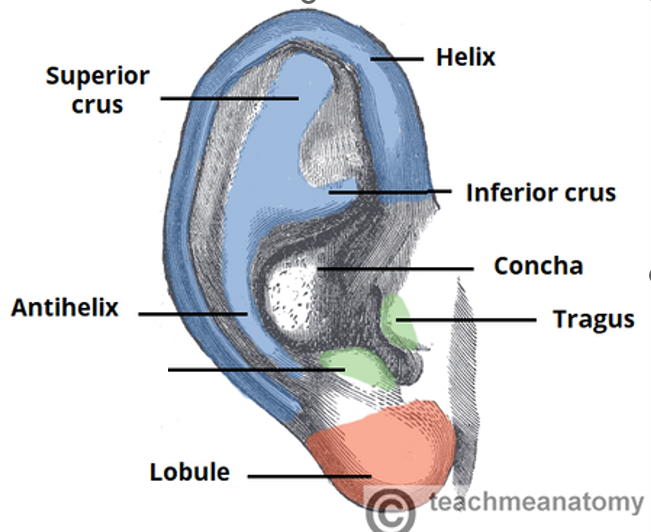
label missing part
anti-tragus
label missing part
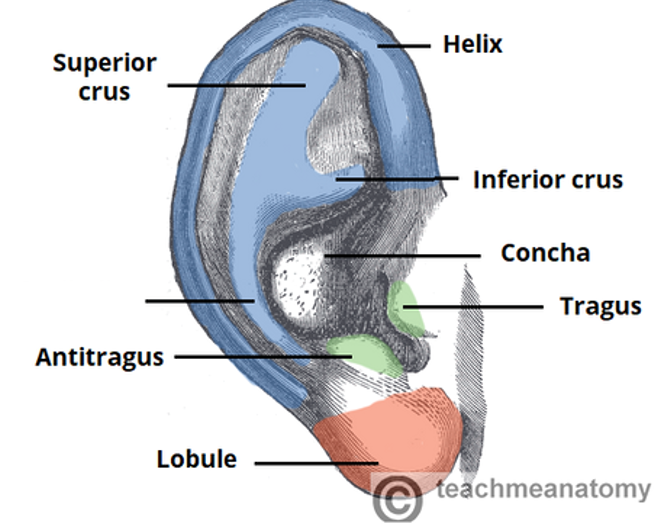
label missing part
antihelix
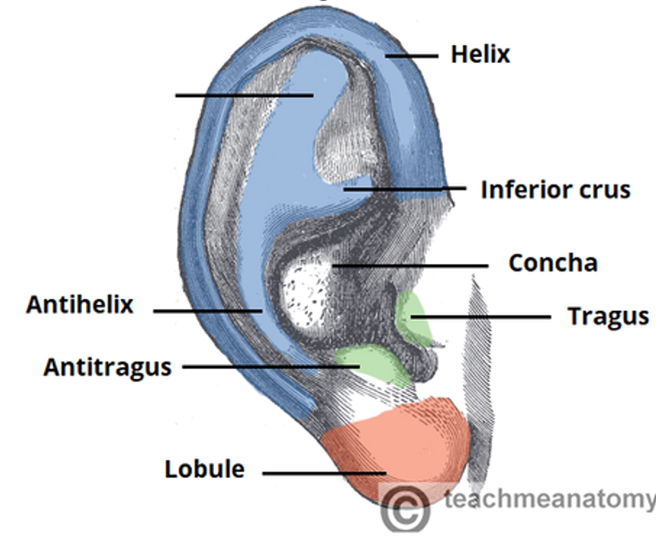
label missing part
superior crus
pinna can move also by
startle reflex or lateral eye movement
moves pinna up and back and opens canal.
pinna convolutions individuals differences have no known
function, but act as complex resonators for high frequency sounds
what is the function of the EAM?
protection of ear canal from foreign agents or objects.
amplification of sound.
localisation of sound.
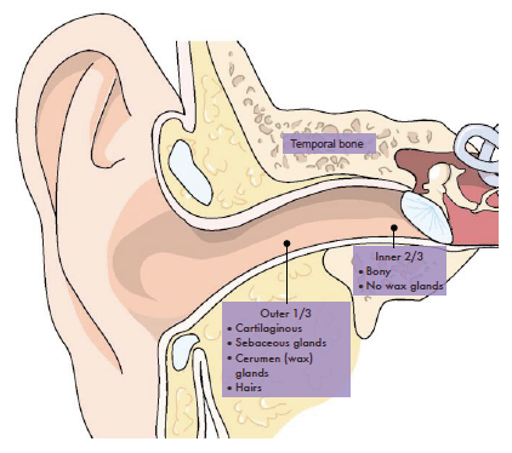
EAM is made out of 2 parts:
a cartilaginous (outer 1/3) and bony part (inner 2/3)
outer 1/3 of outer ear contains
cartilage
sebaceous gland
cerumen gland
hairs
describe the cartilaginous part of the EAM anatomically its position
runs medially, upwards and posteriorly from lateral to medial
describe the bony part of the EAM anatomically its position
runs medially downward and anterior from lateral to medial
what shape is the EAM?
S shape (protective function)
sebaceous gland function
secrete oil which act as a lubricant or moisturiser.
dry skin gets cracked and becomes entry point for microbes.
ceruminous gland function
produces ear wax which is a natural antimicrobial
tiny hairs function in EAM
prevent dust form settling inside ear.
funnels wax from medial to lateral (out of canal).
what is the pinna and tragus?
The pinna (or auricle) is the visible, cartilaginous outer ear that collects sound, while the tragus is a small, cartilaginous flap in front of the ear canal opening.
Outer ear physiology describe length and width of adult ear
long (2.5 - 3.5 cm) and narrow (5-7mm).
bony part lying at an angle to the cartilaginous part.
outer ear amplification
collects and directs sound waves onto the TM or eardrum.
sound pressure increased by outer ear due to its natural resonance (concha and EAM).
natural resonant frequency of concha vs EAM
~5 kHz versus 2.5 kHz
each structure amplifies sound by how much roughly
10-12 dB at its resonant frequency
EAM amplifies sound by selectively boosting sound pressure at frequencies ~2kHz to 4kHz (within main range of human speech).
amplification is what____ specific?
frequency specific
due to resonance
dB SPL greater at TM between 2 and 5 kHz
sound localisation in humans occurs via:
timing
intensity (loudness)
spectral qualities (changes in spectral shape including reflection and diffraction via pinnas)
what is interaural timing difference or ITD
difference in the time that sound particularly at low frequencies arrives at one ear and then the other.
what is ILD
interaural loudness difference
Horizontal localisation ITD vs ILD for high and low frequency sounds
ITD - low frequency sound pressure waves arrive with different timing (L before R in the image) but at similar intensities
ILD - high frequency sound pressure waves arrive at similar times, but there is a loss in intensity from L to R
sound arriving directly in front of the nose have what ITD and ILD?
same time and intensity so localisation of sound is worse
vertical plane localisation include
pinna cues (refers to how your outer ear—called the pinna—helps you figure out where a sound is coming from) important.
add notches or peaks to signal.
selective amplification of high frequencies.
changes spectral qualities of sound signal.
greater/higher elevation (greater angle and distance above the head) of sound sources
higher frequencies boosted more
greater ability to localise
inaccuracy area is at what frequency roughly
1 to 3kHz
really bad at localising sounds from those frequencies.

