AP Psych Unit 2 definitions (Meyers' Fourth Edition)
 Studied by 0 people
 Call Kai
 Learn
Learn Practice Test
 Spaced Repetition
 Match
Match Flashcards
 Knowt Play
1/126

Earn XP
Description and Tags
2.1-2.8
Name | Mastery | Learn | Test | Matching | Spaced | Call with Kai |
|---|
No analytics yet
Send a link to your students to track their progress
127 Terms
Perception
The process by which our brain rganizes and interprets sensory information, transforming it into meaningful objects and events.
Selective attention
The process of focusing on a specific aspect of information while ignoring others.
Cocktail party effect
The ability to focus on a single conversation in a noisy environmet, like a crowded party, while tuning out other stimuli.
Inattentional blindness
The failure to notice an unexpected stimulus in the visual field when attention is focused on something else.
Change blindness
The failure to notice large changes in one’s environment when the change occurs simultaneously with a visual disruption.
Perceptual set
A mental predisposition to percieve one thing and not another.
Gestalt
An organized whole. ______ psychologists emphasised our tendency to integrate pieces of information into meaningful wholes.
Figure-ground
The organization of the visual field into objects (the _____) that stand out from their surroundings (the _____).
Grouping
The perceptual tendency to organize stimuli into coherent groups. Three principles of gestalt ______: proximity, similarity, closure.
Depth perception
The ability to see objects in three dimensions, although the images that strike the retina are two-dimensional; allows us to judge distance.
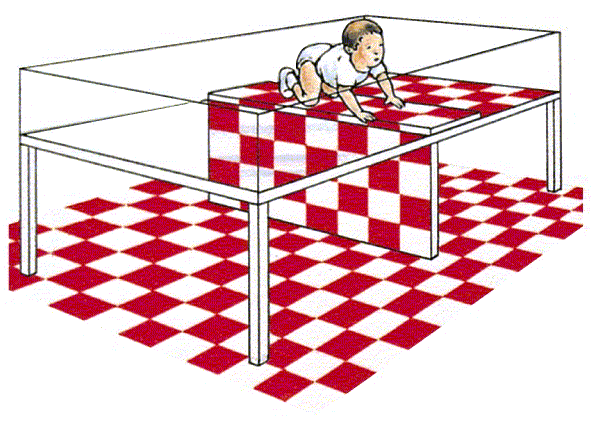
Visual cliff
A laboratory device for testing depth perception in infants and young animals.
Binocular cue
A depth cue, such as retinal disparity, that depends on the use of two eyes.
Convergence
A cue to nearby objects’ distance, enabled by the brain combining retinal images. The inward turning of the eyes to focus on a close object provides information about it’s distance.
Retinal disparity
A binocular cue for percieving depth. By comparing retinal images from the two eyes, the brain computes distance — the greater the disparity between the two images, the closer the object.
Monocular cue
A depth cue, such as interposition or linear perspective, available to either eye alone.
Stroboscopic movement
An illusion of continuous motion (as in a motion picture) experienced when viewing a rapid series of slightly varying still images.
Phi phenomenon
An illusion of movement created when two or more adjacent lights blink on and off in quick succession.
Autokinetic effect
The illusory movement of a still spot of light in a dark room.
Perceptual constancy
Perceiving objects as unchanging (having consistent color, brightness, shape, and size) even as illumination and retinal images change.
Color constancy
Perceiving familiar objects as having constant color, even if changing illumination alters the wavelength reflected by the object.
Perceptual adaptation
The ability to adjust to changed sensory input, including an artificially displaced or even inverted visual field.
Cognition
All the mental activities associated with thinking, knowing, remembering, and communicating.
Metacognition
Cognition about our cognition; keeping track of and evaluating our mental processing.
Concept
A mental grouping of similar objects, events, ideas, or people.
Prototype
A mental image or best example of a category. Matching new ideas to a prototype provides a quick and easy method for sorting items into categories (as when comparing feathered creatures to a prototypical bird, such as a crow).
Schema
A concept or framework that organizes and interprets information.
Assimilation
Interpreting our new experiences in terms of our existing schemas.
Accomodation
Adapting our current schemas (understandings) to incorporate new information.
Creativity
The ability to produce new and valuable ideas.
Convergent thinking
Narrowing the available problem solutions to determine the single best solution.
Divergent thinking
Expanding the number of possible problem solutions; creative thinking that diverges in different directions.
Executive functions
Cognitive skills that work together, enabling us to generate, organize, plan, and implement goal-directed behavior.
Algorithm
A methodical, logical rule or procedure that guarantees solving a particular problem. Contrasts with the usually speedier — but also more error-prone — use of heuristics.
Heuristic
A simple thinking stratefy — a mental shortcut — that often allows us to make judgements and solve problems efficiently; usually speedier but also more error-prone than an algorithm.
Insight
A sudden realisation of a problem’s solution; contrasts with strategy-based solutions.
Confirmation bias
A tendency to search for information that supports our preconceptions and to ignore or distort contradictory evidence.
Fixation
In cognition, the inability to see a problem from a new perspective; an obstacle to problem solving.
Mental set
A tendency to approach a problem in one particular way, often in a way that has been successful in the past.
Intuition
An effortless, immediate, automatic feeling or thought, as contrasted with explicit, conscious reasoning.
Representativeness heuristic
Judging the likelihood of events in terms of how well they seem to represent, or match, particular prototypes; may lead us to ignore other relevant information.
Availability heuristic
Judging the likelihood of events based on their availability in memory; if instances come readily to mind (perhaps because of their vividness) we presume such events are common.
Overconfidence
The tendency to be more confident than correct — to overestimate the accuracy of our beliefs and judgements.
Belief perserverance
The persistence of one’s initial conceptions even after the basis on which they were formed has been discredited.
Framing
The way an issue is posed; how an issue is framed can significantly affect decisions and judgements.
Nudge
Framing choices in a way that encourages people to make beneficial decisions.
Intelligence
The ability to learn from experience, solve problems, and use knowledge to adapt to new situations.
General intelligence (g)
According to Spearman and others, underlies all mental abilities and is therefore measured by every task on an intelligence test.
Factor analysis
A statistical procedure that identifies clusters of related items (called factors) on a test; used to identify different dimensions of performance that underlie a person’s total score.
Fluid intelligence
Our ability to reason speedily and abstractly; tends to decrease with age, especially during late adulthood.
Crystallized intelligence
Our accumulated knowledge and verbal skills; tends to increase with age.
Cattell-Horn-Carroll (CHC) theory
The theory that our intelligence is based on g as well as specific abilities, bridged by Gf and Gc.
Gardner’s multiple intelligences
The theory that identified eight relatively independent intelligences: interpersonal, intrapersonal, bodily-kinesthetic, spatial, musical, logical-mathematical, linguistic, naturalist.
Savant syndrome
A condition in which a person otherwise limitedin mental ability has an exceptional specific skill, such as in computation or drawing.
Sternberg’s triarchic theory
The theory that our intelligence is best classified into three reliably measured areas: analytical, creative, practical.
Grit
In psychology, passion and perserverance in the pursuit of long-term goals.
Emotional intelligence
The ability to perceive, understand, manage, and use emotions.
Intelligence test
A method for assessing an individual’s mental aptitudes and comparing them with those of others, using numerical scores.
Achievement test
A test designed to assess what a person has learned.
Aptitude test
A test designed to predict a person’s future performance; aptitude is the capacity to learn.
Mental age
A measure of intelligence test performance devised by Binet; the level of performance typically associated with children of a certain chronological age. Thus, a child who does as well as an average 8-year-old us said to have a mental age of 8.
Stanford-Binet
The widely used American revision (by Terman at Stanford University) of Binet’s original intelligence test.
Intelligence quotient (IQ)
Defined originally as the ratio of mental age (ma) to chronological age (ca) multiplied by 100 (thus IQ = ma/ca x 100). On contemporary intelligence tests, the average performance for a given age is assigned a score of 100.
Wechsler Adult Intelligence Scale (WAIS)
The ______ and it’s companion versions for children are the most widely used intelligence tests; they contain verbal and performance (nonverbal) subtests.
Psychometrics
The scientific study of the measurement of human abilities, attitudes, and traits.
Standardisation
Defining uniform testing procedures and meaningful scores by comparison with the performance of a pretested group.
Normal curve
The bell-shaped curve that describes the distribution of many physical and psychological attributes. Most scores fall near the average, and fewer and fewer scores lie near the extremes.
Flynn effect
The rise in intelligence test performance over time and across cultures.
Reliability
The extent to which a test yields consistent results, as assessed by the consistency of scores on two halves of the test, on alternative forms of the test, or on retesting.
Validity
The extent to which a test measures or predicts what it is supposed to.
Content validity
The extent to which a test samples the behavior that is of interest.
Construct validity
How much a test measures a concept or trait.
Predictive validity
The success with which a test predicts the behavior it is designed to predict; it is assessed by computing the correlation between test scores and the criterion behavior. (Also called criterion-related validity).
Cross-sectional study
Research that compares people at the same point in time.
Longitudinal study
Research that follows and retests the same people over time.
Cohort
A group of people sharing common characteristics, such as being from a given time period.
Growth mindset
A focus on learning and growing rather than viewing abilities as fixed.
Fixed mindset
The view that intelligence, abilities, and talents are unchangeable, even with effort.
Stereotype threat
A self-confirming concern that one will be evaluated based on a negative stereotype.
Memory
The persistence of learning over time through the encoding, storage, and retrieval of information.
Recall
A measure of memory in which the person must retrieve information learned earlier, as on a fill-in-the-blank test.
Recognition
A measure of memory in which the person identifies items previously learned, as on a multiple-choice test.
Relearning
A measure of memory that assesses the amount of time saved when learning material again.
Encoding
The process of getting information into the memory system — for example, by extracting meaning.
Storage
The process of retaining encoded information over time.
Retrieval
The process of getting information out of memory storage.
Parallel processing
Processing multiple aspects of a stimulus or problem simultaneously.
Sensory memory
The immediate, very brief recording of sensory information in the memory system.
Short-term memory
Briefly activated memory of a few items (such as digits of a phone number while calling) that is later stored or forgotten.
Long-term memory
The relatively permanent and limitless archive of the memory system. Includes knowledge, skills, and experiences.
Working memory
A newer understanding of short-term memory; conscious, active processing of both (1) incoming sensory information and (2) information retrieved from long-term memory.
Central executive
A memory component that coordinates the activities of the phonological loop and visuospatial sketchpad.
Phonological loop
A memory component that briefly holds auditory information.
Visuospatial sketchpad
A memory component that briefly holds information about objects’ appearance and location in space.
Neurogenesis
The formation of new neurons.
Long-term potentiation
An increase in nerve cells’ firing potential after brief, rapid stimulation; a neural basis for learning and memory.
Explicit memory
Retention of facts and experiences that we can consciously know and “declare”. Also called declarative memory).
Effortful processing
Encoding that requires attention and conscious effort.
Automatic processing
Unconscious coding of incidental information, such as space, time, frequency, and familiar or well-learned information, such as sounds, smells, and word meanings.
Implicit memory
Retention of learned skills or classically conditioned associations independent of conscious recollection. (Also called nondeclarative memory).
Iconic memory
A momentary sensory memory of visual stimuli; a photographic or picture-image memory lasting no more than a few tenths of a second.
 Note
Note  Flashcards (52)