Articulation and Phonological Disorders; Bernthal, Bankson, and Flipsen, 7th ed.
 Call Kai
 Learn
Learn Practice Test
 Spaced Repetition
 Match
Match Flashcards
 Knowt Play
1/51

There's no tags or description
Looks like no tags are added yet.
Name | Mastery | Learn | Test | Matching | Spaced | Call with Kai |
|---|
No analytics yet
Send a link to your students to track their progress
52 Terms
Why is a morpheme relevant to identifying phonemes? Pg. 10
Speech
Organized set or system of sounds used to convey meaning
What is meaning based in?
Language
Why does speech have special importance as a language?
It is the first-learned modality for hearing language users
What is the Acoustic signal of speech?
The vibrations of air molecules in response to the energy source of human speech
What might we deduce about a person when they speak?
Ge, sex, mood, health, and dialectal background
From what 2 perspectives can we view Speech sounds?
Motor production and units of expression (language)
What does a layperson typically think of as a unit of meaning?
Words
What does a linguist consider a unit of meaning?
Morphemes
Phonemic Transcription
// transcription of a family of allophones
Phonetic Transcription
[ ] more detailed than a phonemic transcription
Speech Sound Disorders (previously used definition)
Disorders related to saying the sounds of a language
Speech sound disorders used to be called what?
Articulation disorders
What was the prevailing viewpoint related to speech sound disorders from the 1920s - 1970s
They reflected a clients inability to perceive or discriminate particular sound(s)
And/or
They reflected a clients inability to motorically produce these sounds
What was the definition of Phonological Disorders?
Disorders related to learning phonological rules of a language
Allophones
More numerous set of distinct sounds, may belong to the same phoneme family
What happens to /n/ in the word tenth?
The th influences the n to be dentalized, instead of alveolar
Complementary Distribution
2+ allophones never occur in exactly the same phonetic environment, making the occurrence not overlap
Free variation
When allophones occur in the same phonetic context
What is the dual use of Syntax, Semantics, Morphology, and Phonetics?
Structure, and Processing
Where does a thought initiate?
At the cognitive level where the concepts are created before the words are attached
Information Processing Model of Verbal Formulation Production
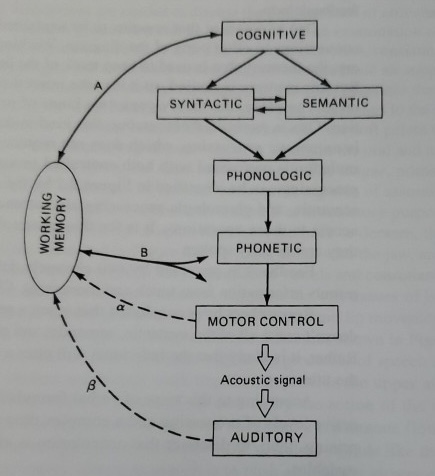
How is information at the cognitive level get used?
To make decision's at the syntactic and semantic levels
Lexicalization
The semantic level, a 2 stage process
What is the process of Lexicalization
Select a lexical concept
Phonological specification
Phonological Specification
Specification of a words sound pattern
Phonological level
The evolving sentence becomes a phonological structure Guides the phonetic level
Phonetic level
Details of the sound pattern are worked out, producing a detailed phonetic representation of the utterance
Motor Control Level
Actual motor instructions; decides which muscles, and controls the timing and strength off the muscle contractions
How many muscles are activated in speech?
About 100
When us the feedback loop complete?
When the speaker listens to the auditory information
Speech Sound Disorders (present definition)
Umbrella term for clients who have3 difficulty producing speech sounds
Delay
Speech sound errors that are considered normal in young children as they learn to “properly” use sounds
Deviant
Errors not typically found in young children’s development
Speech Disorders Study, Campbell and colleagues
2003, 15.2% of 3 year olds
Speech Disorders Study, Shriberg, Tomblin, and McSweeny
1999, suggests that by 6 years old, 3.8% still have difficulty with speech sound production
When do most speech sound disorders occur?
Under 8 years old
What typically causes speech sound disorders in adults?
Organic conditions
Semantics
Meaning attached to words
Morphology
Minimum meaningful units in a language
Syntax
Grammar
Pragmatic
Appropriate language use in a social context
Discourse
Ability to string sentences together while communicating with others
Pragmatic and discourse are targets for who?
Older Children
When do we target mainstream English sound systems?
When the client elects to do this, usually for “educational” business or social reasons
Why are phonemes relevant to identifying allophones?
Traditional Phonetic description of articulation
Distinctive features description of articulation
Similarities between phonetic transcription and distinctive features
Differences between phonetic transcription and distinctive features
Coarticulation
Why does coarticulation occur?

