8: Population Distribution and Abundance
 Call Kai
 Learn
Learn Practice Test
 Spaced Repetition
 Match
Match Flashcards
 Knowt Play
1/35

There's no tags or description
Looks like no tags are added yet.
Name | Mastery | Learn | Test | Matching | Spaced | Call with Kai |
|---|
No analytics yet
Send a link to your students to track their progress
36 Terms
What is a population?
A group of individuals of the same species living in the same geographic area at the same time
What factors do ecologists consider when studying populations?
Conservation of species, controlling pests/diseases, managing natural resources, and understanding human population growth
What is distribution?
The size, shape, and location of the area a population occupies
What is density?
The number of individuals per unit area (e.g., per km²)
What is abundance?
The total number of individuals or total biomass in a given area
What is a niche?
The full set of environmental conditions and resources required for a species to survive, grow, and reproduce
What is a fundamental niche?
The full range of environmental conditions where a species could potentially live without biotic limitations
What is a realized niche?
The actual conditions where a species lives after limits like competition, predation, and environmental stress
What limits a realized niche?
Biotic interactions (competition, predation) and abiotic factors (temperature, moisture)
What did Hutchinson define a niche as?
An n-dimensional hypervolume representing all environmental conditions and resources needed for survival
Key difference between fundamental vs realized niche?
Fundamental = potential range
Realized = restricted
actual range due to limiting factors
What environmental factors limit species (barnacle example)?
Moisture availability and temperature extremes
Do Chthalamus and Balanus have larger fundamental or realized niches?
Both species have larger fundamental niches than their realized niches
Why is Balanus’ realized niche restricted to lower zones?
It cannot tolerate desiccation and extreme temperature changes in the upper intertidal
Why does Balanus experience high mortality in the upper intertidal?
Exposure during low tide leads to drying out (desiccation)
Where are Chthalamus and Balanus typically found?
Chthalamus = upper intertidal
Balanus = middle to lower intertidal
Why is Chthalamus absent from the lower intertidal?
It is outcompeted by Balanus in those regions
Compare tolerance of Chthalamus vs Balanus
Chthalamus tolerates drying better; Balanus is less tolerant but better competitor in moist areas
Why is scale important in ecology?
Ecological patterns and processes change depending on spatial and temporal scale
What happens at small vs large scales?
Small scale = relatively uniform conditions
Large scale = strong environmental gradients (e.g., mountains, continents)
Distribution: What are the three main population distribution patterns?
Random, uniform (regular), and clumped
What is random distribution?
Individuals are spaced unpredictably, often due to weak interactions or random processes
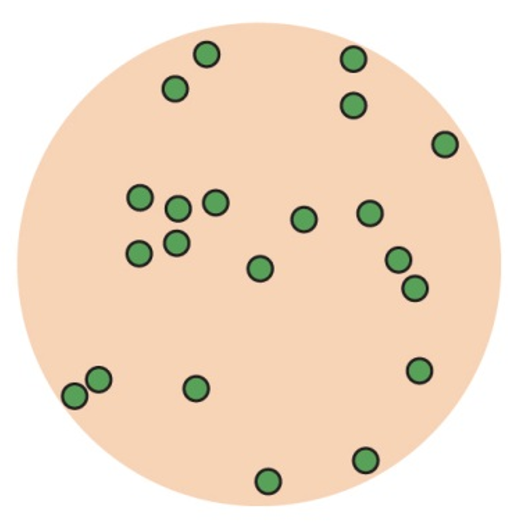
What is uniform (regular) distribution?
Individuals are evenly spaced, often due to competition or territorial behavior
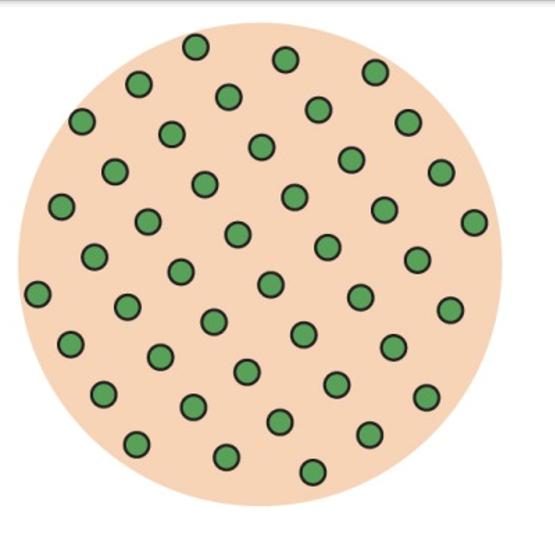
What is clumped distribution?
Individuals are grouped together, often due to resource availability or social behavior
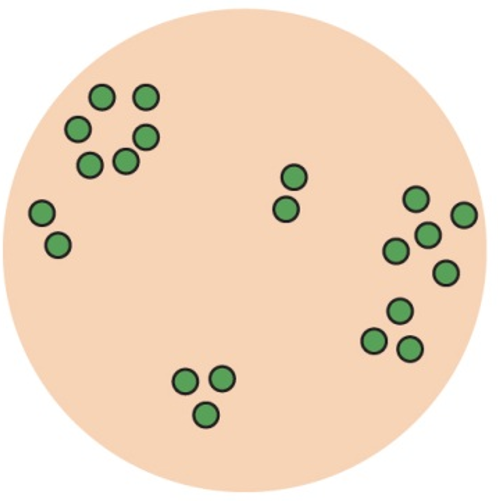
What determines distribution patterns?
Physical environment, interactions among individuals, or a combination of both
How do interactions influence patterns?
Ignore each other → random; repel each other → uniform; attract each other → clumped
Examples of distribution patterns?
Aggressive stingless bees = uniform
Non-aggressive bees = random
Desert shrubs = influenced by competition
How do patterns differ across scales?
Local scale = influenced by interactions and random colonization
Large scale = populations tend to be clumped
What is population density?
The number of individuals in a given area or volume
How does body size relate to population density?
As body size increases, population density generally decreases
Why is the size–density relationship important?
It helps predict rarity, resource use, and extinction risk across species
What three factors determine species rarity or commonness?
Geographic range (wide vs restricted), habitat tolerance (broad vs narrow), and local population size (large vs small)
Why are rare species more vulnerable to extinction?
They often have small populations, limited ranges, and narrow habitat requirements
Example of species with wide range but small populations?
Peregrine falcon
Example of species with large populations but narrow habitat?
Passenger pigeon (now extinct)
Example of species with restricted range and small populations?
Mountain gorilla and California condor

