Cellular Respiration and Photosynthesis: Processes, Stages, and Adaptations
 Call Kai
 Learn
Learn Practice Test
 Spaced Repetition
 Match
Match Flashcards
 Knowt Play
1/80

There's no tags or description
Looks like no tags are added yet.
Name | Mastery | Learn | Test | Matching | Spaced | Call with Kai |
|---|
No analytics yet
Send a link to your students to track their progress
81 Terms
What is cellular respiration?
The set of processes that break down sugars to produce ATP.
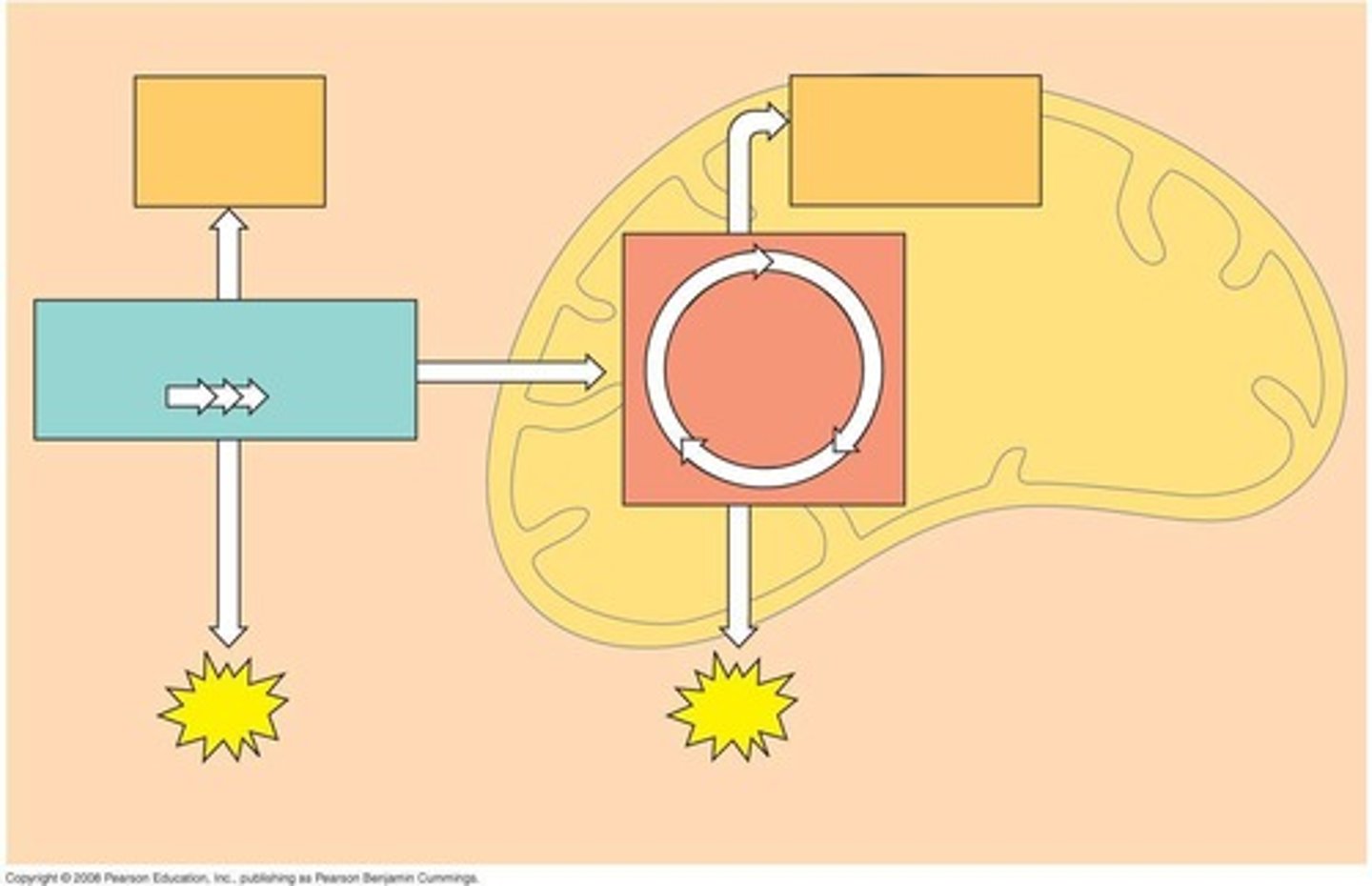
What are the waste products of cellular respiration?
Carbon dioxide (CO2) and water (H2O).
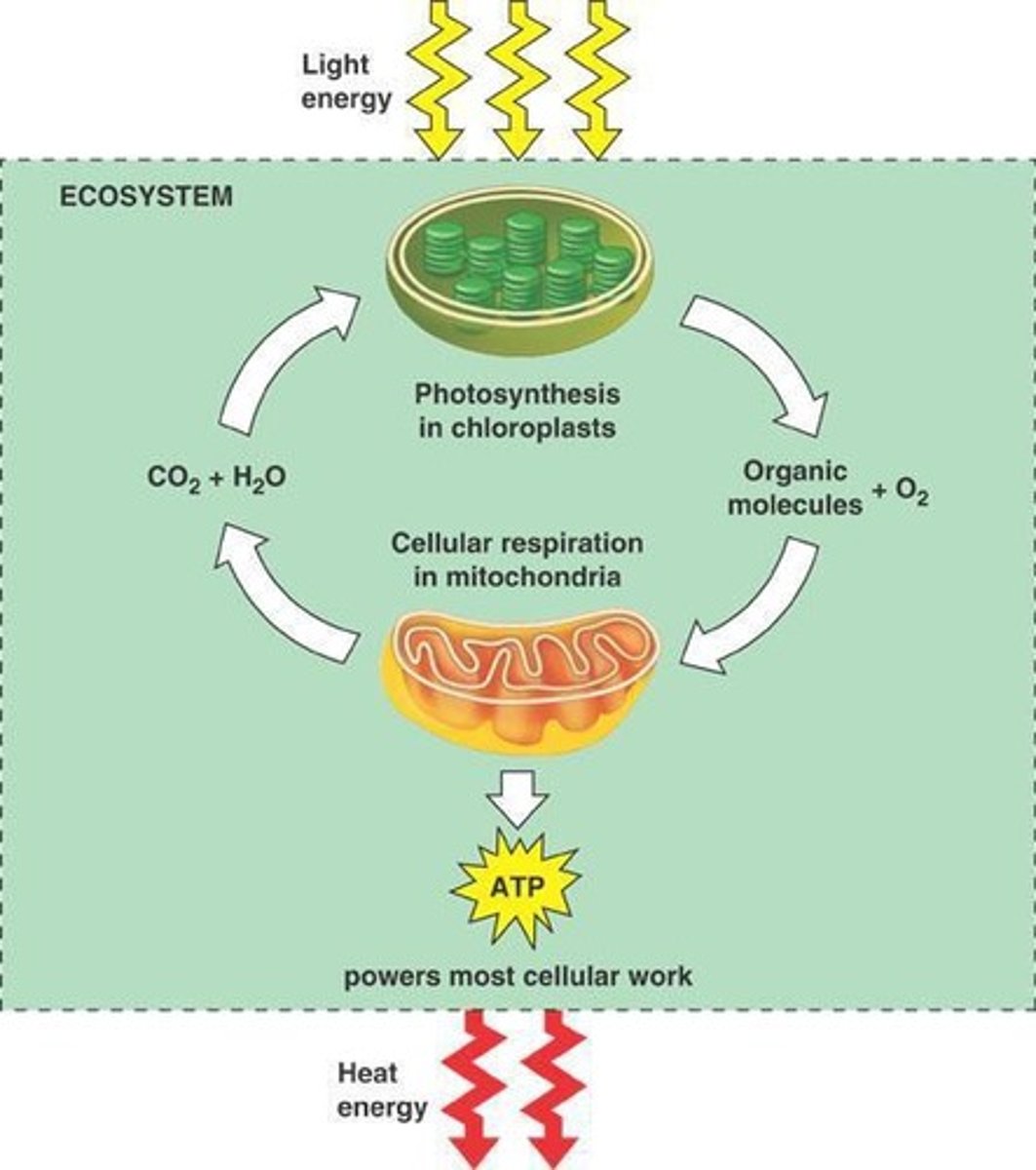
How does energy flow in an ecosystem?
Energy flows into an ecosystem as sunlight and leaves as heat.
What type of reaction is photosynthesis?
Anabolic and endergonic.
What type of reaction is respiration?
Catabolic and exergonic.
What is anaerobic respiration?
Breakdown of sugars to produce ATP without oxygen.
What is aerobic respiration?
Respiration that consumes organic molecules and oxygen, yielding ATP more efficiently.
What is the chemical equation for glucose breakdown in cellular respiration?
C6H12O6 + 6 O2 → 6 CO2 + 6 H2O + Energy (ATP, heat).
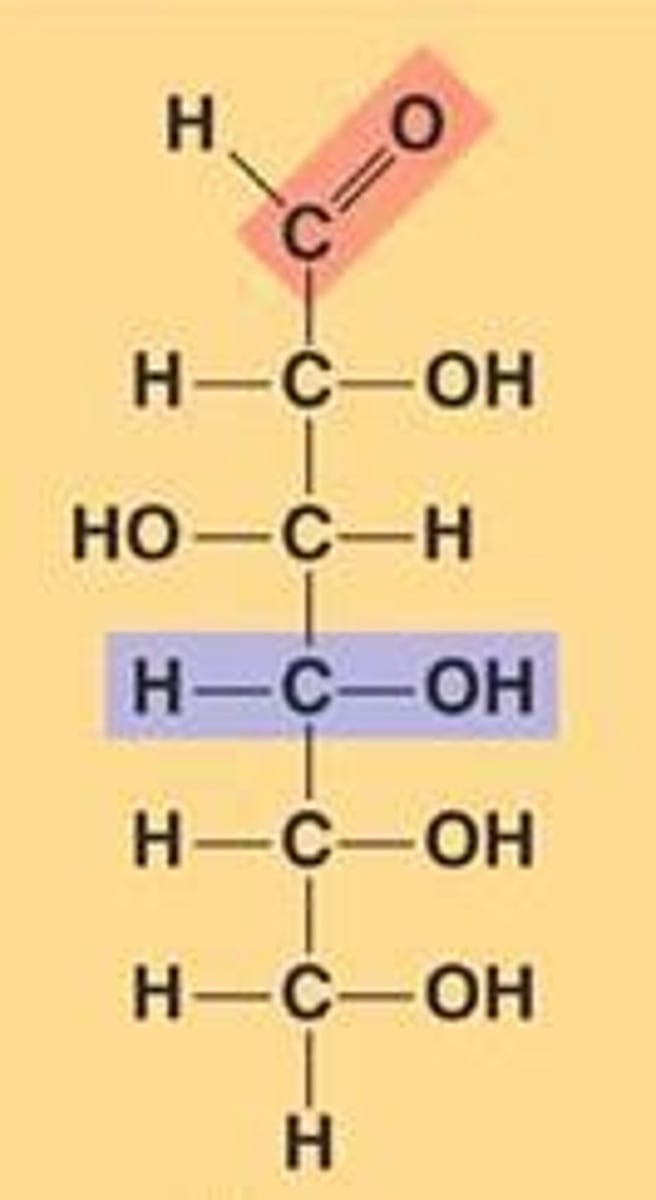
What are redox reactions?
Reactions where hydrogen atoms (electrons and protons) are passed from electron donors to electron acceptors.
What is an electron donor?
A substance that loses electrons in a redox reaction.
What is an electron acceptor?
A substance that gains electrons in a redox reaction.
What is substrate-level phosphorylation?
The direct transfer of a phosphate group from a sugar molecule to ADP to produce ATP.
What are the three stages of cellular respiration?
Glycolysis, the citric acid cycle, and oxidative phosphorylation.
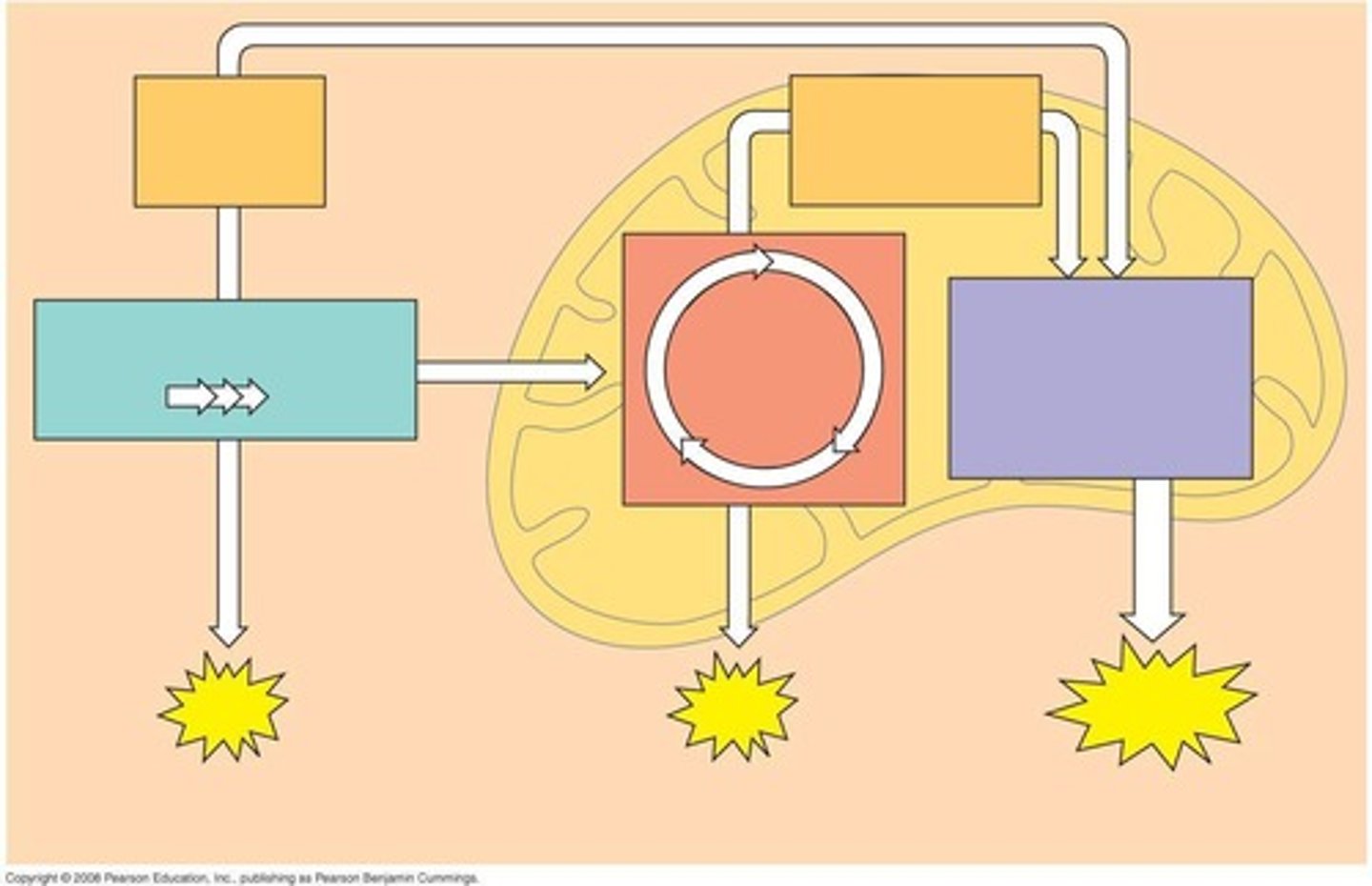
Where does glycolysis occur?
In the cytoplasm.
What does glycolysis produce?
Two molecules of pyruvate, two ATP, and two NADH.
What is the citric acid cycle?
A stage of cellular respiration that completes the breakdown of glucose, yielding CO2, NADH, FADH2, and ATP.
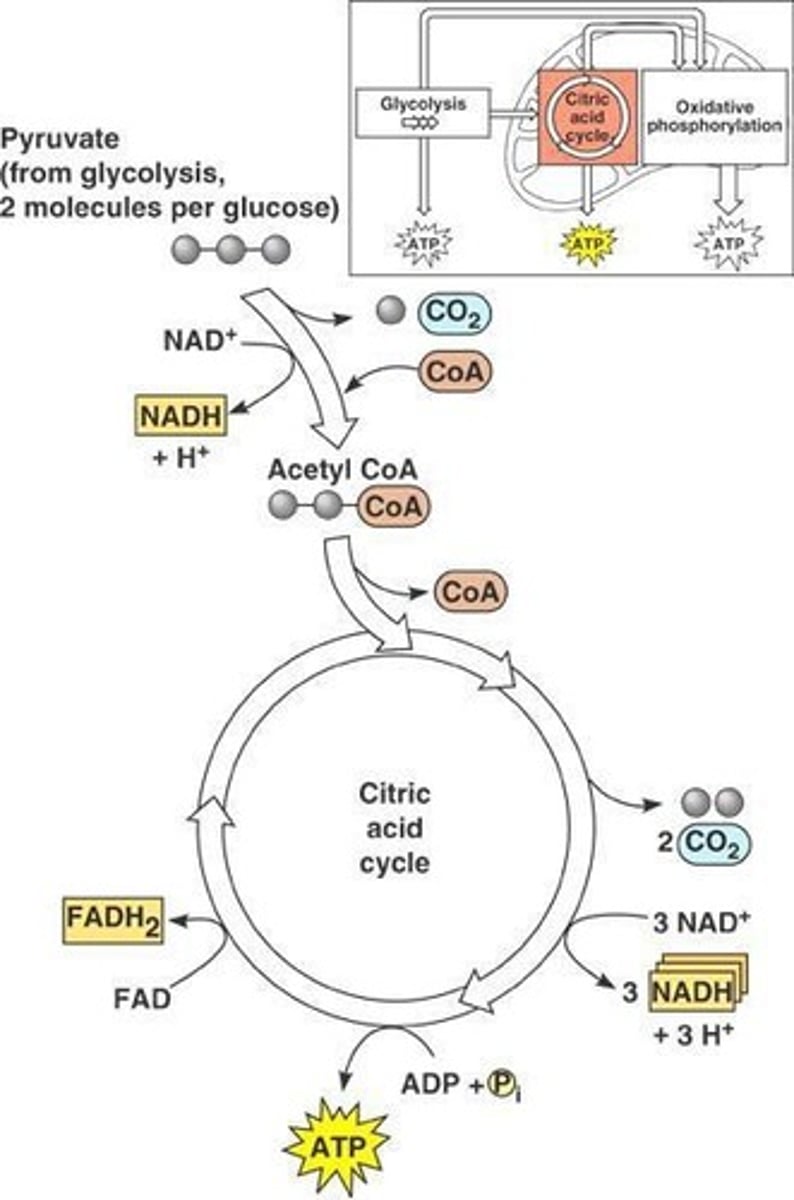
Where does the citric acid cycle occur?
In the mitochondrion.
What are the products of the citric acid cycle per glucose molecule?
6 NADH, 2 FADH2, 2 ATP, and 4 CO2.
What is oxidative phosphorylation?
The stage of cellular respiration that produces most ATP through the electron transport chain and chemiosmosis.
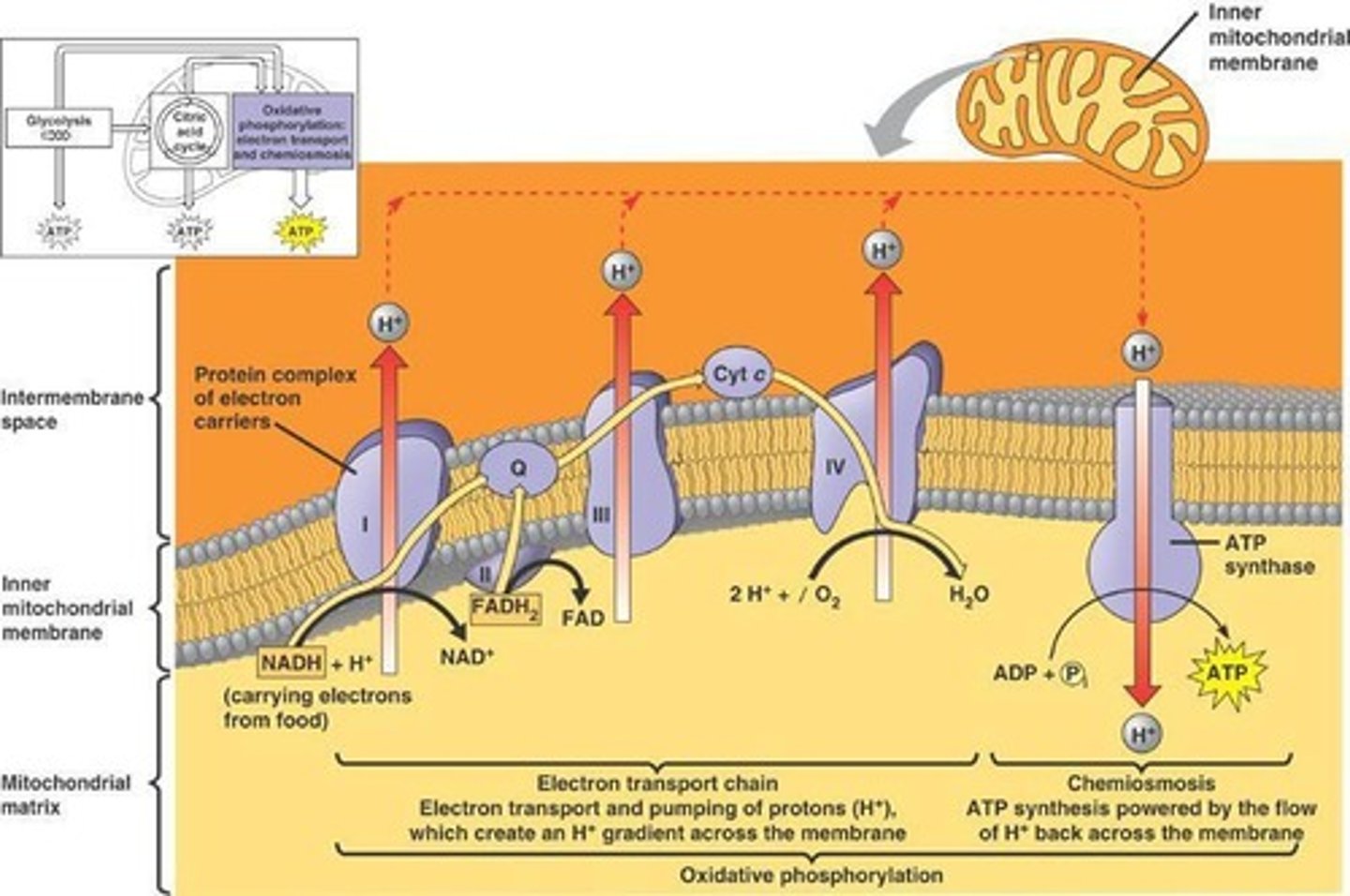
What role does ATP synthase play in cellular respiration?
It uses the H+ gradient established by the electron transport chain to drive ATP synthesis.
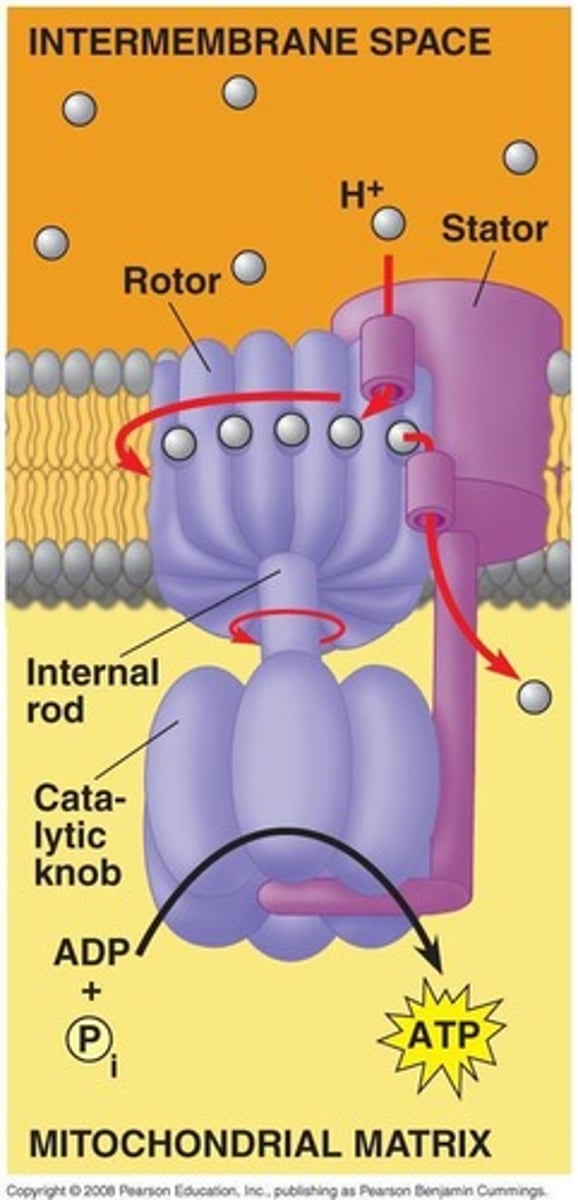
What is the proton-motive force?
The H+ gradient that stores energy and drives chemiosmosis.
How much ATP is produced from one glucose molecule during cellular respiration?
About 30 to 32 ATP.
What happens to energy during cellular respiration?
Most energy flows from glucose to NADH, FADH2, then to the electron transport chain, and finally to ATP.
What is the significance of NADH in cellular respiration?
NADH represents stored energy that is tapped to synthesize ATP.
What is the main function of the electron transport chain?
To facilitate the transfer of electrons and pump H+ ions to create a gradient for ATP synthesis.
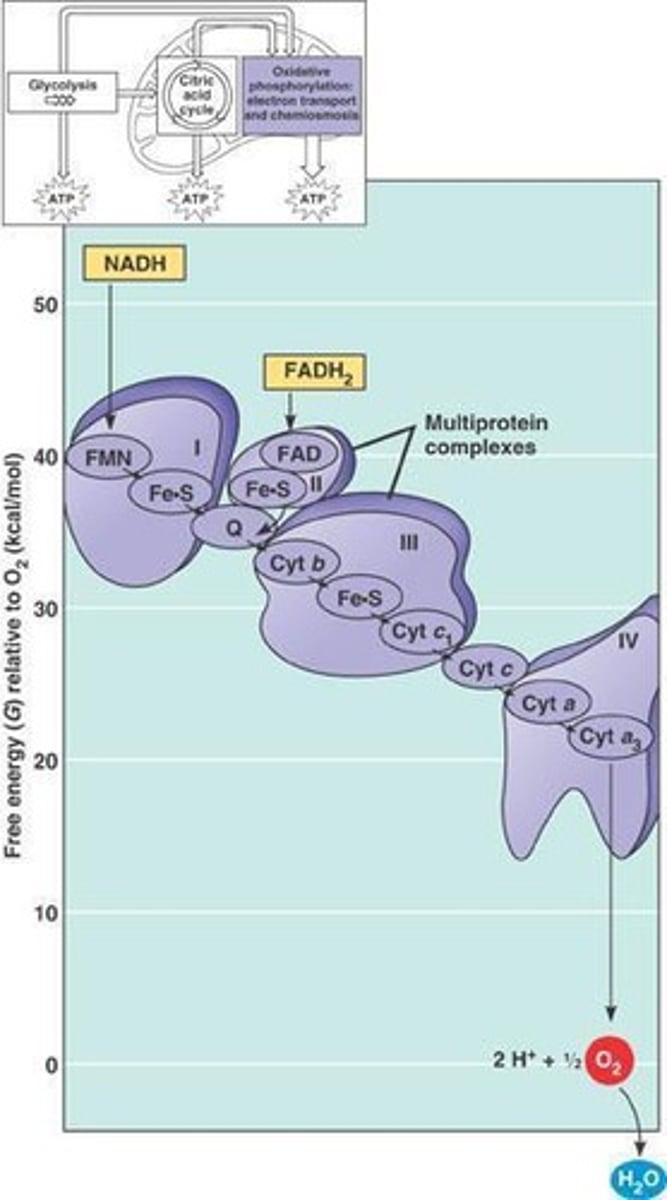
What is the role of oxygen in cellular respiration?
Oxygen acts as the final electron acceptor in the electron transport chain, forming water.
What is the difference between aerobic and anaerobic respiration?
Aerobic respiration requires oxygen and yields more ATP, while anaerobic respiration occurs without oxygen and yields less ATP.
What is the energy efficiency of ATP synthesis during cellular respiration?
Approximately 40% of the energy in a glucose molecule is transferred to ATP.
What are autotrophs?
Organisms that sustain themselves without eating anything derived from other organisms.
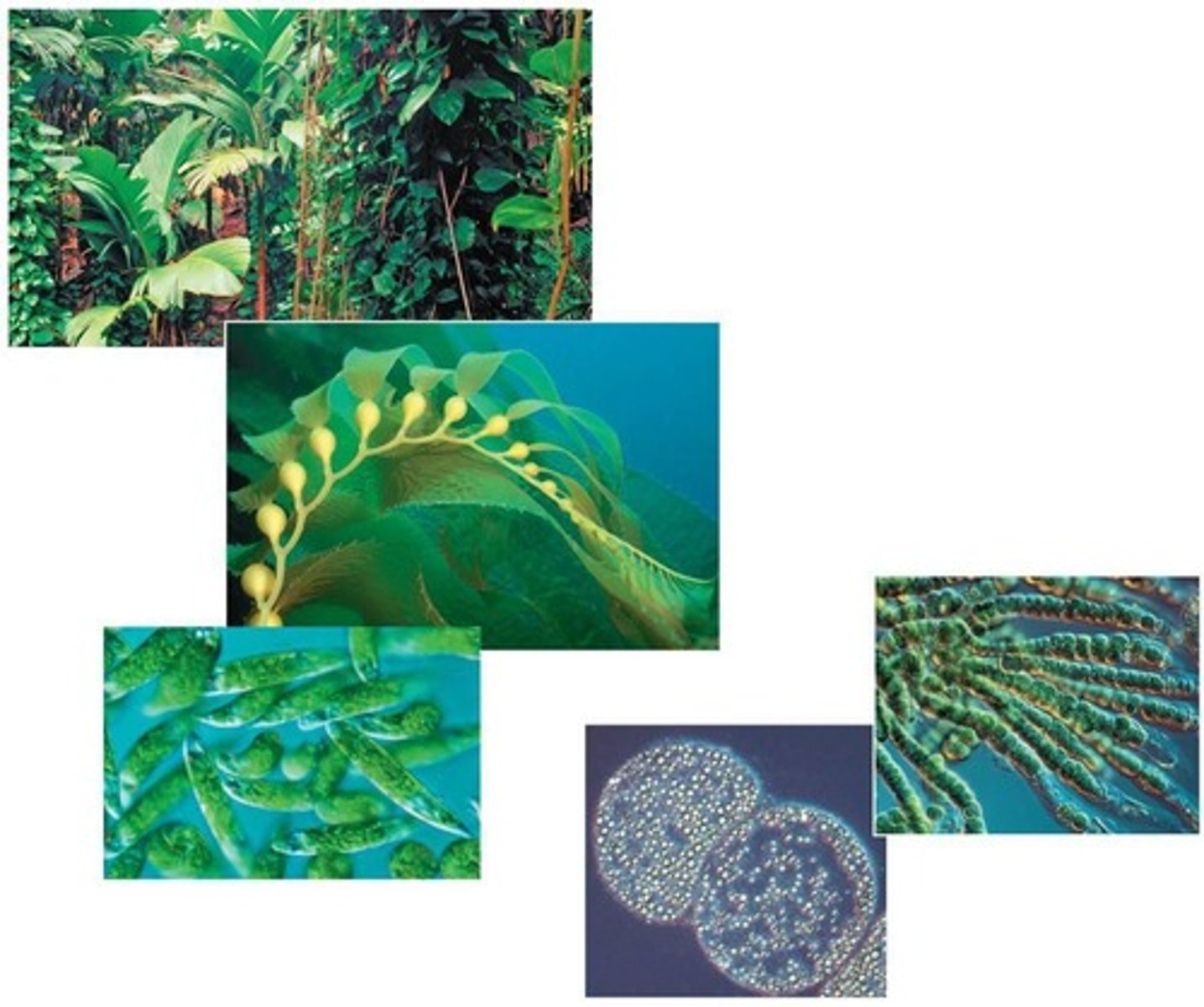
What is the primary function of photoautotrophs?
To produce organic molecules from CO2 and other inorganic molecules using sunlight.
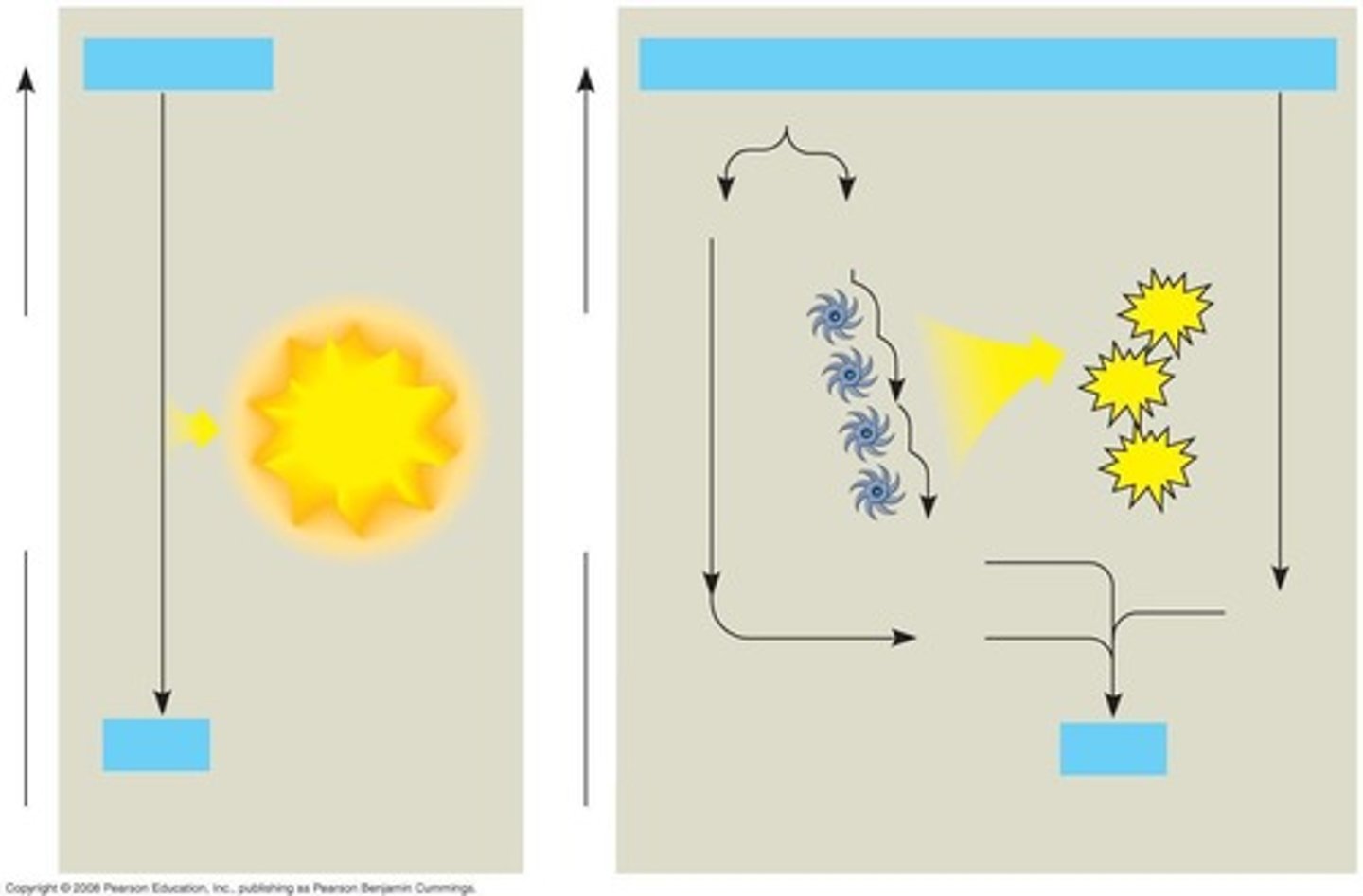
Which organisms are primarily involved in photosynthesis?
Plants, algae, certain protists, and some prokaryotes.
What type of process is photosynthesis?
Anabolic and endergonic.
What are heterotrophs?
Organisms that obtain their energy by consuming other organisms.
What is the significance of fossil fuels in relation to photosynthesis?
They represent stores of solar energy captured by ancient organisms.
What pigment gives plants their green color?
Chlorophyll.
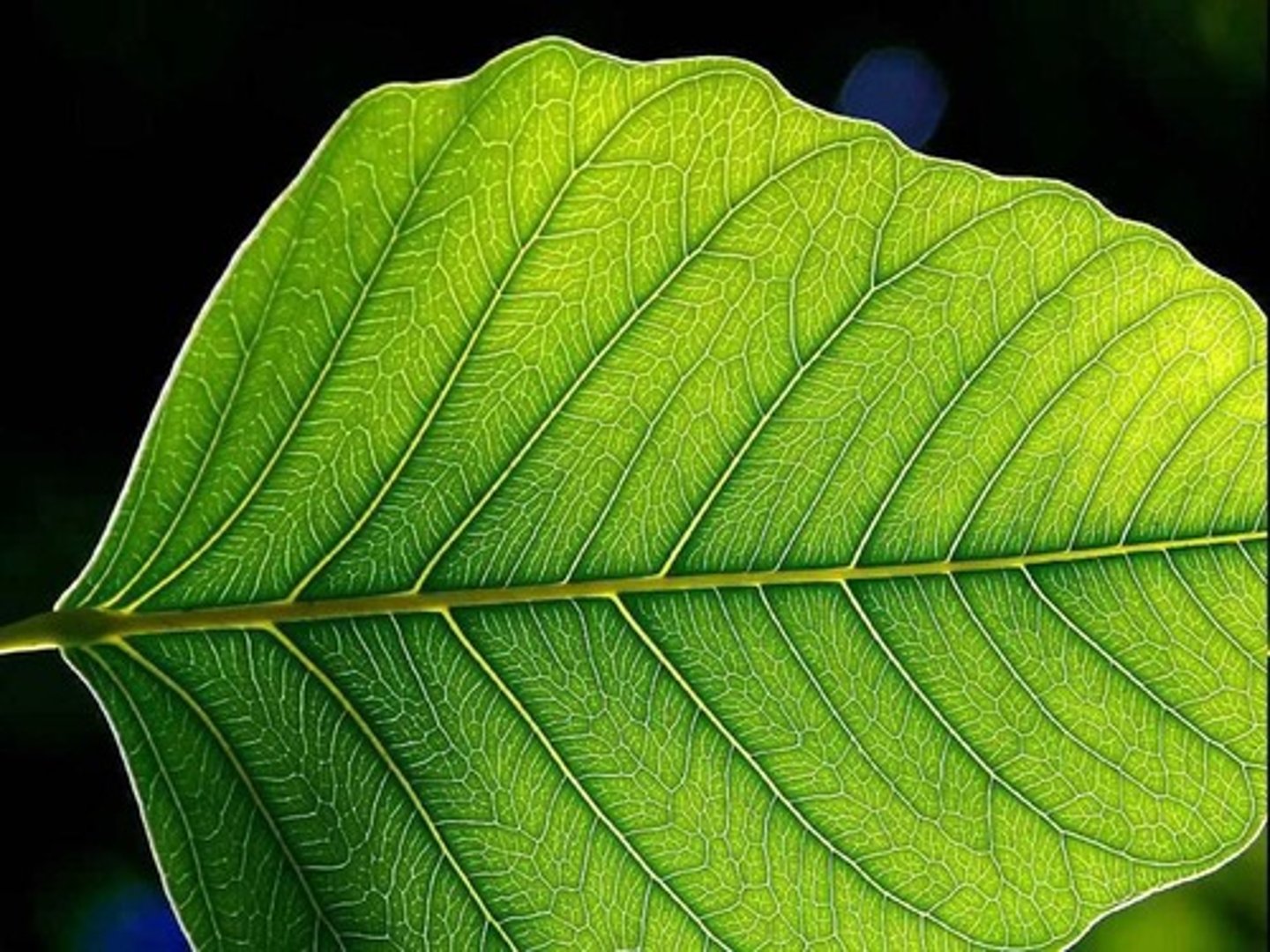
Where does photosynthesis primarily occur in plants?
In the leaves, specifically within chloroplasts.
What is the equation that summarizes photosynthesis?
6 CO2 + 12 H2O + Light energy → C6H12O6 + 6 O2 + 6 H2O.
What happens to water (H2O) during photosynthesis?
It is oxidized.
What is the Calvin cycle?
The part of photosynthesis that synthesizes sugar from CO2 using ATP and NADPH.
What are the two main stages of photosynthesis?
The light reactions and the Calvin cycle.
What occurs during the light reactions of photosynthesis?
Water is split, oxygen is released, NADP+ is reduced to NADPH, and ATP is generated.
What is the role of chlorophyll a in photosynthesis?
It is the main photosynthetic pigment that absorbs light energy.
What are accessory pigments?
Pigments like chlorophyll b and carotenoids that broaden the spectrum of light used for photosynthesis.
What is fluorescence in the context of photosynthesis?
The emission of light by chlorophyll when excited electrons fall back to a stable state.
What is a photosystem?
A complex in the thylakoid membrane consisting of a reaction-center complex and light-harvesting complexes.
What are the two types of photosystems involved in photosynthesis?
Photosystem II (PS II) and Photosystem I (PS I).
What wavelength does Photosystem II best absorb?
680 nm.
What wavelength does Photosystem I best absorb?
700 nm.
What is the primary electron acceptor in photosystems?
A molecule that receives excited electrons from chlorophyll.
What is the role of the electron transport chain in photosynthesis?
It transfers electrons from the primary electron acceptor to establish a proton gradient for ATP synthesis.
How is ATP generated during the light reactions?
By the flow of protons through ATP synthase due to the established proton gradient.
What is the function of carotenoids in photosynthesis?
To absorb excessive light that could damage chlorophyll.
What is the stroma in chloroplasts?
The dense fluid surrounding the thylakoids where the Calvin cycle occurs.
What is the thylakoid membrane?
The membrane structure in chloroplasts where light reactions take place.
What is the significance of stomata in leaves?
They allow CO2 to enter and O2 to exit the leaf.
What are the two main photosystems involved in photosynthesis?
Photosystem I and Photosystem II
What is the primary acceptor in Photosystem I?
P700
What is the primary acceptor in Photosystem II?
P680
What does the electron transport chain in Photosystem II produce?
ATP and NADPH
What is the role of rubisco in the Calvin Cycle?
Rubisco fixes carbon from CO2 to ribulose bisphosphate (RuBP).
What is the final product of the Calvin Cycle?
Glyceraldehyde 3-phosphate (G3P)
How many phases are there in the Calvin Cycle?
Three phases: Carbon fixation, Reduction, and Regeneration.
What is the significance of NADPH in photosynthesis?
NADPH is a form of stored energy used in the Calvin Cycle to build sugars.
What is the role of ATP in the Calvin Cycle?
ATP provides energy for the phosphorylation of sugars.
What adaptation do C4 plants have for photosynthesis?
C4 plants use PEP carboxylase for carbon fixation, which has a higher affinity for CO2.
How do CAM plants adapt to hot, dry climates?
CAM plants open their stomata at night to fix CO2 into organic acids.
What is the main problem caused by closing stomata in plants?
It conserves water but limits CO2 access, affecting photosynthesis.
What is the relationship between photosynthesis and cellular respiration in plants?
About 50% of sugars made in photosynthesis are used in cellular respiration.
What is the role of the thylakoid membrane in photosynthesis?
The thylakoid membrane houses the photosystems and electron transport chains.
What is produced as a byproduct of the light reactions of photosynthesis?
Oxygen (O2)
What happens during the reduction phase of the Calvin Cycle?
ATP phosphorylates the sugar and NADPH donates electrons to raise the sugar's potential energy.
What is the significance of the Calvin Cycle in plants?
It converts CO2 into sugars using ATP and NADPH from light reactions.
What is the initial reactant in the Calvin Cycle?
Carbon dioxide (CO2)
What is the role of the cytochrome complex in photosynthesis?
It transfers electrons between photosystems and aids in ATP synthesis.
What is the concentration of H+ ions in the thylakoid space during photosynthesis?
High concentration
What is the concentration of H+ ions in the stroma during photosynthesis?
Low concentration
How many molecules of CO2 must be fixed to produce one molecule of G3P?
Three molecules of CO2
What is the role of ATP synthase in photosynthesis?
ATP synthase synthesizes ATP from ADP and inorganic phosphate using the H+ gradient.
What is the main enzyme involved in carbon fixation?
Rubisco (ribulose bisphosphate carboxylase/oxygenase)
What is the fate of sugars produced in photosynthesis?
Sugars are used for energy, stored, or used to synthesize other molecules.
What is the significance of photosynthesis in the context of Earth's energy?
Photosynthesis converts solar energy into chemical energy, supporting life on Earth.

