magnetism
 Call Kai
 Learn
Learn Practice Test
 Spaced Repetition
 Match
Match Flashcards
 Knowt Play
1/27

There's no tags or description
Looks like no tags are added yet.
Name | Mastery | Learn | Test | Matching | Spaced | Call with Kai |
|---|
No analytics yet
Send a link to your students to track their progress
28 Terms
Poles of a magnet
The poles of a magnet are the places where the magnetic forces are strongest. When two magnets are brought close together they exert a force on each other. Two like poles repel each other. Two unlike poles attract each other. Attraction and repulsion between two magnetic poles are examples of non-contact force.
permanent magnet
A permanent magnet produces its own magnetic field.
induced magnet
An induced magnet is a material that becomes a magnet when it is placed in a magnetic field. Induced magnetism always causes a force of attraction. When removed from the magnetic field an induced magnet loses most/all of its magnetism quickly.
Magnetic fields
The region around a magnet where a force acts on another magnet or on a magnetic material (iron, steel, cobalt and nickel) is called the magnetic field.
The force between a magnet and a magnetic material is always one of attraction.
The strength of the magnetic field depends on the distance from the magnet. The field is strongest at the poles of the magnet.
the direction of magnetic fielf
The direction of the magnetic field at any point is given by the direction of the force that would act on another north pole placed at that point. The direction of a magnetic field line is from the north (seeking) pole of a magnet to the south(seeking) pole of the magnet.
what does a manetic compass contain
A magnetic compass contains a small bar magnet. The Earth has a magnetic field. The compass needle points in the direction of the Earth’s magnetic field.
4 types of magnetic material
-iron
-steel(alloy of iron)
-cobalt
-nickel
what happens when a current flows through a conducting wire
When a current flows through a conducting wire a magnetic field is produced around the wire.
what does the strength of magnetic field depend on
The strength of the magnetic field depends on the current through the wire and the distance from the wire. if we chnage the direction of the current we change the direction of the magnetic field
how do we more that there is a magnetic field around the wire
-when current turned off, compass needle lines up with the earth’s magnetic field
-however, if we turn the current on again then the compass needle deflects like this which proves that there is a magnetic field around wire
how to work out the direction of the magnetic field produced by wire
-use right hand grip rule
-place right hand so that the thumb is pointing to the direction of the conventional current
-now the finger is pointing in the direction of the magnetic field
one other way to increase the strength of the magnetic fiekd
Shaping a wire to form a solenoid increases the strength of the magnetic field created by a current through the wire. The magnetic field inside a solenoid is strong and uniform.
The magnetic field around a solenoid has a similar shape to that of a bar magnet. Adding an iron core increases the strength of the magnetic field of a solenoid .
what is an electromagnet
An electromagnet is a solenoid with an iron core.
how to increase strength of magnetic field
-increase size of current,
-increasing the number of turns of the coil
-if we place an iron inside the solenoid
why are electromagnets useful
as we change the strength of the magnetic field by changing the size of the current
-we can also turn an electromagnet on or off
a relay
with a high voltage circuit, using a switch to turn them on and off can be dangerous (risk of electricution and sparking). to turn circuits like this on and off we use a relay,
-it will contain two separate circuits
-there will be a low voltage circuit containing an electromagnet. this circuit is safe to be switched on and off
-on the high voltage circuit we have replaced the switch with two metal contacts
one of the contacts is connected to a spring which keeps the contacts apart
-we also have an iron block next to the spring. in one of the cases, the low voltage circuit is turned off. No current is flowing thorugh the electromagnet and there is no magnetic field. the high voltage circuit is turned off because the contacts are not touchign. now we have switched on the low voltage circuit. a current now flows around the circuit. This means that there is now a magnetic field around the electromagnet
-the magnetic field now attracts the iron block in the high voltage circuit.this causes the contacts to close and switches on the high voltage circuit
-if we switch off the low voltage circuit, then now there is no magnetic field. the contacts now spring apart and the high voltage circuit is switched off
what is another appliance that uses an electromagnet
dorbell- the switch is closed when the buzzer is pressed. this causes a current to flow through the circuit. A magnetic field is now produced by the electromagnet. the iron contact is now attracted towards the magnetic field. when the contact moves towards the magnetic field, the clapper hits the bell and at the same this breaks the circuit. nwo there is no current flowing so there is no magnetic field
-the iron contact now springs back to its original position
-now the circuit is complete again so a current flows around the circuit and the proces is repeated
motor effect
When a conductor carrying a current is placed in a magnetic field the magnet producing the field and the conductor exert a force on each other. This is called the motor effect.
For a conductor at right angles to a magnetic field and carrying a current:
force =magnetic flux density ×current ×length [ F =B I l ] force, F , in newtons, N magnetic flux density, B , in tesla, T current, I , in amperes, A (amp is acceptable for ampere) length, l , in metres, m |
how to determine the direction of force using fleming’s left hand rule
place your thumb, first finger and second finger so they are at right angles
-point your first finger in the direction of the magnetic field from North to South
-point your second finger in the direction of the conventional current
-the direction that your thumb is pointing shows you the direction of the motion (the force)
what happens if conduction is parallel to magnetic field in motor effect
will not experience any force
what is the basis of an electric motor
A coil of wire carrying a current in a magnetic field tends to rotate. This is the basis of an electric motor.
Students should be able to explain how t he force on a conductor in a magnetic field causes the rotation of the coil in an electric motor. |
|
useful application of motor effect and that is in electric motors.
-a loop of wire carrying current
-current is running in opposite directions on either side of the loop
-on the left side the current might be running back to front and on the right side the current might be running front to back
-placed the loop of wire a magnetic field
-the wire experiences a force on both the left and right sides
-using fleming’s left hand rule we can see that the force on the left hand side acts upwards and the force on the right hand side acts downwards
-we have moment on the left side and a moment on the right hand side
-this means will rotate in clockwise direction but once the loop is at 90 degrees it will stop rotating
-imagine that the loop rotates beyond 90 degrees. now the direction of the current means that force on the left hand side is acting downwards and the force on the right hand side is acting upwards
-these forces push the loop back to the 90 degrees position
-we can solve this problem if we swtich the direction of the current when the loop passes 90 degrees
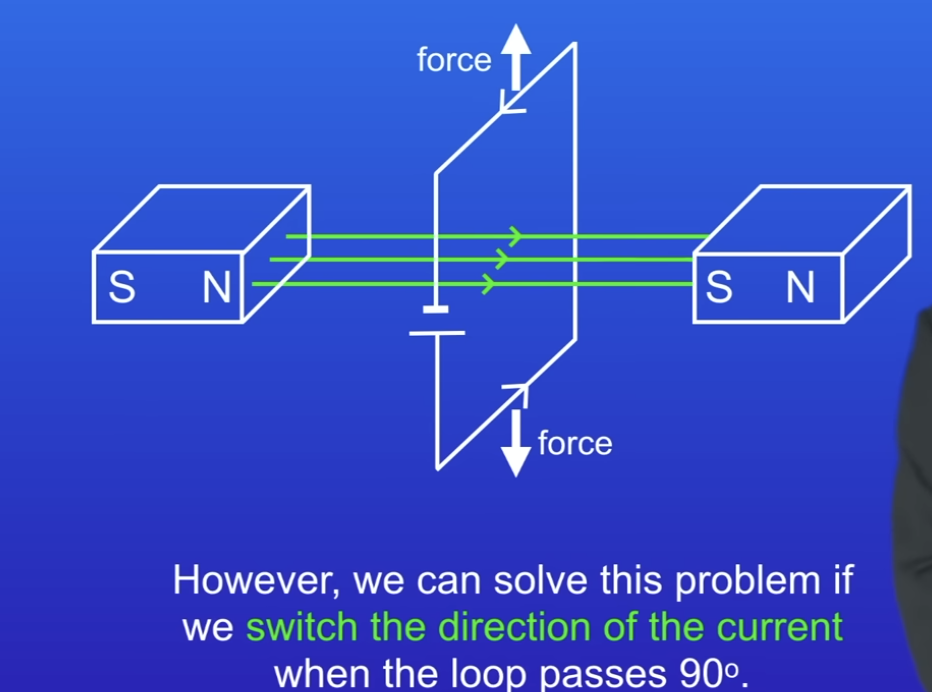
how to switch the direction of the current when the loop passes 90 degrees
use a device called split-ring commutator -this is a split metal ring which is connected to conducting brushes
-the brushes allow the electric current to pass onto the ring.this means current produces a turning force on the motor. the force makes the motor rotate in the clockwise direction
-at this point the current is broken for a tiny fraction of a second. the wires keep turning due to momentum
-now current switches direction. once again, force on the left hand side acts upwards and force on right hand side still acts downwards
-by switching the direction of the current, the split ring cummutator allows the motor to keep rotating in the same direction
how is motor effect used in headphones and loudspeakers
-a moving-coil loudspeaker which we can find in the speakers on a stereo. headphones will contain a similar set-up only much smaller
-a cone which has a coil of wire wrapped around one end
-the coil of wire is connected to an alternating current electrical supply
-there will be a permanent magnet which goes inside the coil of wire
-as current passes through the coil, it generates a magnetic field
-the magnetic field from coil will interact with the magnetic field from the permanent magnet
-these magnetic fields either attract or repel each other
-this produces a resultant force which causes the cone to move
-when the current switches direction, the direction of the force on the cone reverses
-this causes the cone to move in and out, generating sound waves
-by changing the frequency of the AC supply we can change the frequency that the cone vibrates
-a higher frequency will produce a higher pitch sound and lower frequency will produce a lower pitch sound
-if we increase the size of the current then we increase the amplitude of the vibration. this increases the volume of the sound
generator effect
If an electrical conductor moves relative to a magnetic field or if there is a change in the magnetic field around a conductor, a potential difference is induced across the ends of the conductor. If the conductor is part of a complete circuit, a current is induced in the conductor.
what happens

