Psychopathology Exam 1
 Call Kai
 Learn
Learn Practice Test
 Spaced Repetition
 Match
Match Flashcards
 Knowt Play
1/44

There's no tags or description
Looks like no tags are added yet.
Name | Mastery | Learn | Test | Matching | Spaced | Call with Kai |
|---|
No analytics yet
Send a link to your students to track their progress
45 Terms
Psychopathology
The scientific study of mental difficulties or disorders, including their explanations, causes, progression, symptoms, assessment, diagnosis, and treatment
Etiology
The cause or causes for a condition
Psychodiagnosis
Assessment and description of an individual’s psychological symptoms, including inferences about what might be causing the distress
Treatment plan
a proposed course of treatment, developed collaboratively by a provider and client.patient that addresses the client’s mental health symptoms
What makes a mental disorder ?
Diagnostic and Statistical Manual :
1) involves significant disturbance in thinking, emotional regulation, or behavior caused by a dysfunction in the basic psychological, biological, developmental processes involves in normal development
2) causes significant distress with day-to-day function
3) Is not merely a culturally expected response to common stressor or losses or a reflection of political or religious beliefs that conflict with societal norms
Distress
Deviance
Dysfunction
Dangerousness
Distress
The person experiencing the symptoms is distressed about the symptoms
Examples :
Trying to hide or mask symptoms
Wishing symptoms go away
Self-perception that symptoms are causing problems
Ex : unpleasant emotions such as worry or guilt, thought patterns that are confusing or distracting, physiological responses such as racing heart or stomach aches
Deviance
Behavior that is unusual/atypical
The DSM has incidence rates for disorders, demonstrating the prevalence of the condition in populations
Dysfunction
Is the person’s life negatively impacted by the symptoms, particularly in important life domains : work or school, relationships, or take care of themself
Is there a marked difference between this person’s life with these symptoms and someone else’s life without these symptoms
Did this person experience new impairment after these symptoms emerged or increased?
Dangerousness
If the symptoms puts the person or others at risk
Prevalence
The % of individuals in a targeted population who have a particular disorder during a specific period of time
21% of adults had mental illness in 2020
30% of young adults 19-25 years of age had a mental illness in 2020
50% of adolescents 13-18 has experienced a mental illness at some point in their lives
Diagnosis, Treatment, & Insurance
US passed federal parity law in 2008 intended to equalize healthcare coverage for mental and physical health
Managed care system: healthcare coverage in which the insurance company largely controls the nature, scope, and cost of medical and psychological services
Healthcare insurance provides more access to mental health services (like psychotherapy) to more people
This system constrains diagnosis, treatment, and pay rates by the terms set by insurance companies
Research concepts in mental health applications
Operational definitions : concrete description of the variables that are being studied
Clinical significance : the degree to which the finding of the study is useful in practice/ clinical contexts
Statistical significance is influenced by the sample size
A study with many participant may find a small difference that is statistically significant but so small that it has little impact on clinical decision making
Research on mental disorders
Case study
Correlational design
Experimental design
Quasi experimental design
Meta analysis
Qualitative
Case Study
an intensive study of one individual that relies on clinical data, such as observations, psychological tests, and historical and biographical data
Correlational Design
Correlation: relationship between variables
Often large studies to have the statistical power to detect even very small magnitude relationships between variables
What can we learn from correlational design ?
Twin studies: examine similarities and differences between twins, compare to non-twin pairs
Experimental design
Scientific inquiry in which a prediction is made about two variables; the independent variable is then manipulated in controlled situation, and changes in the dependent is measured
Special types of experimental design important in research on mental disorders:
Experimental design : random assignments and includes a true control group
Randomized control trial (RCT)
Randomization, control group, treatment condition, measurement points
Double blind RCT (or masked design)
Quasi-Experimental Design
Similar to an experimental design, except one or both of the following are true:
It contains a quasi-independent variable (does not meet the criteria pf controlled experimenter manipulation)
Lacks randomization
Lacks control group
Why might this be used??
Ethics
Feasibility
Types of Quasi-Experimental Designs
Single subject multiple baseline
single subject reversal ABAB
Matched designs
Natural experiments
Analogue Experiments
Integrative models
Biopsychosocial model : perspective that includes interactions between biological, psychological, and social factors in the etiology of mental disorders
biopsychosocial spiritual models is an adaptation
Sociocultural influences : factors such as gender, sexual orientation, spirituality, religion, SES, race/ethnicity, and culture that can have an effect on mental health
Integrative models also tend to include strengths, resources, and/or protective factors
Developmental Psychopathology Perspective
Integrative model
Includes timing of developmental needs (risks and protective factors)
Accumulation of risks and protective factors
Trajectories over time
Equifinality : multiple paths can lead to the same outcome
Multi finality : multiple outcomes can come from the same experiences/biological factors
Multi-path model
An integrative model that provides an organizational framework for understanding the numerous influences on the development of mental disorders, the complexity of their interacting components, and the need to view disorders from a holistic and resilience inclusive framework
Assumptions :
multiple dimensions must be considered in development of mental disorders
multiple pathways can result in the same disorder
not all dimensions contribute equally to all disorders
dimensions interact with each other in complex combinations or reciprocal relationships
dimensions include protective influences as well as risks. assests may exert preventative influence, mitigate severity, or improve recovery in mental disorders
Multi-path model dimension
Biological
Psychological
Social
Sociocultural
Biological Dimension
CNS :
structures such as hypothalamus, hippocampus, amygdala, pituitary gland
systems such as : autonomic nervous system (SNS and PNS), hypothalamic-pituitary-adrenal (HPA) axis regulates hormones
functions such as : synaptic transmission, neurotransmitter reuptake
Genetics :
heritable traits
epigenetic - interactions between environmental conditions and the genome, influencing gene expression
Biological dimension : Treatment
Psychopharmacology/Psychotropic medications
Created enormous change in the field of mental health treatment
Has reduced institutionalization and hospitalization for many people
widely used
Neurostimulation Treatments
Devices/psychosurgery: deep brain stimulation, vagus nerve stimulation
Treatments: Electroconvulsive Therapy (ECT), Transcranial Magnetic Stimulation (TMS)
Psychological Dimension
thoughts
thought patterns
can be risk factor or protective factors
emotions
How much of different emotions does a person feel
beliefs
Personal philosophies that are often about self, others, or the way the world works
personality traits
Ex — grit, openness, rigidity
Psychological Dimension : Treatment
Contemporary Psychodynamic Therapy : Object relations, self theory, and attachment
Focus is resolving past conflicts or “traumas”
Behavioral :
classical conditioning and operant conditioning
observational learning
exposure therapies : OCD, PTSD, phobias
Cognitive Behavioral :
Cognitive Behavioral Therapy
Dialectal Behavior Therapy (DBT) and acceptances and commitment therapy (ACT) incorporate mindfulness
Humanistic : Core beliefs : basic goodness and power of unconditional positive regard
Existential : attention to topics such as isolation, meaning, death, freedom
contemporary existential therapist : Irvin Yalom
Social Dimension + Treatment
Quality of social support and social connections
Treatment :
Social relationship models — emphasize the formation and maintenance of quality relationship
Family and Couple Therapy :
Family systems theory → based on an application of General Systems Theory with assumption such as “The whole is greater than the sum of its part” and includes application of concepts such as feedback loops, homeostasis, and adaptation
Considers pathology in a relational, systemic context- the focus is typically bi-directional interactions and influences that sustain patterns, including biopsychosocial factors (not about blaming parents)
Treatment can be effective with individuals-indidvuals are influential parts of the system they belong to
Sociocultural Dimension
A person’s social location may afford them benefits or marginalization within their cultural context
Treatment : Multicultural models and trans theoretical multicultural competence
providers may be culturally informed or the intervention may be culturally designed or adapt
Clinical interviews
extremely common in mental health care, psychotherapy, psychiatry
can range from structured, semi-structured, to unstructured
Pros :
Provides opportunity for simultaneous observation of some behavior
Allows provider to make a connection with client
Allows for open communication that can be more descriptive
Cons :
Provider/assessor bias
Factors that may limit communication or self-awareness for the individual
The less structured, the reliability and validity tend to be compromised
Observations
Can be formal or informal
Formal : ex → certain tests for ADHD, Austism spectrum disorder
Informal : ex → noting the person’s speech patterns, body posture, facial expression
External, behavioral signs
Pros :
Additional information can be gathered from behavior
Very helpful with conditions that limit self-awareness
Cons
Cultural differences with behavior meanings can lead to inaccurate conclusions
Can be context specific rather than a general pattern
Psychological Tests and Inventories
Projective Personality Tests: Rorschach, TAT, sentence completion
Wide range of interpretation, limited utility for diagnosing disorders
Self-report : beck depression inventory, PHQ-9, MMPI
Pros :
can be helpful with scaling the severity of symptoms
can gather information in a systematic way
Cons :
not all have been tested with sufficiently diverse populations
require some level of self awareness
the individual can answer inaccurately
Assessment
Methods for understanding accuracy :
reliability
how confident are we that each administration of this assessment neans the same thing as other administrations of this assessment ?
intra-rater reliability : the same assessor draws the same conclusion from the same information
inter-rater reliability : different assessors draw the same conclusions from the same information
test-retest reliability : multiple assessments of the same individual result in the same conclusion
validity
how confident are we that this assessment measures what we think is measuring?
Diagnosing mental disorders
Any diagnostic system is a method for organizing information so that it can be communicated with a shared understanding
Diagnostic and statistical manual (DSM)
organized by symptom sets into diagnoses which are grouped by categories
some disorders include clear etiology, some do not
some disorders have standardized assessment tools to assist with diagnosing others do not
recent revisions have included more dimensional focus within diagnoses
autism spectrum disorder and alternative
adding subtypes and specifiers to the existing diagnoses
Purposes for diagnosing
How diagnosing is approached, and the decisions about what methods are acceptable, depend partially on the purpose
in research, reliability is essential
in outcome studies, sensitivity to change is also important
in clinical work, individualized treatment utility is more important than in research
Accuracy in diagnosing always matters but the decision on how to execute accuracy may depend on the purpose
Evaluating effectiveness of treatment
psychopharmacology: clinical trials (double blind RCTs)
psychotherapy: RCTs
what should the control conditions be ?
nothing at all
some type of non-therapy condition (placebo)
treatment as usual (TAU)
another specific type of therapy
Common factors research
since different models for psychotherapy tend to perform similarly, what is it that makes therapy work?
common factors research tries to identify the “active ingredients” in successful therapy across different therapy models
client-therapist relationship is the strongest common factor in predicting successful outcomes
Evidence-based treatment and practice
evidence based treatment/therapy (EBTs) — treatment techniques with strong research supp.
psychotherapy interventions tend to be manualized, step-by-step
require specific training
may apply to a small range of mental health disorders
tend to be preferred by insurance companies
criticisms : can limit clinical judgement, adaptations are often untested, some models are easier to test in an experimental design than others
Examples of EBT :
narrative exposure therapy for PTSD
exposure response prevention for OCD
Parent management training for children with ADHD
evidence based practice (EBPs) — treatment decisions based on current research combined with clinician judgement and client need
Inter-rater reliability of DSM-5
Inter-rater reliability — do different assessors assign the same diagnosis to the same individual?
depends on the diagnosis
high inter-rater reliability (major neurocognitive disorder)
low inter-rater reliability (GAD)
how reliable is relaible enough ?
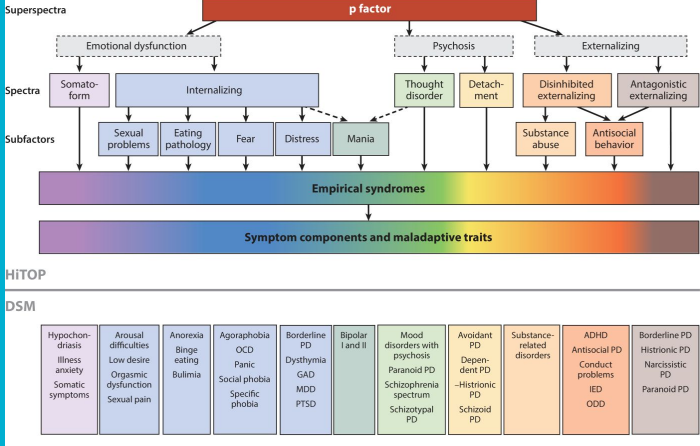
HiTOP
organized by looking at the structure (latent patterns) of symptoms in the data
group similar symptoms instead of creating many different categories
people can have any of the symptoms on a spectrum of severity
Assumptions :
psychopathology is best characterized as dimensional
natural organization of psychopathology can be discerned in co-occurence
psychopathology is better understood as varying in symptom
om presentation for each person than as distinct categories of symptoms
Anxiety Disorder
US 12 month prevalence :
19.1% adult prevalence prior to COVID-19 pandemic
US lifetime prevalence for adolescents :
31.9% lifetime adolescent prevalence prior to COVID-19 pandemic
Increase during COVID-19 pandemic :
25% global increase in anxiety disorders in 2020
More common in woman than men
Specific phobias
refers to intense, persistent, fear reaction to a specific object or situation
does not include instances when the object is associated with a traumatic event
Agoraphobia
intense fear of situations related to being in public places
etiology of phobias
biological: limbic system, specifically amygdala
psychological:
classical conditioning
observational learning
negative info.
cognitive0behavioral
social:
family environment
peer experiences : bullying
sociocultural
experiences w/ discrimination
cultural values
Treatment of phobias
biochemical:
SSRIs, SNRIs, tricyclics, MAOIs somewhat effective
beta blockers (blood pressure medication)
benzodiazepines for short acting short term solutions
therapy

