Evolution making Sense of Life Chapter 14
 Call Kai
 Learn
Learn Practice Test
 Spaced Repetition
 Match
Match Flashcards
 Knowt Play
1/57

There's no tags or description
Looks like no tags are added yet.
Name | Mastery | Learn | Test | Matching | Spaced | Call with Kai |
|---|
No analytics yet
Send a link to your students to track their progress
58 Terms
Macroevolution also includes abrupt drops in __________ rates caused by the rapid extinction of many species.
diversification
biogeography
is the study of the distribution of species across space (geography) and time.
dispersal
describes the movement of populations from one geographic region to another with very limited, or no, return exchange.
Vicariance
is the formation of geographic barriers to dispersal and gene flow, resulting in the separation of once continuously distributed populations.
A molecular phylogeny can show only the relationships of species from which scientists can obtain DNA. A morphological phylogeny, on the other hand, can include ______ species as well
fossil
fauna
is an assemblage of many different species that live together. A fauna may comprise the species in a single ecosystem, in a region, or across the entire planet.
Turnover
refers to the disappearance (extinction) of some species and their replacement by others (origination) in studies of macroevolution.
The ________ ______ is the number of species eliminated and replaced per unit of time.
turnover rate
standing diversity
is the number of species (or other taxonomic unit) present in a particular area at a given time.
The concentration of heat-trapping gases, such as _________ and __________, is influenced by many factors, from the absorption of carbon dioxide by photosynthesizing plants and algae to the eruptions of carbon dioxide-rich plumes from volcanoes.
Carbon dioxide, methane
_______ water has a higher concentration of the isotope oxygen-18 than cool water does, for example, and so rocks that form in______ water will lock in those isotopes as well.
cold
After correcting for sampling biases in the fossil record, they found that periods with warmer ocean temperatures also had increased _______ __________ of marine invertebrates
standing diversity
anagenesis
refers to wholesale transformation of a lineage from one form to another. In macroevolutionary studies, is considered to be an alternative to lineage splitting or speciation.
Cladogenesis
the formation of a new group of organisms or higher taxon by evolutionary divergence from an ancestral form
punctuated equilibrium
is a model of evolution that proposes that most species undergo relatively little change for most of their geological history. These periods of stasis are punctuated by brief periods of rapid morphological change, often associated with speciation.
___________ ___________ can keep a lineage from deviating far from a given phenotype, for example, making it possible to produce long periods of stasis.
stabilizing selection
In macroevolutionary studies, speciation events can be difficult to discern because changes in the morphologies of fossils are often the only clues available, and gaps in the fossil record may leave important __________ undocumented.
transitions
adaptive radiation
is an evolutionary lineage that has undergone exceptionally rapid diversification into a variety of lifestyles or ecological niches.
Adaptive radiations may occur when clades evolve to occupy __________ ______ in the absence of competition. These opportunities can arise with the emergence of a new island or lake.
ecological niches
key innovation
is a novel trait that allows the subsequent radiation and success of a clade.
Columbine flowers (Aquilegia) provide a compelling case of a _____ _________. The common ancestors of the genus evolved “nectar spurs” — tubes that dangle down from the flower and hold nectar. The evolution of nectar spurs was followed by a rapid diversification of many species of columbines.
key innovation
The near simultaneous appearance of such a diversity of body forms has been called the “_________ ___________,” and it stands as one of the most important macroevolutionary events in the history of life
Cambrian explosion
developmental toolkit
is the small subset of genes in an organism's genome whose products control the organism's embryonic development. These genes are central to the synthesis of molecular genetics, paleontology, evolution and developmental biology
A ________ is a lineage made up of linked populations. It can endure for a million years or more, although the total number of individuals in the species may fluctuate wildly over time
species
Small populations also have less _______ ___________, which can leave them less prepared to adapt quickly to a changing environment
genetic variation
Background extinction
refers to the normal rate of extinction for a taxon or biota.
A clade can endure only if its origination rate of new species is _______ than the background rate of extinction.
greater
Mass extinction
describes a statistically significant departure from background extinction rates that results in a substantial loss of taxonomic diversity.
The warmer oceans become, the ____ oxygen they can hold. Thus, the oxygen level would drop even further.
less
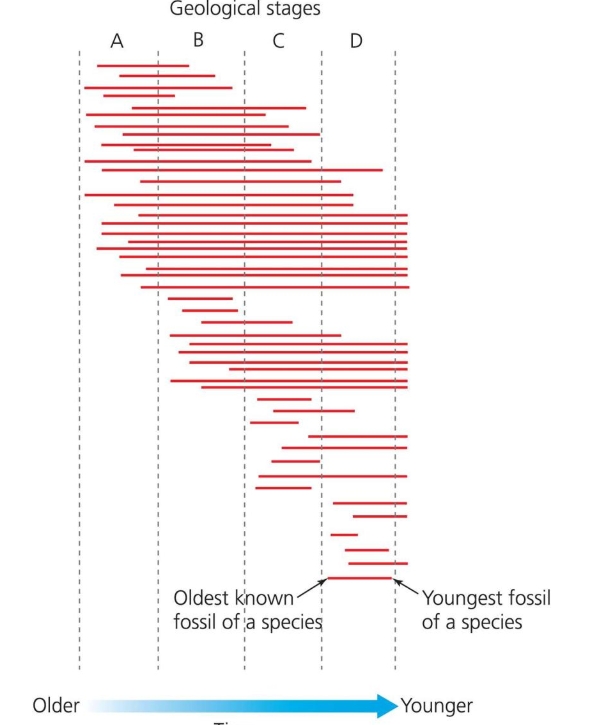
What is the turnover rate in stage B shown in the figure at the right?
20 (34 total species minus 2 that originated and went extinct within the stage, minus 4 more extinctions, minus 8 more originations).
16 (6 extinctions plus 10 originations).
28 (34 total species minus 6 extinctions).
4 (10 originations minus 6 extinctions).
16 (6 extinctions plus 10 originations).
Wallace’s boundary is significant in biogeography because it
indicates continental barriers to dispersal.
divides two very distinctive faunas that are geographically very close together.
separates Australia from South America.
divides two geographic areas whose faunas are almost identical.
Divides two very distinctive faunas that are geographically very close together.
Which of these statements about vicariance is true?
Plate tectonics is a primary mechanism of vicariance.
Vicariance led to Australian and South American lineages of marsupials.
Vicariance prevents dispersal.
Both a and b.
Both a and b.
Which of the following is not a hypothesis about the conditions that can lead to adaptive radiations?
Adaptive radiations occur as a result of the absence of competition for ecological resources.
Adaptive radiations occur as a result of island formation.
Adaptive radiations occur as a result of key innovations.
All are hypotheses about the conditions that can lead to adaptive radiations.
All are hypotheses about the conditions that can lead to adaptive radiations.
The typical tempo of extinctions within a particular taxon is called
background extinction.
mass extinction.
total extinction.
episodic extinction.
background extinction.
Can the Big Five extinctions all be attributed to a single cause? If so, what caused them?
Yes. The Big Five extinctions were caused by asteroids that had major impacts on habitats when they hit Earth.
Yes. The Big Five extinctions resulted from plate tectonics that changed the quantity and quality of available habitats.
No. The Big Five extinctions were caused by various abiotic and biotic factors that affected different taxa differently.
No. The Big Five extinctions resulted from low origination rates that resulted from a variety of biotic factors.
No. The Big Five extinctions were caused by various abiotic and biotic factors that affected different taxa differently.
Which of the following is not a dispersal event?
Plant seeds falling in rivers and being carried downstream.
Insect populations separated by a cataclysmic volcanic event.
Elk crossing mountain ranges.
Seagulls flying from island to island.
Insect populations separated by a cataclysmic volcanic event
→ That is vicariance, not dispersal
Which of the following best explains the model of punctuated equilibria?
The average life span of a species is about one million years.
A large population gradually splits into two distinct lineages.
Most species change very little for most of their history.
Periods of stasis are punctuated by brief periods of rapid morphological change.
Periods of stasis are punctuated by brief periods of rapid morphological change.
Which of the following statements about climate change is true?
Photosynthesis helps mitigate the effects of carbon dioxide on the atmosphere.
The chemical composition of the atmosphere can alter the amount of heat it traps.
Eruptions of carbon dioxide from volcanoes contributes to the concentration of gases in the atmosphere.
All of the above.
All of the above.
Studies show that the Cambrian explosion
occurred after about 200 million years of animal evolution.
was a time when evolution proceeded at a relatively slow pace.
was a result of one of the Big Five extinctions.
happened because the oceans underwent a massive drop in sea level.
Occurred after about 200 million years of animal evolution.
What are the differences between microevolution and macroevolution? What are the similarities? Which has more evidentiary support: microevolution or macroevolution?
Differences:
Microevolution:
Changes in allele frequencies within populations
Short timescales
Macroevolution:
Large-scale changes (speciation, extinction, diversification)
Long timescales
What lines of evidence have macroevolutionary biologists used to determine the origin of marsupials? How are these lines distinct?
Scientists use:
Fossil record
→ Shows timing and morphologyBiogeography
→ Distribution across continents (Australia, South America)Molecular phylogeny
→ DNA comparisons to infer relationships
How do paleontologists use fossils to reconstruct macroevolution?
Show transitional forms
Track changes in morphology over time
Reveal:
Extinction events
Adaptive radiations
Stasis vs change
➡ Fossils help reconstruct evolutionary history and patterns
What are the major proposed causes of the Big Five mass extinctions?
Major proposed causes include:
Asteroid impacts (e.g., end-Cretaceous)
Volcanic activity → CO₂ release, climate change
Climate shifts → warming/cooling
Sea level changes
Ocean anoxia (low oxygen)
Which pattern in the fossil record best supports the idea of successive dominant faunas (Cambrian → Paleozoic → Modern)?
A) Continuous gradual replacement of species without extinction
B) Abrupt shifts in dominant groups associated with extinction events
C) Equal representation of all taxa across time
D) Random appearance of unrelated taxa
B) Abrupt shifts in dominant groups associated with extinction events
Why is the fossil record considered incomplete?
A) Fossilization is rare and biased toward certain organisms and environments
B) Fossils only form in terrestrial environments
C) All organisms fossilize equally
D) Fossils are destroyed immediately after formation
A. Fossilization is rare and biased toward certain organisms and environments
A time period with high speciation and high extinction rates would most likely show:
A) Low turnover and low diversity
B) High turnover with stable or fluctuating diversity
C) No change in diversity
D) Only increasing diversity
High turnover with stable or fluctuating diversity
Which factor would most likely increase standing diversity?
A) High extinction with low speciation
B) Low extinction with high speciation
C) Equal extinction and speciation with no change
D) Constant environmental disturbance preventing speciation
B) Low extinction with high speciation
How can climate change drive macroevolutionary patterns?
A) By altering habitats, leading to extinction and speciation
B) By directly mutating DNA sequences in all organisms
C) By preventing natural selection
D) By eliminating genetic drift
A) By altering habitats, leading to extinction and speciation
Which climate-related factor is most likely to increase extinction rates?
A) Stable temperatures over millions of years
B) Rapid environmental change
C) Increased sunlight only
D) Decreased mutation rates
B) Rapid environmental change
Which of the following is a major cause of high turnover rates?
A) Environmental stability
B) Frequent environmental disturbances
C) Lack of competition
D) Uniform habitats
B) Frequent environmental disturbances
Which pattern is most consistent with gradual evolution?
A) Long stasis with sudden change
B) Continuous slow morphological change over time
C) Immediate speciation without intermediates
D) No change in morphology
B) Continuous slow morphological change over time
Which situation best supports punctuated equilibrium?
A) Species gradually adapting over millions of years
B) Rapid speciation following environmental disruption
C) Constant mutation without selection
D) No fossil evidence of change
B) Rapid speciation following environmental disruption
What is the primary effect of a key innovation?
A) Decreases genetic variation
B) Opens new ecological opportunities and increases diversification
C) Prevents speciation
D) Eliminates competition
B) Opens new ecological opportunities and increases diversification
Which of the following is most likely to trigger an adaptive radiation?
A) Colonization of a new environment with few competitors
B) Loss of genetic diversity
C) Stable environment with no change
D) Decrease in ecological niches
A) Colonization of a new environment with few competitors
What best characterizes the Cambrian Explosion?
A) Sudden decrease in biodiversity
B) Rapid diversification of animal body plans
C) First appearance of plants on land
D) Mass extinction of marine species
B) Rapid diversification of animal body plans
Which fauna is most closely associated with modern marine ecosystems?
A) Cambrian fauna
B) Paleozoic fauna
C) Modern fauna
D) Precambrian fauna
C) Modern fauna
How can Large Igneous Provinces contribute to mass extinction?
A) By increasing oxygen levels
B) By releasing large amounts of CO₂, causing climate change
C) By stabilizing ecosystems
D) By reducing ocean temperatures permanently
B) By releasing large amounts of CO₂, causing climate change
The Siberian Traps are associated with:
A) The Cambrian explosion
B) The largest mass extinction at the end of the Permian
C) The origin of mammals
D) The formation of modern coral reefs
B) The largest mass extinction at the end of the Permian
Explore top notes

