cardiovascular
0.0(0)
Studied by 0 people Call Kai
 Learn
Learn Practice Test
 Spaced Repetition
 Match
Match Flashcards
 Knowt Play
Card Sorting
1/108

Last updated 2:46 PM on 11/17/22
Name | Mastery | Learn | Test | Matching | Spaced | Call with Kai | Chat |
|---|
No analytics yet
Send a link to your students to track their progress
109 Terms
1
New cards
aort(o)-
aorta
2
New cards
angi(o)-
vessel
3
New cards
arter(o)/arteri(o)-
artery
4
New cards
ather(o)-
fatty substance
5
New cards
atri(o)-
atrium
6
New cards
cardi(o)-
heart
7
New cards
coron(o)-
heart or crown
8
New cards
corpor(o)-
body
9
New cards
cutane(o)-
skin
10
New cards
duct(o)-
to bring
11
New cards
ech(o)-
sound
12
New cards
electr(o)-
electricity
13
New cards
embol(o)-
plug or blockage
14
New cards
fluor(o)-
emitting of reflecting light
15
New cards
hem(o)-
blood
16
New cards
isch(o)-
to hold back
17
New cards
lip(o)-
fat
18
New cards
mediastin(o)-
mediastinum
19
New cards
my(o)-
muscle
20
New cards
orth(o)-
straight
21
New cards
path(o)-
disease
22
New cards
pector(o)-
chest
23
New cards
phleb(o)-
vein
24
New cards
pulmon(o)-
lung
25
New cards
radi(o)-
x-ray or radiant energy
26
New cards
AED
automated external defibrillator
27
New cards
AF
atrial fibrillation
28
New cards
AMI
acute myocardial infarction
29
New cards
ASCVD
atherosclerotic cardiovascular disease
30
New cards
AV/A-V
atrioventricular
31
New cards
Bld
blood
32
New cards
BMP
basic metabolic panel
33
New cards
BP
blood pressure
34
New cards
Bpm
beats per minute
35
New cards
CABG
coronary artery bypass graft
36
New cards
CAD
coronary artery disease
37
New cards
Cath
catheterization
38
New cards
CC
chief complaint
39
New cards
c/o
complaint of
40
New cards
CCU
coronary care unit
41
New cards
CHF
congestive heart failure
42
New cards
CP
chest pain
43
New cards
CPR
cardiopulmonary resuscitation
44
New cards
CV
cardiovascular
45
New cards
d/c/DC
discharge
46
New cards
DM
diabetes mellitus
47
New cards
DNR
do not resuscitate
48
New cards
DOE
dyspnea on exertion
49
New cards
DVT
deep vein thrombosis
50
New cards
ECG/EKG
electrocardiogram
51
New cards
ECHO
echocardiogram
52
New cards
ED
emergency department
53
New cards
ER
emergency room
54
New cards
h/o
history of
55
New cards
H & P
history and physical
56
New cards
HTN
hypertension
57
New cards
ICD
implantable cardioverter defibrillator
58
New cards
ICU
intensive care unit
59
New cards
IMP
impression
60
New cards
IV
intravenous
61
New cards
K
potassium
62
New cards
KCL
potassium chloride
63
New cards
Lytes
electrolytes
64
New cards
M/H
medical history
65
New cards
MI
myocardial infarction
66
New cards
Mm Hg
millimeters of mercury
67
New cards
MVP
mitral valve prolapse
68
New cards
N/V
nausea and vomiting
69
New cards
Na
sodium
70
New cards
NCP
nursing care plan
71
New cards
npo
nothing by mouth
72
New cards
NSR
normal sinus rhythm
73
New cards
O2
oxygen
74
New cards
OR
operating room
75
New cards
P
pulse
76
New cards
PMI
point of maximum impulse of the heart when felt during examination
77
New cards
prn
as needed
78
New cards
PVC
premature ventricular contraction
79
New cards
R/O
rule out
80
New cards
ROS
review of systems
81
New cards
s/p
status post
82
New cards
SOB
shortness of breath
83
New cards
T
temperature
84
New cards
V fib
ventricular fibrillation
85
New cards
VSS
vital signs stable
86
New cards
VT
ventricular tachycardia
87
New cards
Know the difference between epicardium, myocardium, endocardium, and pericardium.
epi: above, myo: middle, endo: inside, peri: outside/around
The endocardium, from endo-, meaning inner or within, and cardi(o)-, meaning heart, is the thin inner layer that lines each chamber. The myocardium, from myo-, meaning muscle, and cardi(o)-, meaning heart, is the middle, muscular layer that contracts to pump blood. The epicardium, from epi-, meaning upon or on, and cardi(o)-, meaning heart, is the outer layer.
The endocardium, from endo-, meaning inner or within, and cardi(o)-, meaning heart, is the thin inner layer that lines each chamber. The myocardium, from myo-, meaning muscle, and cardi(o)-, meaning heart, is the middle, muscular layer that contracts to pump blood. The epicardium, from epi-, meaning upon or on, and cardi(o)-, meaning heart, is the outer layer.
88
New cards
Know the difference between visceral and parietal
visceral: inside, parietal: outside
89
New cards
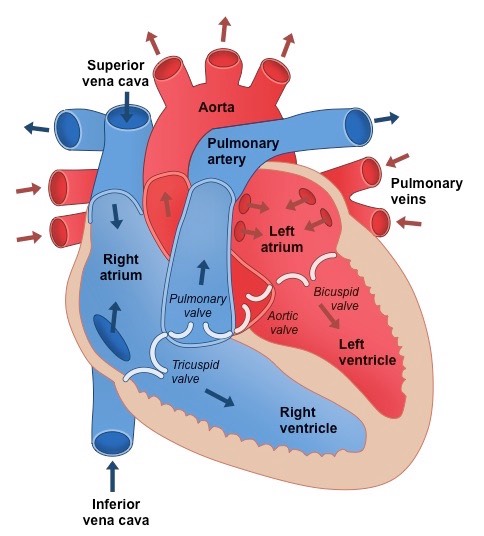
Name the 4 valves of the heart and identify their location
aortic, mitral (bicuspid), tricuspid, pulmonary
90
New cards
Venules
the smallest veins and receive blood from capillaries. They also play a role in the exchange of oxygen and nutrients for water products
91
New cards
arterioles
Small arteries
Branch off main arteries
Branch off main arteries
92
New cards
pulmonary circulation
This circulation refers to the path deoxygenated, from de-, meaning without, and oxy-, meaning oxygen, blood travels as it goes to the lungs to get oxygen and then returns to the heart.
93
New cards
Explain the following tests/diagnostic procedures:
a.) Sphymomanometer
b.) Stethoscope
c.) Holter monitor
d.) Echocardiogram
e.) EKG
f.) Stress test
g.) Ultrasonography
h.) Cardiac enzymes
a.) Sphymomanometer
b.) Stethoscope
c.) Holter monitor
d.) Echocardiogram
e.) EKG
f.) Stress test
g.) Ultrasonography
h.) Cardiac enzymes
a.) instrument to measure pressure. Most nonmedical people call it a blood pressure cuff
b.) instrument for viewing. This tool, as you know, is used to listen for the sounds of the heart, but it also helps us listen to other body sounds like the lungs and intestines
c.) a portable ECG machine that the patient wears over a few days. The monitor records heart activity to show a possible pattern for the symptoms the patient may be having
d.) a test that uses ultrasound to look at the heart and its vessels
e.) The machine records the electrical activity of the heart. This test helps check heart rhythm and may diagnose other heart issues
f.) evaluate how well the system is working. The patient’s oxygen levels and EKG are monitored during the test.
g.) This test uses ultrasound to look at blood going through blood vessels to determine if they are narrowed or have a thrombus
h.) used to measure certain items in the blood that may indicate heart muscle damage.
b.) instrument for viewing. This tool, as you know, is used to listen for the sounds of the heart, but it also helps us listen to other body sounds like the lungs and intestines
c.) a portable ECG machine that the patient wears over a few days. The monitor records heart activity to show a possible pattern for the symptoms the patient may be having
d.) a test that uses ultrasound to look at the heart and its vessels
e.) The machine records the electrical activity of the heart. This test helps check heart rhythm and may diagnose other heart issues
f.) evaluate how well the system is working. The patient’s oxygen levels and EKG are monitored during the test.
g.) This test uses ultrasound to look at blood going through blood vessels to determine if they are narrowed or have a thrombus
h.) used to measure certain items in the blood that may indicate heart muscle damage.
94
New cards
Explain the follow treatments:
a.) Heart transplant
b.) CPR
c.) Cardiac catheterization
d.) Pacemaker
e.) Implanted defibrillator
a.) Heart transplant
b.) CPR
c.) Cardiac catheterization
d.) Pacemaker
e.) Implanted defibrillator
a.) a surgical procedure in which the patient’s heart is replaced with the heart from a donor. This procedure allows patients to live when all other options won’t work.
b.) Cardiopulmonary Resuscitation
c.) insertion of a catheter into a
chamber or vessel of the heart
d.) a small electronic device implanted in the chest
signals the heart to beat when the heartbeat is too slow or irregular
e.) shocking the heart to restore normal rhythm
b.) Cardiopulmonary Resuscitation
c.) insertion of a catheter into a
chamber or vessel of the heart
d.) a small electronic device implanted in the chest
signals the heart to beat when the heartbeat is too slow or irregular
e.) shocking the heart to restore normal rhythm
95
New cards
where in the chest is the heart?
mediastinum
96
New cards
the bottom of the heart is
the top of the heart is
the top of the heart is
apex
base
base
97
New cards
another name for the bicuspid valve
mitral valve
98
New cards
The muscle that contracts the heart wall is
myocardium
99
New cards
The outer layer sac that contains the heart is the
pericardium
100
New cards
What separates the right from the left side of the heart?
septum