Psychology Exam 3
 Call Kai
 Learn
Learn Practice Test
 Spaced Repetition
 Match
Match Flashcards
 Knowt Play
1/14

There's no tags or description
Looks like no tags are added yet.
Name | Mastery | Learn | Test | Matching | Spaced | Call with Kai |
|---|
No analytics yet
Send a link to your students to track their progress
15 Terms
Cognition
Basically thinking: it encompasses the process associated with perception, knowledge, problem solving, judgement, language, and memory
Perception
The process through which individuals interpret and organize/experience sensory information to understand their environment.
What are concepts?
Mental categories or groupings your brain creates to organize information; such as, linguistic information, images, ideas, or memories
Example: A concept is a mental label your brain uses to group similar things together.
Examples:
“Tree”
“Dog”
“Love”
“Justice”
Even though individual examples look different, your brain groups them under one idea.
Define each type of concepts
Simple concept: Information your brain categorizes that is concrete, obvious, and easy to understand, usually based on direct experience. For example, snow is white and wet.
Complex: A complex concept is a mental category made up of multiple features or simple concepts combined, making it more complicated to understand. You can see this when learning chemistry or math.
Abstract: An abstract concept is a mental category that does not have a physical form and can be understood differently by different people, such as love or justice.
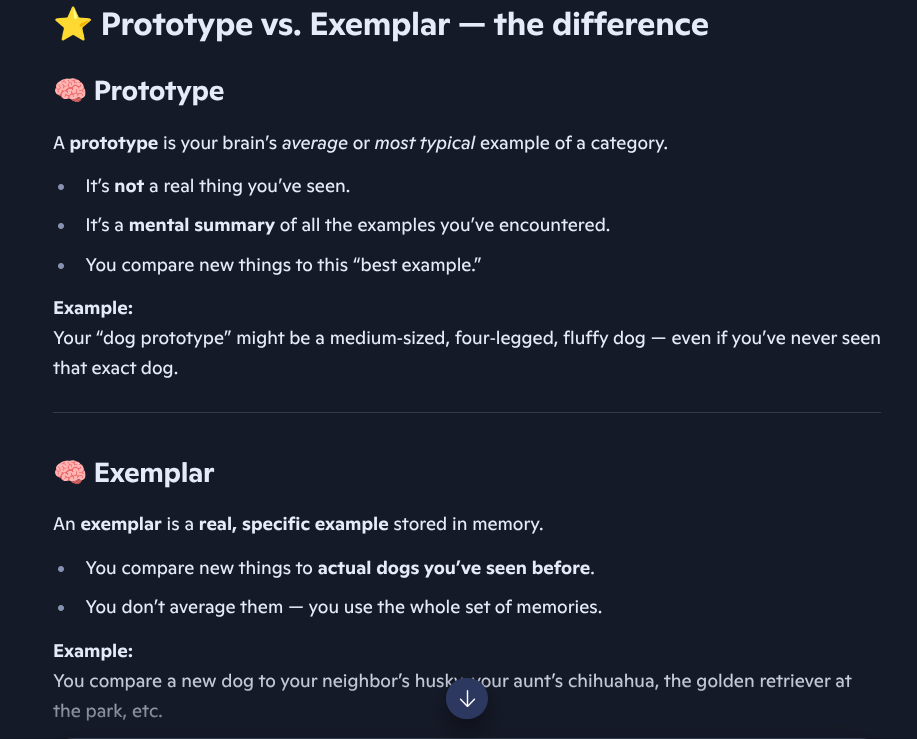
Prototype
A prototype is the mental “best example” or “average example” your brain uses to decide whether something belongs in a category.
Prototype-based categorization happens when the brain classifies concepts by comparing their features to a general, typical example formed from past experiences.
When you see something new, your brain asks:
“How similar is this to my mental idea of a typical one?”
If it’s close enough → you say it belongs.
Example:
You see an animal
You compare it to your mental image of a bird
If it matches closely enough, you say “that’s a bird.” Because your brain compares things to a mental reference
Examplar
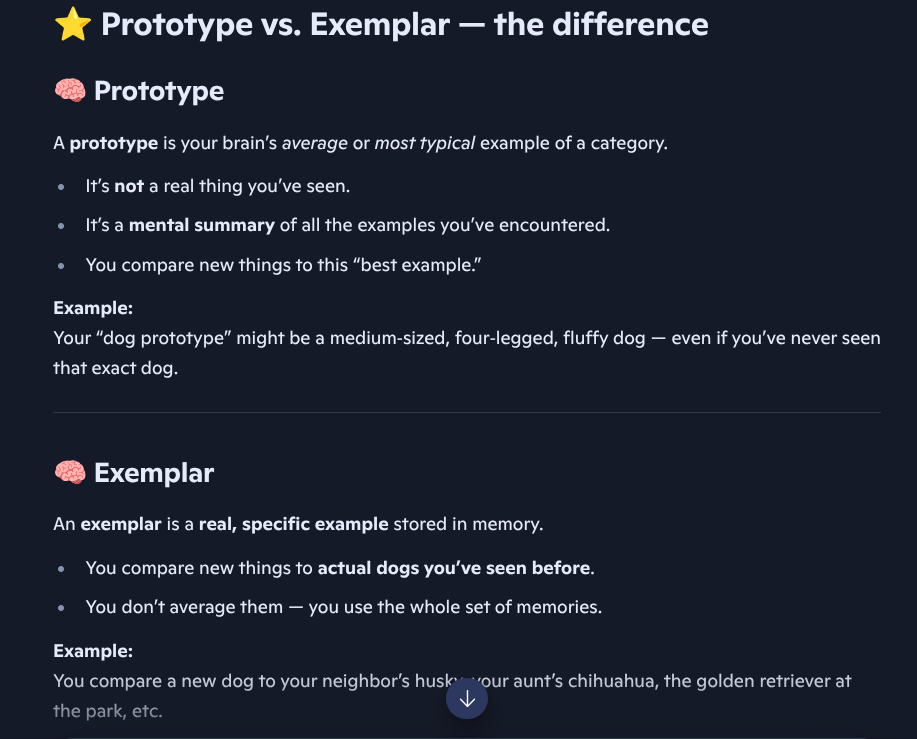
An exemplar is a specific, real example of something that you store in memory and use to judge or categorize new things.
Example:
You see a chicken and go through your brain to remember all the types of birds you encountered in your life (sparrow, pigeon, lovebird, dove, eagle, etc) and compare it to them to see if that chicken is a bird.
Natural concept
Mental category that occurs naturally or organically through experiences direct or indirect (e.g. snow).
Artificial concept
a mental category that is defined by strict rules, formulas, or specific characteristics, not by experience.
ex:
A triangle → must have 3 sides
A square → 4 equal sides + 90° angles
Even numbers → divisible by 2
Chemical elements → defined by atomic number
These categories don’t form “naturally” in your brain — you learn them because someone teaches you the rules.
Schema
A mental construct consisting of a cluster or collection of related concepts that helps in organizing and interpreting information based on prior knowledge.

Role Schema
Assumptions about how individuals in certain roles will behave
Event Schema
Set of behaviors for a given event
Example:
Think about what you do when you walk into an elevator you push the button, wait facing the door, and walk out.
Language
Communication system uses words and rules to organize ideas and transmit information
Lexicon
Words of a given language; language’s vocab
Grammar
Set of rules used to convey meaning through use of lexicon

