culture + attention
 Studied by 0 people
 Call with Kai
 Learn
Learn Practice Test
 Spaced Repetition
 Match
Match Flashcards
 Knowt Play
1/30

There's no tags or description
Looks like no tags are added yet.
Name | Mastery | Learn | Test | Matching | Spaced | Call with Kai |
|---|
No study sessions yet.
31 Terms
what is the definition of culture
behaviours, beliefs, expectations + values that a large group of people in the same geographical location agree upon (implicitly) —> these are passed on by communication + imitation between generations meaning they are consistent over time, though they are dynamic
2 cautions that need to be taken when conducting research cross-culturally
need to be careful to not overgeneralise + stereotype, and instead talk about average differences
measuring cognition vs performance —> performance is only a marker for cognition, and affected by experience (so some cultures may perform better on tasks not due to natural cognitive abilities, but experience)
what is + what are features of low-level cognitive function
the basis of cognitive function, e.g. perception, attention + encoding
they are unconscious, as consciousness usually relies on these processes
they are inflexible + mostly hardwired (not learnt)
result from early evolution, so are shared with most other mammals
what is + what are features of high-level cognitive function
more complex cognitive processes that rely on the mechanisms of low-level cognition, e.g. systematic decision making, creativity, rule usage
they are mostly conscious
flexible + can change
resulted from late evolution, so are more unique to humans + primates
what is an anecdotal example of culture affecting perception
the myth of the invisible ships —> Native Americans allegedly didn’t know the coloniser’s ships were approaching as they didn’t have the concept of what a ship was
demonstrates if you don’t expect to see something, you’re less likely to perceive it
what is the Sapir Whorf hypothesis
language affects lower-level cognition, meaning that perceptions will differ between languages spoken
how did Winawer et al. (2006) demonstrate the Sapir-Whorf hypothesis + what is a limitation of this study
Winawer et al. found that Russians, who have different names for shades of blue, were quicker at perceiving + categorising different shades of blue than English speakers
couldn’t determine whether results were due to language affecting perception (a low-level cognitive function) or categorisation (a high-level cognitive function)
is social attention a top-down or bottom-up process
it’s generally considered to be a bottom-up process as it’s the automatic attention we give to social stimuli (that are more salient to us)
however, top-down influences + experiences (e.g. culture) can shape these processes, so both influence it
what were Blais et al. (2008)’s findings pertaining to eye contact in Western + Eastern participants + what is this consistent with
found regardless of the race of the stimulus (a face), Western participants were more likely to fixate directly on the eyes, whether East Asian participants more likely fixated just below the eyes
consistent with cultural norms of eye contact —> mostly encouraged in Western societies, whether it may be considered rude in Eastern cultures, especially with elders
what did Uono + Hietenan (2015) investigate + what was the method used
whether eye contact perceptions different in people with different cultural backgrounds, so whether cultural norms affected attention
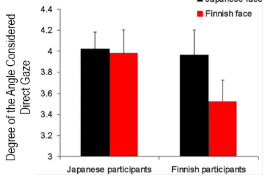
Finnish + Japanese participants were tested on the degree of the angle considered direct eye contact for Western + Eastern faces as stimuli
what were the results of Uono + Hietenan (2015)’s study and what does this imply
found Finnish participants were more accurate in discerning direct gaze of Finnish faces in comparison to Japanese faces —> showed an ‘own-race’ effect where they can better perceive faces from one’s own ethnic background
Japanese participants did not show an ‘own-race’ effect, as performance was consistent across both Western + Eastern faces
what are reasons for differences in own-race effect shown in Finnish people, but not Japanese people
visual experience with Finnish faces throughout development, due to eye-contact being a social norm, likely led to more effective processing of Finnish faces
less visual experience with faces throughout development, due to eye-contact being more minimal in Japanese culture, may have resulted in equal performance for both faces
what is analytic thinking + where is this more dominant
emphasizes a linear object-oriented focus —> separate objects are focused on one at a time
more dominant in Western Europe + North America
what is holistic thinking + where is this more dominant
emphasises a non-linear context-oriented focus —> background is focused on more relative to individual aspects
dominant in East Asian cultures e.g. China, Korea + Japan
how did Masuda + Nisbett (2001) assess whether methods of thinking affected cognition + what were the results
asked Japanese + American participants to look at a scene with background/central objects and describe it. 2 examples included:
‘I saw 3 big fish + 2 small fish’ —> analytic as it focuses on main, individual objects
‘some fish were swimming near the ocean floor towards the seaweed, and the ones in the back swam away from it’ —> holistic, as it focuses on the whole picture’s context
shows Japanese participants = more likely to make statements regarding contextual info + relationships
how did Chua et al. (2005) assess cultural variation in eye movements
participants were shown pictures, instructed to scan + describe them. assessed differences in eye-movement cross-culturally when conducting scene perception —> whether focus was more on background info or central objects
what were 3 results found from Chua et al. (2005)’s study + what does this suggest
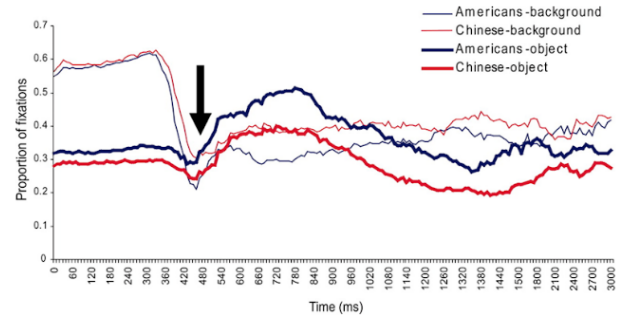
Chinese participants made more fixations on background details
Americans were quicker to fixate on the target object, though number of fixations on target object were the same for American + Chinese participants
when plotting proportion of fixations, no cultural differences are observed for the first 5 seconds, then split occurs
shows initial wave of fixation + attention is the same, and only later do cultural differences change what we prioritise
what conclusion did Chua et al. (2005) draw from their research
‘differences in judgement + memory may have their origins in differences in what is actually attended as people view a scene’
what were the findings of Senzaki et al. (2014)’s cultural attention research + how does this conflict Chua et al. (2005)
found differences in perception of a scene only occurred when asked what to report was going on in the scene —> suggests cultural differences do affect cognition, but mostly the more flexible process of what we want to prioritise at the time
what is SOA and what form of this is usually used in gaze cueing paradigms
stimulus onset asynchrony —> the time between the cue and the target is displayed
gaze cueing paradigms typically use short SOA, which results in the gaze cueing effect, regardless of whether the cue is predictive of target location
how did Takao et al. (2018) investigate cross-cultural differences in gaze cueing + what were the results
used a longer SOA (500-700ms) in a gaze-cueing paradigm to allow Japanese + American participants to process contextual information (i.e. that the cue is not predictive of the target location)
found with longer SOA, Japanese participants were better at using contextual info + disengage from the cue than Americans —> did not display the gaze cueing effect
therefore found cultural differences, but only in later, conscious stages of perception (were still subject to gaze-cueing effect at short SOA)
what is the Ebbinghaus illusion
two circles that appear different sizes due to the size of the dots around them, even though they are the same size

how did Imada et al. (2013) investigate when cultural differences in perception develop + what were the results
showed Japanese + American children pictures of the Ebbinghaus illusion with + without illusional context, and were asked to discern whether the circles were the same size
ages 4-5 —> no differences in accuracy
ages 6-7 —> Japanese children showed better performance on the task, indicating higher context sensitivity due to development of holistic thinking
what are affordances
the property of an object that defines its possible uses
how did Miyamoto et al. (2006, study 1) investigate perceptual affordances + what were the results
studied whether culturally-specific patterns of attention were afforded by the perceptual environment of each culture —> whether Japanese vs American environments affect attention
participants were asked to classify photos from Japanese + American streets
found that Japanese city scenes are more complex + ambiguous than American city scenes (where backgrounds are more bare, so objects are more distinctive)
because objects look more embedded in the field of the perceptual environment, Japanese people may learn to focus on background features more
how did Miyamoto et al. (2006)’s second study differ from the first + what were the results
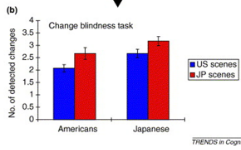
used a ‘change blindness task’ —> shows a picture flickering + participants must determine what changed in the photo from one flicker to another
found Japanese participants were more likely to detect change in the background, as they attend more to contextual info
both Japanese + American participants who viewed Japanese city scenes were more able to detect changes —> implies the layout of Japanese cities helped participants attend to more contextual info
what theory does Miyamoto et al. (2006, study 2)’s findings support
reciprocal feedback loop —> cultural differences in perception affect how the cities are built, which in turn helps Japanese participants to attend to contextual info
therefore culturally characteristic environments may afford distinctive patterns of perception
what did Kitayama et al. (2003)’s frame + line test investigate + how was it conducted
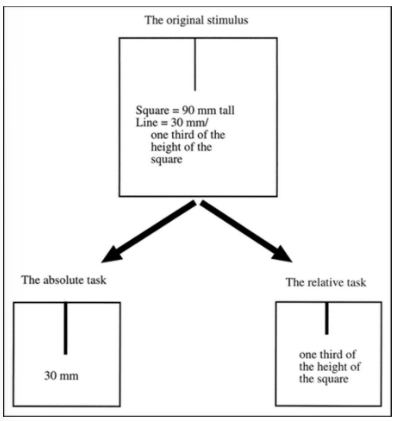
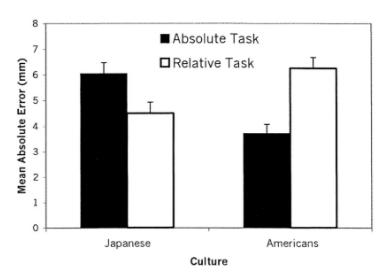
assessed the ability to both incorporate + ignore contextual info in a non-social domain —> 40 undergraduate participants (20 Japanese + 20 American) were shown a square frame with a line within it, then were shown a second frame of either the same or different size. then they had to complete one of 2 tasks:
absolute task → redraw the line identical to the first one (disregarding frame size)
relative task → redraw the line identical to the height of the surrounding frame (have to pay more attention to the overall context than the subject
participants were moved to a different table after observing the first frame + line to ensure iconic memory didn’t contribute to results
what were the results of Kitayama et al. (2003)’s first study
found that when measuring mean absolute error (by how many mm did participants get the answer wrong), Japanese participants performed significantly better + more accurately at the relative task than the absolute, and American participants performed significantly better + more accurately at the absolute task
therefore interaction between culture + specific task performance was significant
what did Kitayama et al. (2003)’s follow-up study assess + what were the results
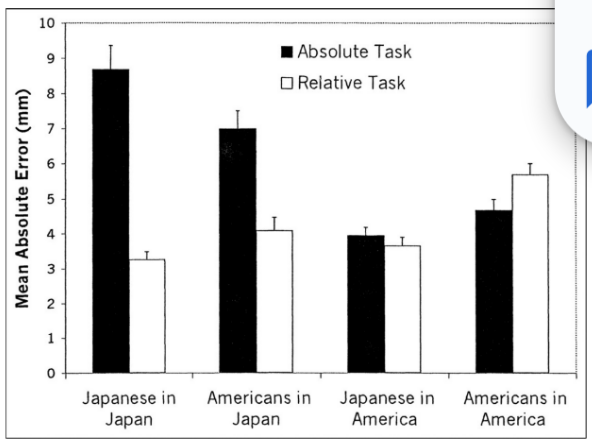
investigated whether cognitive abilities are due to our culture of origin (stable + traitlike) or due to exposure to our host society (variable + malleable)
assessed Japanese participants in Japan + America, and American participants in America + Japan —> Americans had been living in Japan ~4 months, whether Japanese had been living in America 2 months-4 years
found participants not in country of origin did not show the benefit of the relative/absolute tasks that those in their country of origin did (data fell between the other 2 groups) —> results more closely mirrored those of their host countries than countries of origin
participants presenting cognitive characteristics common in their host culture suggests cultural differences aren’t as hardwired, so perception = flexible depending on one’s environment
what 3 limitations to Kitayama et al. (2003)’s follow-up study limit our ability to draw conclusions as to the effects of host culture on perception
average stay at the host country greatly differed between conditions —> causes differences in the level of cultural assimilation
English language used for both Americans in Japan + Japanese in America —> this may have primed the associated culture, affecting results
possibility of selection bias due to participants having voluntarily moved to host countries —> may have psychological affinities to the other culture that may not be present in other members of the population
 Note
Note  Flashcards (40)