Hindi
 Call Kai
 Learn
Learn Practice Test
 Spaced Repetition
 Match
Match Flashcards
 Knowt Play
1/109

Earn XP
Description and Tags
Name | Mastery | Learn | Test | Matching | Spaced | Call with Kai | Chat |
|---|
No analytics yet
Send a link to your students to track their progress
110 Terms
I eat fruits daily
main roz phaL khaaTaa huun
also
bhi
still
ab tak
however
fir bhi
therefore
isliye
on the other hand
doosri or
currently
is samay
in fact
asal mein
finally
ant mein
nevertheless
fir bhi
consequently
is karan se
indeed
vaastav mein
instead
ke bajay
likewise
isi tarah
moreover
iske ilawa
meanwhile
is beech
eventually
antth:
besides
ke atirikt
certainly
nishchit roop se
in addition
iske sath sath
then
phir
I eat fruits in the evening
main saam ko phaL khaaTaa huun
I eat fruits at four p.m. in the evening
main saam ko caar baje phaL khaaTaa huun
Every evening, I eat fruit in the office.
main roz saam ko DafTar men phaL khaaTaa huun
I eat fruits after cutting them
main phaL kaat kar khaaTaa huun
I eat fruits after washing them
main phaL dho kar khaaTaa huun
I eat fruits after peeling them
main phaL chiil kar khaaTaa huun
Every evening, I eat fruits with milk
main roz saam ko DuuDH ke SaaTH phaL khaaTaa huun
I eat fresh fruits every day
main roz Taaze phaL khaaTaa huun
I eat all types of fruits
main har Tarah ke phaL khaaTaa huun
rich
amiir
poor
ġariib
Many stars
kaii Taare
Fifty flowers
pacaaS phuuL
His / her book
uSkii kiTaab
Masculine Adjectives
For adjectives referring to masculine nouns, the adjective description in Hindi usually ends with the sound aa.
लंबा आदमी (Lambaa aaDamii) = “A tall man”
सस्ता फल (SaSTaa phaL) = “Cheap fruit”
नीला आसमान (NiiLaa aaSamaaN) = “Blue sky”
Feminine Adjectives
For adjectives referring to feminine nouns, the adjective description in Hindi usually ends with the sound ii.
लंबी औरत (Lambii auraT) = “A tall woman”
सस्ती सब्ज़ी (SaSTii Sabzii) = “Cheap vegetable”
नीली किताब (NiiLii kiTaab) = “Blue book”
Gender-neutral Adjectives
For adjectives referring to gender-neutral nouns, the descriptive words in Hindi usually end with the sound “-a”. Nonetheless, there can be exceptions.
ईमानदार (iimaaNaDaar) आदमी (aaDamii) / औरत (auraT) = “An honest man / woman”
सुंदर (SuNDar) लड़की (Ladkii) / लड़का (Ladkaa) = “A beautiful boy / girl”
A narrow lane
paTaLii gaLii
A wide road
caudii Sadak
A short man
Naataa aaDamii
A heavy stone
bhaarii paTTHar
A light bag
haLkaa jhoLaa
A high mountain
uuncaa pahaad
A low hill
Niicii pahaadii
Far away temple
Duur kaa maNDir
Little food
kam / THodaa bhojaN
More water
zyaaDaa paaNii
A few coins
kuch Sikke
Many books
kaii kiTaaben
bad habit
burii aaDaT
Exceptional music
behaTariiN SangiiT
Awful handwriting
kharaab Likhaavat
Cheap toy
SaSTaa khiLauNaa
Original diamond
aSaLii hiiraa
Fake painting
NaqaLii ciTr
Painful incident
DarDaNaak haaDaSaa
Kind ruler
DayaaLu raajaa
Quiet girl
saaNT Ladakii
Generous person
uDaar vyakTi
Honest shopkeeper
iimaaNaDaar DukaaNaDaar
Trustworthy servant
bharoSemaND Naukar
Angry teacher
ġuSSaiL aDHyaapak
Talkative student
baaTuuNii viDyaarTHii
Sad kid
uDaaS baccaa
Naughty boys
saiTaaN Ladake
Clever fox
caaLaak Lomadii
Dumb officer
muurkh aDHikaarii
Cruel king
NirDayii raajaa
Fast rabbit
तेज़ ख़रगोश
(Tez kharagos)
Slow tortoise
धीमा कछुआ
Difficult riddle
मुश्किल पहेली (muskiL paheLii)
Important meeting
ज़रूरी बैठक (zaruurii baithak)
Ordinary task”
मामूली काम (maamuuLii kaam)
I have two apples
मेरे पास दो सेब हैं। (mere paaS Do Seb hain.)
“This apple is not mine.”
यह सेब मेरा नहीं है। (yah Seb meraa Nahiin hai.)
“The apple that I had kept in the fridge has gone bad.”
मैंने जो सेब फ़्रिज में रखा था वो ख़राब हो गया है। (mainNe jo Seb frij men rakhaa THaa vo kharaab ho gayaa hai.)
I like to eat fruits
मुझे फल खाना पसंद है।
(mujhe phaL khaaNaa paSaND hai.)
Do I like to eat fruits?
क्या मुझे फल खाना पसंद है?
(kyaa mujhe phaL khaaNaa paSaND hai?)
Apple is my favorite fruit.
सेब मेरा सबसे पसंदीदा फल है।
(Seb meraa Sab Se paSaNDiiDaa phaL hai.)
I can not eat six apples in a day
मैं एक दिन में छः सेब नहीं खा सकता हूँ।
(main ek DiN men chah Seb Nahiin khaa SakaTaa huun.)
Seema goes to school every morning at eight a.m. by rickshaw
सीमा रोज़ सुबह 8 बजे रिक्शा से स्कूल जाती है।
(Siimaa roz Subah aath baje riksaa Se SkuuL jaaTii hai.)
Container/Box
डिब्बा (dibbaa)
Light
हल्का (haLkaa)
Anger
ग़ुस्सा (ġuSSaa)
Masculine Gender
More often than not, masculine, or पुल्लिंग (puLLing), nouns and pronouns end with an अ (-a) sound.
“Fruit” = फल (phaL) = फ् + अ + ल् + अ
“Cloud” = बादल (baaDaL)
“Utensil” = बर्तन (barTaN)
Feminine Gender
usually end with the sounds ई / ी (-ii) and आ / ा (-aa).
“Youth” = जवानी (javaaNii)
“Mat” = चटाई (cataaii)
“Shadow” = छाया (chaayaa)
Masculine Word Exceptions
“Room” = कमरा (kamaraa)
“Bungalow” = बंगला (bangLaa)
“Dream” = सपना (SapaNaa)
Feminine Word Exceptions
“Bottle” = बोतल (boTaL)
“Evening” = शाम (saam)
“Morning” = सुबह (Subah)
“Book” = किताब (kiTaab)
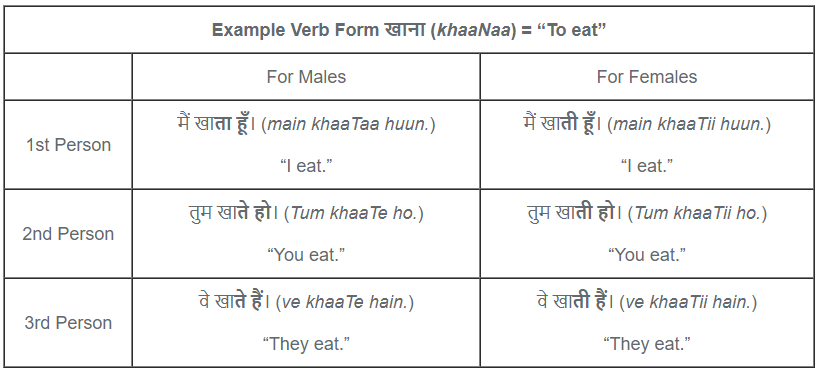
Simple Present Tense
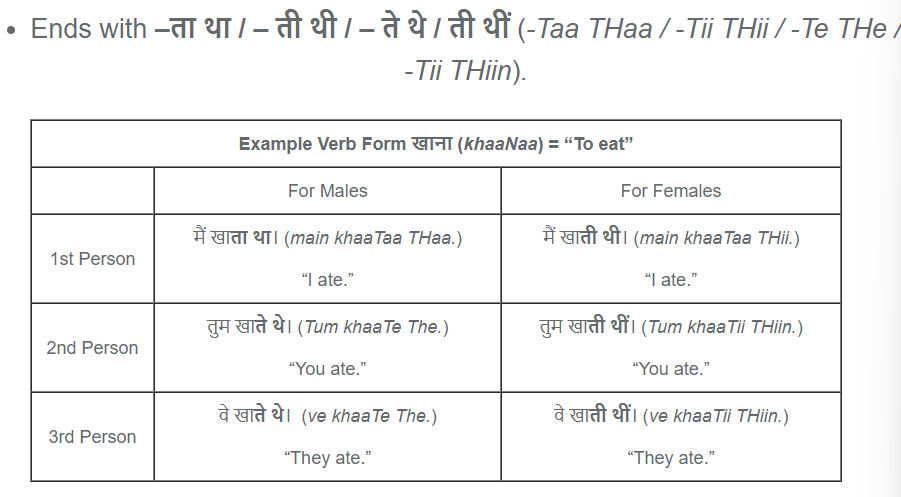
Simple Past Tense
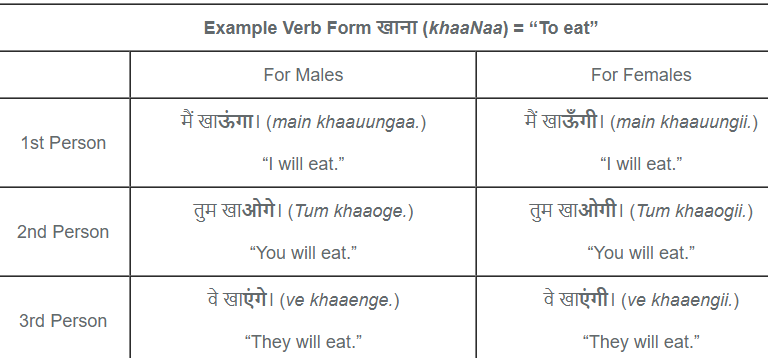
simple Future Tense
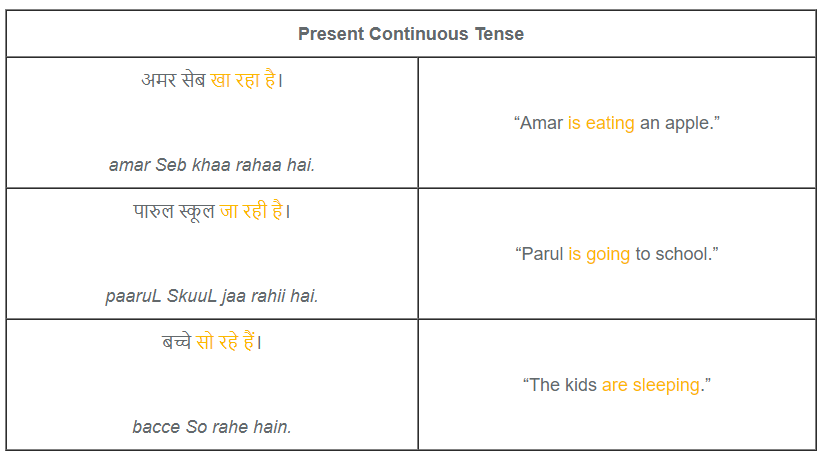
Present Continuous Tense
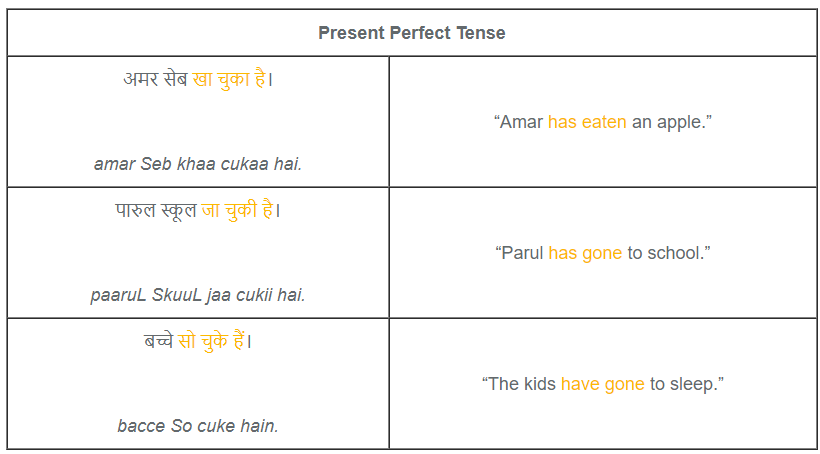
Present Perfect Tense
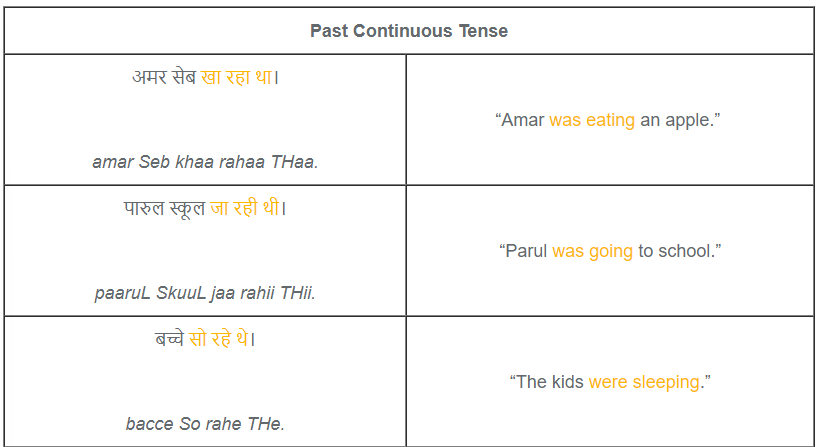
Past Continuous Tense
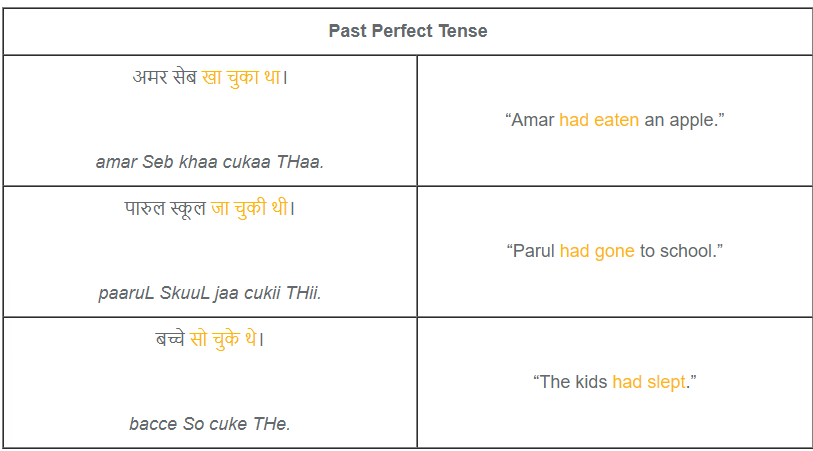
Past Perfect Tense
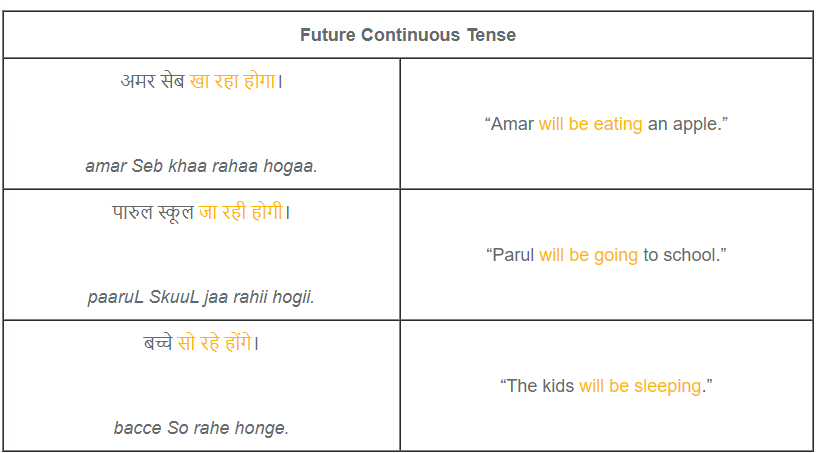
Future Continuous Tense
Verb conjugation for third person
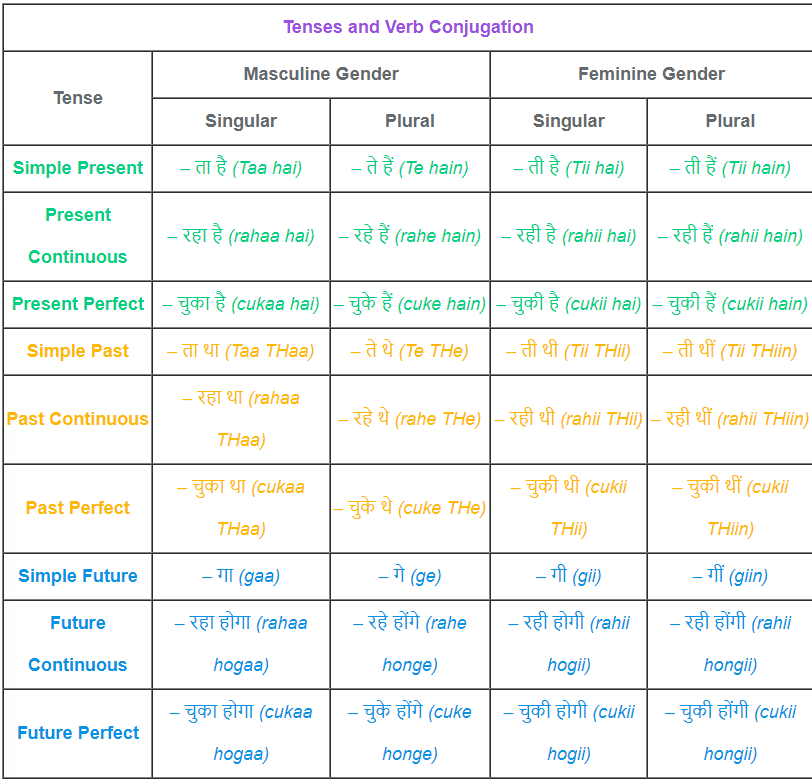
verbs conjugated for the masculine gender always end with an -aa or – e sound.
Verbs conjugated for the feminine gender end with an -ii or -iin sound.
Adjectives
