CH19: ENZYMES & VITAMINS
 Call Kai
 Learn
 Practice Test
 Spaced Repetition
 Match
 Flashcards
 Knowt Play
1/235

Earn XP
236 Terms
______ is the energy associated with a chemical reaction
Gibbs Free Energy (G)
_______ is another word for reactants
Substrates
Transitional state is an ______
intermediate state
Reaction occurrence is determined by the _______-
change in G (gibbs free energy)
Activation energy is the _____
input of energy
GR definition
Free energy of the reactants
G‡ definition
free energy of the transition state; the peak of the energy curve
GP definition
Free energy of the products.
Ea = G‡ - GR explain
Activation energy; energy required for a reaction to occur.
∆G = GP - GR explain
Change in free energy between reactants and products; indicates whether the reaction is spontaneous (ΔG < 0) or non-spontaneous (ΔG > 0) [have to input energy for the rxn to occur!].
Catalyst definition
substance that increases the rate of rxn by lowering the activation energy and is not consumed or changed after catalyzing a rxn
what changes in a catalyzed rxn?
rate increase and G‡ (free energy of the transition state) decrease
what is not changed in a catalyzed rxn?
GR, GP, and ∆G and the catalyst
enzymes definition
Are biological catalysts that within the mild conditions of temperature, pH, and pressure of the cells, carry out biochemical reactions at amazing high rates
Nearly all enzymes are _____and a few are RNA called______
proteins
ribozymes
enzymes are characterized by a remarkable efficiency and _______, meaning that certain enzyme recognizes ________.
specificity (substrate and stereoisomerism)
only certain substances
Some enzymes require non-protein part, called _______ (such as mineral and vitamin) to function.
co-factors
conjugated proteins definition
proteins that incorporate one or more non–amino acid units (co-factor) in its structure (compare to simple proteins)
turnover number definition
the number of substrate molecules converted into product by an enzyme molecule in a unit time - how catalytic activity of an enzyme is measured
the greater the turnover number, the greater the _____
efficiency (more cleaved bonds per second)
papain enzyme reaction catalyzed
hydrolysis of peptide bonds
ribonuclease enzyme reaction catalyzed
hydrolysis of phosphate ester link in ribonucleic acid (RNA)
kinase enzyme reaction catalyzed
transfer of phosphoryl group b/t substrates
acetylcholinesterase enzyme reaction catalyzed
deactivation of the neurotransmitter acetylcholine
carbonic anhydrase enzyme reaction catalyzed
converts CO2 to HCO3-
catalase enzyme reaction catalyzed
decomposition of H2O2 to H2O + O2
enzyme specificity definition
each enzyme works on one or a few substrates only
thrombin enzyme reaction catalyzed
recognizes Leu-Val-Pro-Arg-Gly-Ser peptide sequence and cuts only at the Arg-Gly bond
chymotrypsin enzyme reaction catalyzed
hydrolysis of peptide bonds of a few amino acids: Trp, Tyr, and Phe
carboxypeptidase A enzyme reaction catalyzed
removes the C-terminal amino acid from a wide variety of peptides
Enzymes are specific w/ respects to stereochemistry, which refers to ________
molecules that different only in terms of overall structure shape
If a substrate is chiral, an enzyme usually catalyzes the reaction of ___________
only one of the pair of enantiomers; either L od D but not both
Only one _______ fits the enzyme in such a way that the reaction can occur
enantiomer
An enzyme may require a ______ to function.
cofactor
A _____ is a non-protein part of an enzyme that is essential to the enzyme’s catalytic activity
cofactor
A cofactor can be a ______ or an ________
metal ion (e.g., Mg²⁺, Zn²⁺)
organic molecule (e.g. heme, vitamin)
Myoglobin contains an _______ cofactor, which facilitates oxygen binding and transport
iron-containing heme
Most enzyme have their names end with ______
-ase (enzymes w/out this, were discovered prior to this naming rule)
the first part of nomenclature of enzymes IDs the ________
substrate on which the enzyme operates
the second part of the nomenclature of enzymes is the enzyme’s ________
class name that describes the reaction
aldose reductase function
Catalyzes the reduction of aldehyde to alcohol
aldose reductase requires the vitamin-derived coenzyme ______ to function
nicotinamide adenine dinucleotide phosphate (NADPH)
An enzyme provides its specific substrate with an active site to form an ________ that is necessary for its catalyst properties and the formation of the products
enzyme-substrate complex
_______ lowers the activation energy, in order for the reaction to occur
enzyme-substrate complex
Substrates are the substances (called reactants in chemistry) on which _______
enzymes act upon
Active site is the specific region in an enzyme with the ____ and _____ necessary to bind a substrate and catalyze the reaction.
specific shape
chemical makeup
The shape of an enzyme's active site is _______ to the shape of its specific substrate or substrates
complementary
enzymes provide proximity effect: _______
Bring substrate(s) and catalytic site together
enzymes provide orientation effect: _____
Hold substrate(s) at the exact distance and orientation necessary for the reaction
enzymes provide catalytic effect: _______
Provide acidic, basic, or other types of groups required for catalysis; often involves transient covalent bond formation and breakage
enzymes provide energy effect: ______
Lower the energy barrier by inducing strain in bonds in the substrate molecule
_______ of enzyme triggers the release of the substrate
Shape change
The three amino acids that form the active site of chymotrypsin are not adjacent in its _______
peptide sequence (primary structure)
Chymotrypsin is a protease consisting of ___ amino acid residues
241
active site of chymotrypsin involves only three amino acids: _______ {numbering indicates the distance in the primary structure}
Asp (102) which is positioned close to His (57) and Ser (195)
chymotrypsin’s substrates are specific amino acid residues with ____ side chains in proteins
aromatic
Chymotrypsin is an enzyme that cleaves peptide bonds on the carboxyl side of _____
Phe, Tyr, and Trp (aromatic)
Enzyme-catalyzed reactions begin with _____ into the active site to form an enzyme-substrate complex
migration of the substrate
first step of how enzymes work
substrate anhors to the active site
second step of how an enzyme works
formation of enzyme-substrate intermediate
in an enzyme-substrate interaction, the _______ hold the substrate in place via weak and non-covalent intermolecular forces, while amino acids that could act as ______ carry out the reaction.
nonpolar amino acids
acids or bases
in an enzyme-substrate interaction, it is necessary to ______ by inducing strain in bonds in the unstable intermediate that facilitates the ______.
lower the energy barrier
cleavage
in an enzyme-substrate interaction, the enzyme forms an ______ with the substrate at the transitional state but ______ after the reaction.
intermediate complex
remains unchanged
Two models were proposed to represent the mechanism by which substrates and enzymes interact: ______
lock-and-key
induced fit
in the lock-and-key model, the lock is the ____, and the key is the _____.
enzyme
substrate
Only the correctly sized key (substrate) fits into the keyhole (active site) of the lock (enzyme)
In lock-and-key model, the active site is _____; an enzyme only binds the substrates that _______ its active site. The shape _____ upon the binding
rigid
exactly fit
does not change
The_____ assumes that the substrate plays a role in determining the final shape of the enzyme and that the enzyme is partially flexible
induced-fit model
A change in the conformation of an enzyme in response to substrate binding renders _______
the enzyme catalytically active
_____ promotes an enhanced fit at the active site of the enzyme hexokinase, optimizing enzyme-substrate interactions
Glucose
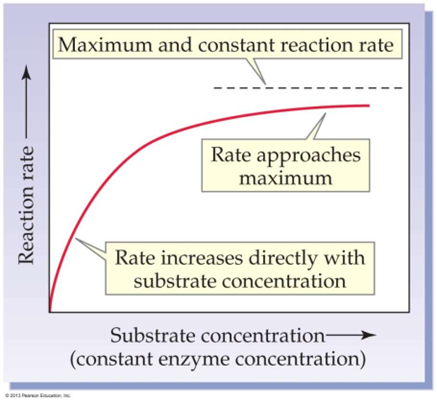
If the amount of the enzyme is kept constant and the substrate concentration is then gradually increased, the reaction velocity will _____
increase until it reaches a maximum
at the point of maximum substrate concentration, increases in substrate concentration will ______
not increase the velocity because all enzymes are in use (plateau occurs).
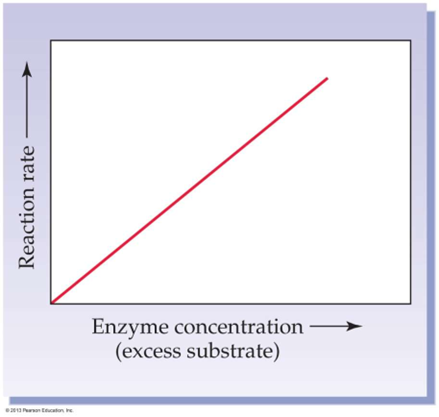
When the substrate is present in an excess amount increases in _______ increases the rate of reaction with a linear relationship
enzyme concentration
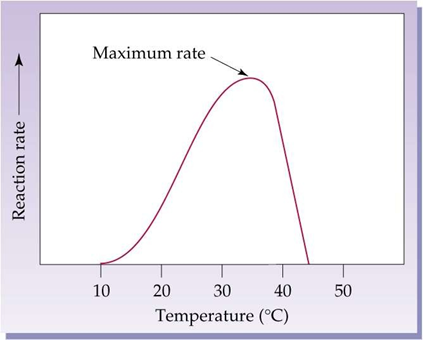
At low temperature, the rate of an enzyme-catalyzed reaction _____ as the temperature is raised
increases
the reaction rate temperature at which enzymes work most optimally within the human body is _____
37C
the reaction rate abruptly declines with further increase of temperature (above 40C) because most enzymes become ________.
denatured
3D structure of proteins is affected by the ______
increasing temperature
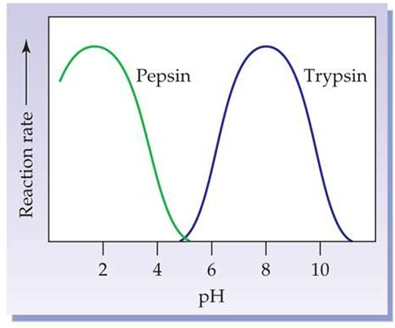
The pH range at which the enzyme is most active is known as the _____
optimum pH
Extremely _______ values generally result in complete loss of activity
high or low pH
Changes in pH alter the charges of ______, results in altered shape and function of enzymes
ionizable groups
The _________ varies from one enzyme to another
optimum pH value
substrate concentration change has what type of graph curve?
hyperbolic curve that plateaus
enzyme concentration change has what type of graph curve?
linear curve
temperature change (enzyme activity) has what type of graph curve?
asymmetrical bell-shaped curve
pH change (enzyme activity) has what type of graph curve?
symmetrical bell-shaped curve
Enzymes are divided into six major classes according to the type of reaction catalyzed:
Oxidoreductases
Transferases
Hydrolases
Lyases
Isomerases
Ligases
oxidoreductases (major enzyme class) function
Catalyze oxidation-reduction reactions of substrate molecules, most commonly by addition or removal of oxygen or hydrogen
Because oxidation and reduction must occur together, these oxidoreductases require _____ that are reduced or oxidized as the substrate is oxidized or reduced, respectively.
coenzymes
major oxidoreductases subclasses:
oxidases
reductases
dehydrogenases
examples of oxidoreductases coenzmes
NADPH and NADH
oxidase enzyme function
use oxygen to oxidize its substrates
reductases enzyme function
add hydrogen atoms to substrates and catalyze reduction
dehydrogenases enzyme function
transfers/remove hydrogens from a substrate to electron carriers such as NAD+ and FAD and catalyze oxidation
product type of oxidase reactions
oxidized product
product type of reductase reactions
reduced product
product type of dehydrogenase reaction
oxidized reaction
common cofactors of oxidase
FAD, FMN, Cu2+
common cofactors of reductase
NADH, NADPH
common cofactors of dehydrenase
NAD+, FAD
oxidase’s electron acceptor
O2
reductase’s electron acceptor
various (not O2)