Math Basics (from Lecture 1)
 Studied by 0 people
 Call Kai
 Learn
Learn Practice Test
 Spaced Repetition
 Match
Match Flashcards
 Knowt Play
1/26

There's no tags or description
Looks like no tags are added yet.
Name | Mastery | Learn | Test | Matching | Spaced | Call with Kai |
|---|
No analytics yet
Send a link to your students to track their progress
27 Terms
what does SOH CAH TOA stand for?
SOH = sin, opposite, hypotenuse → sin() = length of opposite side / length of hypotenuse
CAH = cos, adjacent, hypotenuse
TOA = tan, opposite, adjacent
only applicable for right triangles
pythagorean theorem
a² + b² = c²
where a and b are “straight sides” while c is the diagonal/hypotenuse
only applies to right triangles
properties of equilateral/isoceles triangles
equilateral:
all sides are the same length
all interior angles are 60 degrees
isoceles:
at least two sides are the same length
at least two angles are the same
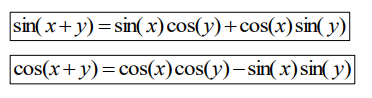
sin and cos addition laws
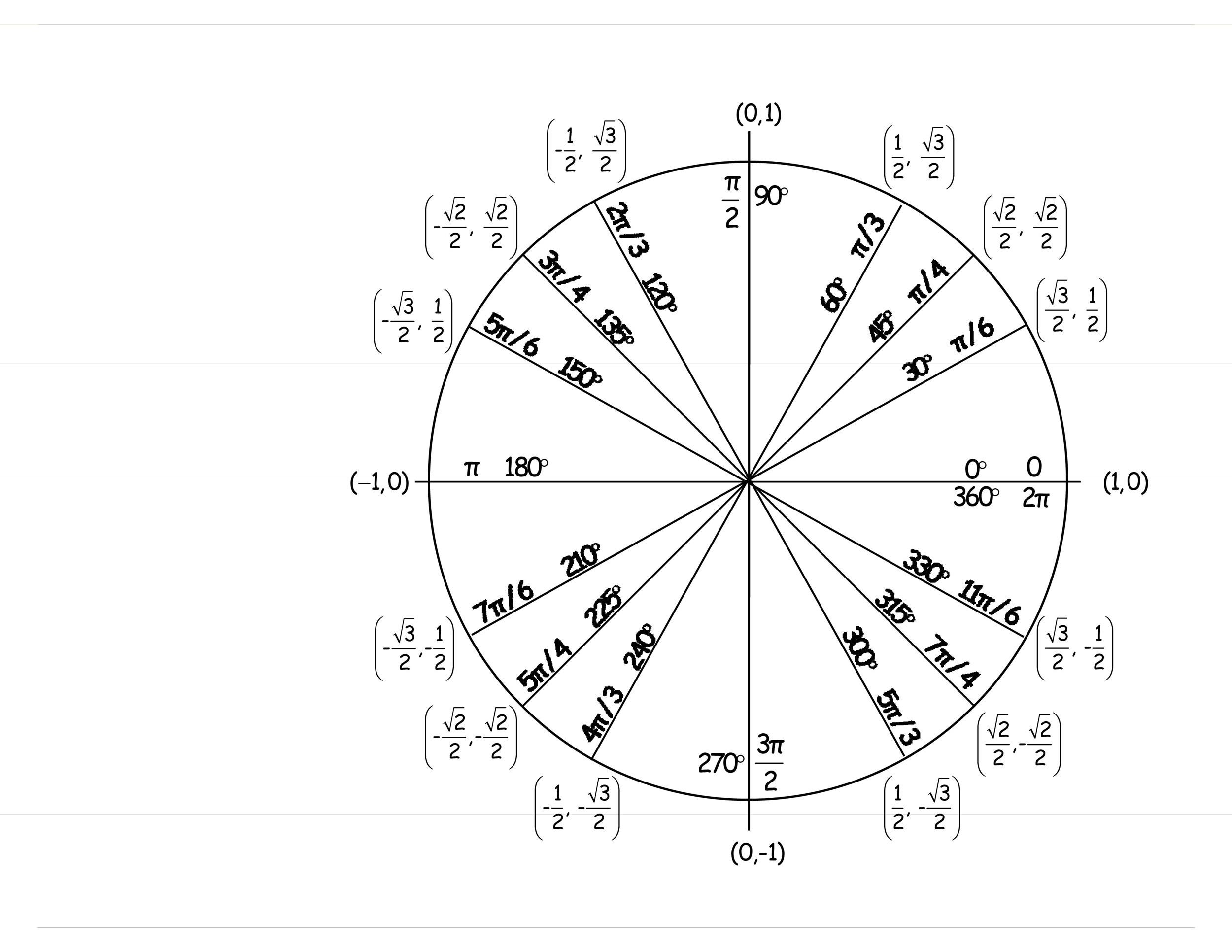
unit circle
ways that a position can be expressed mathematically
cartesian system → (x, y) on the x-axis and y-axis
polar system → (r, theta) where r = dist of the point from the origin, and theta = angle from the pos hori axis
relationship between cartesian coords and polar coords
x = rcos()
y = rsin()
r² = x² + y²
this relationship is best for when an object moves in an arc or circular path on the cartesian plane
vector
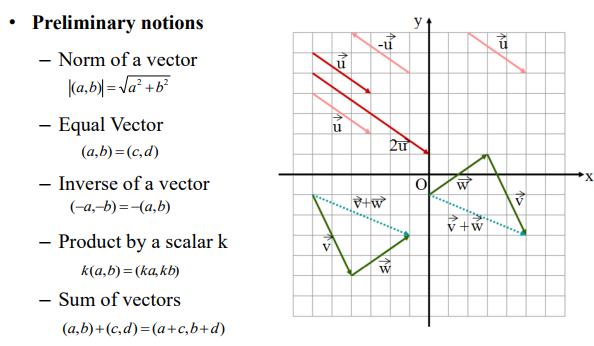
mathematical object representing a physical quantity that has a magnitude (or MODULUS) and direction
can rep position, speed, force, etc
vectors typically look like arrows, with the arrowhead repping the orientation and the length of the arrow repping the modulus (magnitude)
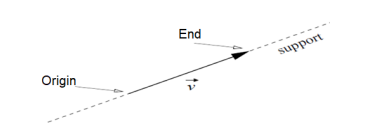
vector notations
you have position/point A = (ax, ay), and position/point B = (bx, by), so you’d find the vector that starts at A and points to B → AB = A - B = (bx - ax, by - ay)
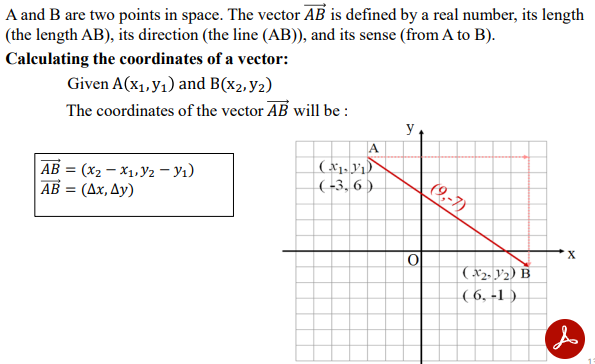
how to calculate scalar magnitude of a vector
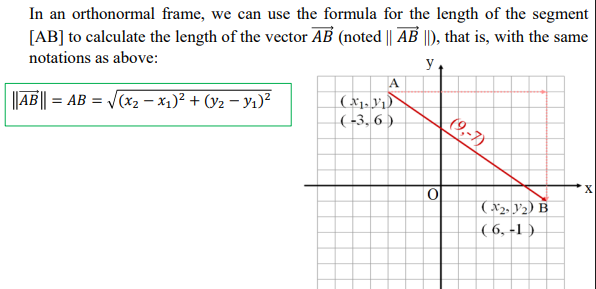
two vecs are equal when:
they have the same dir, sense (measured w the same units), and length
the vector directly opposite to BA =
-AB
(opposite dir, same scalar mag)
vectors addition: triangle method
and solve using geometric analysis
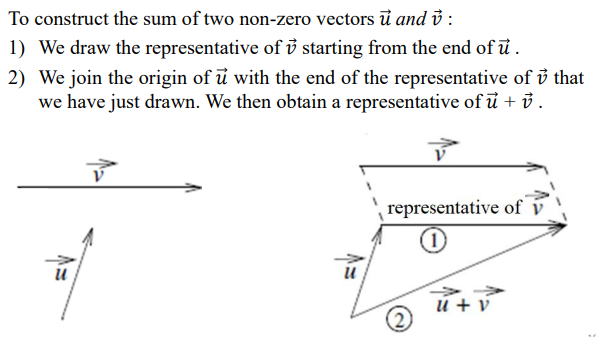
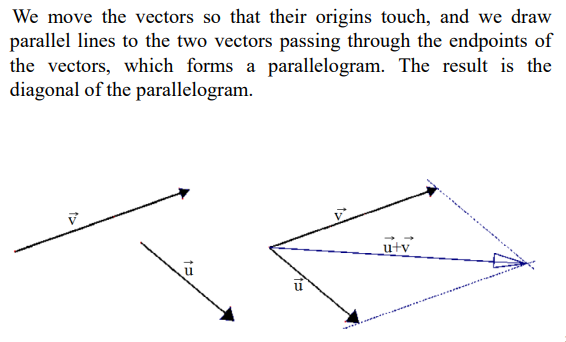
vector addition: parallelogram method
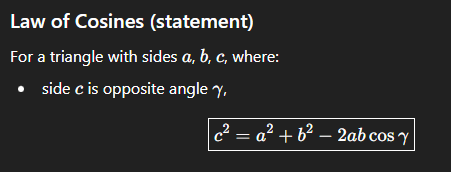
analysis of a triangle: cos law
best for when you have two sides sandwiching an angle
analysis of a triangle: sin law
best for when you know two angles and one side of a triangle
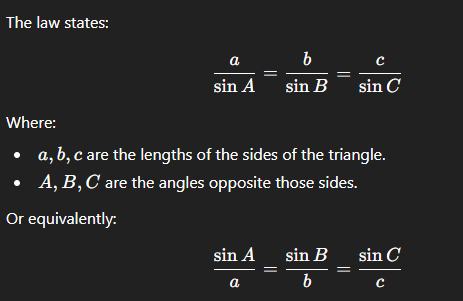
vector addition: general rule
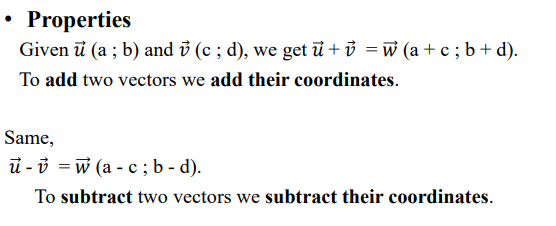
add the x-components and the y-components together to get the resulting vector
if vectors aren’t already given in component form, remember: vec = (vec*cos(), vec*sin()) where the angle is from the pos hori dir
how to extract the direction from a vector:
divide the vector by its norm/magnitude to get the corresponding unit vector
how to approach vector subtraction
always rmbr: a - b = a + (-b), and the “negative” version of a vector is just the same vector but in the opposite dir
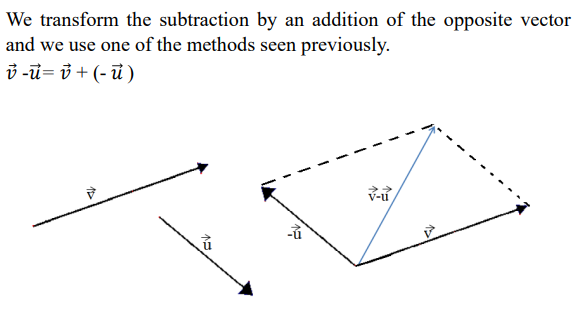
vector algebra: adding or subtracting vectors in component form
component form: v = <3, 4> = 3i + 4j, where i and j are unit vectors in the same dir as the hori axis and the vert axis
preliminary notions of vectors
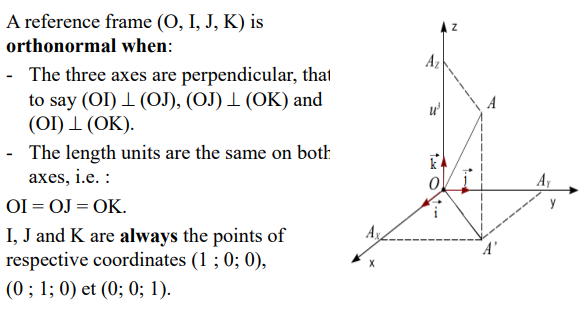
orthonormal reference frame
the 3D cartesion system is an orthonormal ref frame
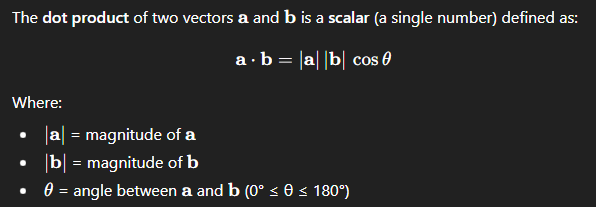
scalar (or dot) product: definition
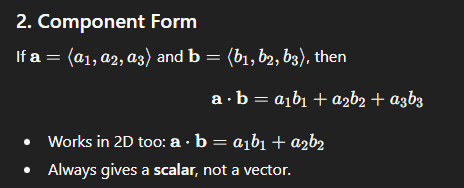
scalar (or dot) product: how to calculate when vecs are in component form
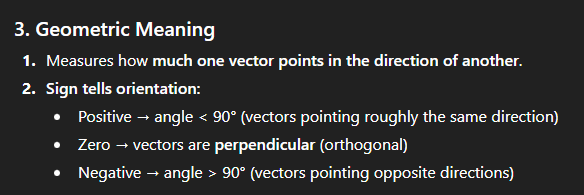
scalar (or dot) product: geometric meaning
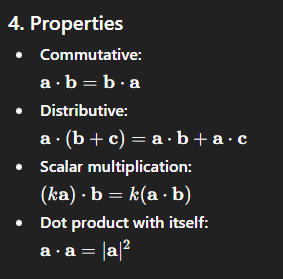
properties of scalar (or dot) product
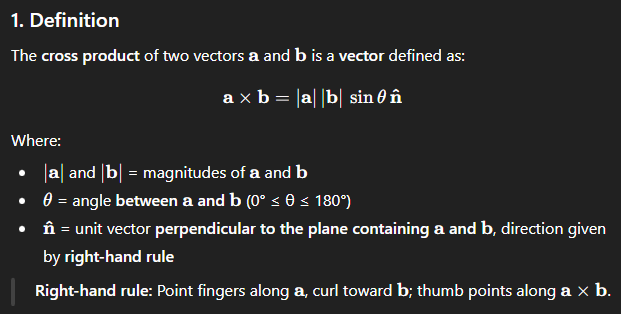
vector (or cross) product: definition
the result of computing cross product with two or three vectors is a vector that’s perpen to both of them
 Note
Note  Flashcards (48)