Hearing Science
 Studied by 0 people
 Call with Kai
 Learn
Learn Practice Test
 Spaced Repetition
 Match
Match Flashcards
 Knowt Play
1/17

There's no tags or description
Looks like no tags are added yet.
Name | Mastery | Learn | Test | Matching | Spaced | Call with Kai |
|---|
No analytics yet
Send a link to your students to track their progress
18 Terms
What is a Formant?
A harmonic that peaks with the highest resonance energy.
What are the pure tone components like in Periodic complex waves?
Harmonics of fundamental frequency
What are the pure tone components like in aperiodic complex waves?
Unrelated to one another and the fundamental frequency. (NO harmonics).
Difference between periodic and aperiodic signals in TIME DOMAIN graph?
Periodic: repeat, symmetrical
Note: Even/uneven spacing of peaks does NOT matter in the Time domain. (See freq)
Aperiodic: don’t repeat, assymetrical
Difference between periodic and aperiodic signals in FREQUENCY DOMAIN graph?
Periodic: have harmonics (evenly spaced spectral lines)
Aperiodic: don’t have harmonics (spectral lines are not evenly spaced/ harmonically aligned)
What does the Fourier Theorem state?
Complex tones are made by adding a bunch of pure tones together.
How to find the harmonic’s frequency based on the fundamental frequency?
Multiply the fundamental frequency with the harmonic number of interest.
Ie) h(3) = (3)(f0)
How to find the fundamental frequency based on harmonic frequencies?
Subtract adjacent harmonic’s frequencies.
F0 = h1 - h2
Divide the harmonic frequency with the # of harmonic.
F0 = hx/x
How to find the fundamental period?
Divide the number of cycles with seconds.
P = cycles/ s
Divide 1 by f0. (Reciprocal/inverse)
P = 1/f0
What is a resonance system? Examples?
Any device or process that produces an output signal in response to an input signal.
Loudspeaker: electronic signal in, sound pressure wave out
Middle ear: sound pressure wave in, mechanical wave out
Guitar string: strum in, vibrations out
Bottle: air in, one frequency out
Free Vibration vs Forced Vibration?
Free Vibration: Has no external forces acting on the system.
Ie) Guitar string
Forced Vibration: External force is needed to continue vibration.
Ie) Speech (airflow has to come through), pendulum???
What is the Characteristic frequency? What does it cause?
The frequency at which an object resonates/ vibrates maximally (based on their size, shape, and density).
Causes resonance.
Amplification
When a frequency gets louder as they approach the resonant frequency (CF).
Attenuation
When frequencies get quieter as they move further away from the resonant frequency (CF).
*What do filters do?
*What is the Mass-spring model?
Represents sin wave.
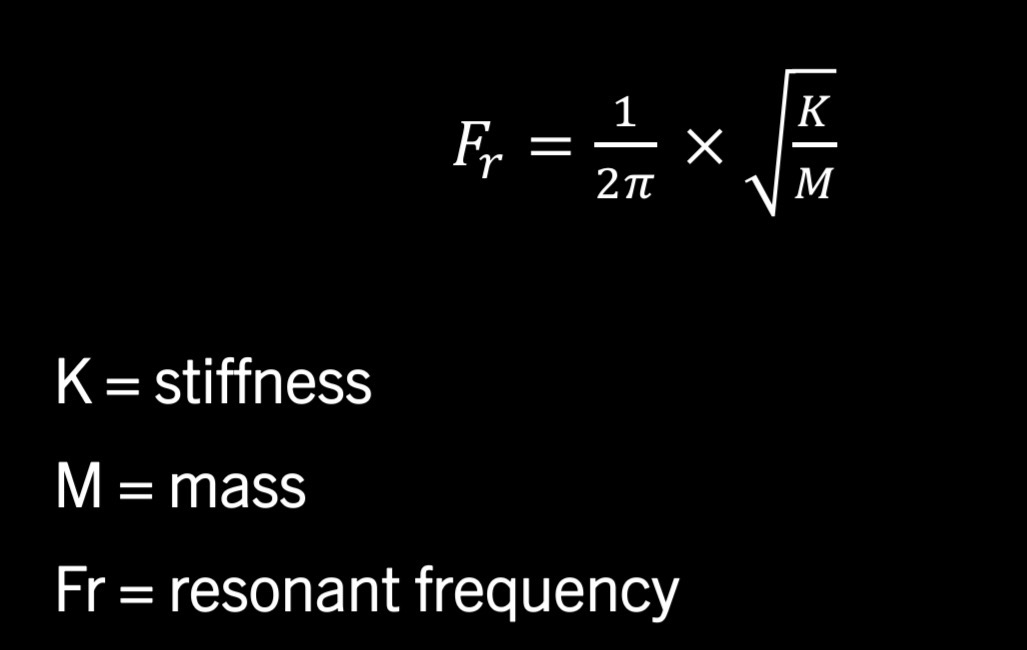
Formula to calculate a system’s resonant frequency (based on it’s mass + stiffness)?
How do changes in stiffness change the frequency? How do changes in mass change the frequency?
How do changes in stiffness change the frequency?
Stiffness increases —> frequency higher
Stiffness decreases —> frequency lower
How do changes in mass change the frequency?
Mass increases —> frequency higher
Mass decreases —> frequency higher
 Note
Note  Flashcards (22)