Creams, ointments and other topical treatments for the skin
 Studied by 0 people
 Call with Kai
 Learn
Learn Practice Test
 Spaced Repetition
 Match
Match Flashcards
 Knowt Play
1/58

There's no tags or description
Looks like no tags are added yet.
Name | Mastery | Learn | Test | Matching | Spaced | Call with Kai |
|---|
No analytics yet
Send a link to your students to track their progress
59 Terms
What does topical mean?
-applied to any external body surface for a localised effect
What must all topical treatments be labelled stating?
‘‘for external use only’’
Give 3 advantages of giving treatment topically/locally on the skin
• To enhance barrier function of the skin
• Targeted delivery to specific layers of the skin e.g. fungal infections are in the outermost part of skin but for eczema need to deliver drugs deeper into the skin
• Better to give a topical formulation to treat the skin as fewer side-effects compared with oral delivery of drugs
Give 5 different topical formulations that can help protect skin from environment
• Sunscreens
• Antibiotics
• Emollients
• Moisturisers
• Barrier creams
What are sunscreens for?
-protect against UV radiation
What are topical antibiotics for?
-abrasions to protect them from infection
What are emollients for?
-adds moisture to improve dry skin conditions
What do moisturisers do?
-give moisture to protect against drying atmospheric conditions
What do barrier creams do?
-they prevent exposure of skin to harsh chemicals (e.g. good for hair stylists)
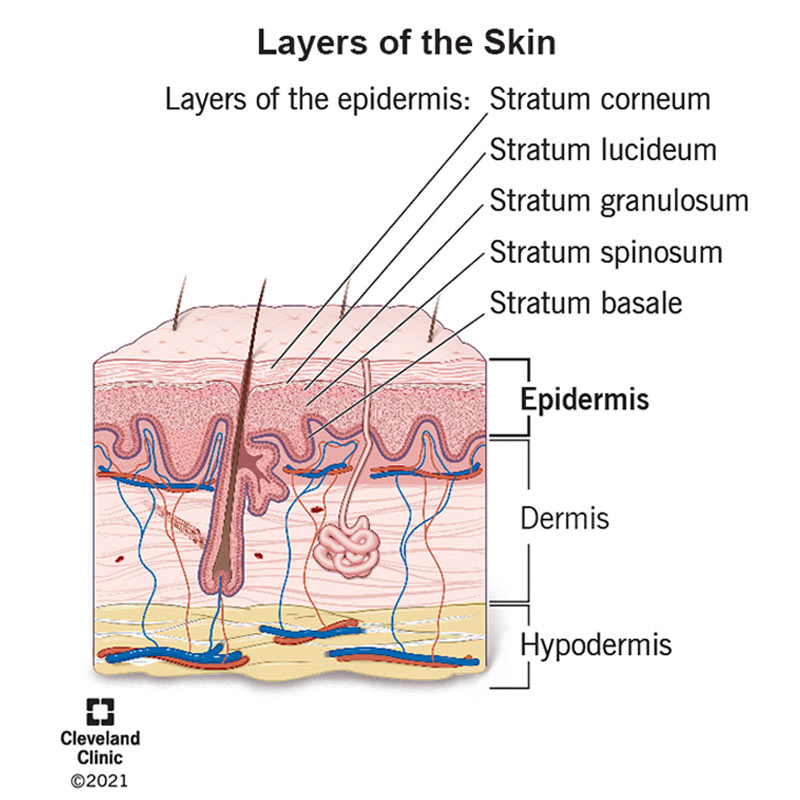
What are the 3 main layers of the skin?
epidermis=outer layer
dermis=below epidermis
subcutaneous layer/hypodermis
What is the outer layer of the epidermis called?
stratum corneum
Which layer of the skin are blood vessels present in?
-the dermis but not the epidermis
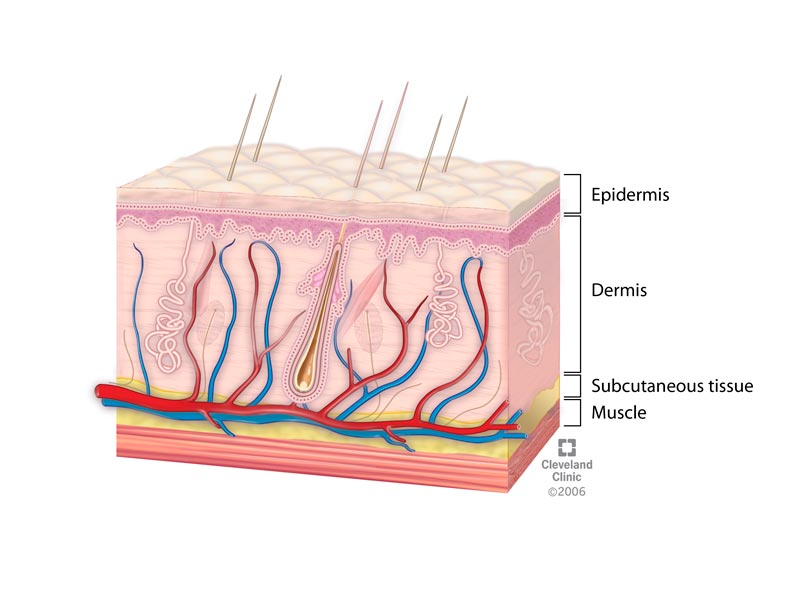
Which layer of the skin do sweat glands, hair follicles and sebaceous glands originate from?
present in hypodermis and dermis (but just say dermis)
-the hair follicles puncture the epidermis
What is the subcutaneous layer? Give an example of an area of the body that doesn’t have a thick subcutaneous layer
-fatty tissue that acts as a ‘‘cushion’’ for the skin
-eyelids and under the eyes
Which layer of the skin do skin cells begin life?
-stratum basale layer (deepest layer of epidermis)
Which is an easier target, above or on the skin OR below the skin surface or into the skin?
below the skin surface or on the skin
What is percutaneous absorption?
-crossing the stratum corneum, which is the type of absorption needed if you want the epidermis or dermis to be targeted
Give examples of topical dosage forms
-topical solutions
-shampoos/soaps
-powders
-tinctures
-aerosols/foams
-topical patches
What is an occlusive topical treatment? Why is it good? When can it be bad?
-the formulation prevents water movement out of the body. So, increases skin hydration and moisture content. Also, it enhances the skin barrier because it creates a shield on the skin. (exactly like vaseline and tret)
• Good for dry skin but bad for infected skin because it can create an environment for bacterial growth. But, having dry skin+ bacteria infection is also bad. Also bad because if you put harsh product on first and then occlusive, skin will hydrate and absorb more of the harsh chemical
• Good penetration of drugs through the skin because skin is more hydrated
What are ointments?
-class of topical formulation
-semisolid preparations used on the skin or mucous membranes externally
-2 types
What are the 2 types of ointments?
Hydrocarbon ointments.
Water-soluble ointments
What are hydrocarbon ointments?
-composed of hydrocarbons e.g. petroleum and hydrophobic oils.
-Soft paraffin is the most common ingredient in these ointments but liquid paraffin (mineral oil) or hard paraffin can be used to thin or thicken formulation as needed.
-Other types of oils may be found in hydrocarbon ointments such as: vegetable oils e.g. castor, olive synthetic oils e.g. silicone oils (used as water repellents)
What are the 2 types of soft paraffin?
yellow petrolatum (petroleum jelly)
white petrolatum (white petroleum jelly). Has been bleached to remove yellow colour dye from original Vaseline as some people are allergic to it
Give 3 advantages and 2 disadvantages of hydrocarbon ointments
• Occlusive, so hydrates skin
• Emollient - Hydrate skin due to moisture accumulation.
Good if drug not stable in water
• Difficult to remove, just water does not work
• Greasy
When it comes to water-soluble ointments, how can we control the melting point of the ointment?
-mixing short and long-chain polymers. The longer the chain length of the polymer, the higher the melting point of the ointment
Give 2 advantages and 1 disadvantage of water-soluble ointments
• Washable more easily than hydrocarbon ointments
• Non-greasy
• Non-occlusive or not as occlusive as hydrocarbon ointments so they do not lock water in as well as hydrocarbon ointments
What are pastes?
-Ointments with 20-50% of solid material, so are stiffer than ointments
ortho para, ointment paste
Give 3 advantages of pastes
- Good protective barrier, acts as skin barrier
• occlusive, especially oil-based pastes, therefore prevents dehydration
• Pastes are used to prevent nappy rash – absorb ammonia from break down of urine. Pastes hard to wash off, which is good and bad
What are creams and how do they work? What do all creams have and why?
-semi-solid emulsions
-Two phases, oil phase and a water phase.
• Either oil in water (O/W) or water in oil (W/O) so Oil droplets suspended in water or water droplets suspended in oil
• emulsifiers to keep the droplets suspended
What 2 things must be added to creams always?
-emulsifiers
-preservatives to stop contamination because water is present in creams
What are the most common type of creams for drugs?
O/W creams
Give 3 advantages and 1 disadvantage of creams
• Good patient acceptability
• Spread easily because nicer consistency and less thick, greasy feel on skin
• For O/W creams, water evaporates to leave a thin “film” on the skin
Disadvantage:
- Not as occlusive as ointments. Occlusion alone may damage skin barrier function. Applying chemicals/drugs under occlusion can increase the penetration of chemicals and antigens into the skin, increasing dermatitis.
Give 4 examples of a w/o emulsifier. State a disadvantage of one of them
-wool fat (lanolin)
-Wool alcohols (lanolin alcohols)
-Hydrous wool fat (hydrous lanolin) is 7 parts wool fat, 3 parts water
-beeswax
-comes from animal
Why are wool alcohols better than wool fats? (2)
-It is richer in cholesterol and lanosterol
-freer of impurities than wool fat
Give an advantage of hydrous wool fat
it is softer than wool fat or wool alcohols
What are 3 types of o/w emulsifiers (i.e. emulsifying waxes) and what do they all have in common?
• Emulsifying wax BP contains sodium lauryl sulphate and CSA (1:9)
• Cetrimide emulsifying wax BPC contains cetrimide and CSA (1:9)
• Cetomacrogol emulsifying wax BPC contains cetomacrogol 1000 and CSA (8:2)
-• Each one has two ingredients – cetostearyl alcohol (CSA) and a surface active agent (i.e. surfactant)
What is the purpose of emulsifying waxes?
-to create and stabilise o/w emulsions, commonly found in lotions, creams, and other cosmetic products
What type of emulsions do low HLB materials produce?
w/o emulsions
high produce o/w
Why are co-solvents added sometimes?
because the drug or one of the main ingredients (API) is poorly soluble
A preservative added indicates… is in the formulation
water
What are lotions? Give 3 advantages and 1 disadvantage of them
-liquid topical formulations, usually emulsion or suspension
-Low viscosity so lotions spread very easily and they are easy to apply
-Dry on skin quickly after application
-Good if drug not stable in water
-stability issues
phenol in lotion. Why could this be?
-antibacterial agent
What are liniments? Describe them
-A lotion with oils
• Similar viscosity to lotions but rubbed in with pressure
• May contain methyl salicylate or other materials which act to relieve pain and stiffness
Why may powders be used as topical treatment?
fine powder used!!
for a surface effect such as drying or lubricating or for an antibacterial or antifungal action
What are tinctures/paints?
-Alcohol based solutions. Used to dissolve large amounts of drug particles
What are gels? What do they require? How do gels look?
-Solid or semisolid preparations. Gels are a dispersion of liquid within a solid where the solid is the continuous phase and the liquid is the disperse phase
-• Require a gelling agent. Gelling agents used can be natural or synthetic. Example of natural gelling agents is pectin, cellulose. Examples of synthetic gelling agents include synthetic polymers e.g Carbomer
-• Gels are usually transparent or translucent (semi-transparent)
-very similar to creams but in creams they are liquid
Why are gelling agents used?
-The gelling agent forms a cross-linked network in liquid in order to give the gel structure, thickness, and stability
What are hydrogels? How are they formed?
-gels where the liquid component is water and majority of the gel is water.
- formed by a hydrophilic polymer swelling in water. When the hydrophilic polymer is placed in water, it soaks up the water and expands. This swelling process creates the gel structure. e.g. like water beads
What are carbomer gels? How do they form?
•gels
• add carbomers, which are polymers and gelling agents that form a low viscosity dispersion with an acid pH in water. Alkali and amine added to neutralise the dispersion, which creates a gel
Why is ethanol commonly used in alcohol creams?
-dries up oil and it’s a very good antibacterial
What are collodions and what are they used for?
• Sticky liquid which dries to a film
• Used as a skin protectant, applied to the skin to close small wounds, abrasions, and cuts, to hold surgical dressings in place, and to keep medications in contact with the skin.
Why aren’t sunscreens formulated as ointments? Give 4 reasons why
-Greasy and Heavy Feel – Ointments tend to leave a thick, oily residue on the skin, which can feel uncomfortable, especially in hot and humid conditions.
Poor Spreadability – Sunscreens need to be spread evenly over large surface areas. Ointments are more difficult to spread compared to lotions, creams, or gels.
Reduced Breathability – Ointments form an occlusive barrier, which can trap heat and sweat, making them uncomfortable for outdoor activities.
Aesthetic Issues – The greasy nature of ointments can leave a shiny or sticky appearance on the skin, which many users find unappealing.
Why would it not be appropriate to formulate fungal infection treatments as ointments?
-• Fungal infections reside in the stratum corneum so need to deposit the antifungal drug in the outer layers of skin not in deeper layers, so again, ointment not appropriate. Formulating as an ointment would be a waste as we only want it on surface not deeper in the skin
Why would ointments be good for inflamed skin?
-• Inflamed skin often associated with problems in skin barrier so ointments good as they are good for skin barrier
Give a comparison between topical delivery and transdermal delivery
• Topical delivery does not aim to get the drug into the bloodstream. Transdermal delivery does aim to get the drug into the bloodstream
Give 2 benefits of topical and transdermal delivery
Transdermal delivery avoids the problems associated with oral delivery (break down in the stomach and gut)
• Is associated with better patient compliance
What are transdermal patches?
• Adhesive patch placed on the skin to deliver medicine all the way through the skin and into the bloodstream
Give 2 limitations of transdermal gels/patches
• Skin is good barrier and therefore large amounts of drug cannot permeate
. • Maximum daily dose ~ mg per day (can’t give specific number as everyone’s skin is different). Maximum attainable flux across the skin therefore important.
-may not stick properly
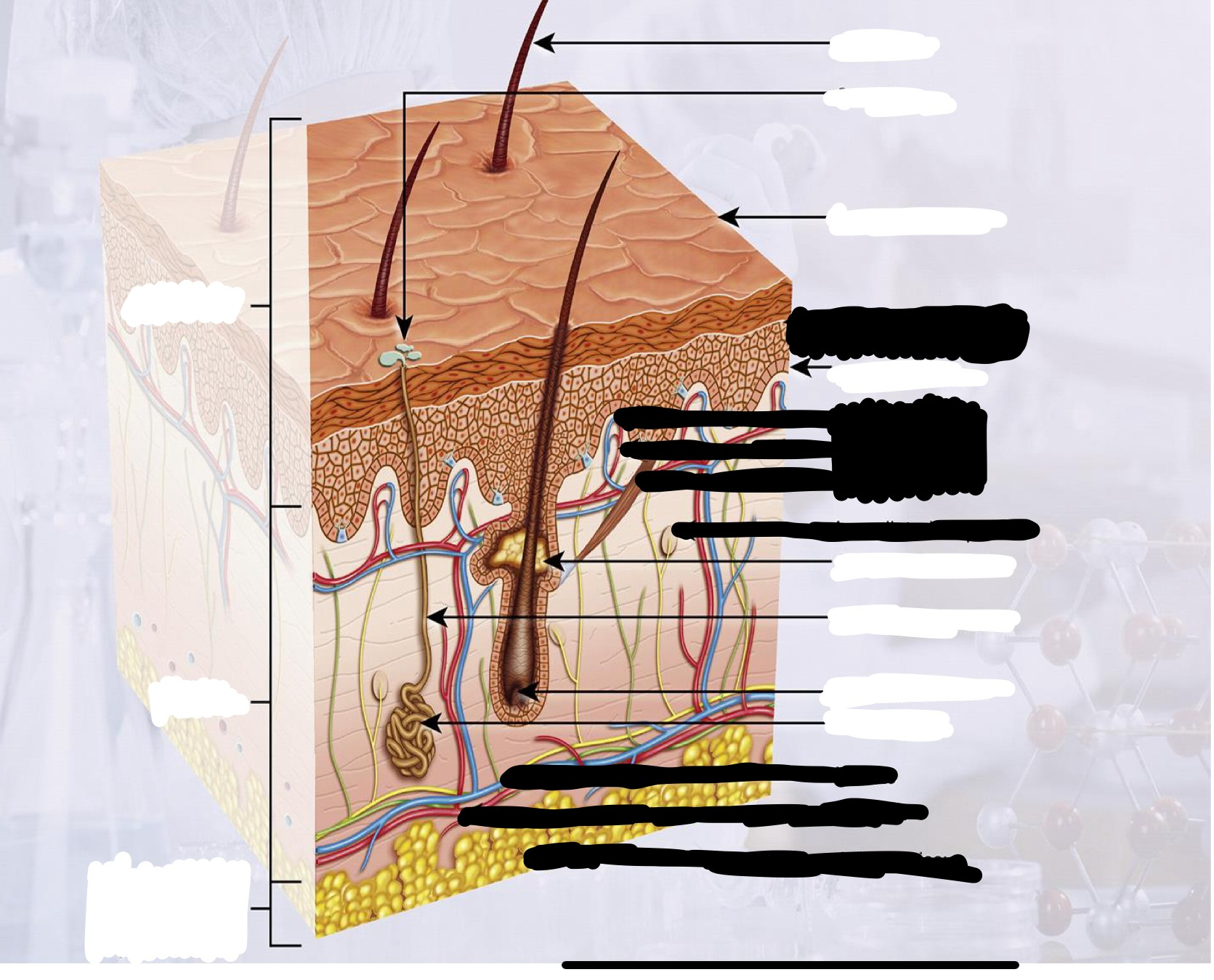
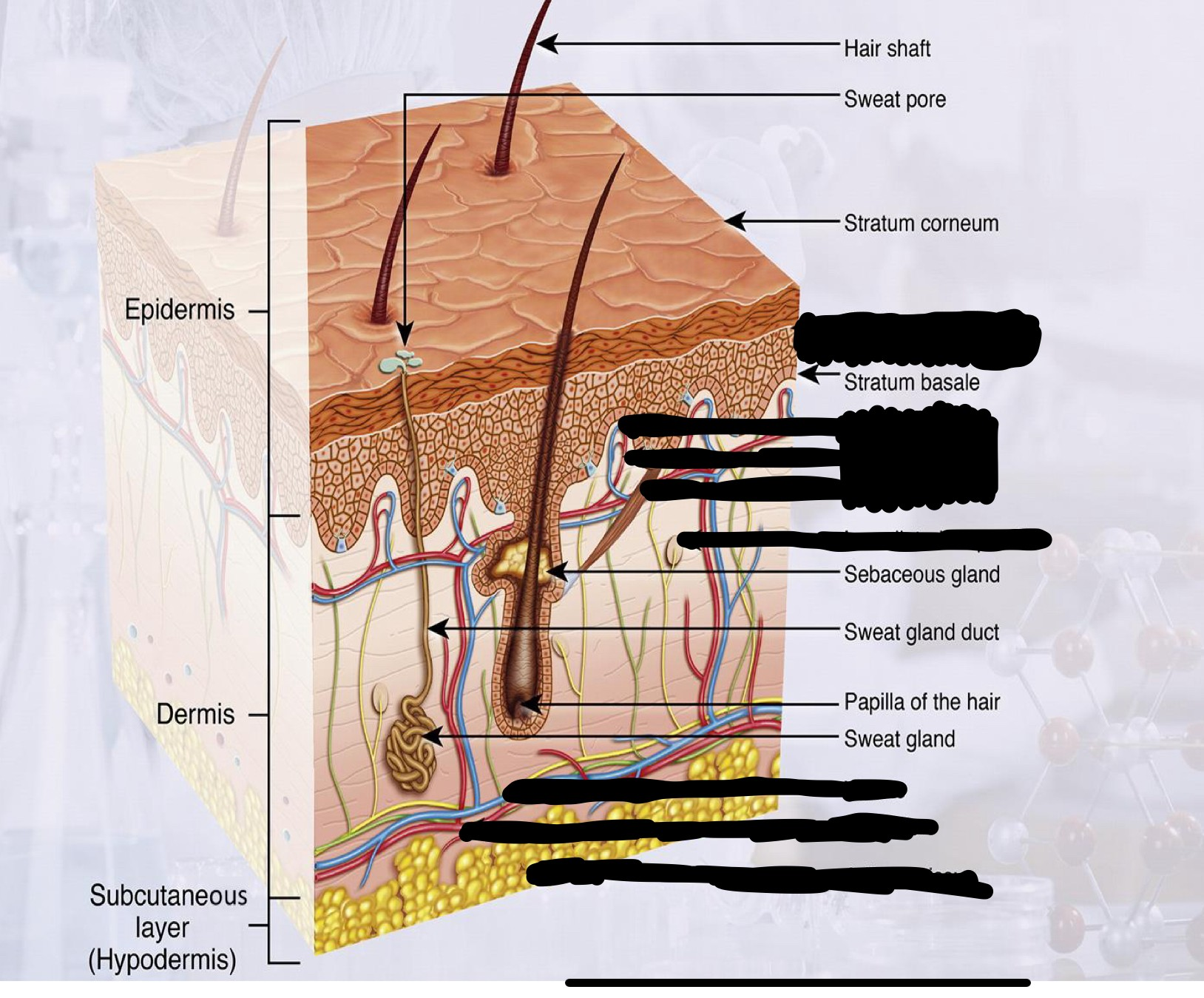
Identify everything in white
stratum corneum is outermost layer of skin
 Note
Note  Flashcards (31)