NSCI 201 - Language
 Call Kai
 Learn
Learn Practice Test
 Spaced Repetition
 Match
Match Flashcards
 Knowt Play
1/24

Earn XP
Description and Tags
Name | Mastery | Learn | Test | Matching | Spaced | Call with Kai |
|---|
No analytics yet
Send a link to your students to track their progress
25 Terms
areas that speech-language pathologists might help with
-alternative and augmentative communication
-voice
-stroke and aphasia
-early detection for diagnosis
why cannot mice or rats be used for language models
they have unlearned vocalizations and learning is not a huge component in their communication
species that have a learning component in their language
songbirds, chimpanzees, bonobos
vocalizations of white-crowned sparrows (WCSP)
-only males sing
-only one song type for their whole lifespan
-learned = song
-unlearned = call
-used for mate attraction and territory defense
Peter Marler’s hypothesis for the different songs from 3 different regions
the different songs from the different regions are learning differences, not genetic (innate) differences
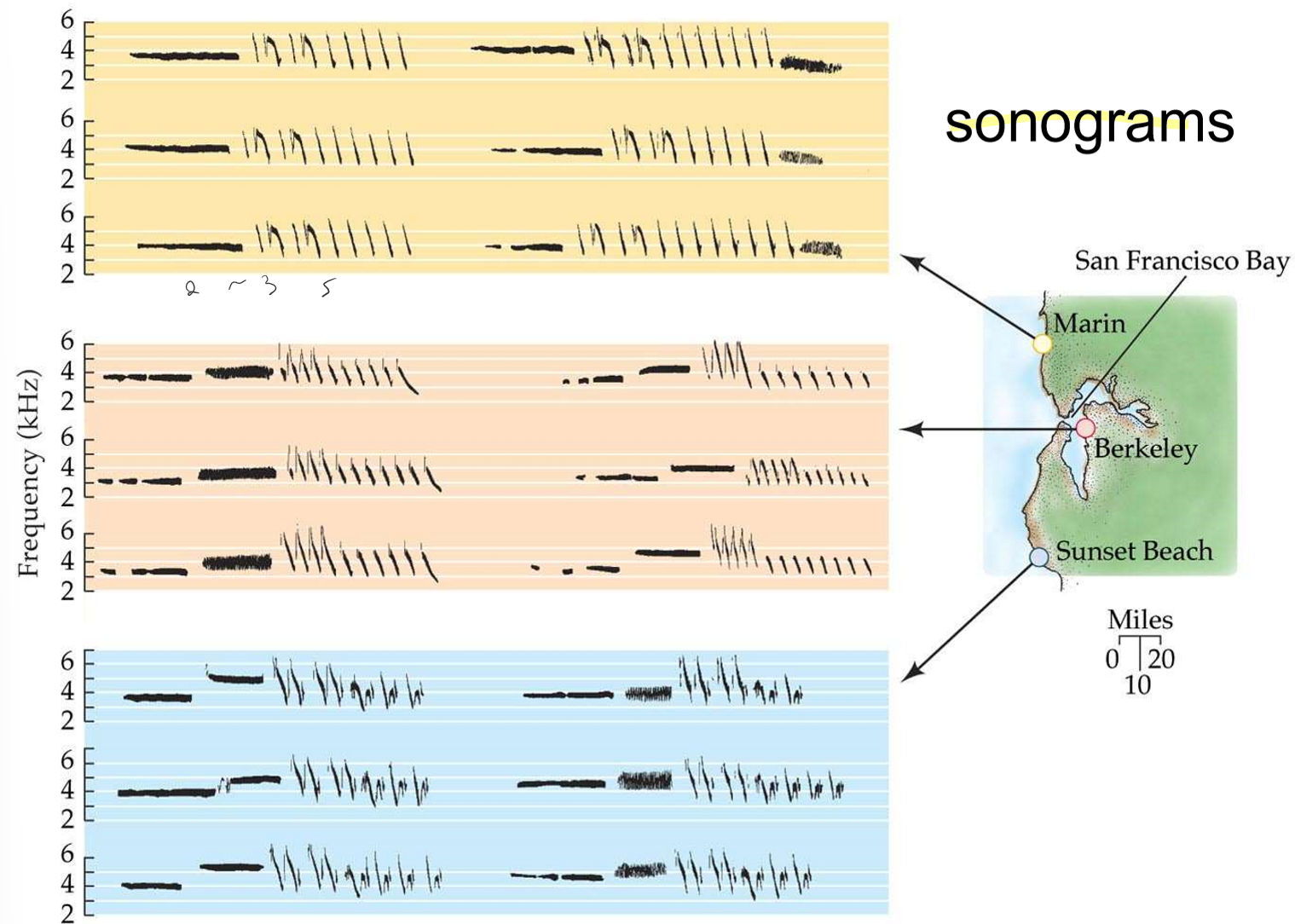
Peter Marler’s isolation experiment
-collected eggs from nests in the 3 different areas
-raised male WCSP in soundproof chambers in lab
result: isolate songs that did not resemble normal WCSP were produced at 150 days of age
what do the results of Peter Marler’s isolation experiment show us
-importance of learning is shown
-can see basic similarities, genetic causes (innate)
→ final songs are an interaction between learning and genetics
what do the results of Peter Marler’s tape tutoring experiments show
tutored young WCSP sang good copy of taped song, regardless of dialect → strong evidence for learning
tutoring was ineffective after 50 days old → critical period for learning exists (gene interaction)
heterospecific songs were ineffective → preference caused by genes
what are the two main neural circuits that songbirds have
production -HVC is important, high order of motor control
learning → forebrain areas are important, lesions in the young impair production
traits of chimpanzee communication
use language but rarely use symbols in new combinations
-main goal is to request, not describe
traits of bonobos communication
-show better comprehension and use of language than chimpanzees
-requests items that are not currently visible
-use symbols to describe past events
-make original, creative requests (more developed on the productivity aspect)
human language development in early years
-a sensitive period, critical period, exists for the learning of language
-lack of language exposure in early life can lead to permanent impairment
learning a second language
-differs as a function of age
-children are better at learning pronunciation, grammar while adults are better with vocab
learned before 6 years: bilateral activation in brain for both languages
learned after 6 years: unilateral activation for both languages, generally left hemisphere
functional magnetic resonance imaging (fMRI)
-indirect measure of neuronal activity like c-fos
-glucose and oxygen flows towards activated areas
→ measures flow of oxygenated blood in the brain
deaf children and language learning
-those who began sign language while young learned much better
-not learning any type of language while young impairs ability to learn language later
neural mechanisms for language
-the areas used for language are also necessary for other tasks (memory, music perception)
-case studies of patients with brain damage are very useful (aphasia)
aphasia
sever language impairment
Broca’s area
part of left frontal lobe near motor cortex
-found in 1865, first case to pinpoint certain brain area for symptoms
Broca’s aphasia
-aka nonfluent aphasia
-severe impairment in language production
-can be caused by trauma or infection
-for spoken, written, and sign language
-omission of most pronouns, prepositions, conjunctions, etc. → difficulty understanding grammar
-language comprehension intact except when sentence has unusual word order or depends on prepositions
-intelligence remains intact most of the time
Wernicke’s area
part of left temporal lobe near the auditory cortex
Wernicke’s aphasia
-aka fluent aphasia
-severe impairment in language comprehension and ability to remember the names of objects
-poor language comprehension, especially written and sign language
-fluent/articulate speech (except pauses to find the right word)
-anomia
anomia
difficulty recalling the name of objects
mechanism of brain-computer interface (BCI) developed by Edward Chang at UCSF
electrical impulses firing across the motor cortex are collected and transmitted to a computer, where language-prediction algorithms would decode them into words and sentences
how well did the neuroprosthesis (BCI) developed by Chang’s team work in 2019
the algorithm corrected constructed sentences from a 50-word vocabulary with 75% accuracy
what are some challenges with brain-computer interfaces
-many different brain regions are involved in language, too vast to create recording techniques and decode
-signals are produced by thinking about saying words, tend to be weaker and more noisy
-long term chronic use: deeper, surgically embedded electrodes can increase accuracy with individual neurons but corrosive salty fluid in brain creates risk of inflammation or infection during operations

