Module 12 – Strategic Behavior
 Studied by 0 people
 Call Kai
 Learn
Learn Practice Test
 Spaced Repetition
 Match
Match Flashcards
 Knowt Play
1/60

There's no tags or description
Looks like no tags are added yet.
Name | Mastery | Learn | Test | Matching | Spaced | Call with Kai |
|---|
No analytics yet
Send a link to your students to track their progress
61 Terms
Game theory
the study of how people and firms behave when their actions affect others’ payoffs
Strategy
a complete plan of action a player will follow in a game
Payoff
the outcome or reward from a given combination of strategies
Simultaneous-move games
players choose strategies at the same time without knowing what the other will do
Dominant strategy
a strategy that gives a player a higher payoff no matter what the other player does
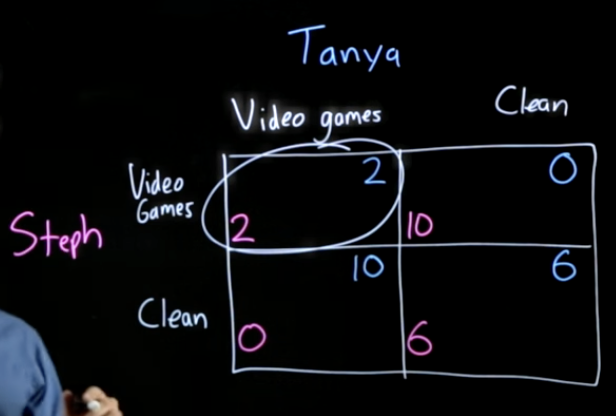
Prisoner’s Dilemma Example
Two friends decide whether to clean or play video games.
Both playing games → low payoff; both cleaning → higher payoff.
Each has incentive to avoid cleaning, so equilibrium ends up with both slacking.
Dominant strategies can lead to
outcomes that are individually rational but socially inefficient
Nash Equilibrium (NE)
a set of strategies where no player can improve their payoff by unilaterally changing their decision
Each player’s choice is the best response to the other’s choice
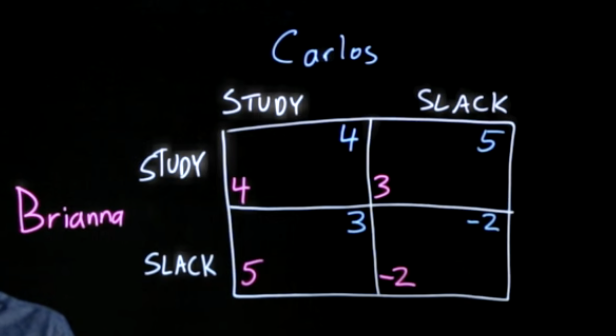
Nash Equilibrium Example (Brianna & Carlos)
deciding whether to study or slack off.
Two Nash equilibria: one studies while the other slacks.
No player has an incentive to switch given the other’s action.
Multiple equilibria
Sometimes, games have more than one NE, leading to coordination problems
No equilibrium
In some games, there’s no stable solution (players keep switching strategies)
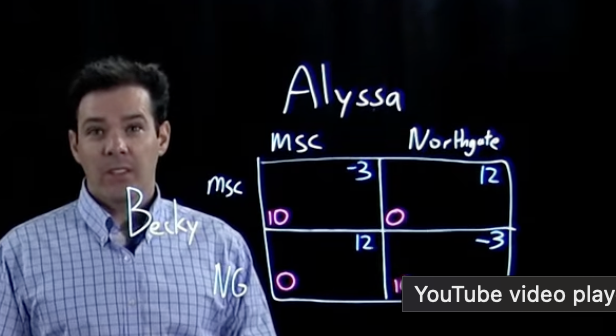
No equilibrium example
Alyssa wants to avoid Becky, Becky wants to follow Alyssa → endless switching, no NE
Nash equilibrium shows stability
not necessarily fairness or efficiency
Nash Equilibrium Example (Yolanda & Zack)
both choose between MSC and Northgate.
Preferences differ, but both want to be together.
Checking each outcome shows Northgate/Northgate is the Nash equilibrium — neither wants to move given the other’s choice
In any game matrix
Identify each player’s best response for each possible action of the other.
The square where best responses intersect is the Nash equilibrium.
Larger games
For games with 3+ strategies, the method is the same — just more options in the matrix
Nash Equilibrium Key Rule
If no player can improve their payoff by switching strategies alone → equilibrium achieved
Sequential-move (extensive-form) games
one player moves first, and the other moves after observing that choice
Game trees
diagram that represents the order of moves, possible strategies, and payoffs
Backward induction
solving the game starting from the last mover’s decision
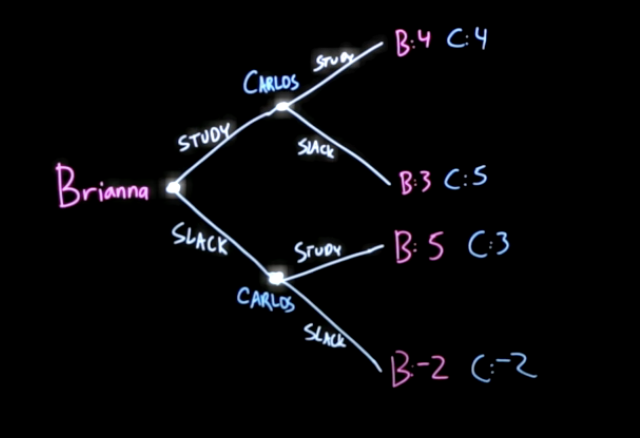
Backward induction Example (Brianna & Carlos)
Brianna moves first; Carlos responds.
Carlos’s best responses: if Brianna studies → he slacks; if Brianna slacks → he studies.
Brianna anticipates this and chooses to slack, while Carlos studies.
Outcome: Brianna (5), Carlos (3) → Nash equilibrium.
First-mover advantage
the first player can shape outcomes to their benefit
Sequential Games Applications
business entry, lending decisions, reputation-building
A “tough reputation”
deters competitors or challenges
Repeated games
same players interact multiple times, allowing reputation and trust to matter
Cooperation
can emerge if players value long-term benefits
Reputation effects
If a player cheats now, future partners may avoid them
Reputation effects examples
Restaurants maintain quality because they want repeat customers
Communication
talking helps coordinate expectations; lack of it can cause misunderstanding or conflict
Social distance
closeness increases cooperation — people trust those similar to them (e.g., Aggies with Aggies)
Dr. Ragan Petrie’s experiment
Showing participants photos of others increased public good contributions by one-third
Social norms
informal rules that govern acceptable behavior
Fairness and the Ultimatum Game
Player 1 (Vince) offers how to split $10 with Player 2 (Rochelle).
Rochelle can accept or reject; if she rejects, both get $0.
Traditional model predicts Rochelle should accept any positive amount, but in practice, offers below 25% are often rejected
Fairness matters
people gain utility from treating others well and punishing unfairness
People maximize utility, not just money
Social trust and fairness improve economic efficiency
Game theory applies to
pricing, quality, and entry decisions
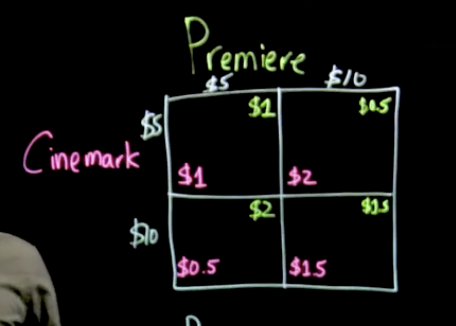
Duopoly Pricing (Simultaneous Game) Example: Cinemark vs. Premiere
Each chooses ticket price: $5 or $10.
If both charge $5 → each earns $1 million.
If one charges $10 while the other charges $5 → high-price firm earns $0.5M; low-price firm earns $2M.
If both charge $10 → each earns $1.5M.
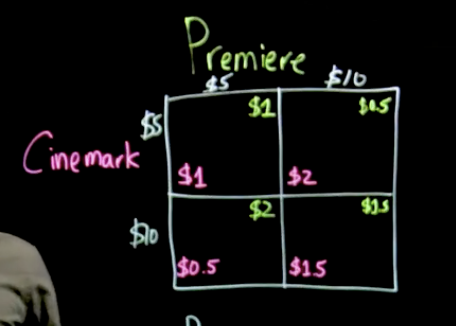
Duopoly Pricing (Simultaneous Game) Nash equilibrium
both charge $5 → each $1M.
Dominant strategy for both is low price.
Consumers benefit, but firms could collude to raise prices to $10 (though illegal)
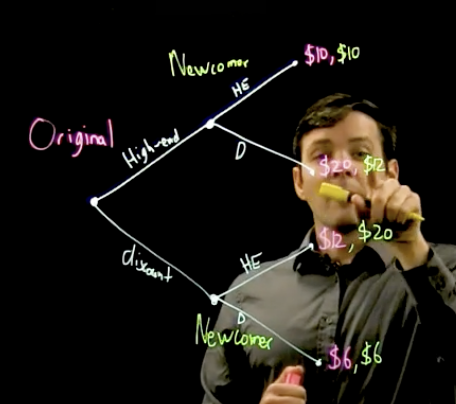
Sequential Game (Entry/Quality Decision) Example: Original & Newcomer
Original (incumbent) moves first, Newcomer (entrant) responds.
If Original chooses high-end clothing, Newcomer responds with discount.
If Original chooses discount, Newcomer goes high-end.
Using backward induction: Original earns $20M by choosing high-end, forcing Newcomer to pick discount.
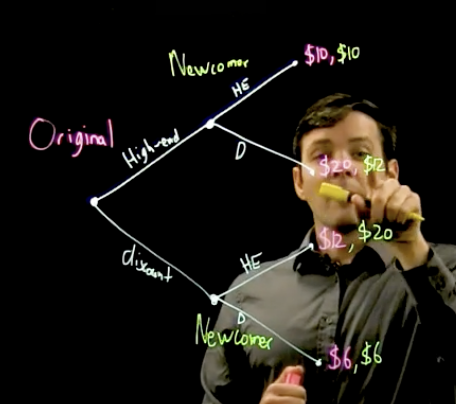
Sequential Game (Entry/Quality Decision) Outcome
Original gains first-mover advantage; both find stable niches
Game theory clarifies
how firms anticipate rivals’ reactions and position themselves strategically
Traditional models
assume people act rationally to maximize utility
Behavioral economics
studies systematic deviations from rationality
Principles of behavioral economics
People try to choose their best feasible option, but sometimes fail in predictable ways
People care (in part) about how their circumstances compare to reference points
People have self-control problems
Limiting people’s choices could make them better off in theory, but in practice, the record is mixed
Behavioral economics principal 1
People try to choose their best feasible option, but sometimes fail in predictable ways
Behavioral economics principal 2
People care (in part) about how their circumstances compare to reference points
Behavioral economics principal 3
People have self-control problems
Behavioral economics principal 4
Limiting people’s choices could make them better off in theory, but in practice, the record is mixed
Predictable mistakes
People try to optimize but make consistent errors
Overconfidence
underestimate risk, overestimate skill
Availability bias
judge likelihood by how easily examples come to mind (e.g., fear flying > driving)
Reference points and loss aversion
Happiness depends on gains/losses relative to expectations
Loss aversion
losses feel worse than equal-size gains feel good
Anchoring
people rely too heavily on initial numbers (e.g., “original price” framing in sales)
Honoring sunk costs
continuing actions because of past investment (e.g., finishing a bad movie)
Self-control problems
Present bias
Present bias (myopia)
overvalue immediate gratification, undervalue long-term goals.
Explains procrastination, poor saving, and overeating.
Governments and firms
can “nudge” people toward better choices using defaults
Nudge example
organ donation opt-out systems → 90% participation; opt-in → 15%
Policymakers also have biases
paternalism can be overused
Behavioral economics complements not replaces, traditional theory
it deepens understanding of real human behavior
 Note
Note  Flashcards (43)