nervous system and the eye
 Call Kai
 Learn
Learn Practice Test
 Spaced Repetition
 Match
Match Flashcards
 Knowt Play
1/38

There's no tags or description
Looks like no tags are added yet.
Name | Mastery | Learn | Test | Matching | Spaced | Call with Kai |
|---|
No analytics yet
Send a link to your students to track their progress
39 Terms
Label the diagram
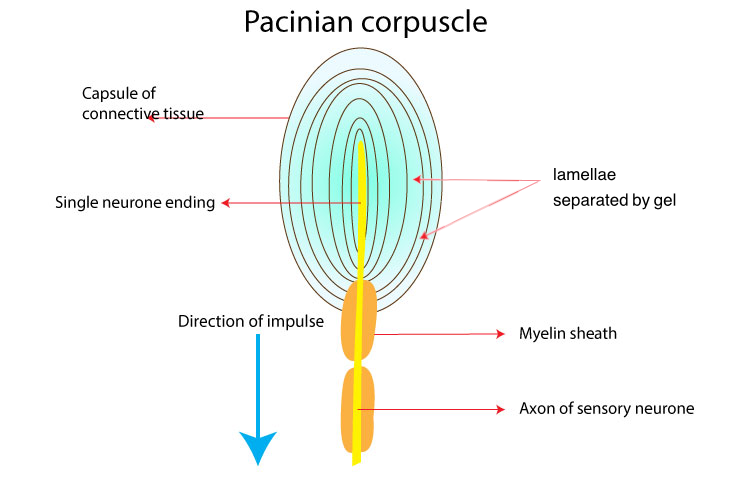
What is the function of the pacinian corpuscle
They are mechanical pressure receptors that act as transducers
That produce generator potentials by applying a potential difference across a membrane
Why are reflexes fast?
Because they bypass the brain, have short neural pathways and there are very few synapses.
Why are reflexes needed?
They are automatic responses that protect the body from harmful stimuli and are needed for homeostasis, preventing injury and posture.
What type of receptor detects pressure?
Mechanic receptors
What type of receptor detects Temperature changes
Thermoeceptors
What type of receptor detects Light
Photoreceptors
What type of receptor detects Chemicals
Chemoreceptors
Define current (as in the nervous system)
Current in a neurone is the rate of flow of charge of sodium and potassium ions, and is causes by a potential difference across the membrane of the axon
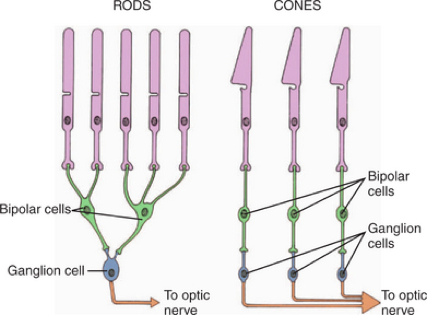
Compare the similiarities and differences between rods and cones
Rod and cone cells are light receptors in the retina which convert light energy into an electrical nerve impulse. multiple Rod cell is connected to one bipolar neuron, rod cells contain rhodopsin, and are sensitive to low light intensity, but low resolution/ low visual acuity. can trigger summation between other rod cells. Are mostly found on the edge of the retina.
cone cells contain iodopsin, cannot trigger summation.each cone cell connects to each bipolar neuron. respond to only high intensity light. iodopsin break down at high light intensity. Cone cells only respond to high light intensities. Are mostly found in the fovea.
cones
what is rhodopsin and iodopsin an example of?
a light sensitive pigment
explain what happens when light hits rod cells (4 marks)
rhodopsin is broken down
causing the bipolar neuron to be depolarised
when the depolarisation is greater than the threshold a generator potential is triggered in the bipolar neuron
this triggers a nerve impulse down the sensory neuron to the brain
where is rhodopsin found?
in rod cells
where is iodopsin found?
in cone cells
which part of the eyes are most cone cells found in?
the fovea
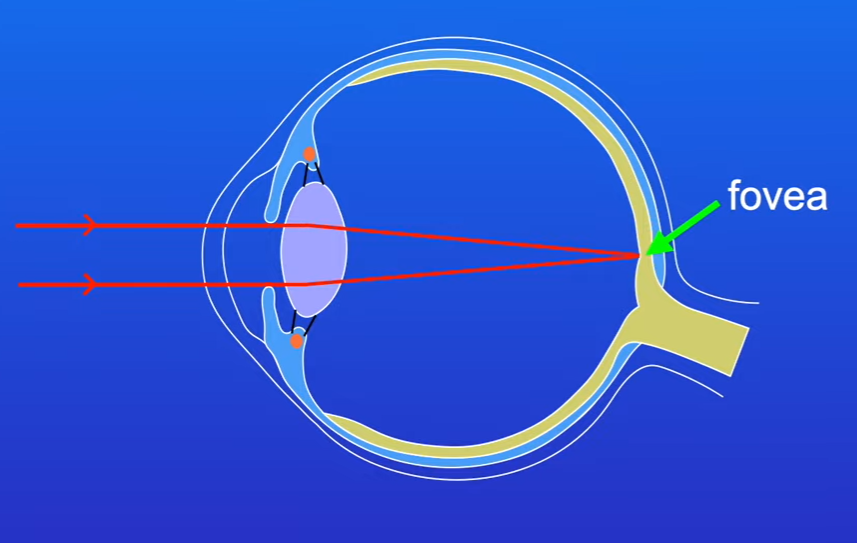
Which part of the eye are most rod cells found in?
Peripheral retina or the edge of the retina
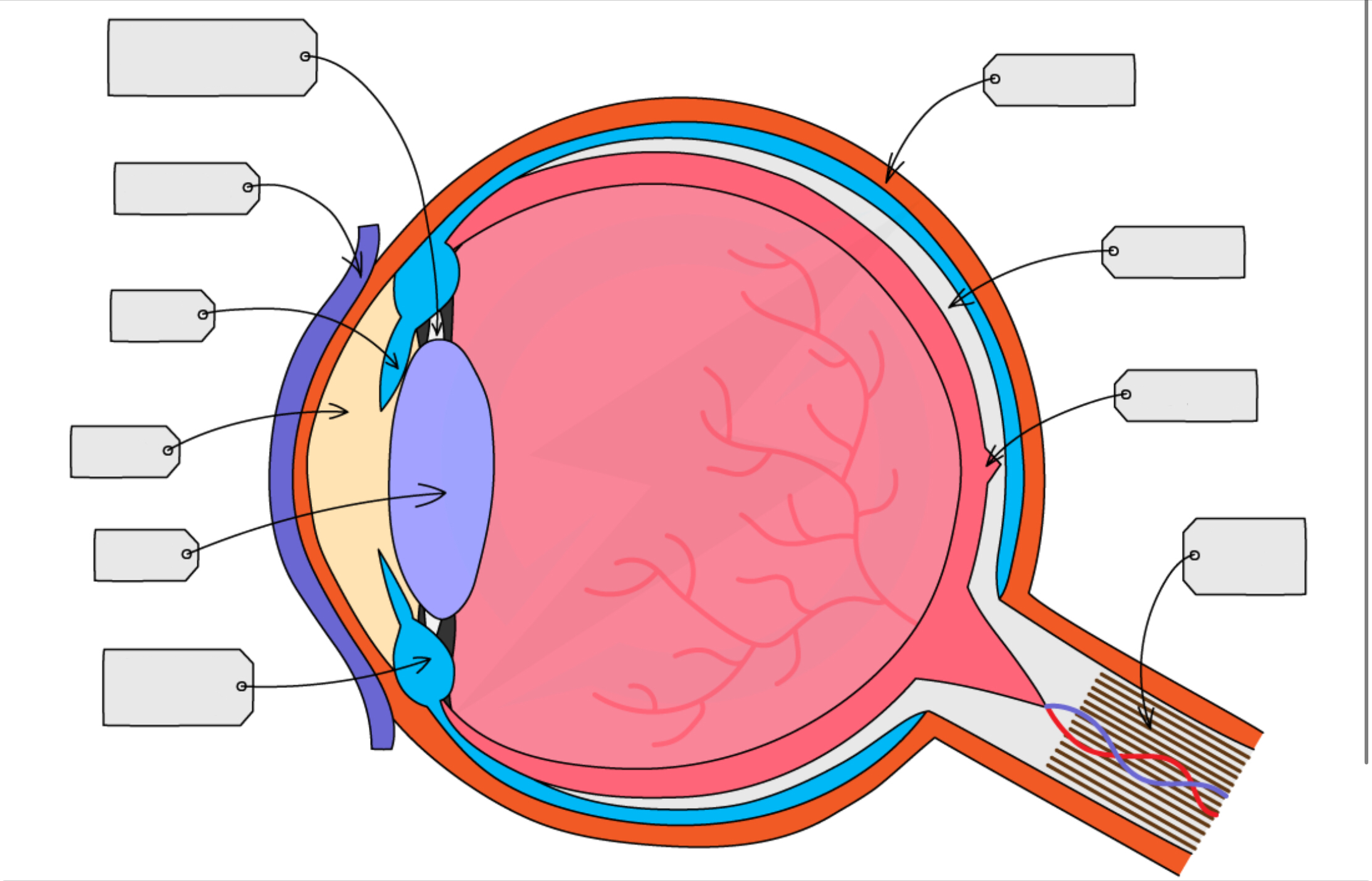
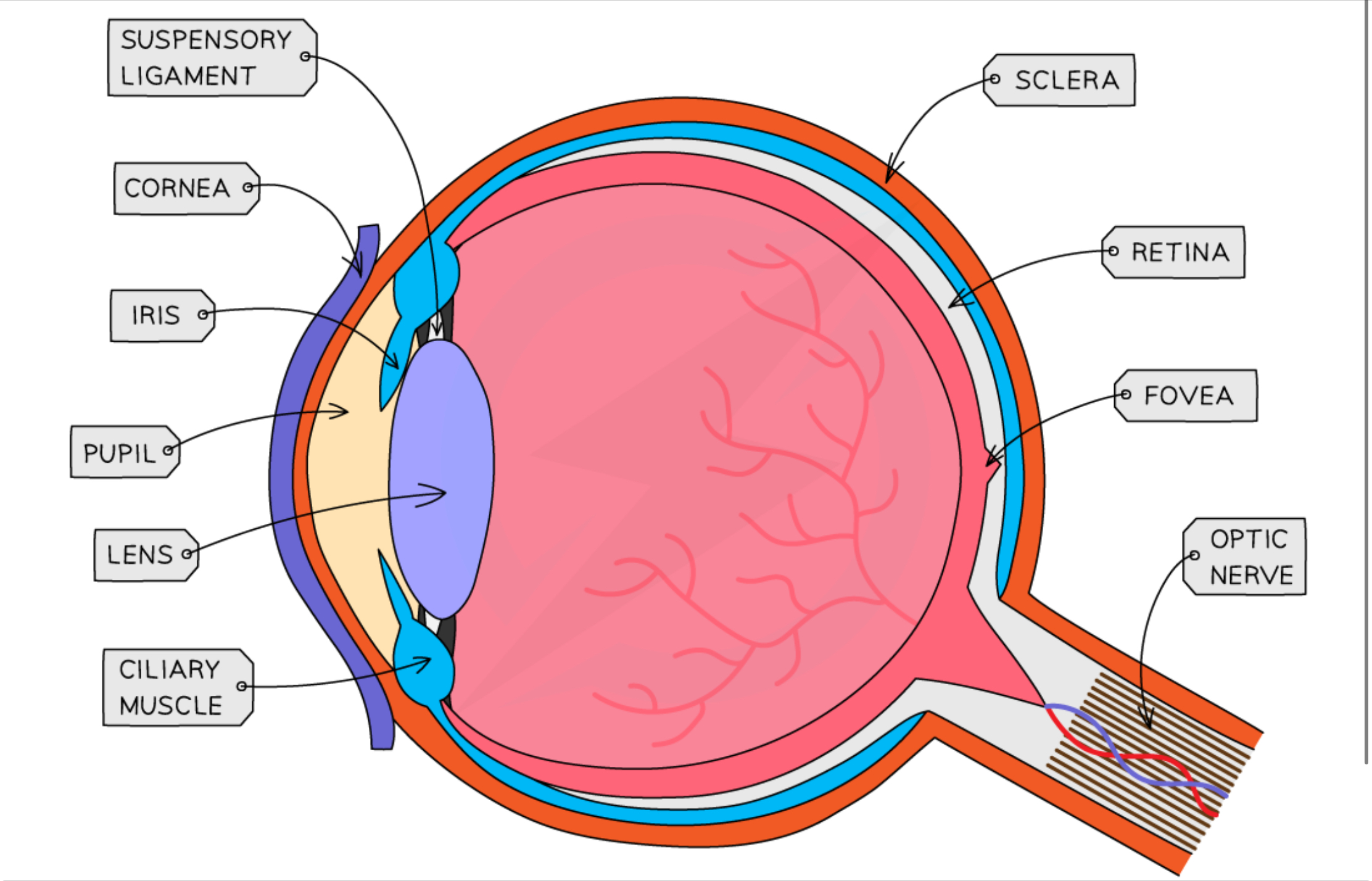
State the role of the Retina
Where the image is formed, covered in light sensitive cells
state the role of the Cornea
Clear tough covering that focuses light
State the role Iris
Coloured part, it is made up of muscles to control the size of the pupil
State the role of the Pupil
The hole that allows light to enter
State the role of the Lens
It focusses the light on the retina as needed to produce a clear image
State the role of the Suspensory ligaments
Attach to the lens and ciliary muscles
State the role of the Ciliary muscles
Muscles that control the shape of the lens
Compare the difference between the hormone endocrine system and the nervous system
In the hormone endocrine system messages are transmitted via hormones in the bloodstream, very slow, the hormones can target many organs, so the effect is widespread. Long lasting, permanent or irreversible response in organs
In the nervous system messages are transmitted via nervous impulses in neurones, very fast. The impulses target a few organs, so the effect is localised. Short lasting, temporary or reversible effects.
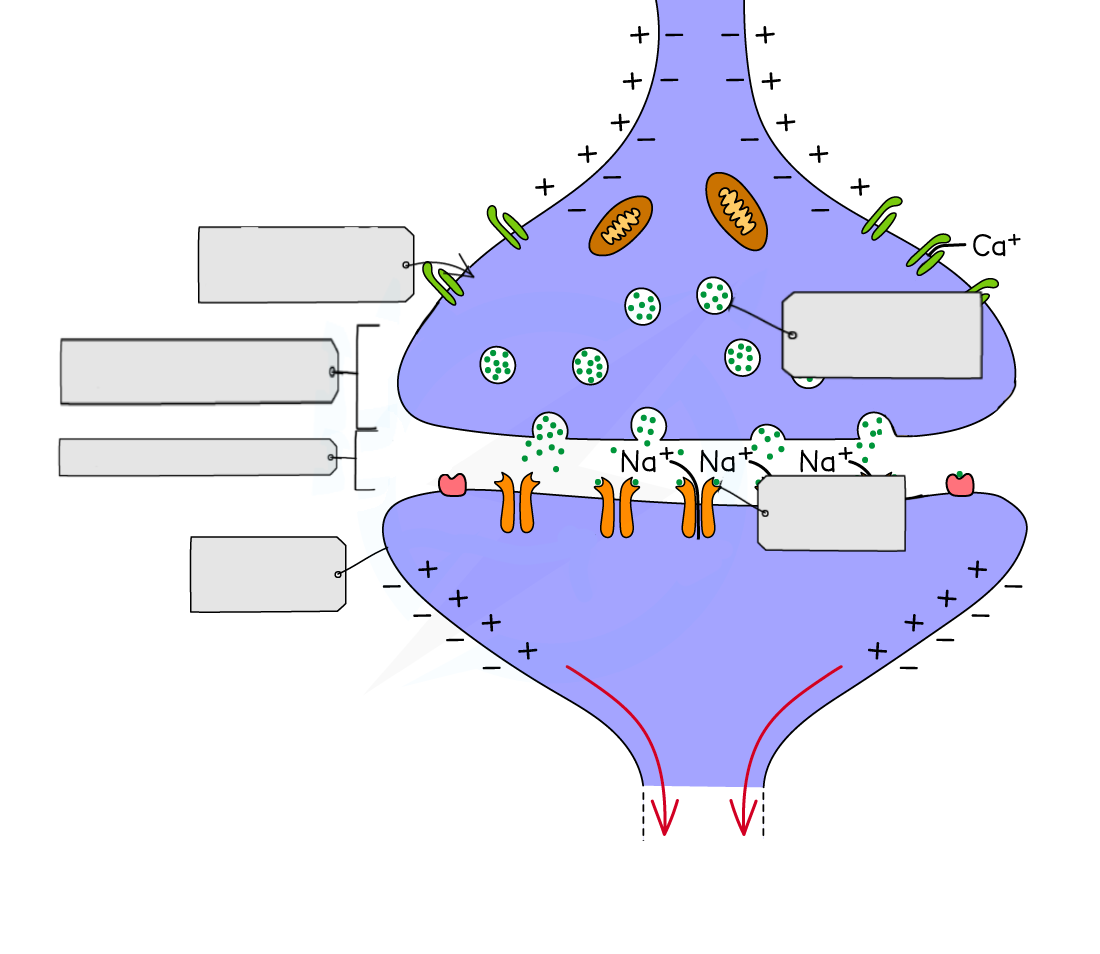
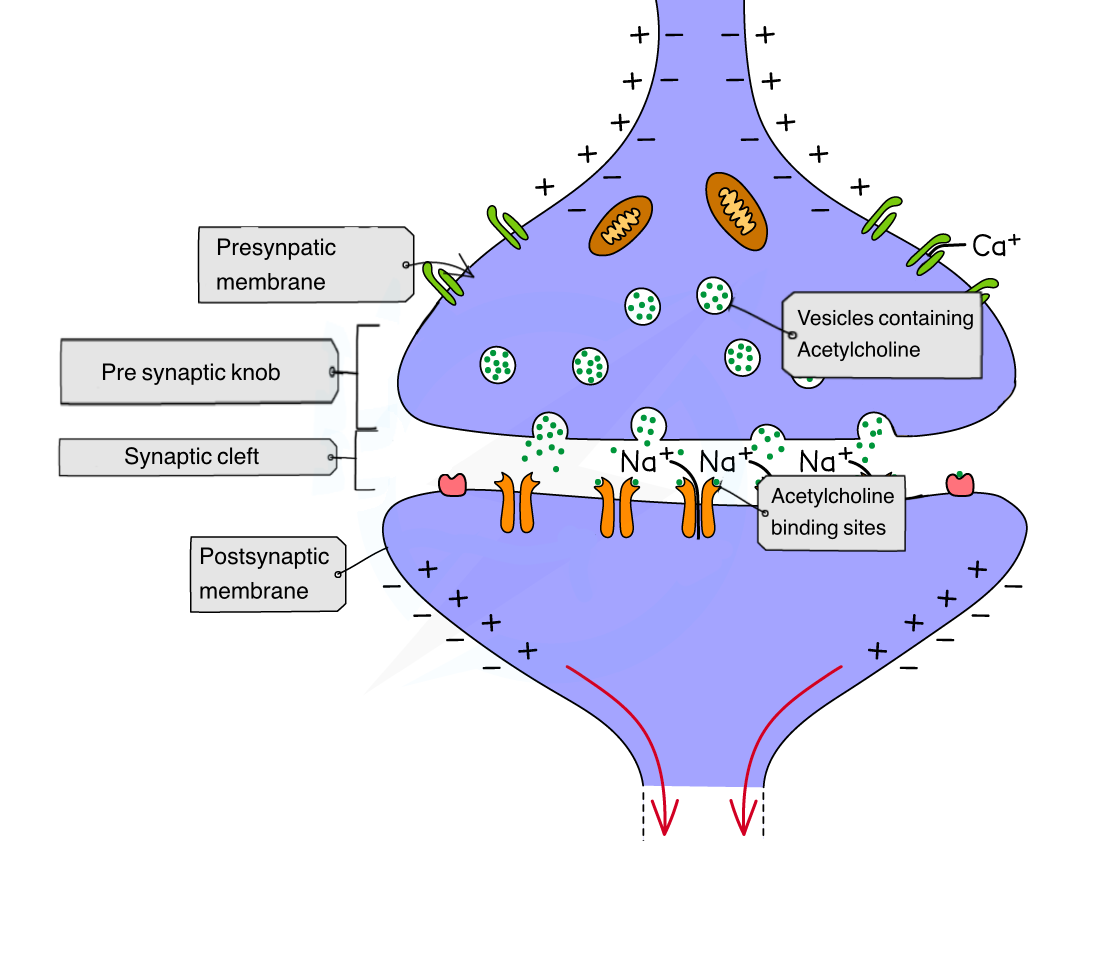
Describe the process of how an action potential is triggered in a cholinergic synapse (7 marks)
action potential reaches the synaptic knob of a presynaptic neurone
this causes calcium channels to open and Ca+ ions move into the synaptic knob via facilitated diffusion
this triggers the synaptic vesicles to move towards the synaptic knob and fuse with the presynaptic membrane
Acetylcholine is released into the synaptic cleft and diffuse down a concentration gradient to the post synaptic membrane
Acetylcholine binds to complementary receptors on the postsynaptic membrane
this causes the sodium ion channel proteins to change shape and open
allowing Na+ ions to diffuse into the postsynaptic membrane, via facilitated diffusion, depolarising it
generating an action potential
Acetylcholine is hydrolysed by acetylcholinesterases into acetate and choline which is recycled in the presynaptic neurone
and sodium ion channel proteins close
re-establishing the resting potential in the post synaptic neurone
Label this diagram
what is Acetylcholine? (1 mark)
a neurotransmitter
what are the two types of summation?
spatial summation
temporal summation
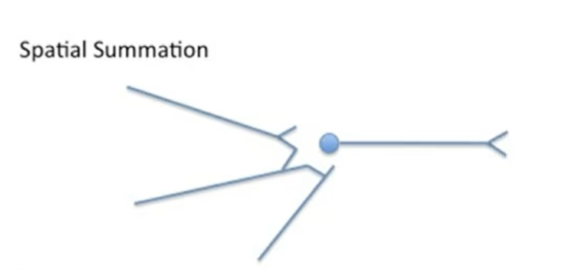
describe Spatial summation (1 mark)
multiple pre-synaptic neurones converge to one post synaptic neurone
generating an action potential
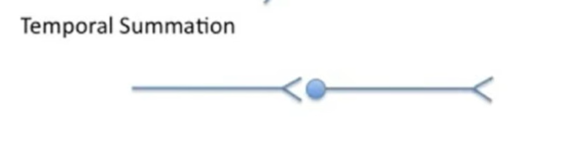
describe Temporal summation (1 mark)
when one presynaptic neurone connected to one post synaptic neurone
when a presynaptic neurone releases lots of neurotransmitter in quick succession.
generating an action potential
give 3 advantages of summation in a cholinergic synapse
the generator potential is more likely to reach the threshold and cause an action potential
large amount of Acetylcholine being released in the synaptic cleft
larger number of open sodium channel proteins
suggest 4 benefits of summation
allows for the effect of a stimulus to be magnified
a combination of stimulus to trigger a response
it avoids the nervous system being overwhelmed by impulses
synapses act as barriers and slows down the rate of transmission of a nerve impulse
Explain how a drug that inhibits acetylcholinesterase (AChE) can affect nerve transmission and cause excessive muscle contractions. (4 marks)
Inhibiting AChE prevents the breakdown of acetylcholine in the synaptic cleft.
this causes the concentration gradient of Acetylcholine to no longer be maintained, and Acetylcholine to remain attached to the binding site on the Na+ channel proteins.
This causes Na+ channel proteins to remain open, causes action potentials to be generated repeatedly
causing temporal summation which leads to repeated muscle contractions.
explain why nerve impulses in a cholinergic synapse is unidirectional (1 mark)
the Na+ channel proteins are only found on the postsynaptic neurone membrane
suggest why lots of mitochondria can be found in the presynaptic membrane and why it’s beneficial in cholinergic nerve transmission (3 marks)
Mitochondria provides lots ATP
so Ca+ can be actively transported out of the presynaptic membrane
maintaining the Ca+ gradient in the presynaptic neurone
suggest on example of spatial summation in the eye
retinal convergence via rod cells in the eye
what can inhibition of a nerve impulse in a cholinergic synapse be caused by?
neurotransmitters or drugs
What does it mean when impulses are “Unidirectional”?
the impulse travels in one direction across the synapse this is because
the acetylcholine is only released from the pre-synaptic neurone and diffuses to the post-synpatic neurone
acetylcholine receptors are only found on the post-synaptic neurone.

