Papa T.J. Earth Science Ch. 27
 Call Kai
 Learn
Learn Practice Test
 Spaced Repetition
 Match
Match Flashcards
 Knowt Play
1/54

Earn XP
Name | Mastery | Learn | Test | Matching | Spaced | Call with Kai |
|---|
No analytics yet
Send a link to your students to track their progress
55 Terms
electromagnetic spectrum
The ______________ consists of all types of electromagnetic radiation arranged according to wavelength and frequency.
Wavelength
________ is the distance between peaks on a wave
Frequency
____________ is the number of waves or oscillations that pass a given point per second
3.0 × 10⁸ m/s
What is the speed of light ( c )
Refracting Telescopes
___________ use lenses to focus visible light
Reflecting Telescopes
_________ use mirrors to focus visible light. (cuz like mirrors reflect stuff so mirrors-reflecting yk)
Radio telescope
A ________ collects the longer wavelengths of radio waves with a large dish antenna and reflects them to a point above the dish
The Hubble Space Telescope
The _________ was designed to obtain sharp visible-light images without atmospheric interference and to make observations in infrared and ultraviolet wavelengths
Robotic probes
_________ are spacecrafts that can make close-up observations and sometimes land to collect information directly.
384,400 km
The moons distance from Earth (in km)
3.8 cm
The moon is moving away from the Earth how much per year (in cm)
Sputnik 1
The first step toward reaching the Moon was in 1957, when the Soviet Union launched the first artificial satellite, _________.
Yuri A. Gagarin
Soviet cosmonaut ________ became the first human in space.
Apollo 11
Neil Armstrong and Edwin “Buzz” Aldrin landed on the Moon during the ______ mission
Albedo
The _______ of the Moon, the percentage of incoming sunlight that its surface reflects, is very small—only about 7 percent
31%
Earth has an average albedo of nearly ______.
-233 to 1270 C
The temperature of the moon ranges from _______
Highlands
Lunar _______ are heavily cratered regions of the Moon that are light in color and mountainous
Maria
_______ are dark, smooth plains, which average 3 km lower in elevation and have few craters.
Rilles
_____ are valley-like structures that might be collapsed lava tubes.
Impact craters
The craters on the Moon, called _________, formed when objects from space crashed into the lunar surface.
Ejecta
The material blasted out during these impacts fell back to the Moon’s surface as ______.
Rays
Some craters have long trails of ejecta, called ____, that radiate outward from the impact site.
Silicates
The Moon is made up of minerals similar to those of Earth—mostly _______.
Regolith
______ is the layer of loose, ground-up rock on the surface of the moon.
This one prob a short answer
Scientists infer from seismic data that the Moon, like Earth, has a layered structure, which consists of the crust, upper mantle, lower mantle, and core.
large impact basins
After the period of intense bombardment that formed the highlands, lava welled up from the Moon’s interior and filled in the ______.
Prob need to know this too
The Moon probably formed as the result of a collision between Earth and a Mars-sized object about 4.5 bya when the solar system was forming.
Impact
The ______ theory of the Moon’s formation states that material ejected from Earth and from the striking object eventually merged to form the Moon.
Foucault pendulum and the Coriolis effect
Both a ______ and the _______ demonstrate that Earth is rotating.
Solar day
The time period from one noon to the next is called a ______.
Ecliptic plane
Earth orbits the Sun in a slightly elliptical orbit. The plane of Earth’s orbit is called the ______.
365.25
It takes _____ days for the Earth to orbit the sun
23.5°
Earth’s axis is tilted relative to the ecliptic at approximately ____.
Tilt and orbital motion
Earth’s ____ and _____ around the Sun result in a cycle of the seasons.
Solstice
At a ______, the Sun is overhead at its farthest distance either north or south of the equator.
Tropic of Cancer and the Tropic of Capricorn
The lines of latitude that correspond to these positions on Earth have been identified as the ________ and ________.
Equinox
At an ________, Earth’s axis is perpendicular to the Sun’s rays and at noon the Sun is directly overhead at the equator.
Zenith
The Sun’s maximum height, called its _______, varies throughout the year depending on the viewer’s location.
Know this, Sun would be highest on the summer solstice, lowest on winter solstice. Just think summer with Sun or smtn.
For a person standing on the 23.5° north latitude, the Sun would be at zenith on the summer solstice. It would be at its lowest position at the winter solstice.
27.3
It takes _____ days for the moon to orbit the Earth
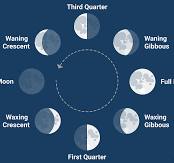
Waning is when the right side of the moon is becoming visible, waxing is when the left side is becoming more visible. Gibbous is when most of the moon is shown, so a waning gibbous would be when there is a crescent of shadow on the right side. Crescents are self explanatory, the only light part of the moon is a crescent. The quarters are when it is half and half. Third quarter is when the left side is shown, first quarter is when the right side is shown.
Know the phases of the moon.
Synchronous rotation
The state at which the Moon’s orbital and rotational periods are equal is called _______.
29.5, 27.3
The length of a lunar month is about ___ days, which is longer than the ____ days it takes for one revolution, or orbit, around Earth.
Tides
The Moon’s gravity pulls on Earth along an imaginary line connecting Earth and the Moon, and this creates _____ on both the near and far sides of Earth.
Solar eclipse-way to know difference between solar and lunar eclipse, solar=Sun is blocked, lunar =moon is blocked
A ______ occurs when the Moon passes directly between the Sun and Earth and blocks the Sun from view.
Umbra
The darkest part of the Moon’s shadow, called the ______, sees a total eclipse.
Penumbra
The lighter part of the Moon’s shadow, called the ______, see a partial eclipse.
Perigee
The closest point in the Moon’s orbit to Earth is called _____.
Apogee
The farthest point in the Moon’s orbit of the Earth is called _____.
Lunar eclipse
A ______ occurs when the Moon passes through Earth’s shadow.
Total lunar eclipse
A _______ occurs when the entire Moon is within Earth’s umbra.
5
The plane of the moon orbiting the Earth is on a __ degree tilt compared to the plane of the Earth orbiting the Sun.

me when Julian

