Science Chapter 2: Cells the Building Block of life
 Call Kai
 Learn
Learn Practice Test
 Spaced Repetition
 Match
Match Flashcards
 Knowt Play
1/55

Earn XP
56 Terms
Where was Life believed to have Originated from?
It is widely accepted amongst Scientists that life originated in water.
What are heat-loving bacteria known as?
Thermophiles (Unicellular)
Which Mineral Forms Rapidly around Hot springs and protects organic Molecules from Radiation
Calcium Carbonate
Which Place in India has similar springs similar to the Hot Springs where Life first Formed?
the hot springs of Puga Valley in Ladakh
Which group of researchers in Lucknow found out the role of CaCo3 in the Formation of Life
Scientists from the Birbal Sahni Institute of Palaeosciences
What is a cell?
The Cell is the basic Structural and functional unit of life
What are Tissues?
A group of similar cells performing similar functions form tissues
What are Organs and Organ Systems?
Different tissues are organised to form an organ and several organs work together to form organ systems.
Define Near point.
The distance from which the human eye views objects to see them clearly.
What is the length the Near Point of the Human Eye?
25 cm
Define Limit of Resolution
The ability of the eye to see two very close objects as separate and distinct rather than a single point.
What is the Value of the Limit of Resolution of the human eye?
0.1mm
What are the items used for an Object to be Magnified?
An objective lens and an eyepiece
Who was the First person to observe a cell, Which year was it?
Robert Hooke in 1665
How many Micrometers are in a millimetre?
1mm = 1000 µm
How would You Measure the Estimated size of a cell?
Estimated size of a cell = Diameter of the visible field in microns/ Number of cells along the diameter
What is the Cell membrane? What is also called
The cell membrane is a thin boundary that surrounds a cell and protects its contents, it`s also a plasma membrane
Define Diffusion
Diffusion is the net movement of particles from a higher to a lower concentration
Define Osmosis
The diffusion of water through a selectively permeable membrane is called osmosis
Define Hypertonic, Hypotonic and Isotonic Solution
Hypertonic Solution: Intracellular Solute concentration , < Exrtacellular Solute Concentration
Hypotonic: Intracellular Solute concentration > Exrtacellular Solute Concentration
Isotonic: Intracellular Solute concentration = Exrtacellular Solute Concentration
What is the estimated width of the cell membrane?
7-10 nanometers
How many nanometers is one millimeter?
1mm = 1000000nm
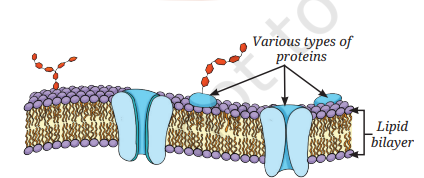
What is this model that explains cell structure called? Why is it called that?
The Fluid Mosaic Model, It`s called that because the molecules can move around freely like a Fluid & the molecules being arranged like tiles in a mosaic
What is a cell wall?
The hard, permeable, outer covering of a cell, that helps maintain a firm structure
Which kinds of cells have cell walls?
The cells of plant, fungi, and bacteria have cell walls
{what is plasmolysis?}
The process of the cell shrinking due to being in a hypertonic solution, but the Cell wall staying intact
What are organelles?
sub-cellular components called organelles
What are the contents present in the cytoplasm
The cytoplasm contains several organelles, along with other substances present in it.
What is a Prokaryote?
a type of cell that lacks a well-defined nucleus and membrane-bound organelles. Eg: Bacteria
What is a Eukaryote?
Cells have a well-defined nucleus and several membrane-bound organelles. Eg: Plant cells, Animal cells
What do the terms "Prokaryote" and "Eukaryote" literally mean?
Prokaryote:
Pro = Primitive
Karyon = Nucleus
Eukaryote:
Eu = True
Karyon = Nucleus
What is the nucleus?
The nucleus is the double membraned organelle that houses the DNA
What is made in the nucleolus?
The nucleolus makes the ribosomal subunits, The large subunit and the small one
What is the distinct characteristic of the nuclear membrane?
It consists of two layers, often referred to as the nuclear envelope, this envelope is also part of the ER
What do ribosomal subunits assemble to make? what does it do?
ribosomal subunits assemble into ribosomes which use amino acids to make proteins
What is DNA? What is a gene?
DNA or Deoxyribonucleic acid is the master molecule containing the complete set of instructions for running the cell , a Gene is a part of DNA for something specific
What is Chromatin?
Chromatin is a material that looks like an entangled mass of thread-like structures, it is DNA wrapped in Proteins (BONUS: Histone proteins)
What are Chromosomes?
Chromosomes contain information for the transfer of genetic information from parent to offspring
What is a Nucleoid?
The open region in the cytoplasm of a prokaryotic cell where its genetic material (DNA) is concentrated.
what are the sites of protein synthesis?
Ribosomes
What is the Endoplasmic Reticulum?
A large, network-like organelle physically attached to the nucleus, serving as the cell's main manufacturing and transport hub.
What are the functions of the RER?
Protein Synthesis: Is the place where the ribosomes make proteins
Protein Processing: Customises the simple protein chains into 3D Shapes
Protein Secretion: Packages Proteins and protein made compounds into vesicles
What are the functions of the SER?
Lipid Synthesis: Makes Lipid molecules and {Steroid proteins}
Detoxification: Contains specialised Enzymes to break down and flush out toxins
Who first observed the Golgi Apparatus in a cell?
Camillo Golgi in 1898
What is the Golgi apparatus?
A system of separate, membrane-bound, flattened sacs {cisternae} stacked parallel to each other that serves as the cell's packaging and dispatch facility.
How is the Golgi linked to the Endoplasmic reticulum?
They are Functionally linked because vesicles from the ER need to go to the Golgi apparatus for modification, and finally trasportation to the entire cell
What are vesicles?
These are membrane bound sacs usually used for transporting proteins from the RER to the Golgi
What are Lysomes?
Lysosomes are single membrane-bound sacs filled with enzymes, which can break down unwanted compounds and damaged parts of a cell.Lysomes are vesicles just filled with enzymes.
Where are Lysomes made?
Lysomes are made in the Golgi Apparatus.
What are Mitochondria? what are they commonly referred to as?
Mitochondria generate energy for the cell by using glucose to produce ATP, hey are commonly known as, “the powerhouse of the cell”
What are Cristae? what molecules sit in them?
Cristae are the folds of the inner membrane of the mitochondria, ATP Synthase sit in them
What is ATP?
ATP (Adenosine Triphosphate) is the energy currency used in cells, it is made by the ATP Synthase molecules in the mitochondria
What are Plastids?
Plastids are double membraned organelles found only in plant and algae cells that store pigment or starch and oil
What are the two typesof Plastids?
Chromoplasts: these store pigments to attract pollinators
Leucoplasts: these store starch and oils
What do “Chromoplasts” and “Leucoplasts” literally mean?
In greek:
Chroma = colour
Leuco = white
What do Chromoplasts and leucoplasts do? what about Chloroplasts?
Chromoplasts store colour, this is to attract pollinators and seed dispersers
Chloroplasts, a type of chromoplast with chlorophyll, it turns sunlight into glucose
Leucoplasts store starch or fat, this is incase there is no sunlight for the chloroplasts to make glucose