10.6 Long-Run Supply Curves
 Call Kai
 Learn
Learn Practice Test
 Spaced Repetition
 Match
Match Flashcards
 Knowt Play
1/31

There's no tags or description
Looks like no tags are added yet.
Name | Mastery | Learn | Test | Matching | Spaced | Call with Kai |
|---|
No analytics yet
Send a link to your students to track their progress
32 Terms
What determines the shape of the long‑run supply curve?
Whether entry/exit changes firms’ costs.
What is a constant‑cost industry?
An industry where entry or exit does not change resource prices or firms’ ATC curves.
Why don’t costs change in a constant‑cost industry?
Because the industry is small relative to the total market for its inputs, so increased demand for resources doesn’t raise their prices.
What happens to price in the long run when demand increases?
Price temporarily rises, but entry pushes it back down to the original minimum ATC.
What happens to price in the long run when demand decreases?
Price temporarily falls, but exit pushes it back up to the original minimum ATC.
What happens to quantity when demand changes in a constant‑cost industry?
Quantity changes (90k, 100k, 110k), but price stays the same.
What is the long‑run equilibrium price in a constant‑cost industry?
The minimum ATC (e.g., $50).
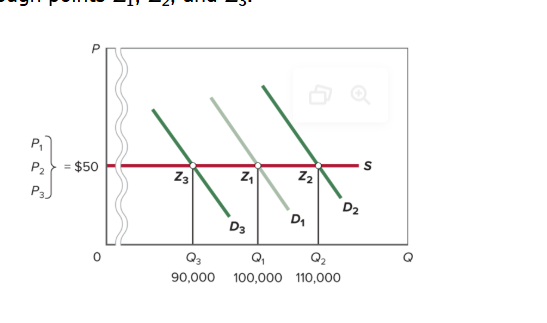
What does the long‑run supply curve look like in a constant‑cost industry?
A horizontal line at the minimum ATC.
Why is the long‑run supply curve horizontal?
Because entry/exit adjusts quantity but never changes price.
What does “perfectly elastic supply” mean in this context?
The industry can supply any amount at the same price in the long run.
What is an increasing‑cost industry?
An industry where firms’ costs rise as the industry expands and fall as the industry contracts.
Why do costs rise when the industry expands?
New firms increase demand for specialized resources → resource prices rise → ATC shifts upward.
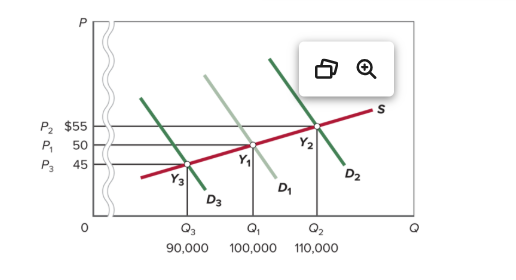
What happens when demand increases in an increasing‑cost industry?
Price rises → firms earn profit → new firms enter → supply increases and costs rise.
Why doesn’t price return to the original level after entry?
Because rising resource prices push ATC upward, so the new equilibrium price must be higher.
What is the final long‑run result after demand increases?
Higher output AND a higher price than before.
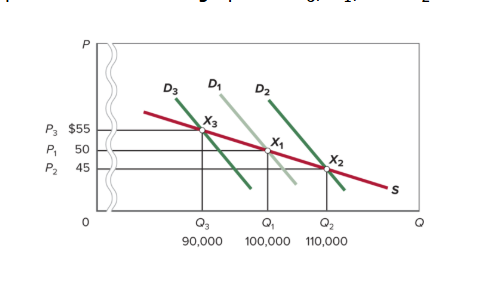
Example of long‑run outcomes in an increasing‑cost industry?
90,000 units at $45
100,000 units at $50
110,000 units at $55
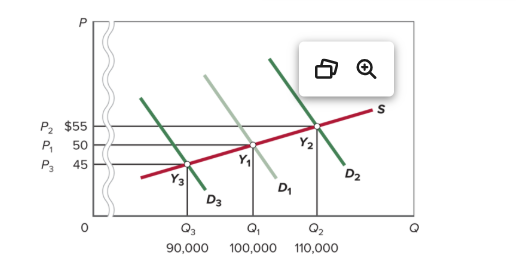
What happens when demand decreases?
Price falls → firms lose money → firms exit → supply decreases → resource prices fall → ATC shifts downward.
What is the final long‑run result after demand decreases?
Lower output AND a lower price than before.
What does the long‑run supply curve look like in an increasing‑cost industry?
Upward sloping.
Why is the long‑run supply curve upward sloping?
Because producing more output requires higher resource prices, which raise firms’ costs and require a higher product price.
What is a decreasing‑cost industry?
An industry where firms’ costs fall as the industry expands and rise as the industry contracts.
Why do costs fall when the industry expands?
Suppliers of inputs get economies of scale, lowering input prices → firms’ ATC decreases.
Example of a decreasing‑cost industry?
The personal computer industry — more firms → cheaper components → lower ATC.
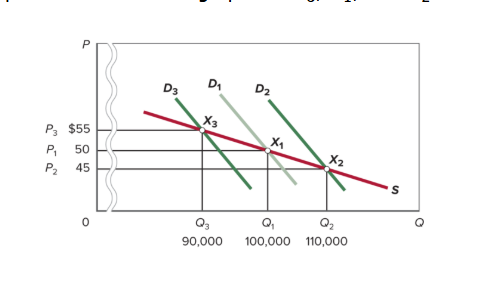
What happens when demand increases in a decreasing‑cost industry?
Price rises temporarily → firms enter → supply increases and costs fall.
What is the final long‑run result after demand increases?
Higher output AND a lower price than before.
Example of long‑run outcomes in a decreasing‑cost industry?
100,000 units at $50
110,000 units at $45 (after entry)
90,000 units at $55 (after exit)
Why does price fall after entry?
Because input prices drop, shifting ATC downward.
What happens when demand decreases?
Price falls → firms exit → supply decreases → input prices rise → ATC rises.
What is the final long‑run result after demand decreases?
Lower output AND a higher price than before.
What does the long‑run supply curve look like in a decreasing‑cost industry?
Downward sloping.
Why is the long‑run supply curve downward sloping?
Because expanding output lowers costs and prices; contracting output raises costs and prices.
Economies of scale
Producing more lowers your ATC per unit
The more you make, the cheaper it becomes
Explore top notes

