Psych 230 Exam 2 (dont kys ur so sexy)
 Call Kai
 Learn
Learn Practice Test
 Spaced Repetition
 Match
Match Flashcards
 Knowt Play
1/173

There's no tags or description
Looks like no tags are added yet.
Name | Mastery | Learn | Test | Matching | Spaced | Call with Kai |
|---|
No analytics yet
Send a link to your students to track their progress
174 Terms
Facial Feedback Hypothesis
sensory feedback from our facial expressions can affect our mood
What is the relationship between botox injections and emotion?
Paralyzes facial muscles which makes emotions less intense
emotions associated with bilateral changes in:
Limbic system
What is included in the Limbic System
Insula, amygdala, striatum, cingulate cortex, prefrontal corte
Love results in increased activity where?
Insula, anterior cingulate cortex, striatum
Love results in decreased activity where?
posterior cingulate, amygdala, right prefrontal cortex
Allostasis is when the brain controls ___ responses and dynamically adjusts physiological parameters to accommodate current and anticipated ___
Stress, stressors
Allostatic load is the ___ from continually adapting so stressors
cost
Fight or flight is when the _____ activates the _____ nervous system to cause adrenal ____ to rapidly release ___ and _____
hypothalamus, sympathetic, medulla, epinephrine, norepinephrine
The HPA axis consists of the ____ releasing CRH, acting on the anterior ___, which then releases ___ causing ___ cortex to release adrenal steroid hormones such as ___ back to the brain
hypothalamus, pituitary, ACTH, adrenal, cortisol
Sensory receptor organs
organs specialized to detect a certain stimulus
Receptor cells
cells within sensory receptor organs that convert stimulus into an electrical signal
sensory transduction
Conversion of stimulus into a change in membrane potential in receptor cell
Doctrine of specific nerve energies
Receptors and neural channels for different senses are independent
labelled lines
brain recognizes distinct senses because action potentials travel along separate nerve tracts
Pacinian corpuscle is a ___ receptor that detects ___ and ___; stimulus opens stretch sensitive ___ channels made of ___ and produces ___ receptor potential
Skin, vibration, pressure, sodium, Piezo, graded
Skin receptors and their functions
Pacinian (vibration), Meissner (light touch), Merkel Discs(fine touch), Ruffini (stretch)
how are intensity of sensory events encoded
number and frequency of action potentials
range fractionation
strength of stimulus increases, more neurons sensitive to higher intensities recruited
Adaptation
progressive loss of response to a maintained stimulus
Phasic receptors
Display adaptation and decrease frequency of action potentials with constant stimulation
tonic receptors
show slow or no decline in action potential frequency
top-down processing
higher brain centers suppress some inputs and amplify others
Dorsal column system
delivers touch information to the brain
First step of Dorsal Column system
Stimulus triggers receptive field of neuron.
Second step of Dorsal Column System
Receptors send projections via the dorsal column of spinal cord where they synapse on dorsal column nuclei in medulla
Third step of Dorsal Column System
Axons from neurons in medulla cross midline and go to thalamus for initial processing, then onto the primary somatosensory cortex
Receptive field
region in which stimulus will alter a sensory neurons firing rate
What does it mean if a cortex has more neurons dedicated to a certain area
The smaller the receptive field there and the better that area is at detecting touch
Positive aspects of pain (3)
helps us withdraw from source, engage in recuperative actions, and signal others
McGill Pain Questionnaire
Sensory-discriminative , Motivational-affective/emotional, Cognitive evaluative
Noiceptors
peripheral receptors/free nerve endings that respond to painful stimuli
Where are noiceptors located
Dermis
How do noiceptors respond to different signals
specialized receptor proteins on cell membrane produced by free nerve endings
Anterolateral/Spinothalamic System transmits sensations of ___ and ___, receptors synapse on____ neurons in ____ ___, pain info crosses midline in ___ horn before ascending to brain
pain, temperature,spinal, dorsal horn, spinal
Neuropathic pain (phantom limb)
microglia release chemicals making dorsal horn neurons hyperexcite and cause chronic pain
What does social rejection activate?
Anterior cingulate cortex
Analgesia
absence or reduction in pain sensation
Opioids
endogenous opiate-like peptides in brain
Periaqueductal gray (PAG)
area in midbrain involved in pain perception
What happens when the PAG is electrically stimulated
produces potent analgesia
How can pain information be blocked?
a gating action in the spinal cord
What does the external ear and pinna do
capture and funnel sound waves into ear canal
What do the ridges and valleys of the external ear do
modifies the character of sound frequencies that reach the middle ear
middle ear
concentrates sound energies
ossicles (3)
mallecus, incus, stapes
What do the ossicles(bones) do
concentrate and amplify vibrations on the oval window
Muscles protecting the inner ear from loud and self-made sounds, and improving auditory perception
Tensor tympani and Stapedius
Where is the tensor tympani
Attatched to Malleus and Tympamic membrane(eardrum)
where is the stapedius
attatched to stapes
Inner ear structures
Convert sound into neural activity
cochlea
fluid filled spiral comprised of three canals (scala vestibuli, scala media, scala tympani)
Organ of corti
receptor system that converts vibration from sound into neural activity (within scala media)
Auditory sensory cells/hair cells
embedded in the basilar membrane and vibrates in response to sound
basilar membrane seperates the scala ___ and scala ___
tympani, media
Effect of high frequency sound in the basilar membrane
displaces the base of basilar membrane
Effect of low frequency sound in the basilar membrane
displaces the apex
What happens as stapes move in and out as a result of sound waves
stapes set up waves in the fluid of scala vestibuli, in turn causes basilar membrane to ripple
hair cells in basilar membrane
transduces movements from stapes into electrical activity
Vestibulocochlear nerve
cranial nerve VIII, contains auditory fibers from the cochlea
Each auditory nerve fiber divides into ___ branches, going to cells in the ___ ___
two, cochlear nuclei
What in the brainstem receives bilateral input from cochlear nuclei and is helpful for identifying location of sound?
Superior Olivary Nuclei
What in the midbrain is targeted by the cochlear nuclei, is considered the auditory integration center of the midbrain, helps initiate reflexes like turning toward sound and contributes to startle reflex
Inferior Colliculi
Where does auditory information go after travelling to cochlear nuclei outputs?
medial geniculate nuclei in thalamus, then to auditory cortex
Brain uses what two binanural cues to signal sound location
Inensity(difference in loudness) and latency (difference in time of arrival btwn ears) differences
Where is information from binanural cues processed?
Superior Olivary Nucleus
spectral filtering
pinna selectively reinforces some frequencies and reduces others, providing info about elevation
Hearing loss
decreased sensitivity to sound
Deafness
loss of hearing so severe speech cannot be perceived with use of hearing aids
Conduction Deafness is a disorder of ___ or ___ ear preventing sound from reaching the ___
outer, middle, cochlea
Sensorineural Deafness is a disorder in the ___ that interferes with ____ of sound activity into neural activity
cochlea, transduction
Central deafness is ____ damage to ____ brain areas
acquired, auditory
What causes tinnitus?
Noise pollution and loud sounds damaging hair cells
Cochlear implants
Used to treat deafness due to hair cell loss, electrical currents stimulate auditory nerve
What type of deafness is treated with hearing aids?
Conduction
How do hearing aids work?
microphone captures sound waves, amplifies and strengthens signal, sends back into ear canal
Vestibular system
Made up of three semicircular canals that detect position and movement of head
Head movement axes
pitch, yaw, roll
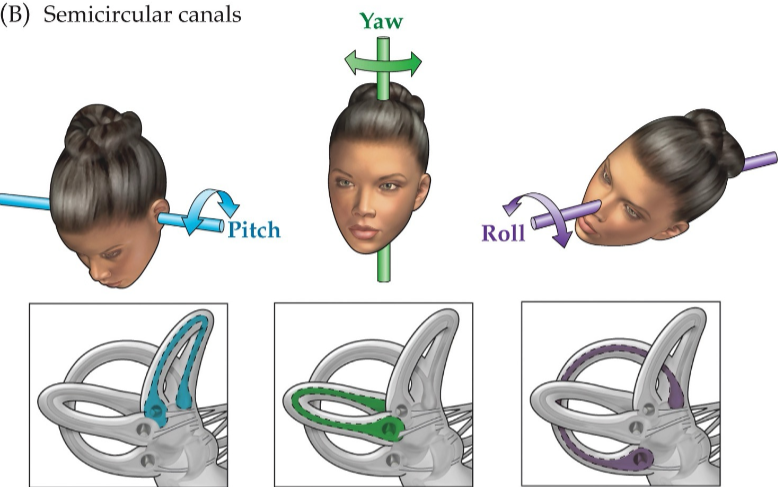
How is the brain signaled that the head has moved
Movement of head in any one axis sets up a flow of fluid in the semicircular canal, deflecting stereocilia in the ampulla
Main adaptive role of chemical senses
Evaluating potential food in natural environments
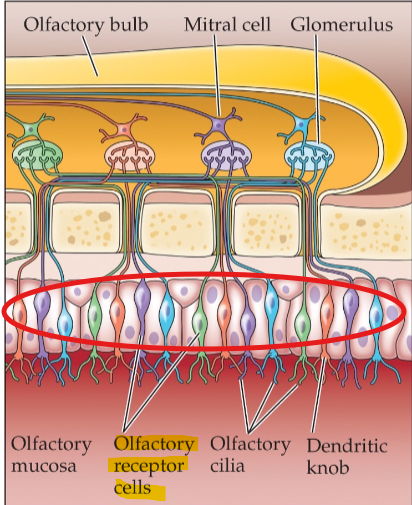
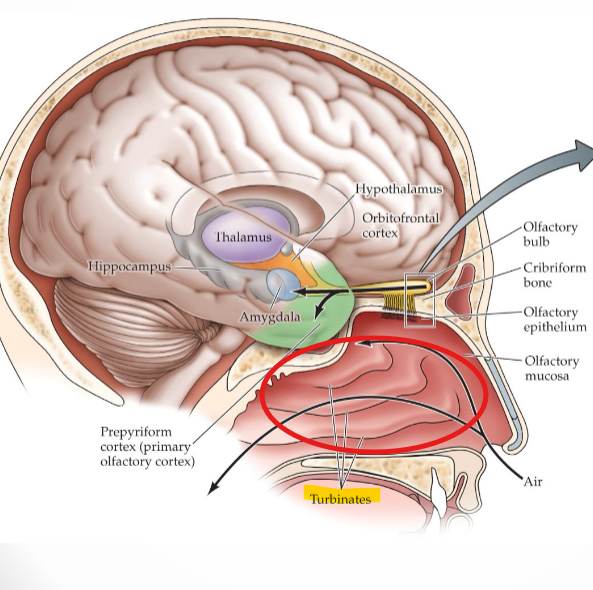
Where does the sense of smell start
receptor neurons within olfactory epithelium
Turbinates
Curved surfaces in nasal cavity that direct air flow
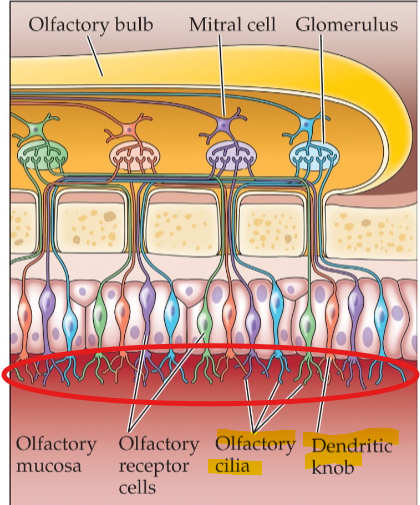
What do odorants do at the receptor cell
Interact with receptons on the cilia and dendritic knob, activating the G protein messenger
Where do olfactory receptor cell axons end?
Olfactory bulb
How is the olfactory bulb organized
Several glomeruli that pass information from similar types of OSNs to mitra cells
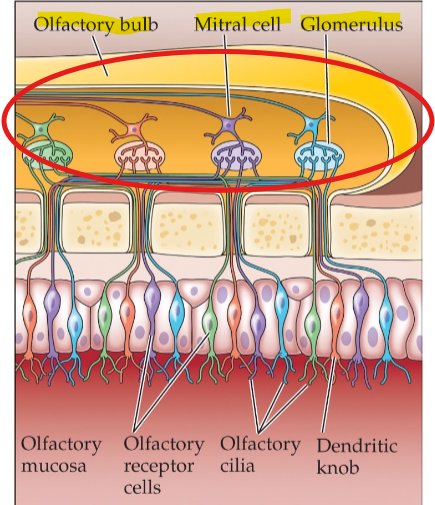
Where does olfactory information go from mitra cells
Primary olfactory cortex
What happens if the olfactory epithelium is damaged
Can be regenerated and will properly reconnect to olfactory bulb
Types of taste papillae
Circumvallate, foliate, fungiform
Where do taste cells extend cilia
Into the taste pore, opening at the surgact of the taste bud ans exposing them to tastants
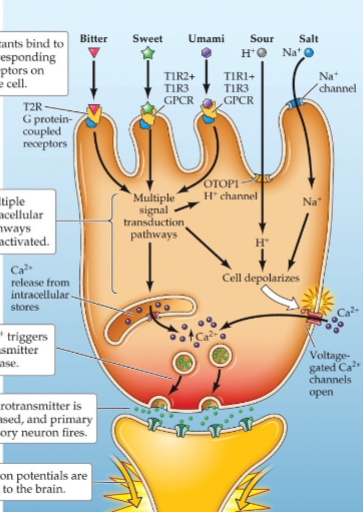
Salty taste cellular process
Na+ ions transported across taste cell membranes, causing depolarization that sends info to brain
Sour taste cellular process
Acids release H+ ions, the more acidic the food —> the more sour it tastes
Sweet, bitter, umami cellular process
All stimulate G-protein coupled receptors
5 steps of taste transduction
Tastants bind to corresponding receptor, multiple intercellular pathways activated, Ca2 triggers transmitter release, NT released and primary sensory neuron fires, action potentials sent to brain
Taste information pathway
tongue → cranial nerves → nuclei in brainstem → thalamus → cortical taste areas
Result of Parkinsons
Degeneration of dopaminergic neurons in substantia nigra
levodopa
Treatment for parkinsons, compund converted to dopamine in brain
6-OHDA
lesions to this cause dopamine loss and same deficits as parkinsons
Dementia
General term for memory loss and decline in other intellectual abilities interfering with daily life
Plaques
Deposits of beta-amyloid (protein fragment) that builds up between nerves
Tangles
twisted fibers of tau/protein that buildup in cells and disrupt nutrient transportation

