Biology - Chapter 29
0.0(0)
Studied by 14 people Call Kai
 Learn
Learn Practice Test
 Spaced Repetition
 Match
Match Flashcards
 Knowt Play
Card Sorting
1/5

Earn XP
Last updated 5:03 PM on 4/24/23
Name | Mastery | Learn | Test | Matching | Spaced | Call with Kai | Chat |
|---|
No analytics yet
Send a link to your students to track their progress
6 Terms
1
New cards
The relationship between senses and action potential.
The relationship is through the process of sensory transduction. Sensory transduction converts stimulus energy into receptor proteins which then trigger an action potential.
2
New cards
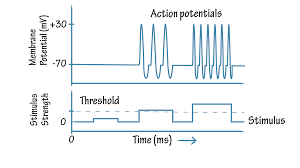
The relationship between action potentials and stimulus strength.
Strong stimulus strength = more frequent action potential
3
New cards
Types of sensory receptors associated with each of the senses.
Thermoreceptor: detect heat and cold
Chemoreceptor: respond to chemical (taste and smell)
Mechanoreceptor: respond to mechanical energy, such as touch (*hair cells*)'
Electromagnetic receptor: respond to electricity, magnetism, or light (photoreceptor)
Pain receptor: sense dangerous stimuli
Chemoreceptor: respond to chemical (taste and smell)
Mechanoreceptor: respond to mechanical energy, such as touch (*hair cells*)'
Electromagnetic receptor: respond to electricity, magnetism, or light (photoreceptor)
Pain receptor: sense dangerous stimuli
4
New cards
List the structures of the ear in the sequence in which they participate in hearing.
sound waves go through the outer ear, to the eardrum, to a chain of brains in the middle ear, and to the fluid in the cochlea in the inner ear
5
New cards
In what part of the ear is the organ of the Corti located?
The inner ear
6
New cards
Parts of the human eye and their functions.
cornea - protective covering for the front of the eyes and help focus light
retina - processes the light into signals
lens - bends the light to focus (fine focus)
pupil - controls the amount of light entering the eyes
iris - regulate the amount of light entering the eyes
optic nerve - relay messages from eyes to brain
retina - processes the light into signals
lens - bends the light to focus (fine focus)
pupil - controls the amount of light entering the eyes
iris - regulate the amount of light entering the eyes
optic nerve - relay messages from eyes to brain