Form Perception 1 and 2
 Call Kai
 Learn
Learn Practice Test
 Spaced Repetition
 Match
Match Flashcards
 Knowt Play
1/64

There's no tags or description
Looks like no tags are added yet.
Name | Mastery | Learn | Test | Matching | Spaced | Call with Kai |
|---|
No analytics yet
Send a link to your students to track their progress
65 Terms
Gestalt Philosophy
The whole is other than the sum of its parts and has an independent representation
Gestalt Principles
Laws that describe how we organize visual input and include:
Figure ground
Proximity
Closure
Similarity
Continuity
Common Fate
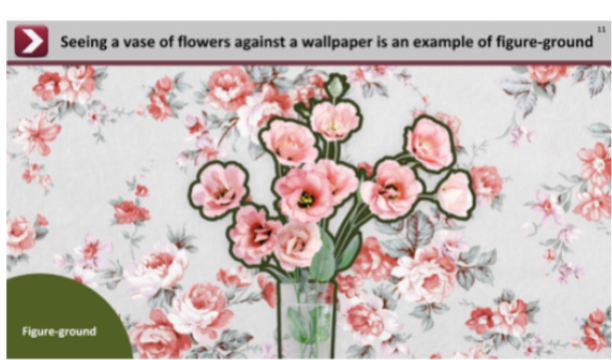
Figure-ground
The ability to distinguish an object from its background in a visual scene
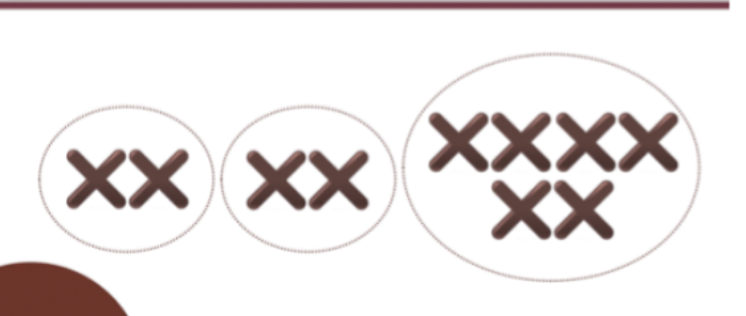
Proximity
The tendency to group elements that are close together in space
Closure
The tendency to fill in gaps in a contour to perceive a whole object

Similarity
The tendency to group together elements that are physically similar
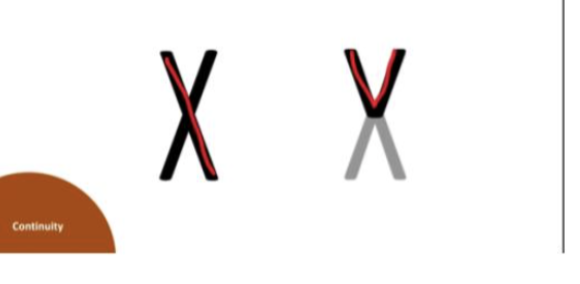
Continuity
The ability to perceive a simple, continuous form rather than a combination of awkward forms
Common Fate
The tendency to group together elements that change in the same way

Bottom-Up Processing
Object recognition guided by features present in the stimulus
Top-Down Processing
Object recognition guided by beliefs, expectations, and prior knowledge
Bidirectional Processing
Interaction of bottom-up and top-down processing where top-down processing cannot work alone because you need input from the stimulus itself before your expectations about that stimulus can influence your recognition of it
Geon Theory
Objects are recognized using basic geometric shapes called geons and we have 36 different “geons”
Geon Theory Limitation
Cannot fully explain recognition of complex objects or brain injury effects where damage to specific areas can affect recognition for different classes of objects
Template Theory
Objects are recognized by matching them to stored templates in memory
Template Theory Limitation
Requires exact matches and large storage capacity
Prototype Theory
Objects are recognized by comparing them to an ideal or average representation
What does prototype theory not explain?
how we can categorize unique specific objects
Perceptual Constancy
Our ability to perceive an object as unchanging even though the visual image produced by the object is constantly changing
Shape Constancy
How an object is perceived to have a constant shape despite the shape of its retinal image changing with shifts in POV or change in object position

Location Constancy
An object is perceived to be stationary despite changing location on our retina due to body movements
Size Constancy
An object is perceived to be the same size despite the size of its retinal image varying with distance
Brightness Constancy
An object is perceived to be the same brightness despite reflecting more or less light onto our retina
Colour Constancy
An object is perceived to have a constant colour despite different illumination conditions
Muller-Lyer Illusion
Lines appear different lengths due to arrow-like ends, cultures and environments without right angles (round huts) are less susceptible
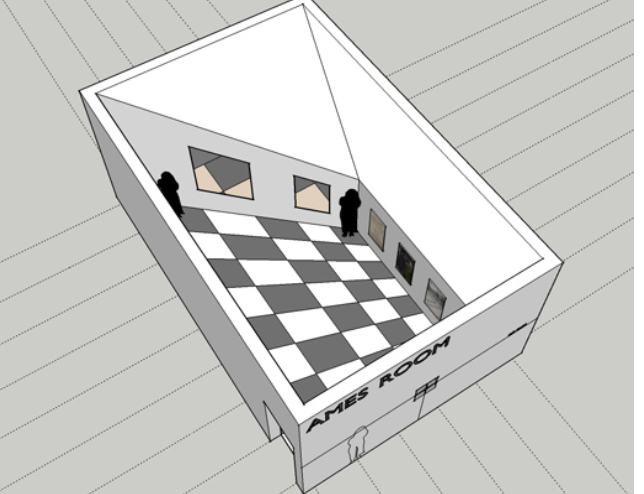
Ames Room
Trapezoidal room where the person that is closer appears to be much larger than the person that is further
Manipulates distance to trick size constancy
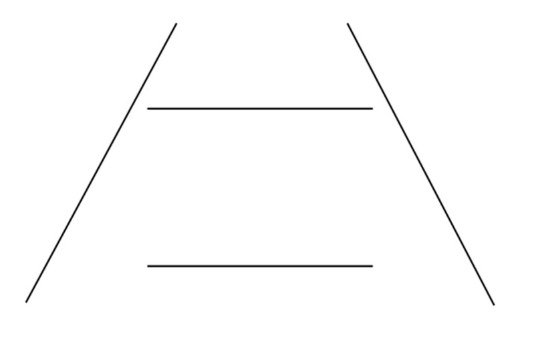
Ponzo Illusion
Depth cues make identical lines appear different in size
Hodgkin and Huxley discovery
discovered neurons in the optic nerve of a frog respond only to movign black dots “bug detectors”
hubel and weisley discovery
Accidentally discovered feature detector cells where they used cats and showed them a light moving and expanding at various different points
As a result, the cell would fire more frequently when the light was in the preferred position
Feature Detector Cells
Neurons in the visual cortex that respond to specific visual features
Simple Cell Maximal Response
Preferred orientation and location in the receptive field
Strong excitatory response
Simple Cell Below Baseline Response
When stimulus is not in preferred orientation or outside of the “ON” region of the receptive field
Complex Cell Maximal Response
Responds maximally to a certain orientation and direction of movement regardless of location
Complex Cell Below Baseline Response
a bar of light that is not preferred orientation or direction of movement
Hypercomplex Cell Maximal Response
Respond maximally to a bar of a particular orientation and direction of movement ending at specific points within the receptive field(lengths)
Hypercomplex Cell Basline Response
No stimulus
Hypercomplex Cell Below Baseline Response
when the stimulus is not in the preferred orientation or direction of movemen
Topographic Organization Function
Spatial arrangement that allows parallel processing for faster perception
Extrastriate cortex
region which has multiple subregions that each receive a different type of information from the primary visual cortex (colour, movement, orientation, etc.)
Dorsal Stream
“Where” stream
Location and movement
Sends the information to the parietal cortex which processes spatial information
Ventral Stream
“What” stream
Form and colour
Sends information to the temporal cortex
Temporal Cortex
Respond to more complex stimuli than what primary visual cortex responds to
Can include hands, faces, apples, chairs
Temporal Cortex Arrangement
Arranged in vertical columns that are oriented perpendicularly to the surface of the cortex
Respond to different complex stimuli
Temporal cortex columns
in each column there are six layers of neurons with each layer responding to complex stimuli that came from the same category (red apples vs green apples)
Infant Recognition
Infants have the machinery to perceive patterns and objects but they cannot necessarily recognize
Infants prefer more complex patterns (than simple patterns) that they can perceive (could be due to visual acuity, bigger vs smaller checkers)
Whole Form Perception
Infants only begin focusing on whole objects after 2 months of age
Whole form perception is an emerging process over the first two months of life
Partial Form Perception
Infant can perceive partial forms as whole forms by 3 months of age
Suggests that they are guided by the Gestalt principle of closure
Partial Form Perception Test
Tested through habituation of a whole square vs four circle square vs four circle circle
Perception of Overlapping Objects at 3 months
can identify separate objects if objects move independently of one another
Perception of Overlapping Objects at 5 months
Begin to use cues like colour or texture to distinguish objects to distinguish between overlapping objects
Form Recognition at 4 months
Recognition of brightness, colour, and shape constancy begins
Size Constancy (Infants)
Begins developing around 4–5 months, infants have some sense of size constancy and understand that an object that is farther away should produce a smaller retinal image
Face Recognition 2 months
Infants at 2 months old like looking at attractive faces over unattractive faces and look at their mother over stranger
Focus their gaze on the outer contours of the face until 2 months old
Face Recognition 5 months
Infants at 5 months can detect different emotional expressions
Cataract Effect on visual development in infants
if they have it removed and replaced with artifical lens, not many visual impairments
if they have it removed later, there is an increase in visual impairment which may not be immediately obvious but visual deficits will be encountered later in life
Sleeper Effect
When normal visual input is disrupted by the presence of the cataracts in early development, the impact may not be immediately obvious, but visual deficits will be encountered in later life
Visual Agnosia
Damage to the extrastriate cortex disrupts object recognition
Object Agnosia
Inability to perceive and recognize objects
Prosopagnosia
Inability to recognize faces
Pareidolia
Interpreting vague stimuli as something familiar
configural face processing
emphasis on face as a whoel
featural face processing
emphasis on features individually
composite face effect
perceptual phenomenon where aligning the top half of one face with the bottom half of another makes it difficult to identify the individual halves, as they are automatically blended into a new, single "whole" face
Thatcher Illusion
Where distorted facial features (upside down eyes and mouth) are difficult to detect when the face is upside down) but upright, it looks grotesque
Flashed Face Distortion Effect
Visual illusion where rapidly alternating, normal faces viewed in the periphery appear grotesque, distorted, or cartoonish.
Hollow Face Illusion
Hollow face which is actually concave appears to be convex due to top down processing
Explore top notes

