MAT172 Chapter 7: Trigonometric Functions
 Call Kai
 Learn
Learn Practice Test
 Spaced Repetition
 Match
Match Flashcards
 Knowt Play
1/120

Earn XP
Description and Tags
Based on Chapter 7: Trigonometric Functions from the 8th edition of Algebra & Trigonometry, Enhanced with Graphing Utilities by Michael Sullivan and Michael Sullivan III. Table of Contents: Section 7.1: cards 1 - 21; Section 7.2: cards 22 - 41; Section 7.3: cards 42 - 43; Section 7.4: cards 44 - 51; Section 7.5: cards 52 - 83; Section 7.6: cards 84 - 102; Section 7.7: cards 103 - 115; Section 7.8: cards 116 - 121.
Name | Mastery | Learn | Test | Matching | Spaced | Call with Kai | Chat |
|---|
No analytics yet
Send a link to your students to track their progress
121 Terms
Degrees to Minutes
1° = 60'
Minutes to Seconds
1’ = 60”
Degree to DMS
Whole degrees, multiply the decimal by 60 and take the whole for minutes, multiply decimals by 60 and take the whole for seconds
DMS to Degree
Divide seconds by 60, add the decimals to minutes and divide by 60, add decimals to degrees
Co-Terminal Angles
Angles that differ by 360°
Positive Angle
Follows counterclockwise rotation
Negative Angle
Follows clockwise rotation
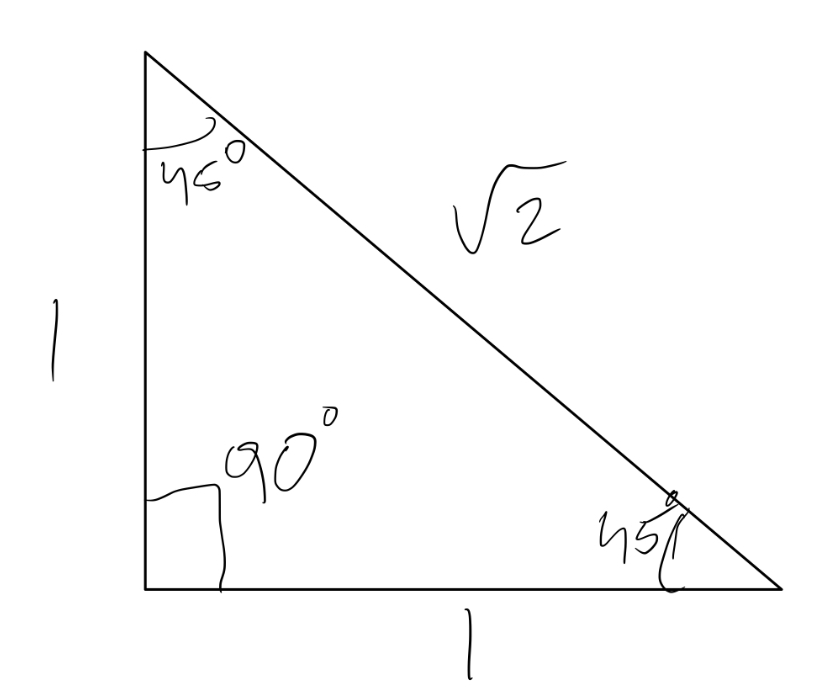
Isosceles Right Triangle
45-90-45
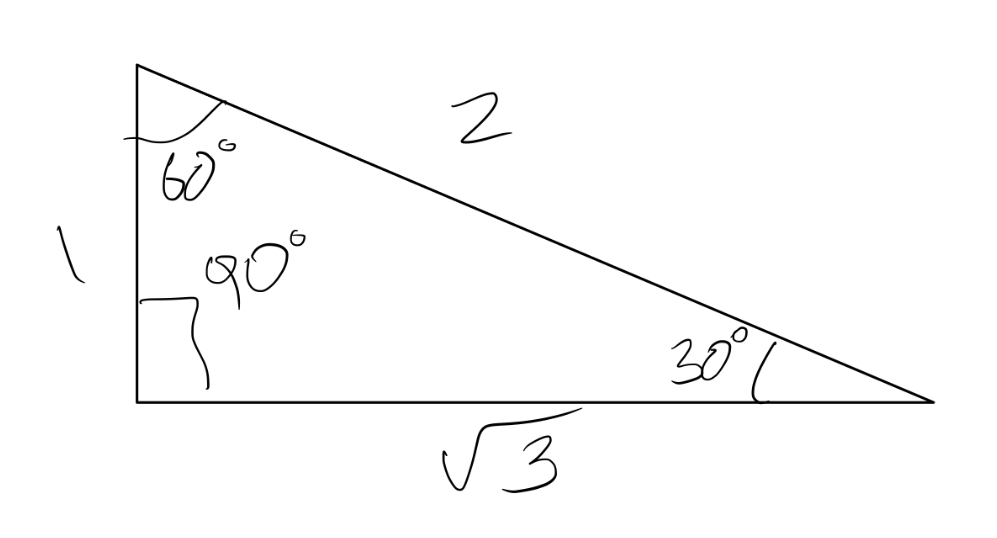
30/60 Triangle
60-90-30
Initial side of an angle
Where the angle begins
Terminal side of an angle
Where the angle stops
Standard position of an angle
When the vertex of an angle is at the origin an the initial side coincides with the positive x-axis
Quadrantal Angle
When the angle is in the standard position and the terminal side lies in one of the quadrants
Arc Length Theorem
s = rθ
Radian measure
θ = s/r
Degree to radians
1° = π/180 radians
Radians to degrees
1 radian = 180/π degrees
Area of a Sector Theorem
A = ½r²θ
Linear Speed of an Object
v = s/t
Angular Speed of an Object
ω = θ/t
Speed of an object traveling in circular motion
v = rω
sinθ
Opposite/hypotenuse
y/r
cosθ
Adjacent/hypotenuse
x/r
tanθ
Opposite/adjacent
y/x
cscθ
Hypotenuse/opposite
r/y
secθ
Hypotenuse/adjacent
r/x
cotθ
Adjacent/opposite
x/y
Reciprocal identity of cscθ
1/sinθ
Reciprocal identity of secθ
1/cosθ
Reciprocal identity of cotθ
1/tanθ
Quotient identity of tanθ
sinθ/cosθ
Quotient identity of cotθ
cosθ/sinθ
sinθ and cosθ Pythagorean identity
sin²θ + cos²θ = 1
cotθ and cscθ Pythagorean identity
1 + cot²θ = csc²θ
tanθ and secθ Pythagorean identity
tan²θ + 1 = sec²θ
sinθ and cosθ Complementary Angle Theorem in degrees
sinθ = cos(90° − θ)
cosθ = sin(90° − θ)
cscθ and secθ Complementary Angle Theorem in degrees
cscθ = sec(90° − θ)
secθ = csc(90° − θ)
tanθ and cotθ Complementary Angle Theorem in degrees
tanθ = cot(90° − θ)
cotθ = tan(90° − θ)
sinθ and cosθ Complementary Angle Theorem in radians
sinθ = cos(π/2 − θ)
cosθ = sin(π/2 − θ)
cscθ and secθ Complementary Angle Theorem in radians
cscθ = sec(π/2 − θ)
secθ = csc(π/2 − θ)
tanθ and cotθ Complementary Angle Theorem in radians
tanθ = cot(π/2 − θ)
cotθ = tan(π/2 − θ)
Angle of elevation
The acute angle measured from the horizontal to line-of-sight observation of the object when looking up
Angle of depression
The acute angle measured from the horizontal to line-of-sight observation of the object when looking down
Co-terminal Angles
Two angles in standard position that have the same terminal side
What quadrants are sinθ and cscθ positive?
Quadrant I and Quadrant II
What quadrants are sinθ and cscθ negative?
Quadrant III and Quadrant IV
What quadrants are cosθ and secθ positive?
Quadrant I and Quadrant IV
What quadrants are cosθ and secθ negative?
Quadrant II and Quadrant III
What quadrants are tanθ and cotθ positive?
Quadrant I and Quadrant III
What quadrants are tanθ and cotθ negative?
Quadrant II and Quadrant IV
Reference Angle
The acute angle formed by the terminal side of θ and the x-axis
What is the point (x, y) in terms of cosθ and sinθ?
(cos t, sin t)
What is the sinθ of the point (x, y) in terms of x, y, r?
sinθ = y/r
What is the cosθ of the point (x, y) in terms of x, y, r?
cosθ = x/r
What is the tanθ of the point (x, y) in terms of x, y, r?
tanθ = y/x, x ≠ 0
What is the cscθ of the point (x, y) in terms of x, y, r?
cscθ = r/y, y ≠ 0
What is the secθ of the point (x, y) in terms of x, y, r?
secθ = r/x, x ≠ 0
What is the cotθ of the point (x, y) in terms of x, y, r?
cotθ = x/y, y ≠ 0
What is the domain of sinθ?
All real numbers
What is the range of sinθ?
-1 ≤ sinθ ≤ 1
What is the domain of cosθ?
All real numbers
What is the range of cosθ?
-1 ≤ cosθ ≤ 1
What is the domain of tanθ?
All real numbers except odd multiples of π/2 (π/2, 3π/2, 5π/2 …)
What is the range of tanθ?
-∞ < tanθ < ∞
What is the domain of cotθ?
All real numbers except integer multiples of π (0, π, 2π, 3π …)
What is the range of cotθ?
-∞ < cotθ < ∞
What is the domain of secθ?
All real numbers except odd multiples of π/2 (π/2, 3π/2, 5π/2 …)
What is the range of secθ?
secθ ≤ -1 or secθ ≥ 1
What is the domain of cscθ?
All real numbers except integer multiples of π (0, π, 2π, 3π …)
What is the range of cscθ?
cscθ ≤ -1 or cscθ ≥ 1
When is a function called periodic?
A function ƒ is called periodic if there is a positive number p with the property that, whenever θ is in the domain of ƒ, so is θ + p, and ƒ(θ + p) = ƒ(θ)
What is the period of sinθ?
2π or 360°
What is the period of cosθ?
2π or 360°
What is the period of tanθ?
π or 180°
What is the period of cscθ?
2π or 360°
What is the period of secθ?
2π or 360°
What is the period of cotθ?
π or 180°
What is the even-odd property of sinθ?
sin(-θ) = -sinθ
What is the even-odd property of cosθ?
cos(-θ) = cosθ
What is the even-odd property of tanθ?
tan(-θ) = -tanθ
What is the even-odd property of cscθ?
csc(-θ) = -cscθ
What is the even-odd property of secθ?
sec(-θ) = secθ
What is the even-odd property of cotθ?
cot(-θ) = -cotθ
Function of sinθ in an xy-plane
ƒ(x) = sin x
Function of cosθ in an xy-plane
ƒ(x) = cos x
Function of tanθ in an xy-plane
ƒ(x) = tan x
Function of cscθ in an xy-plane
ƒ(x) = csc x
Function of secθ in an xy-plane
ƒ(x) = sec x
Function of cotθ in an xy-plane
ƒ(x) = cot x
Draw a graph of ƒ(x) = sin x
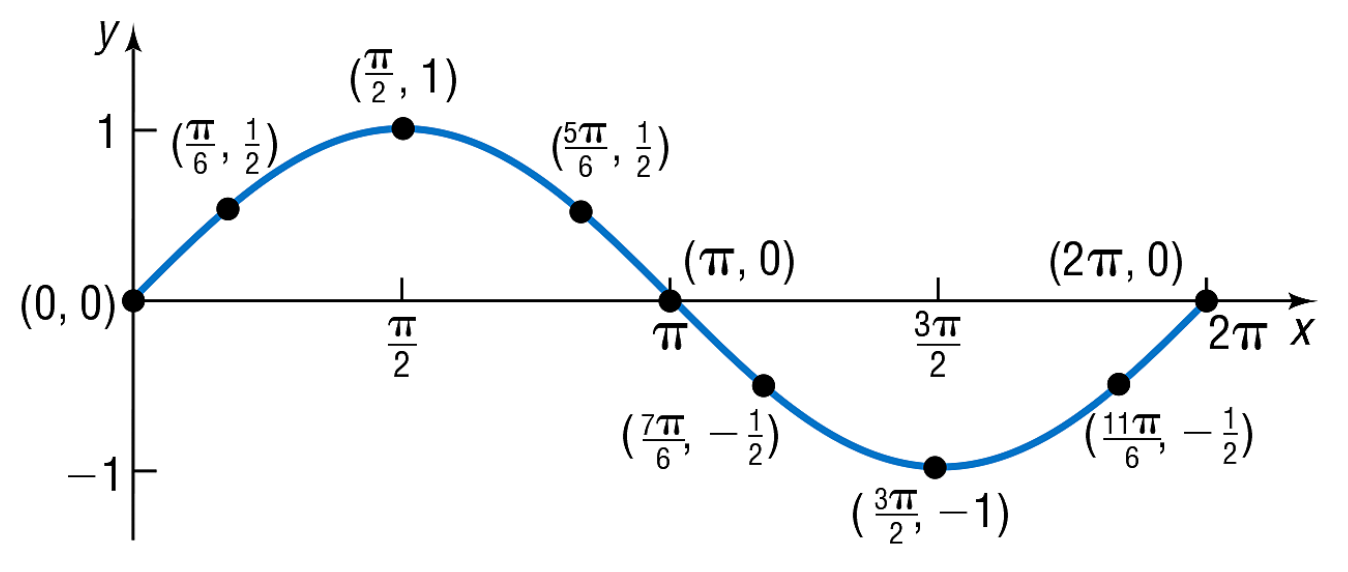
What are the intercepts of ƒ(x) = sin x?
x = … -2π, -π, 0, π, 2π, …
y = 0
What is the maximum of ƒ(x) = sin x?
y = 1 at x = … -3π/2, π/2, 5π/2, …
What is the minimum of ƒ(x) = sin x?
y = -1 at x = … -π/2, 3π/2, 7π/2, …
Draw a graph of ƒ(x) = cos x
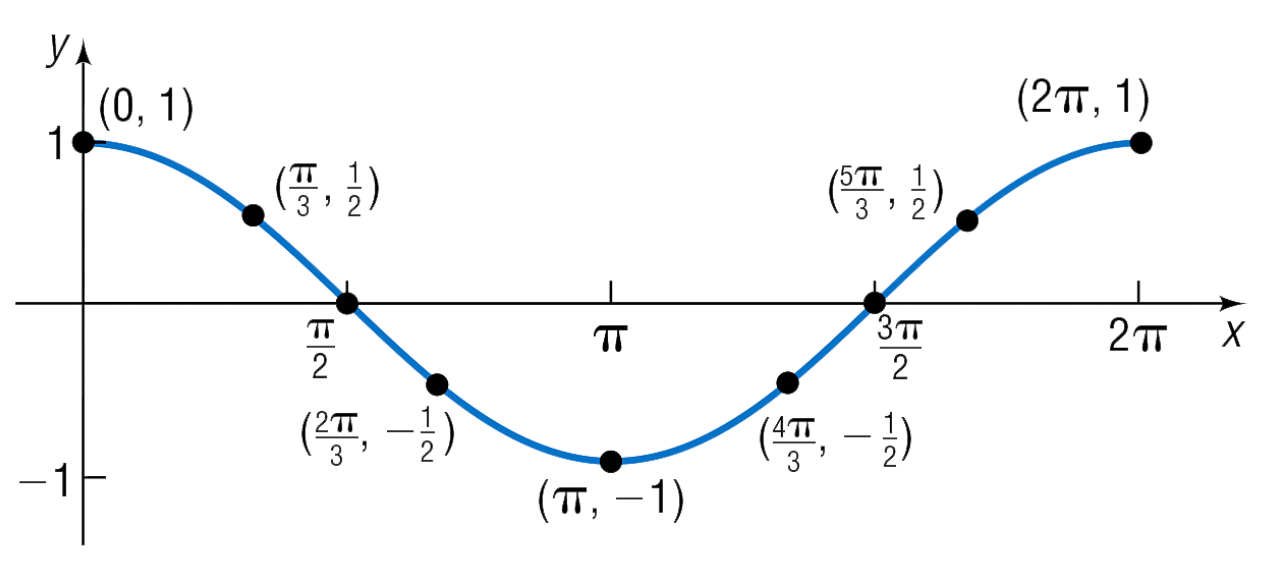
What are the intercepts of ƒ(x) = cos x?
x = … -3π/2, -π/2, π/2, 3π/2, …
y = 1
What is the maximum of ƒ(x) = cos x?
y = 1 at x = … -2π, 0, π, …
What is the minimum of ƒ(x) = cos x?
y = -1 at x = -π, π, 3π, …
What are sinusoidal functions?
Any curve that is a transformation of the sine curve
Sinusoidal relationship between cos x and sin x
cos(x - π/2) = sin x
What is the amplitude of a sinusoidal function?
The height between the max/min value and x-axis, written as A in ƒ(x) = A sin x