Amplitude and Frequency Modulation - 10/20
 Studied by 0 people
 Call Kai
 Learn
Learn Practice Test
 Spaced Repetition
 Match
Match Flashcards
 Knowt Play
1/11

There's no tags or description
Looks like no tags are added yet.
Name | Mastery | Learn | Test | Matching | Spaced | Call with Kai |
|---|
No analytics yet
Send a link to your students to track their progress
12 Terms
what does modulation mean?
to change or exert a modifying control on
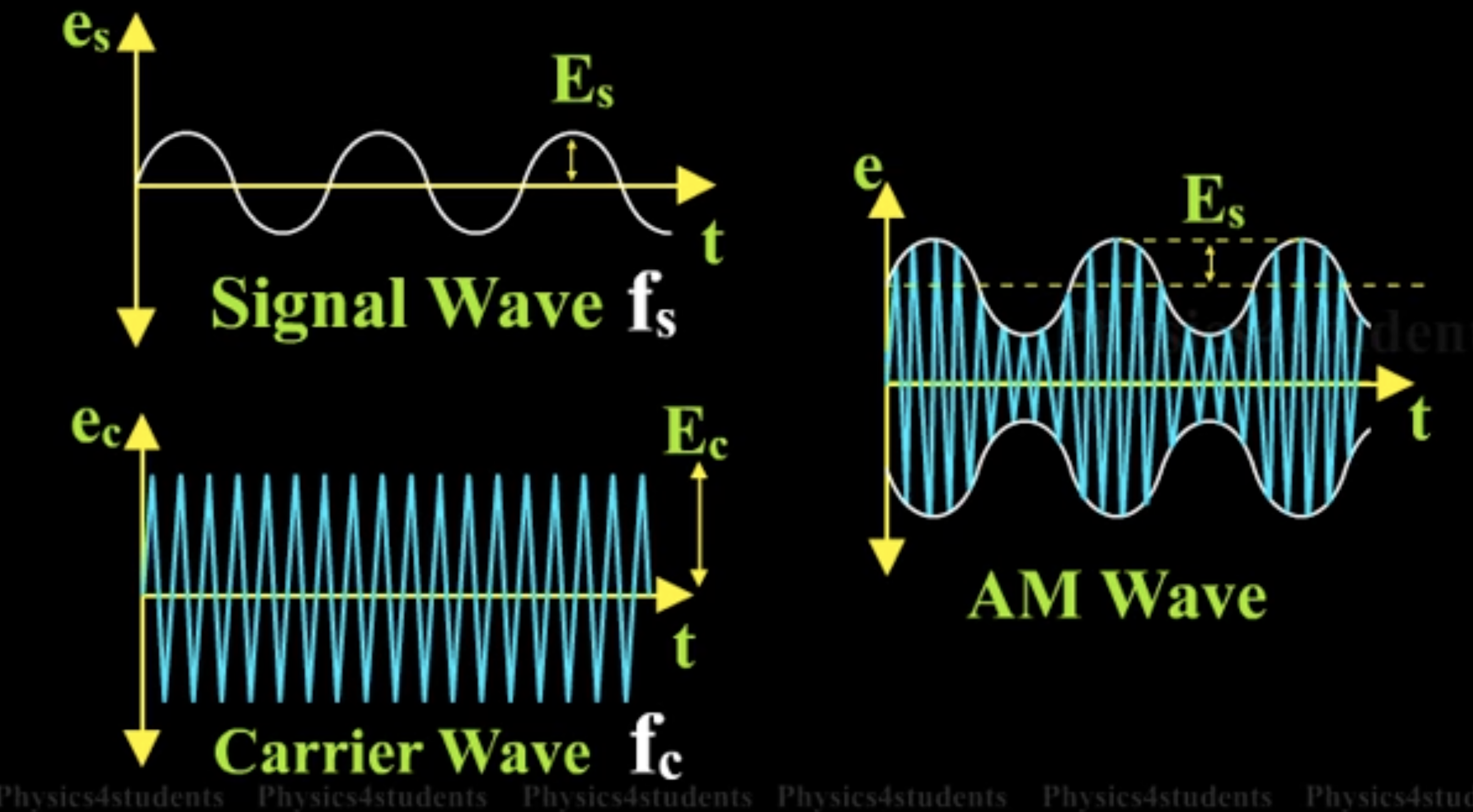
what is amplitude modulation (AM)?
a technique used in communication systems (like radio) where you take a high-frequency carrier wave and vary its amplitude according to a lower frequency message signal (like audio).
a process where the amplitude of a carrier signal is altered according to information in a message signal
explain amplitude modulation using an analogy
carrier wave: a fast, steady “blank” signal (like a flashlight blinking on and off quickly)
message/audio signal: the info you want to send (like someone talking)
amplitude modulation: making the flashlight brighter and dimmer following the shape of the message
what is the point of amplitude modulation? why do we have to use a carrier wave?
it allows for long-distance transmission, separates stations by frequency.
we need a carrier wave because the frequencies of our voices/audio signals cannot be transmitted long distances on their own. a high frequency carrier wave (like a 1 MHz for AM radio) is designed to travel much farther, work with antennas of practical size, and avoid interference by placing each station in a different frequency “slot”
why do we used high frequency carrier waves instead of low-frequency carrier waves for AM?
High-frequency signals create smaller wavelengths, meaning that smaller/more reasonable antennas can pick them up, and they propagate for kilometers → so we “piggyback” the audio onto them
Low frequency signals create huge wavelengths, meaning that antennas would have to be huge to pick up the signals → completely impractical
how does the frequency of the carrier signal in an AM wave compare to the highest frequency of the input message signal?
the frequency of the carrier signal in an AM wave is usually much greater than the highest frequency of the input message signal
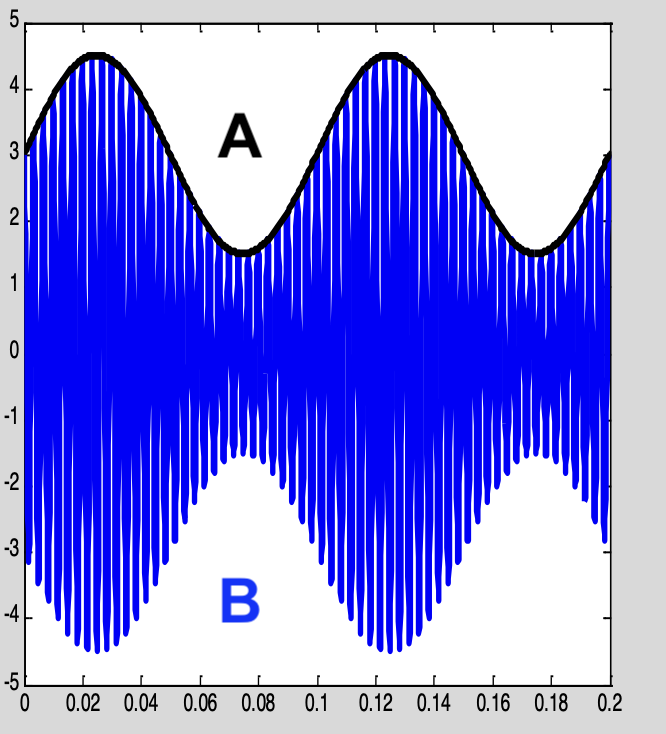
label and define each part
A: envelope = the curve that traces the peaks of the AM signal → contains the original message
B: AM signal = a high-frequency carrier wave that follows this envelope so that it can be transmitted
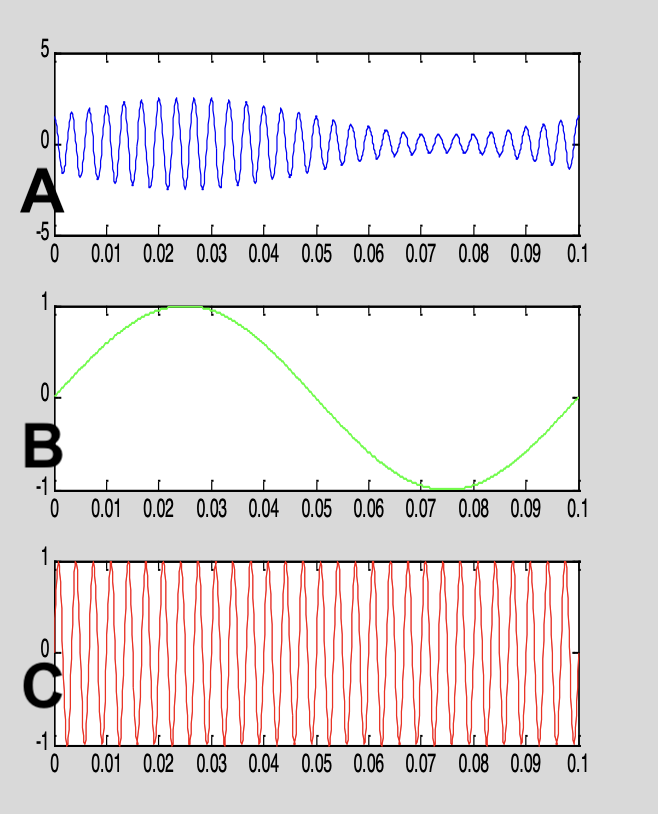
label
A: amplitude modulated signal
B: the modulating signal
C: carrier frequency
in an AM signal, does the frequency change?
no, the frequency does not change. only the amplitude changes.
what is frequency modulation (FM)?
a technique used to encode information onto a carrier wave by varying its frequency in proportion to the message signal's amplitude, often periodically
a wave that contains audio information encoded as frequency shifts
in an FM signal, does the amplitude change?
no, the amplitude does not change. only the frequency changes
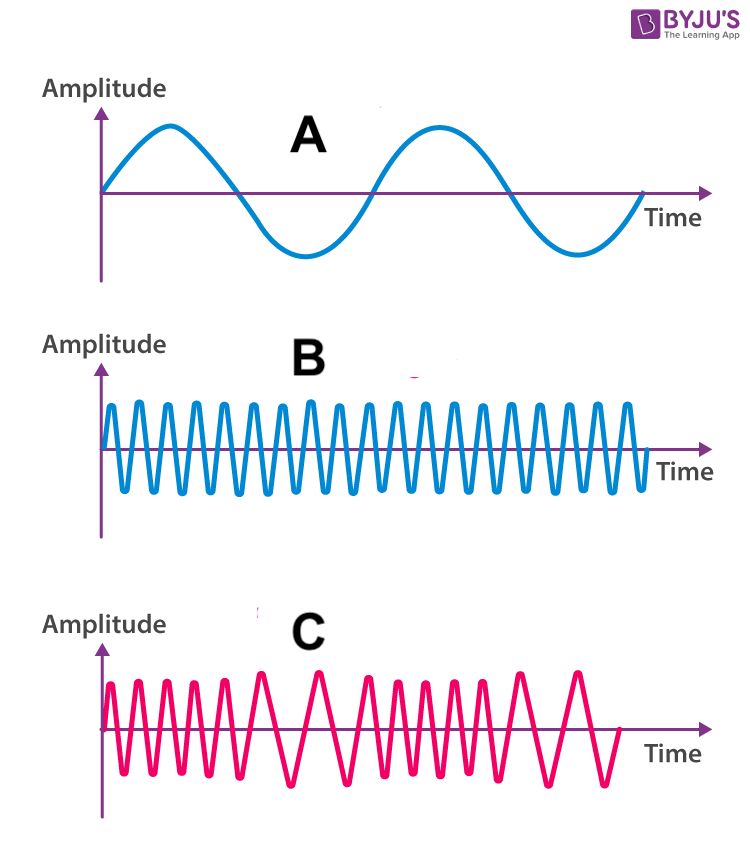
label the parts and define
A: the message signal = the information you want to send
B: the carrier frequency = a blank, high frequency sine wave (consistent frequency before modulation)
C: the FM signal = the carrier wave after being modulated by the message signal
where diagram A is higher, the wavelengths in diagram C are closer together. where diagram A is lower, the wavelengths in diagram C are farther apart.
 Note
Note  Flashcards (26)