🧑⚖️ Intro to Animal Law + Animals in Canadian Legislation
 Call Kai
 Learn
Learn Practice Test
 Spaced Repetition
 Match
Match Flashcards
 Knowt Play
1/34

There's no tags or description
Looks like no tags are added yet.
Name | Mastery | Learn | Test | Matching | Spaced | Call with Kai |
|---|
No analytics yet
Send a link to your students to track their progress
35 Terms
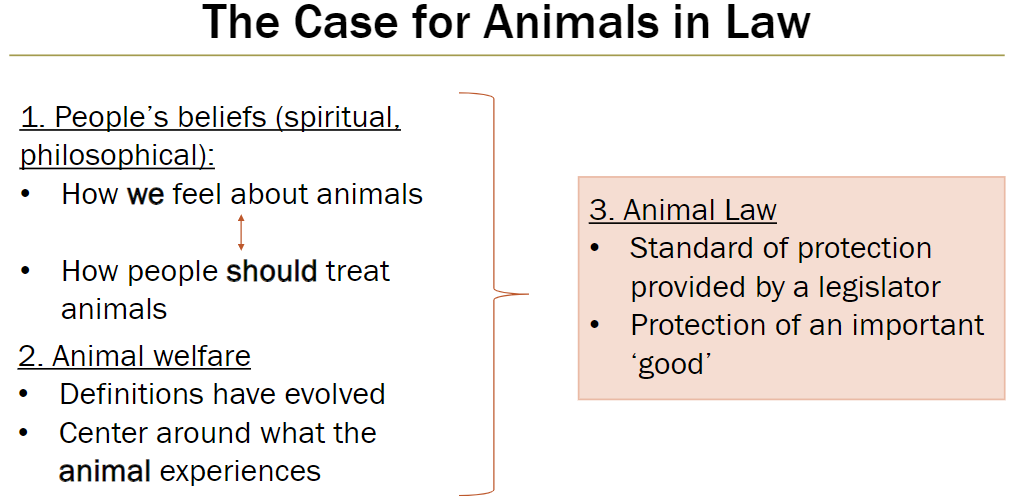
The Case for Animals in Law
Introduction: Animal Law
Concerned with how animals are treated and protected under the law
People’s Beliefs (Spiritual, Philosophical)
How people feel about animals
How people believe animals should be treated
Animal Welfare
Definitions have evolved
Focuses on what the animal experiences
Animal Law
Standard of protection set by legislators
Protects an important “good” (animal welfare)
Law, Rights, and Duties Overview
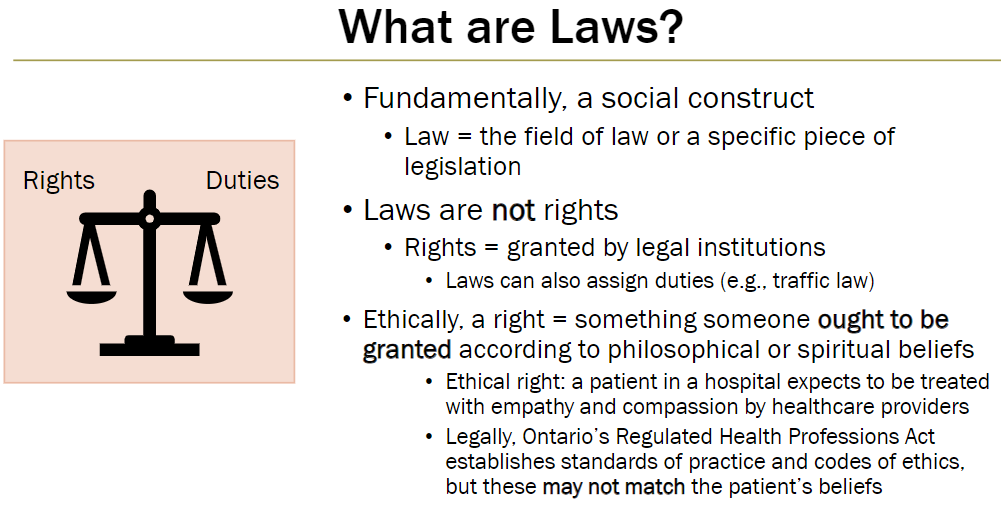
Fundamentally, a social construct
Law exists because societies agree on rules and institutions
What Is Law
Law is the field of law or a specific piece of legislation
Legislation means formally written rules
Laws vs Rights
Laws regulate behavior, what is allowed required or prohibited
Laws are not rights
Rights are granted by legal institutions like governments or courts
Duties
Laws can assign duties, meaning obligations
Example, traffic law requires stopping at red lights
Ethical Rights
Ethically, a right is something a person ought to be granted
Based on moral philosophical or spiritual beliefs
Example, patients expect empathy and compassion
Empathy means understanding feelings, compassion means caring action
Legal Standards
Ontario’s Regulated Health Professions Act sets standards of practice and codes of ethics
These legal standards may not match patient beliefs
Animal Law
Animal law studies how laws define rights duties and protections for animals
Rights and Duties Relationship
Rights describe what someone is entitled to receive
Duties describe what someone is obligated to do
Foundations of Law and Classification
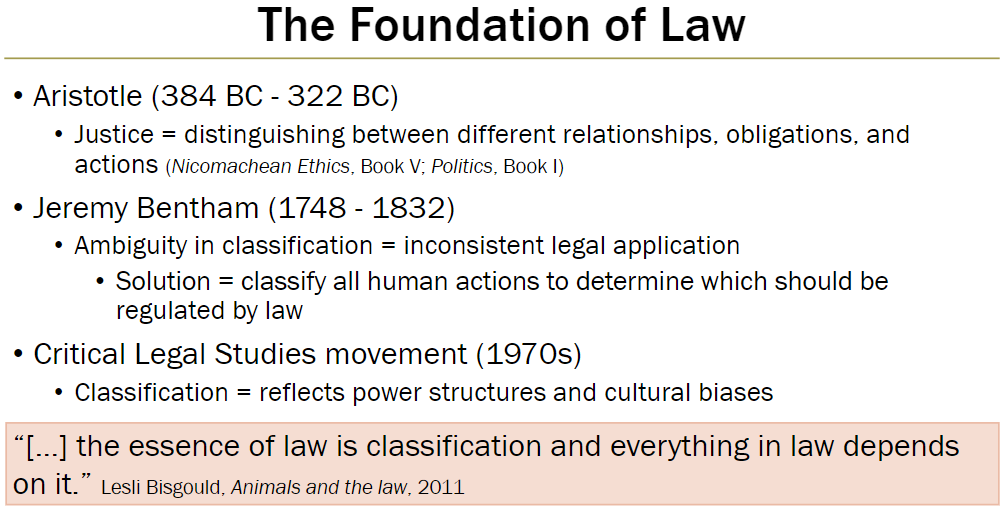
Aristotle 384–322 BC
Justice means distinguishing between different relationships, obligations, and actions
From Nicomachean Ethics Book V and Politics Book I
Justice depends on understanding how situations differ
Jeremy Bentham 1748–1832
Problem, ambiguity in classification leads to inconsistent legal application
Different categories cause different legal outcomes
Solution, classify all human actions
Goal is to decide which actions should be regulated by law
Critical Legal Studies 1970s
Classification is not neutral
It reflects power structures and cultural biases
Who defines categories influences legal outcomes
Core Idea of Law
Law relies on classification
Everything in law depends on how things are categorized
Quote, the essence of law is classification
Lesli Bisgould, Animals and the Law, 2011
Animals as Property
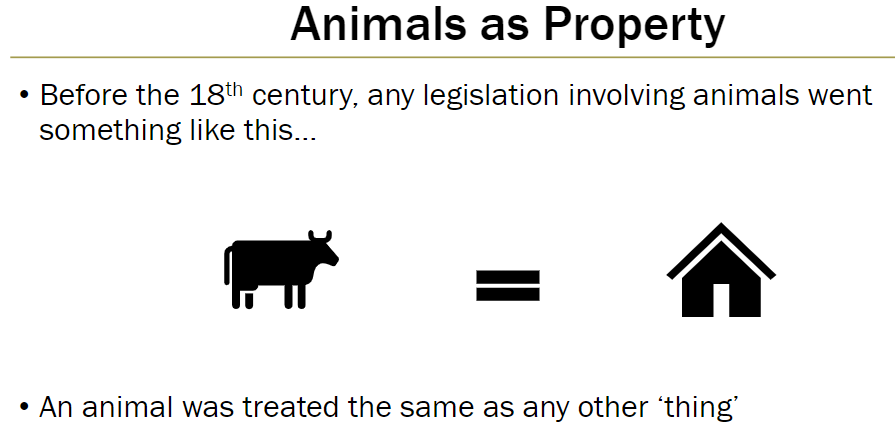
Before the 18th century, animals were treated like any other ‘thing’
Laws considered them property, not beings with rights
Legal status focused on ownership, not welfare
Why Classify Animals as Things
Eurocentric Thinking
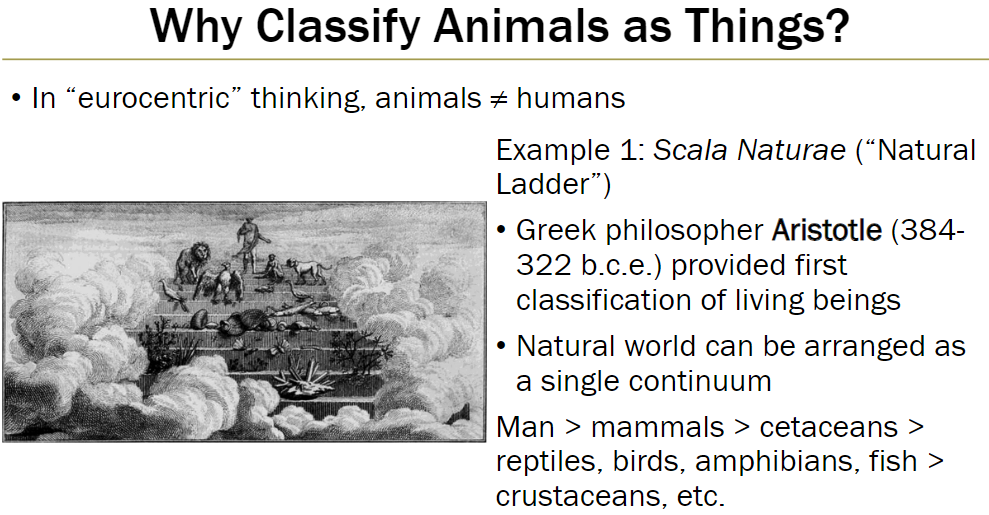
Traditionally, animals were considered distinct from humans
Scala Naturae (Natural Ladder)
Proposed by Charles Bonnet (1781) based on Aristotle’s earlier classification of living beings (384–322 B.C.E.)
Natural world arranged as a single continuum from “higher” to “lower” beings, e.g., Man > mammals > cetaceans > reptiles, birds, amphibians, fish > crustaceans, etc.
Animals as Automata – Eurocentric Views
Descartes and Rationality
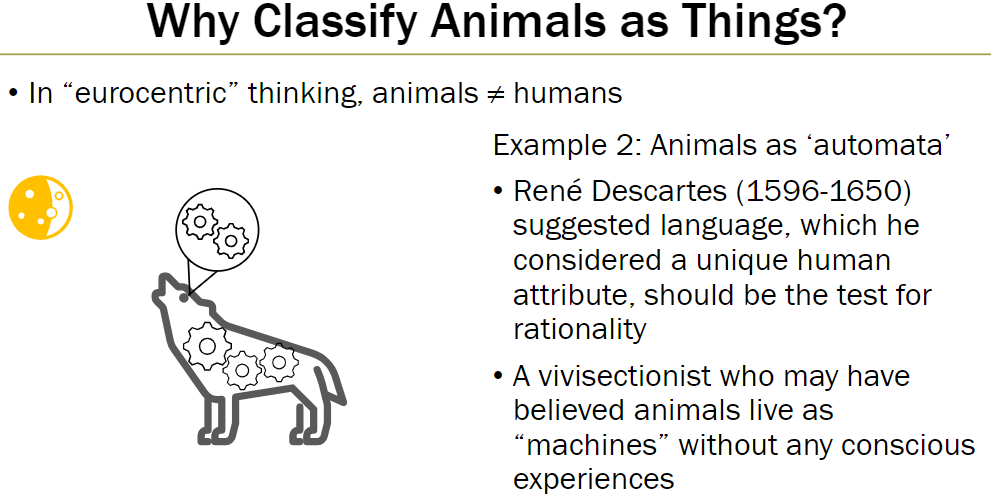
René Descartes (1596–1650) argued language, a uniquely human trait, should test for rationality
Implications for Animals
Animals were considered “machines” without conscious experience
Some vivisectionists treated animals as if they lived mechanically, lacking feelings or awareness
Animals in Legislation – Early Advocacy
Humphry Primatt (1776)
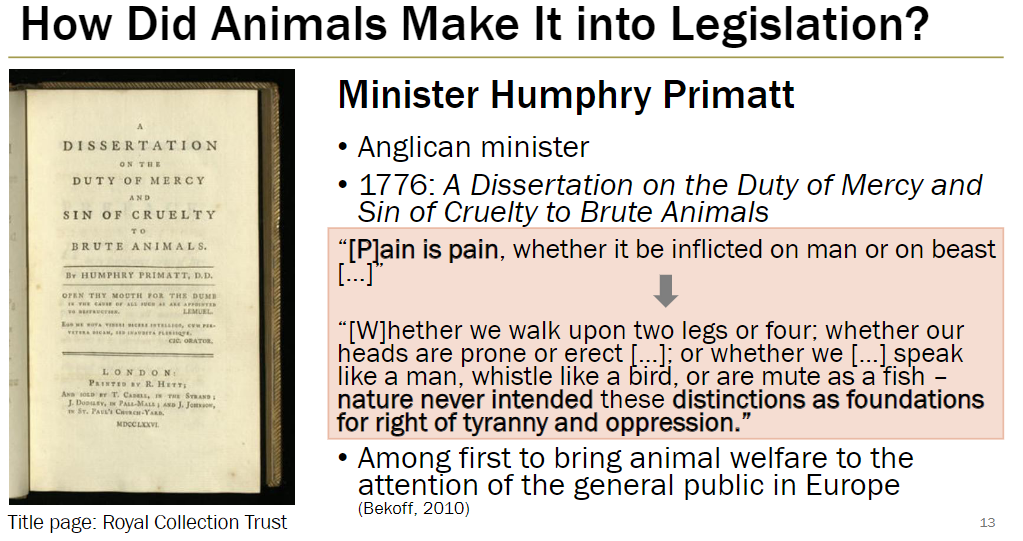
Anglican minister who wrote A Dissertation on the Duty of Mercy and Sin of Cruelty to Brute Animals
Key Ideas
“Pain is pain, whether inflicted on man or beast”
“Whether we walk on two legs or four; whether heads are prone or erect; whether we speak like humans, whistle like birds, or are mute like fish—nature never intended these distinctions as basis for tyranny or oppression”
Impact
Among first to bring animal welfare to public attention in Europe
Highlighted ethical duty to prevent cruelty toward animals
Animals and Legal Protection – Bentham’s Influence
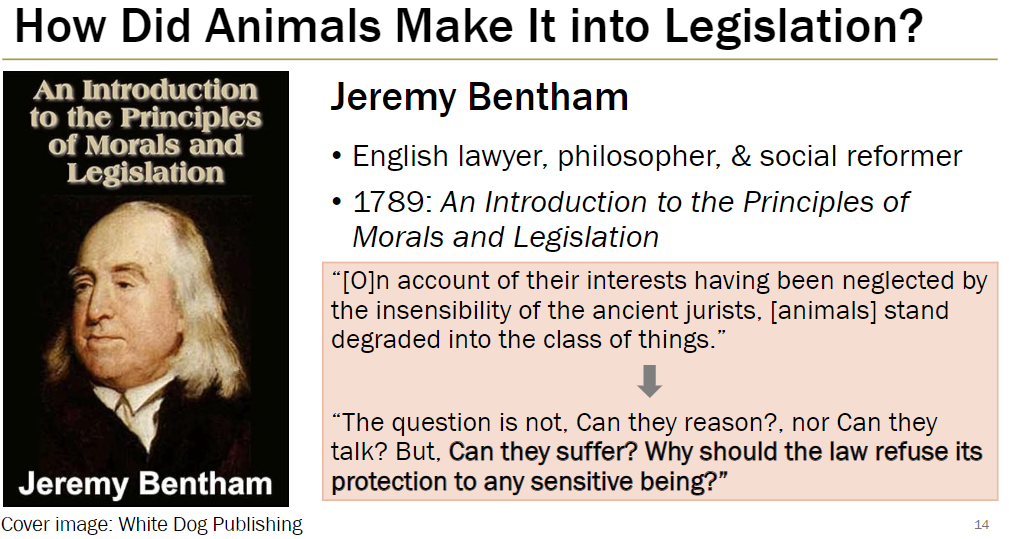
Jeremy Bentham (1789)
English lawyer, philosopher, and social reformer
Wrote An Introduction to the Principles of Morals and Legislation
Key Ideas
Animals were historically treated as “things” because their interests were ignored by ancient jurists
Bentham argued the relevant question is not “Can they reason?” or “Can they talk?” but “Can they suffer?”
Law should protect all sensitive beings, not just humans
Early Animal Protection Legislation – Richard “Humanity Dick” Martin
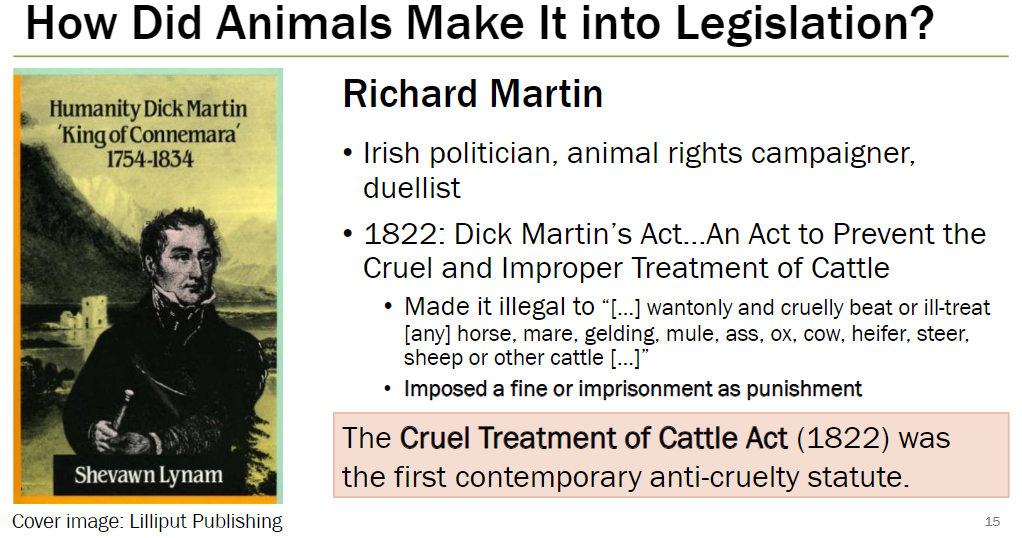
Richard Martin (1754–1834)
Irish politician, animal rights campaigner, and duellist
The 1822 Act
An Act to Prevent the Cruel and Improper Treatment of Cattle
Made it illegal to “wantonly and cruelly beat or ill-treat any horse, mare, gelding, mule, ass, ox, cow, heifer, steer, sheep or other cattle”
Offenders faced fines or imprisonment
Significance
The Cruel Treatment of Cattle Act (1822) was first contemporary anti-cruelty statute
Marked a major step in legal protection for animals
Enforcement of Early Animal Laws – Martin’s Act
Early Enforcement
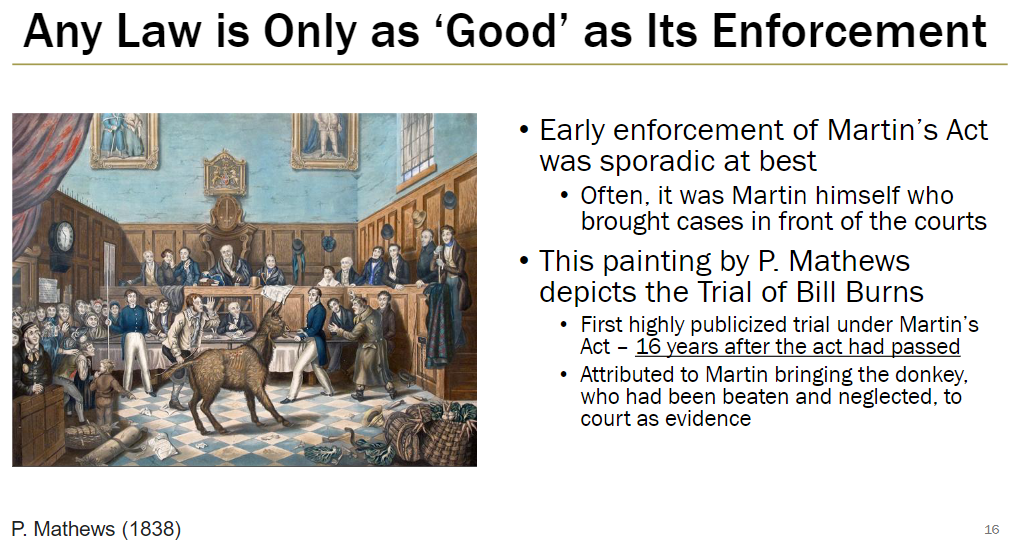
Enforcement of Martin’s Act was sporadic
Often Martin himself brought cases to court
Trial of Bill Burns
Depicted in painting by P. Mathews (1838)
First highly publicized trial under Martin’s Act, 16 years after it passed
Martin brought a beaten and neglected donkey to court as evidence
The Canadian Legal System
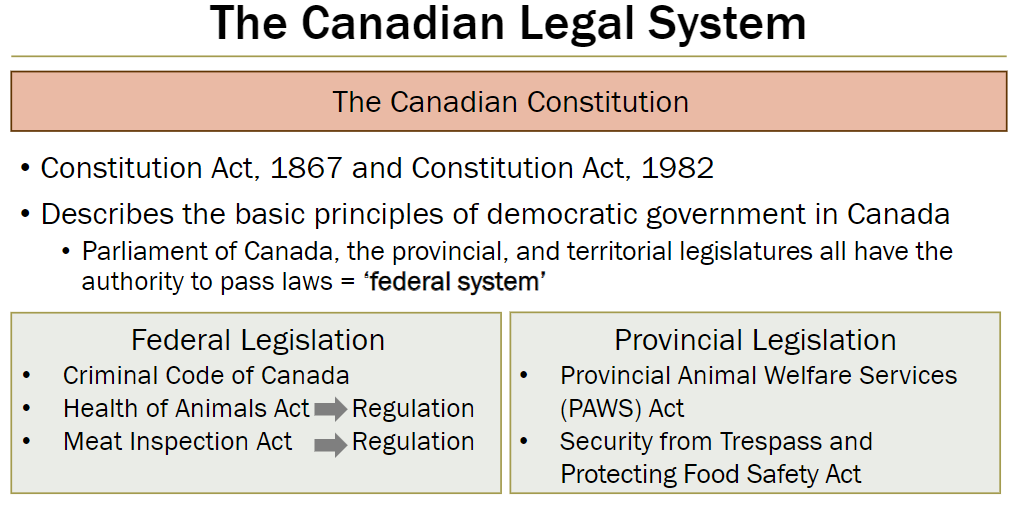
The Canadian Constitution
Constitution Act, 1867 and Constitution Act, 1982
Describes basic principles of democratic government in Canada
Parliament of Canada and provincial/territorial legislatures have authority to pass laws – “federal system”
Federal Legislation
Criminal Code of Canada
Health of Animals Act Regulation
Meat Inspection Act Regulation
Provincial Legislation
Provincial Animal Welfare Services (PAWS) Act
Security from Trespass and Protecting Food Safety Act
Federal Legislation: Criminal Code of Canada
Overview
Enacted 1892, last amended Apr. 25, 2025
Part XI: Wilful and Forbidden Acts in Respect to Certain Property
Section 445(1): Animals – Killing or Injuring
“Every one commits an offence who, wilfully and without lawful excuse, kills, maims, wounds, poisons or injures dogs, birds or animals that are kept for a lawful purpose; or places poison in such a position that it may easily be consumed by dogs, birds or animals that are kept for a lawful purpose”
Federal Legislation: Criminal Code of Canada – Cruelty to Animals
Overview
Enacted 1892, last amended Apr. 25, 2025
Part XI: Wilful and Forbidden Acts in Respect to Certain Property
Section 445.1(1): Causing Unnecessary Suffering
“Every one commits an offence who (a) wilfully causes or, being the owner, wilfully permits to be caused unnecessary pain, suffering or injury to an animal or a bird”
Also prohibits:
Fighting or baiting of animals or birds
Poisoning of animals or birds
Liberation of captive birds for the purpose of shooting them
Meaning of “Wilful” in Section 445 – Criminal Code of Canada
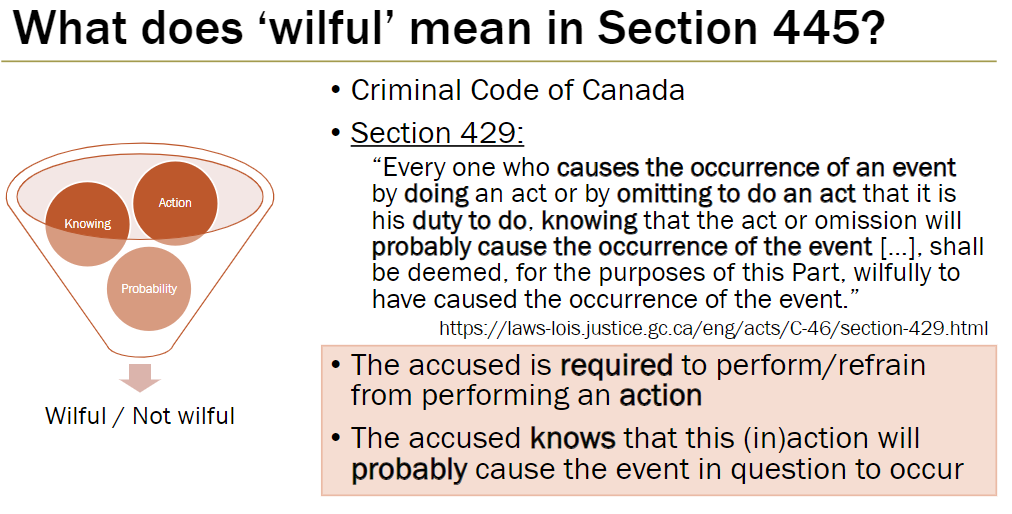
Definition (Section 429)
“Every one who causes the occurrence of an event by doing an act or omitting to do an act that it is their duty to do, knowing that the act or omission will probably cause the occurrence of the event, shall be deemed wilfully to have caused the event”
Key Points
Action – Accused performs or omits an act they have a duty to do
Knowing – Accused knows the act or omission will probably cause the event
Probability – Event is likely to occur as a result of the action or inaction
Interpretation
Wilful = intentional or knowing cause of event
Not wilful = accidental or without knowledge of likely outcome
Case Study: R. v Heynan, Alberta Provincial Court (1992)
Background
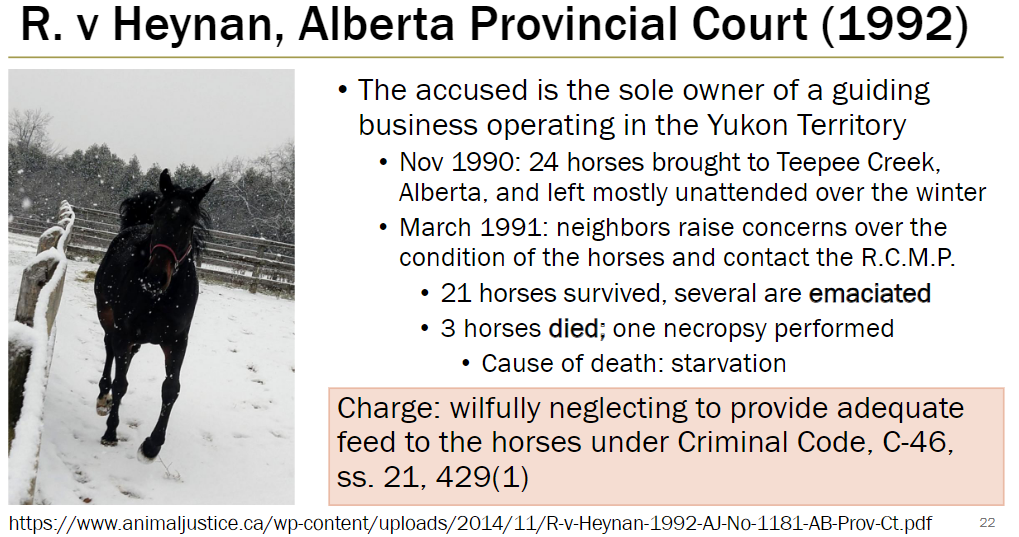
Accused was sole owner of a guiding business in Yukon Territory
Nov 1990: 24 horses brought to Teepee Creek, Alberta, left mostly unattended over winter
Incident
March 1991: neighbors reported poor horse conditions to R.C.M.P.
21 horses survived, several emaciated
3 horses died, one necropsy confirmed cause of death as starvation
Charge
Wilfully neglecting to provide adequate feed to horses under Criminal Code, C-46, ss. 21, 429(1)
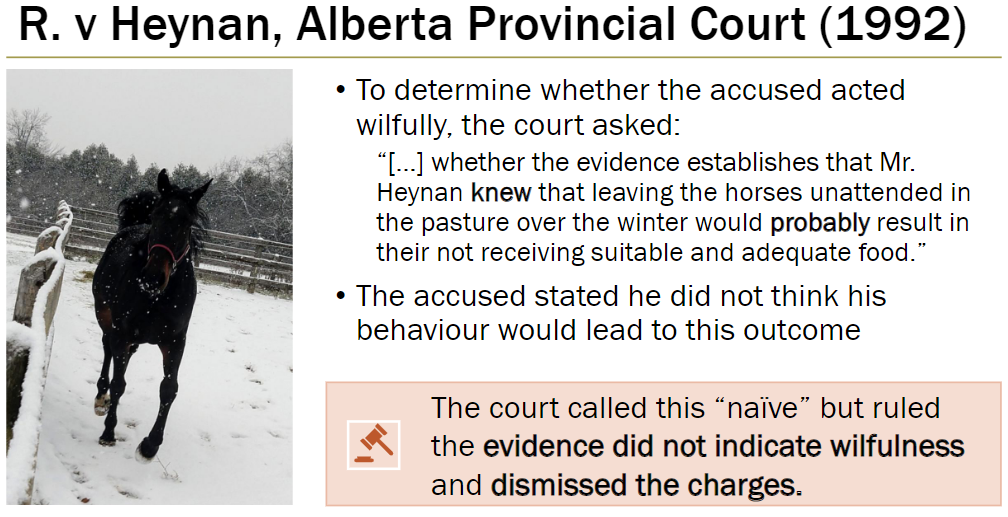
R. v Heynan – Wilfulness Determination
Court Question
Whether evidence showed Mr. Heynan knew leaving horses unattended over winter would probably prevent them from receiving adequate food
Accused’s Statement
Claimed he did not think his actions would cause this outcome
Court Decision
Described the accused as “naïve”
Evidence did not show wilfulness
Charges were dismissed
Animals as Property – Criminal Code of Canada
Anthropocentric Focus
Law considers human behaviour, not the animal’s experience
Wilfulness Requirement
Offence requires wilfully acting contrary to section 445
Case Example: R. v Heynan (1992)
Illustrates difficulty of proving wilful neglect
Even when animals suffered severe consequences – death by starvation, prolonged hunger, poor body condition
Summary
Criminal Code treats animals as property, focuses on human intent rather than animal suffering
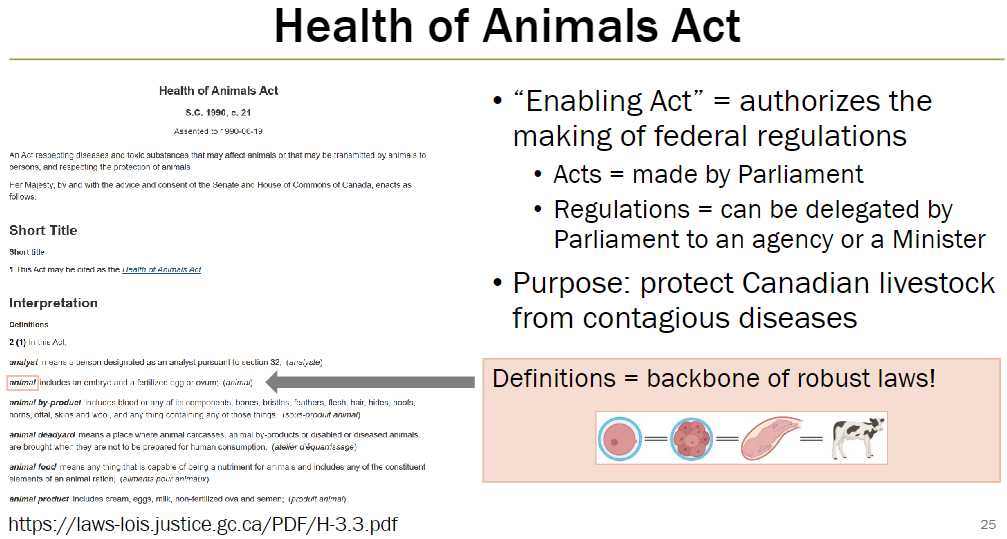
Health of Animals Act – Canadian Legislation
Enabling Act
Authorizes creation of federal regulations
Acts vs Regulations
Acts are made by Parliament
Regulations can be delegated by Parliament to an agency or Minister
Purpose
Protect Canadian livestock from contagious diseases
Importance of Definitions
Clear definitions form backbone of robust laws
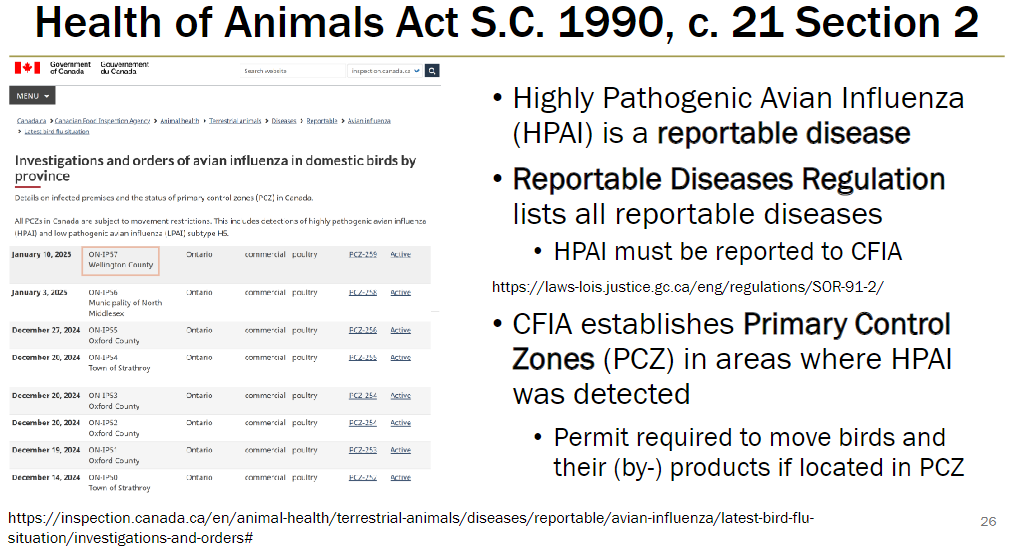
Health of Animals Act – Highly Pathogenic Avian Influenza (HPAI)
Reportable Disease
HPAI is listed under the Reportable Diseases Regulation
Must be reported to CFIA
Control Measures
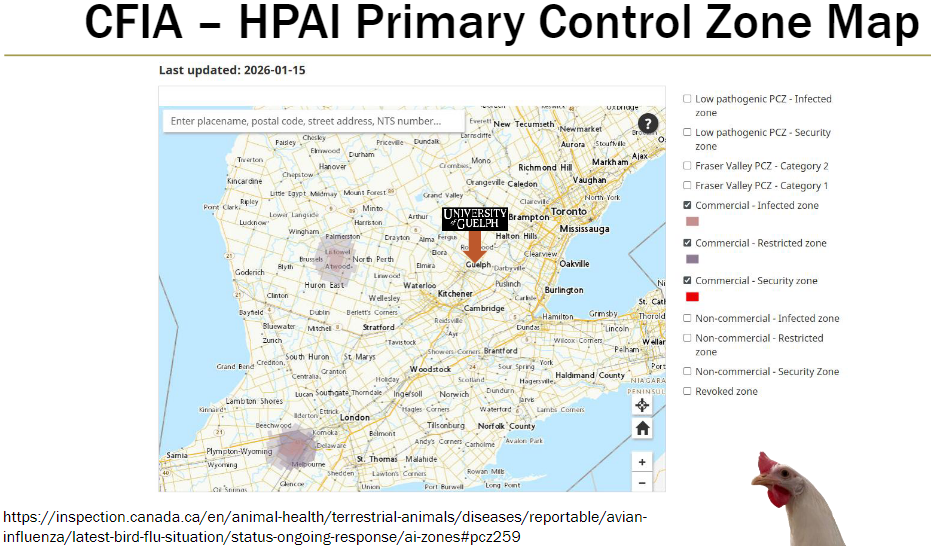
CFIA establishes Primary Control Zones (PCZ) in areas with HPAI detection
Permit required to move birds or their by-products within PCZ
Legal Basis
Health of Animals Act S.C. 1990, c. 21 Section 2
CFIA – HPAI Primary Control Zone (PCZ) Categories
Acronyms
CFIA = Canadian Food Inspection Agency
HPAI = Highly Pathogenic Avian Influenza
PCZ = Primary Control Zone
Low Pathogenic
PCZ – Infected zone: area with confirmed cases of low pathogenic avian influenza
PCZ – Security zone: surrounding area with heightened biosecurity to prevent spread
Fraser Valley
PCZ – Category 2: expanded control area around infected premises
PCZ – Category 1: immediate area around infected premises with strictest controls
Commercial Premises
Infected zone: confirmed cases in commercial flocks
Restricted zone: limited movement of birds/products allowed
Security zone: heightened biosecurity and surveillance
Non-Commercial Premises
Infected zone: confirmed cases in non-commercial flocks or birds
Restricted zone: limited movement, preventive measures in place
Security zone: monitoring and biosecurity measures enforced
Other
Revoked zone: previous control zones no longer active
Health of Animals Regulation (HAR) – Canadian Legislation
Authorization
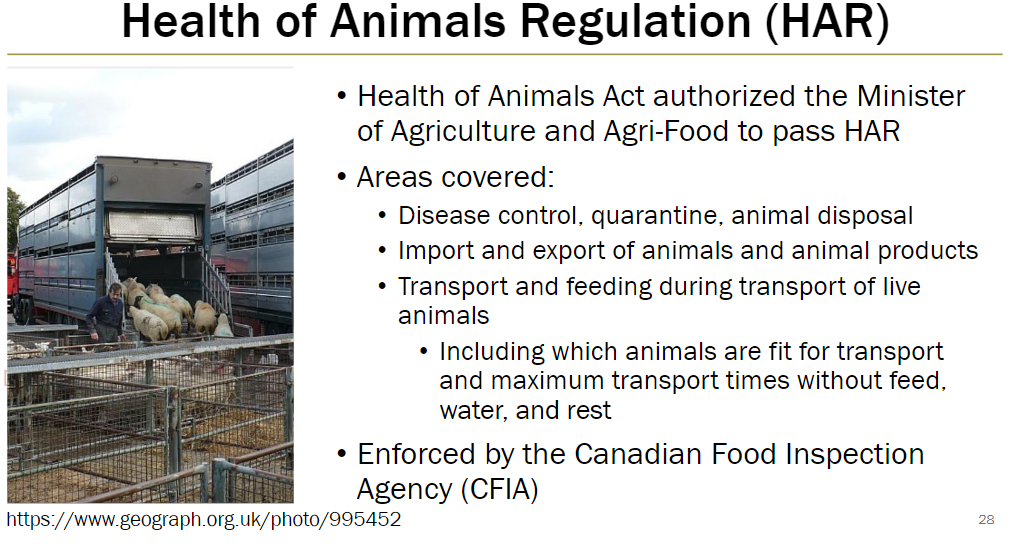
Health of Animals Act allows Minister of Agriculture and Agri-Food to pass HAR
Areas Covered
Disease control, quarantine, and animal disposal
Import and export of animals and animal products
Transport and feeding of live animals during transport, including:
Which animals are fit for transport
Maximum transport times without feed, water, and rest
Enforcement
Canadian Food Inspection Agency (CFIA)
Safe Food for Canadians Act and Regulations – Canadian Legislation
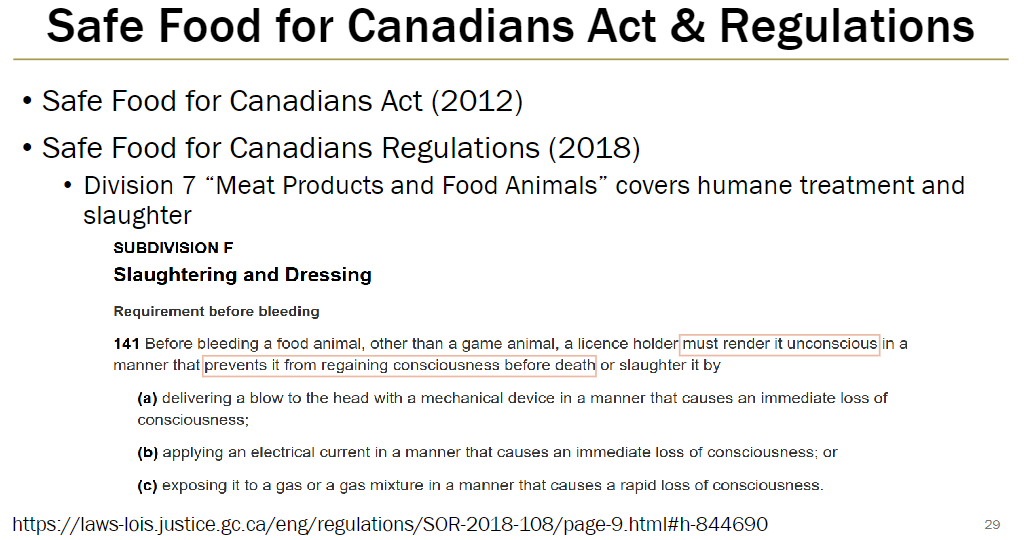
Safe Food for Canadians Act (2012)
Federal legislation governing food safety in Canada
Safe Food for Canadians Regulations (2018)
Division 7: “Meat Products and Food Animals”
Covers humane treatment and slaughter of animals
How Is Canada Perceived Internationally?
Canadian Animal Law – Current Status and Challenges
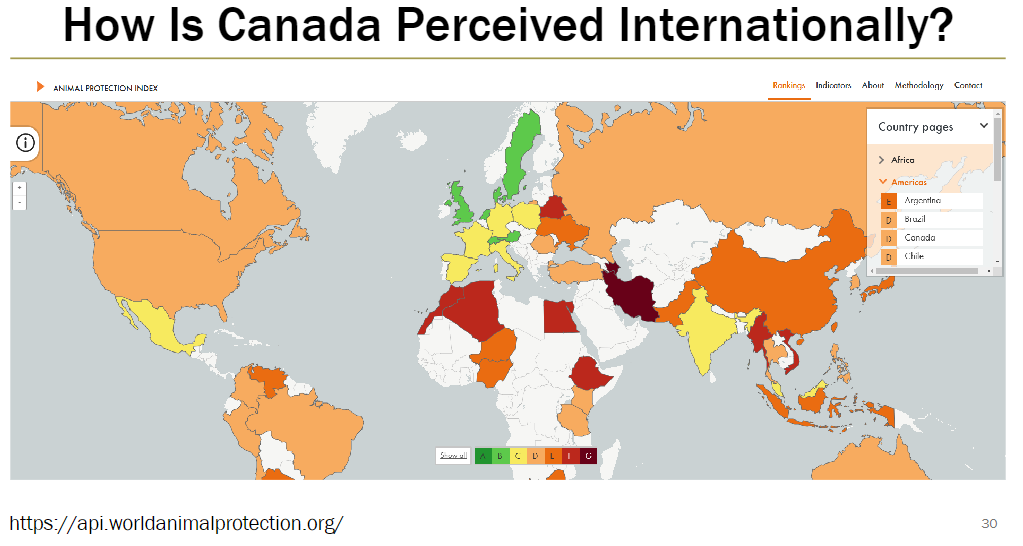
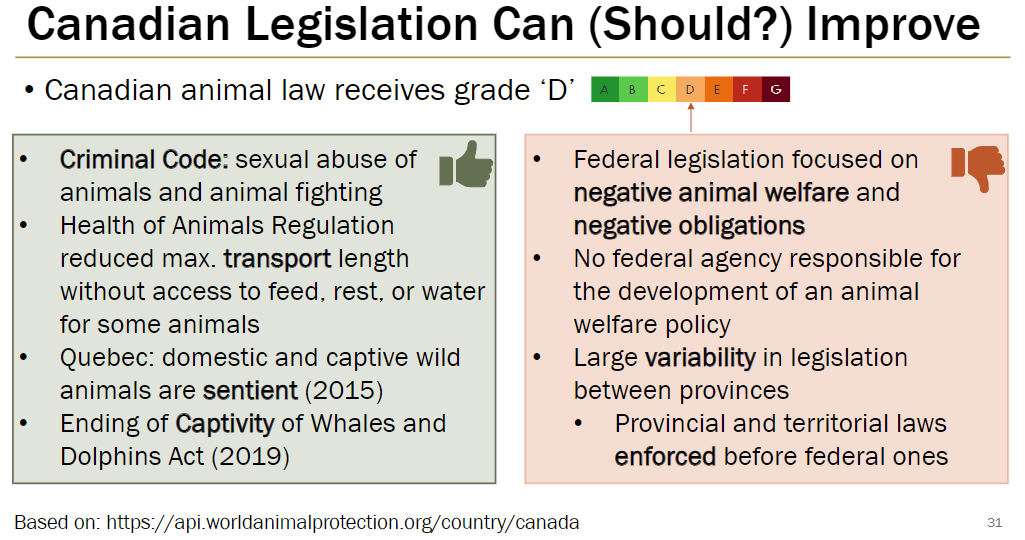
Grade
Canadian animal law receives a “D”
Positive
Criminal Code addresses sexual abuse of animals and animal fighting
Health of Animals Regulation reduced maximum transport time for some animals without feed, water, or rest
Quebec (2015) recognizes domestic and captive wild animals as sentient
Ending of Captivity of Whales and Dolphins Act (2019)
Negative
Federal legislation focuses on preventing harm rather than promoting positive welfare
There’s no federal agency responsible for developing a national animal welfare policy
Legislation varies widely between provinces and territories
Provincial and territorial laws are enforced before federal laws
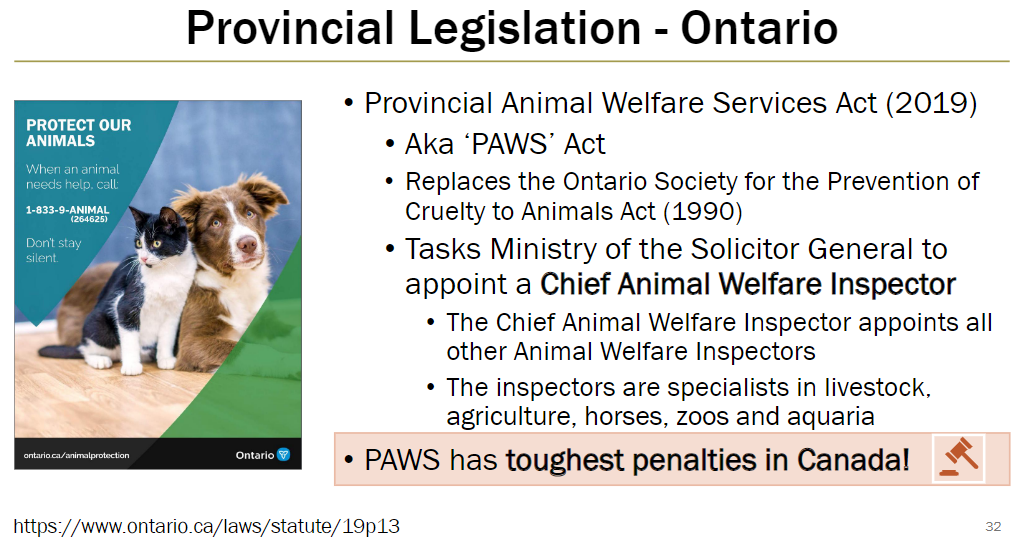
Provincial Animal Welfare Services (PAWS) Act – Ontario (2019)
Overview
Also called the “PAWS” Act
Replaces the Ontario Society for the Prevention of Cruelty to Animals Act (1990)
Administration
Ministry of the Solicitor General appoints a Chief Animal Welfare Inspector
Chief Animal Welfare Inspector appoints all other Animal Welfare Inspectors
Inspectors are specialists in livestock, agriculture, horses, zoos, and aquaria
Penalties
PAWS Act has the toughest penalties for animal welfare offences in Canada
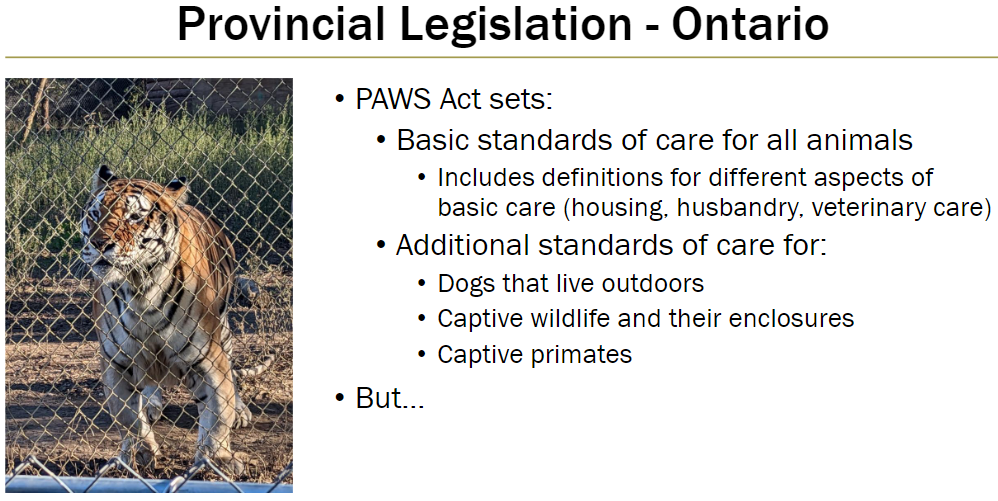
Provincial Legislation (PAWS)
Basic Standards
Sets minimum standards of care for all animals
Includes definitions for housing, husbandry, and veterinary care
Additional Standards
Dogs that live outdoors
Captive wildlife and their enclosures
Captive primates
PAWS Act – Impact and Observations (Ontario)
Improvements vs Concerns
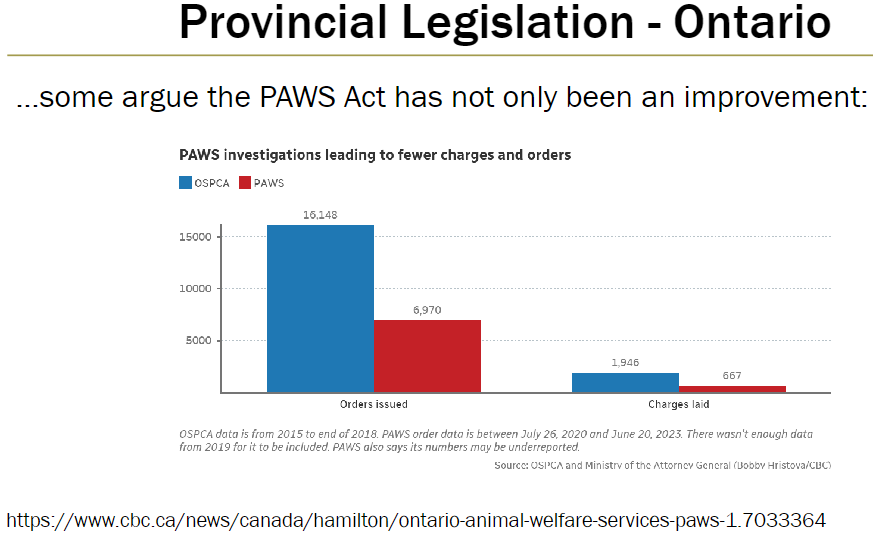
Some argue the PAWS Act has improved animal welfare, but not all outcomes are positive
Investigations and Enforcement
PAWS investigations have led to fewer charges and orders compared to the former OSPCA system
Data Comparison
Orders issued: OSPCA – 15,148; PAWS – 6,970
Charges laid: OSPCA – 1,946; PAWS – 667
Notes on Data
OSPCA data from 2015 to end of 2018
PAWS data from July 26, 2020 to June 20, 2023
2019 excluded due to insufficient data
PAWS reports its numbers may be underreported
Ending of Captivity of Whales and Dolphins Act – Canadian Legislation
Legislative Timeline
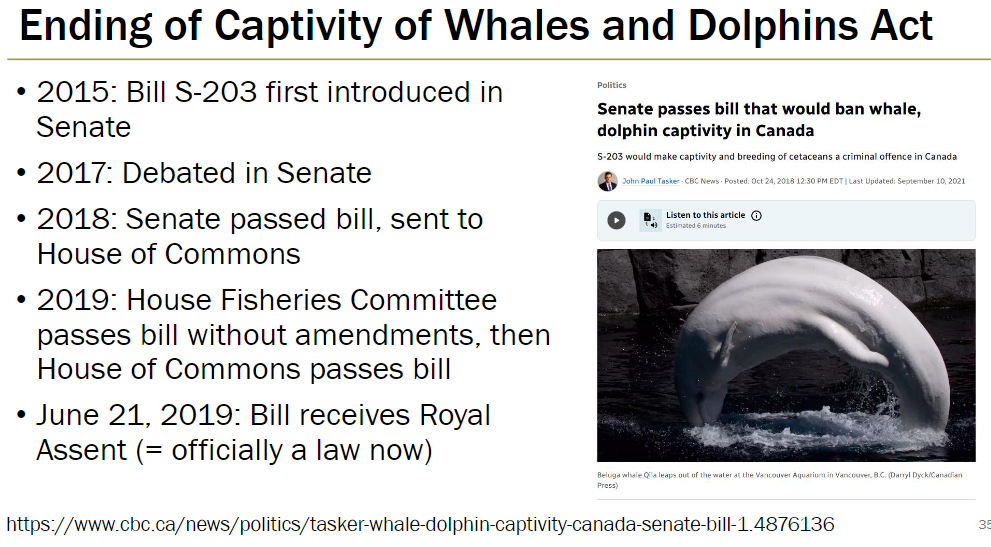
2015: Bill S-203 first introduced in Senate
2017: Debated in Senate
2018: Senate passes bill, sends to House of Commons
2019: House Fisheries Committee passes bill without amendments; House of Commons passes bill
June 21, 2019: Bill receives Royal Assent and becomes law
Ending of Captivity of Whales and Dolphins Act – What Is Banned
Definition
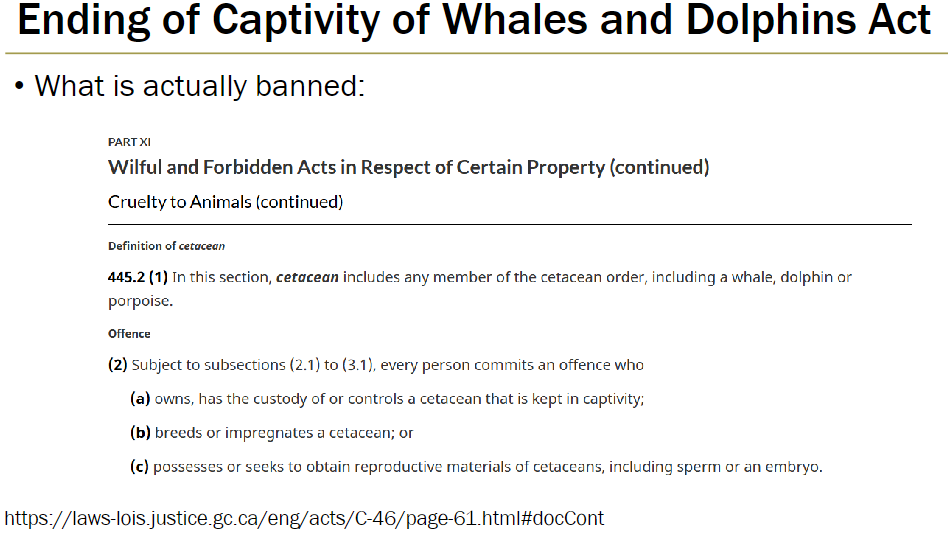
Cetacean = any member of the cetacean order, including whales, dolphins, or porpoises
Offences (Section 445.2)
It is an offence for any person to:
Own, have custody of, or control a cetacean kept in captivity
Breed or impregnate a cetacean
Possess or attempt to obtain reproductive materials of cetaceans, including sperm or embryos
Ending of Captivity of Whales and Dolphins Act – Exceptions
Exceptions to Section 445.2
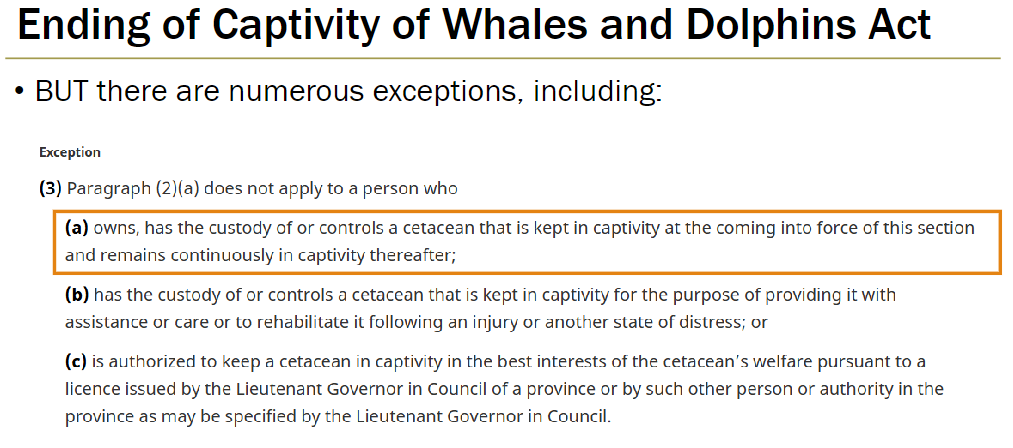
Paragraph (2)(a) does not apply to a person who:
Owns, has custody of, or controls a cetacean that was already in captivity when this law came into force and remains continuously in captivity
Has custody of or controls a cetacean kept in captivity for assistance, care, or rehabilitation following injury or distress
Is authorized to keep a cetacean in captivity for its welfare under a licence issued by the Lieutenant Governor in Council of a province or another specified provincial authority
Marineland Belugas – Current Situation
Closure
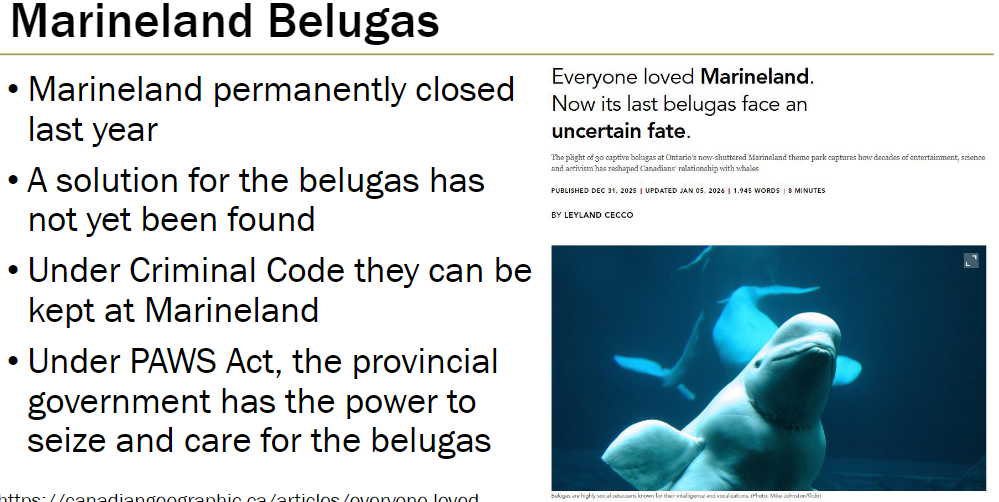
Marineland permanently closed last year
Beluga Fate
No solution for the belugas has been found
Legal Context
Under Criminal Code, belugas can remain at Marineland
Under PAWS Act, provincial government can seize and care for the belugas
Ending of Captivity of Whales and Dolphins Act – Enforcement Challenges
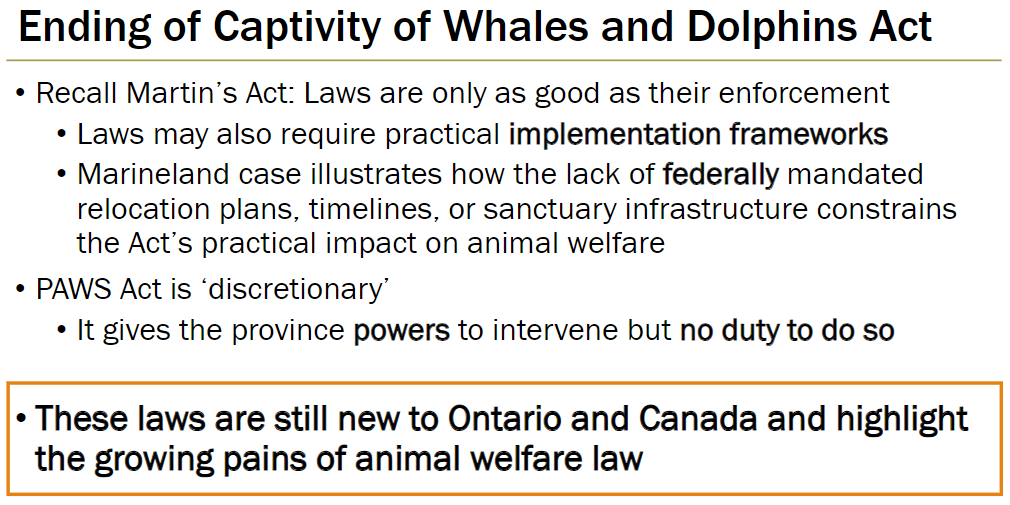
Enforcement Limitations
Recall Martin’s Act: laws are only as good as their enforcement
Laws may need practical implementation frameworks to be effective
Marineland Case
Illustrates lack of federally mandated relocation plans, timelines, or sanctuary infrastructure limits the Act’s impact on animal welfare
PAWS Act
Discretionary – gives province power to intervene but no duty to do so
Context
These laws are still new in Ontario and Canada, showing the growing pains of animal welfare legislation
Ontario Animal Legislation Beyond the PAWS Act
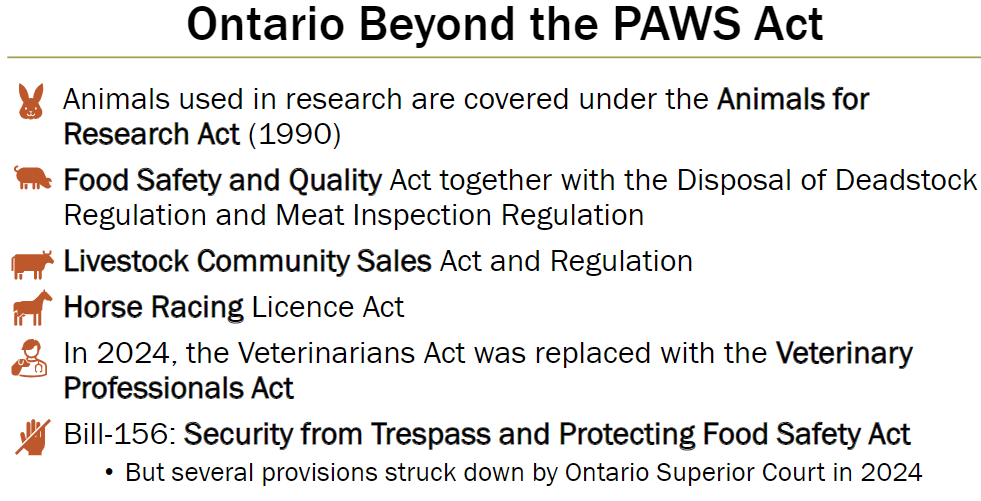
Research Animals
Covered under the Animals for Research Act (1990)
Other Relevant Legislation
Food Safety and Quality Act, together with Disposal of Deadstock Regulation and Meat Inspection Regulation
Livestock Community Sales Act and Regulation
Horse Racing Licence Act
Veterinary Legislation
Veterinarians Act replaced by Veterinary Professionals Act in 2024
Security and Food Safety
Bill-156: Security from Trespass and Protecting Food Safety Act
Several provisions struck down by Ontario Superior Court in 2024
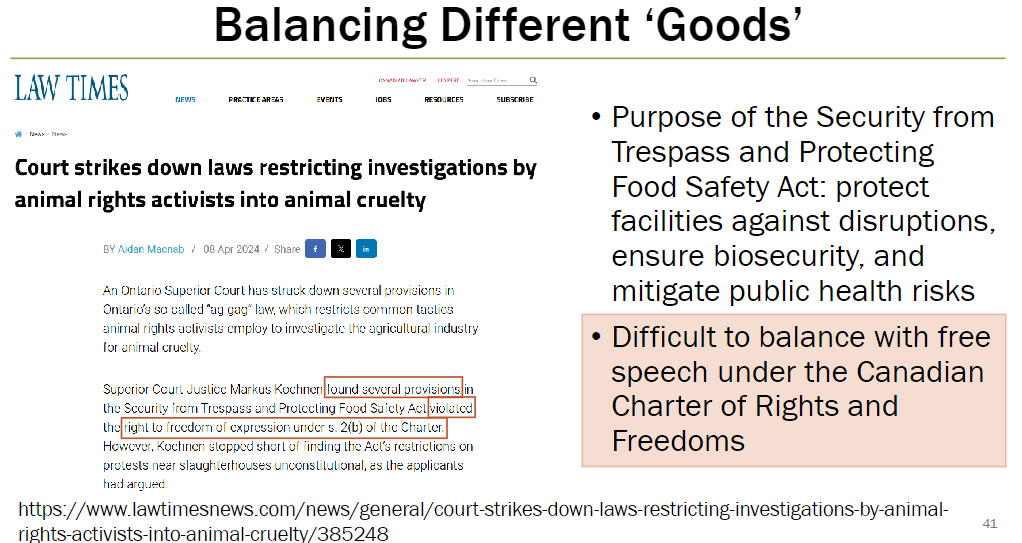
Purpose of the Security from Trespass and Protecting Food Safety Act – Balancing Issues
Purpose
Protect facilities against disruptions
Ensure biosecurity
Mitigate public health risks
Challenges
Difficult to balance enforcement with free speech rights under the Canadian Charter of Rights and Freedoms
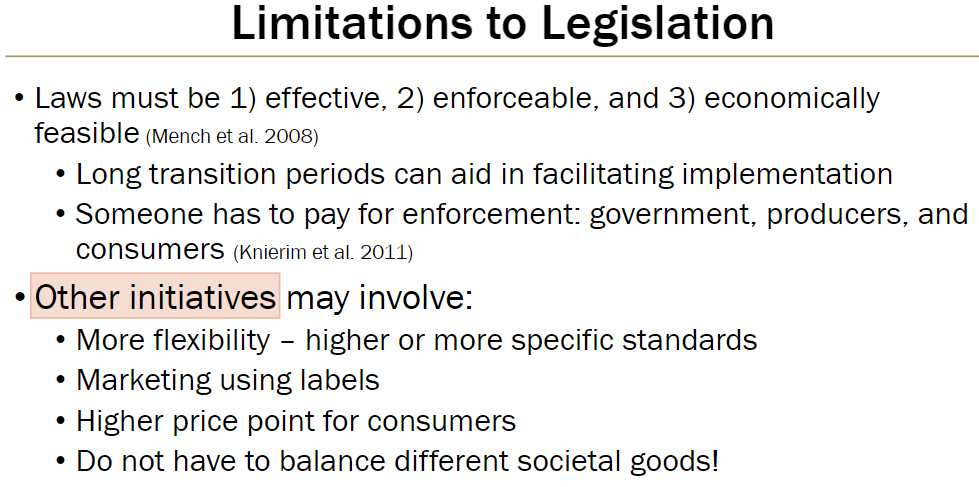
Limitations to Animal Welfare Legislation
Key Principles
Laws must be effective, enforceable, and economically feasible (Mench et al. 2008)
Long transition periods can help facilitate implementation
Enforcement costs must be covered by government, producers, or consumers (Knierim et al. 2011)
Other Initiatives
More flexibility with higher or more specific standards
Marketing using labels
Higher price point for consumers
These initiatives do not require balancing different societal goods