AST101 - Week 1 - Lecture 1
 Studied by 0 people
 Call with Kai
 Learn
Learn Practice Test
 Spaced Repetition
 Match
Match Flashcards
 Knowt Play
1/137

There's no tags or description
Looks like no tags are added yet.
Name | Mastery | Learn | Test | Matching | Spaced | Call with Kai |
|---|
No analytics yet
Send a link to your students to track their progress
138 Terms
What do astronomers mean by “the Universe”?
The Universe is everything that exists: all space, time, matter, energy, planets, stars, galaxies, and the structures that connect them.
What are the main levels of structure in the Universe (from small to large)?
Planets → solar systems → stars → galaxies → clusters of galaxies → the large-scale cosmic web.
What is a solar system?
A solar system is a star and all objects held by its gravity, including planets, moons, asteroids, and comets.
Why do planets orbit stars instead of flying away or falling straight in?
Because gravity pulls planets toward the star, while their forward motion keeps them moving sideways, creating stable curved paths called orbits.
What is a star?
A star is a massive ball of hot gas that produces energy through nuclear fusion in its core, releasing light and heat.
What is a galaxy?
A galaxy is a huge system containing billions of stars, gas, dust, and dark matter, all held together by gravity.
Are stars spread evenly throughout the Universe?
No. Stars group into galaxies, galaxies group into clusters, and clusters connect in long filaments, creating a web-like pattern.
What is the cosmic web?
The cosmic web is the largest structure in the Universe, made of galaxy filaments and walls separated by enormous empty regions called voids.
Why do astronomers use telescopes and spacecraft to study the Universe?
Because most objects are extremely distant or faint, so we need powerful instruments to collect their light and learn about their distance, motion, and composition.
What connects everything in the Universe?
Gravity — it shapes orbits, forms stars and galaxies, and builds the largest structures we see.
What does “scale of the Solar System” mean?
It refers to comparing the sizes of planets and the huge distances between them and the Sun.
Which object in the Solar System is by far the largest?
The Sun — it is much larger than all the planets combined.
About how big is the Sun compared to Earth?
The Sun’s radius is about 100 times larger than Earth’s, meaning over a million Earths could fit inside it by volume.
What is the average distance from Earth to the Sun?
About 150 million km. This distance is called 1 Astronomical Unit (AU) and is used as a standard measuring stick in astronomy.
Why do astronomers use Astronomical Units (AU)?
Because distances in space are enormous, so AU makes Solar System distances easier to compare than writing huge numbers in kilometers.
Which planets are called the inner (terrestrial) planets?
Mercury, Venus, Earth, and Mars — they are small, rocky, and close to the Sun.
Which planets are called the outer (giant) planets?
Jupiter, Saturn, Uranus, and Neptune — they are much larger and located far from the Sun.
Which planet is the largest in the Solar System?
Jupiter.
How does Jupiter compare in size to Earth?
Jupiter’s radius is about 11 times Earth’s, making it vastly larger in volume.
How do distances between planets change as you move outward from the Sun?
The spacing between planetary orbits increases — outer planets are much farther apart than inner planets.
Why do Solar System diagrams often look misleading?
Because they usually exaggerate planet sizes and shrink distances; in reality, planets are tiny compared to the vast empty space between them.
Roughly how far is Neptune from the Sun compared to Earth?
Neptune is about 30 AU from the Sun, meaning roughly 30 times farther than Earth.
How does the Sun compare in size to the planets?
The Sun is vastly larger than any planet — planets are tiny in comparison.
Why do planets appear almost invisible next to the Sun in scale images?
Because the Sun’s radius is about 696,000 km, while Earth’s is only about 6,400 km — the Sun is roughly 100 times wider.
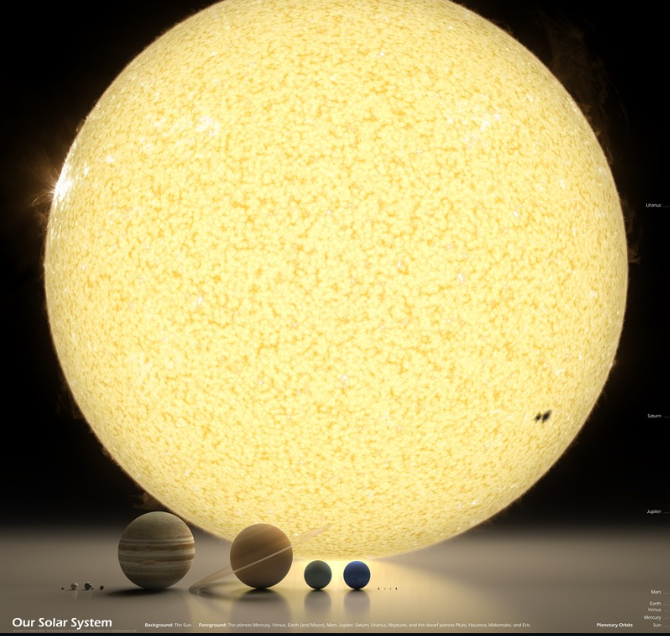
How does the Sun compare to Earth in volume?
Over one million Earths could fit inside the Sun.
Which planet is the largest, and how does it compare to the Sun?
Jupiter is the largest planet, but the Sun is still about 10 times wider than Jupiter.
Why does the Sun dominate the Solar System gravitationally?
Because it contains about 99.8% of the Solar System’s total mass.
Where is most of the Solar System’s mass located?
Almost all of it is in the Sun, not in the planets.
Why are Solar System diagrams often misleading?
They exaggerate planet sizes and compress distances; in reality, planets are tiny and extremely far apart.
Why does space within the Solar System feel mostly empty?
Because the distances between planets are enormous compared to their sizes.
Why do planets orbit the Sun instead of drifting freely?
Because the Sun’s massive gravity controls their motion and keeps them in orbit.
What is the key idea about the Solar System’s structure?
The Solar System is Sun-dominated: nearly all mass is in the Sun, and planets are small objects spread across huge distances.
What is the main idea behind comparing stars using locations on a map?
It’s to show that even the nearest stars are extremely far apart, much farther than anything we experience on Earth.
Approximately how far away is the nearest star to the Sun (other than the Sun itself)?
About 4.3 light-years away (Proxima Centauri).
What is a light-year?
A light-year is the distance light travels in one year — about 9.46 trillion kilometers. It is a unit of distance, not time.
Why do astronomers use light-years instead of kilometers to measure distances between stars?
Because the distances are so enormous that kilometers become impractical; light-years make interstellar distances easier to express.
Compared to distances between planets, how large are distances between stars?
Distances between stars are vastly larger — while planets are separated by millions or billions of kilometers, stars are separated by trillions of kilometers.
Are stars packed closely together like planets in the Solar System?
No. Stars are separated by huge regions of mostly empty space.
What does this imply about space between stars?
Interstellar space is extremely empty, with vast gaps between individual stars.
If the Solar System were shrunk to fit inside a city, how would nearby stars appear?
Nearby stars would be placed in entirely different cities or even different parts of the continent, showing how isolated stars really are.
Why is traveling between stars much harder than traveling within the Solar System?
Because interstellar distances are enormously larger than planetary distances, making travel take thousands to millions of years with current technology.
How far apart are stars, even the closest ones?
Even the nearest stars are incredibly far away (several light-years apart), and most of space consists of vast empty regions between stars.
What is the Milky Way?
The Milky Way is the galaxy that contains our Solar System, made of hundreds of billions of stars along with gas, dust, and dark matter.
Why does the Milky Way appear as a bright band across the night sky?
Because we are inside the galaxy’s flat disk, so when we look along the disk we see the combined light of huge numbers of distant stars.
Why doesn’t the Milky Way look like a spiral galaxy from Earth?
Because we are located inside it, so we can’t see its overall shape directly the way we see other galaxies.
What causes the dark patches seen in the Milky Way band?
Clouds of interstellar dust block starlight, creating dark regions where fewer stars are visible.
About how many stars are in the Milky Way?
On the order of hundreds of billions.
Where is our Solar System located within the Milky Way?
In one of the galaxy’s spiral arms, far from the center.
Is Earth near the center of the Milky Way?
No — Earth is located well out in the disk, not near the galactic center.
What does the Milky Way tell us about our place in the Universe?
Our Solar System is just a tiny part of one galaxy among billions, showing that we are not at a special central location.
Why is the Milky Way easier to see from dark locations?
Light pollution from cities washes out faint starlight, making the Milky Way hard or impossible to see.
How is the Milky Way related to the stars we see at night?
Nearly all stars visible to the naked eye belong to the Milky Way galaxy.
What is the Andromeda Galaxy?
Andromeda is a large spiral galaxy outside the Milky Way and is the closest major galaxy to us.
About how far away is the Andromeda Galaxy from Earth?
About 2.5 million light-years away.
Can the Andromeda Galaxy be seen without a telescope?
Yes — under dark skies, Andromeda can be seen with the naked eye as a faint, fuzzy patch.
How does Andromeda compare in size to the Milky Way?
Andromeda is slightly larger than the Milky Way and also contains hundreds of billions of stars.
What type of galaxy is Andromeda?
A spiral galaxy, meaning it has a flat disk, spiral arms, and a central bulge.
Why is Andromeda important for understanding galaxies?
It allows astronomers to study a galaxy similar to the Milky Way from the outside, helping us learn about galaxy structure and evolution.
Is Andromeda moving toward or away from the Milky Way?
Andromeda is moving toward the Milky Way.
What will eventually happen between Andromeda and the Milky Way?
They are expected to collide and merge in several billion years, forming a single larger galaxy.
Does a galaxy collision mean stars crash into each other?
Usually no — stars are so far apart that direct collisions are extremely rare; the galaxies mainly pass through each other while gravity reshapes them.
What does Andromeda show about the Universe beyond the Milky Way?
It shows that our galaxy is just one of many, and that galaxies exist in enormous numbers across space.
Approximately how many stars are in the Milky Way galaxy?
On the order of 100 billion stars (hundreds of billions).
Why does the slide compare stars to grains of sand?
To help visualize how enormous the number of stars is — imagining each grain of sand as a star makes the scale easier to grasp.
What does “100 billion” help represent in astronomy?
It represents the approximate number of stars in a typical large galaxy like the Milky Way.
Are galaxies made of just stars?
No — galaxies also contain gas, dust, and large amounts of dark matter in addition to stars.
If the Milky Way has ~100 billion stars, what does that imply about the size of the Universe?
Since there are billions of galaxies, the total number of stars in the Universe is unimaginably large.
Why are analogies like sand useful in astronomy?
Because astronomical numbers are so huge that everyday comparisons help humans understand their scale.
Does every galaxy contain about the same number of stars?
No — galaxies vary widely in size, but large spiral galaxies typically contain tens to hundreds of billions of stars.
How many stars are in a typical large galaxy like the Milky Way, and what does this imply about the Universe?
A large galaxy contains on the order of 100 billion stars, and since there are billions of galaxies, the total number of stars in the Universe is unimaginably large.
Why does looking farther into space also mean looking farther back in time?
Because light travels at a finite speed, so light from distant objects takes time to reach Earth. Astronomers therefore see objects as they were in the past, not as they are right now.
What is the speed of light?
About 300,000 km per second.
If a star explodes in a galaxy 1 billion light-years away, when do we see the explosion?
About 1 billion years later, when the light finally reaches Earth.
What does “1 light-year” mean?
One light-year is the distance light travels in one year.
Does a telescope see distant events as they happen right now?
No — telescopes see distant objects as they were when their light began its journey toward Earth.
If light from a galaxy is still traveling toward Earth, what does that mean about our ability to see it?
We cannot see the event yet because the light has not arrived.
Why are very distant galaxies also very old in appearance?
Because their light began traveling billions of years ago, so astronomers are seeing them as they existed long ago.
How does this allow astronomers to study the history of the Universe?
By observing objects at different distances, astronomers can see different stages of cosmic history, effectively looking back in time.
Why is the phrase “light arrives” important in astronomy?
Because only after light reaches Earth can telescopes detect an object or event.
What is the key relationship between distance and time in astronomy?
Greater distance means longer light-travel time, so farther objects are seen further back in time.
What is the Hubble Ultra-Deep Field?
It is an extremely long exposure taken by the Hubble Space Telescope of a tiny patch of sky, revealing thousands of distant galaxies.
What are the bright and faint objects seen in the Ultra-Deep Field image?
Almost all of them are galaxies, not stars.
Why is it surprising that so many galaxies appear in such a small region of sky?
Because the image covers a very tiny area, yet contains thousands of galaxies, showing that galaxies fill the Universe.
What does “everything here is a galaxy” mean in this context?
Each small fuzzy or colored dot represents an entire galaxy containing billions of stars.
Why do galaxies in the Ultra-Deep Field appear in many different shapes and colors?
Because galaxies come in different types and are seen at different stages of evolution and different distances.
Why are many galaxies in the Ultra-Deep Field very faint?
Because they are extremely far away, so only a small amount of their light reaches Earth.
How does the Ultra-Deep Field connect to light-travel time?
Many of the galaxies are so distant that their light has been traveling for billions of years, so astronomers see them as they were long ago.
What does the Ultra-Deep Field show about the number of galaxies in the Universe?
It shows that the Universe contains an enormous number of galaxies, likely in the hundreds of billions.
Why can Hubble see these distant galaxies while our eyes cannot?
Because Hubble collects light for long periods and is above Earth’s atmosphere, allowing it to detect extremely faint objects.
What does the Ultra-Deep Field reveal about Earth’s place in the Universe?
Earth is part of one galaxy among vast numbers of galaxies, showing that we occupy no special central location.
Approximately how many galaxies are observable in the Universe?
On the order of 1 trillion galaxies.
About how many stars does a typical large galaxy contain?
Roughly 100 billion stars.
Using these estimates, about how many stars are there in the observable Universe?
Roughly 10²³ stars (100 sextillion), calculated by multiplying ~1 trillion galaxies by ~100 billion stars per galaxy.
Why does the professor use sand and dump trucks as an analogy?
To help visualize extremely large numbers by comparing galaxies and stars to grains of sand and truckloads.
Why is it misleading to think of a galaxy as just one small object?
Because each galaxy contains billions of stars, so even a single galaxy represents an enormous amount of matter and structure.
What does this comparison reveal about the scale of the Universe?
That the Universe contains an unimaginably large number of stars and galaxies, far beyond everyday human experience.
Are estimates like the number of galaxies and stars in the Universe exact counts?
No — astronomers use observations and models to make estimates, since it’s impossible to directly count every galaxy and star.
What is the main takeaway about stars in the Universe?
The observable Universe contains on the order of 10²³ stars, making it extraordinarily vast.
What is the cosmic web?
The cosmic web is the large-scale structure of the Universe where galaxies are arranged in long filaments and clusters, separated by vast empty regions called voids.
What are filaments in the cosmic web?
Filaments are long, thread-like structures containing many galaxies and matter, connecting dense regions of the Universe.
 Note
Note  Flashcards (31)