EVERYTHING EXCEPT CORAL, LOCOMOTION, AND LAST LECTURE
 Studied by 0 people
 Call Kai
 Learn
Learn Practice Test
 Spaced Repetition
 Match
Match Flashcards
 Knowt Play
1/681

There's no tags or description
Looks like no tags are added yet.
Name | Mastery | Learn | Test | Matching | Spaced | Call with Kai |
|---|
No analytics yet
Send a link to your students to track their progress
682 Terms
Cranial osteology
The study of the bony structures of the head in fishes.
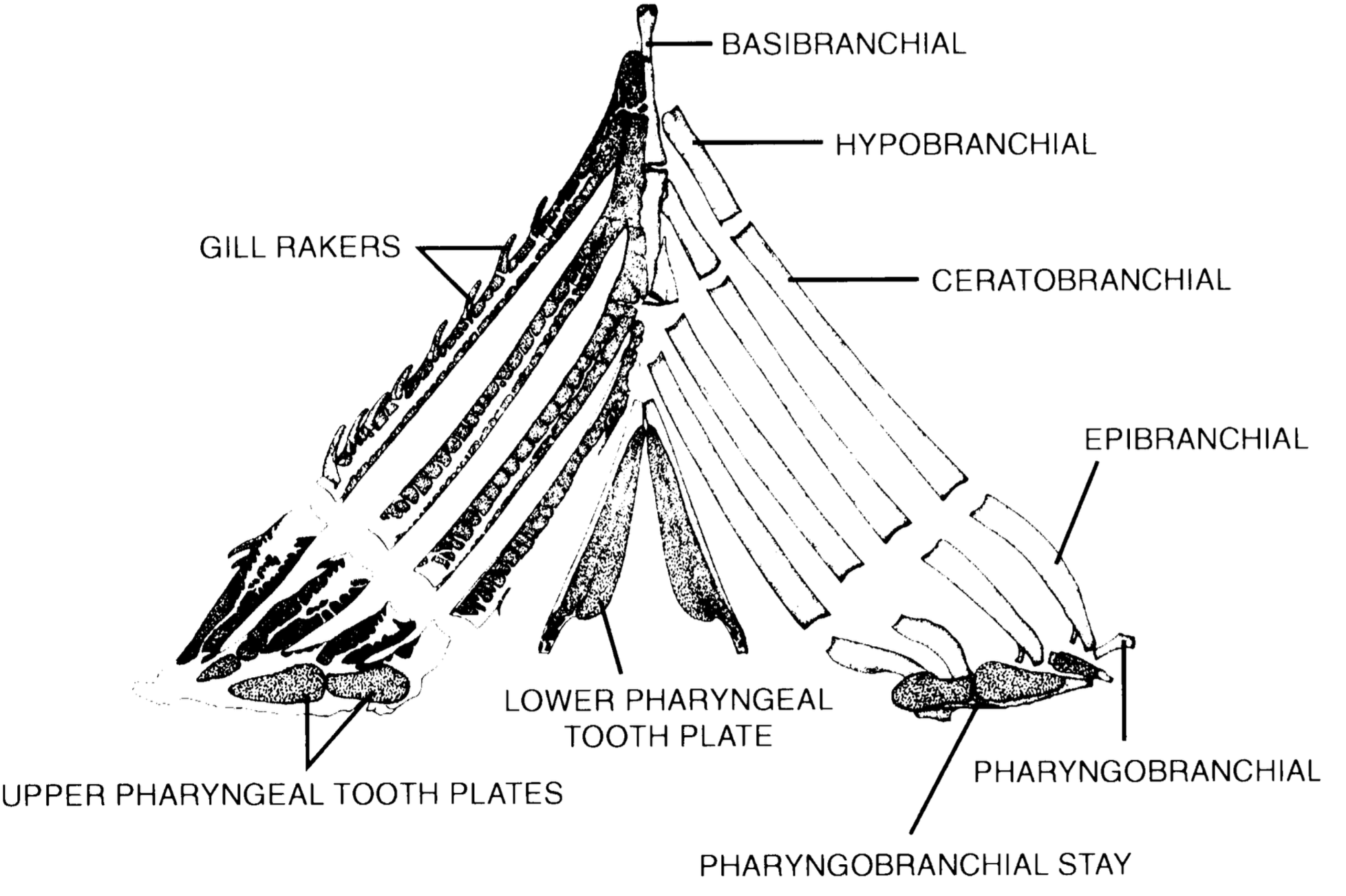
Branchial arch structure
The arrangement of gill arches that support gill filaments and are involved in respiration.
Postcranial osteology
The study of the bony structures found in the body excluding the head.
Premaxilla
The upper jaw bone that typically bears teeth in many advanced fishes.
Dentary
The primary tooth-bearing bone of the lower jaw in fishes.
Suspensorium
A complex of bones that connect the jaws to the cranium allowing for effective jaw movement.
Opercular apparatus
A set of bones that cover and protect the gills, also involved in feeding mechanics.
Gill rakers
Structures that trap food particles in the gills of fishes.
Neurocranium
The part of the skull that encases the brain in fishes.
Infraorbital bones
Flattened bones that bear a canal for the laterosensory system around the fishes' eyes.
Urostyle
A fused bony structure derived from the last vertebra, providing support to the caudal fin.
Molariform teeth
Flattened teeth used for grinding, typically located posteriorly.
Taxon (plural: Taxa)
A taxonomic group of any rank, such as a species, family, or class, used in the biological classification of organisms.
Taxonomic Categories
A hierarchical system of classification including Domain, Kingdom, Phylum, Class, Order, Family, Genus, and Species, used to group organisms based on shared characteristics.
Systematics
The scientific study of measuring the diversity of life and understanding the evolutionary relationships among organisms.
Taxonomy
The branch of systematics concerned with the naming and classification of organisms, including the description and identification of species.
Phylogeny
The evolutionary history of a species or group of related species, represented visually by a phylogenetic tree.
Phylogenetic Tree
A branching diagram that illustrates the evolutionary relationships among biological entities based on shared ancestry.
Synapomorphy
A shared derived character (trait) that originated in the immediate common ancestor of a group and is shared by all of its descendants, indicating a close evolutionary relationship.
Symplesiomorphy
A shared ancestral character (trait) that is present in the common ancestor of a group but also in other, more distantly related groups, making it less useful for defining monophyletic groups.
Homoplasy
A character shared by a set of species but not present in their common ancestor, often resulting from convergent evolution (independent evolution of similar traits) or reversal.
Monophyletic Group (Clade)
A group of organisms that includes a common ancestor and all of its descendants.
Node (in a phylogenetic tree)
A point on a phylogenetic tree that represents a speciation event or a common ancestor from which two or more descendant lineages diverged.
Common Ancestor
An ancestral organism or species from which two or more species or lineages are descended.
Defining Characteristics of a Fish
aquatic vertebrates that possess gills throughout life, swim with fins, and usually have a streamlined body covered with scales. Most are ectothermic.
General Diversity of Fishes
Fishes represent the largest and most diverse group of vertebrates, encompassing over 35,000 known species that inhabit nearly all aquatic environments, exhibiting a vast array of sizes, forms, and life histories.
Fin Types in Fishes
Paired Fins: Pectoral (anterior) and Pelvic (posterior), aiding in steering, braking, and stability.
Unpaired Fins: Dorsal (on back), Anal (ventral, posterior to anus), and Caudal (tail fin), providing propulsion, stability, and control.

Spines (Fin Structure)
Unsegmented, unbranched, stiff, and typically pointed rays in fins, often serving a defensive function.
Soft Rays (Fin Structure)
Segmented, branched, flexible rays in fins, involved in propulsion and maneuvering.
Rover Predator Body Form
A streamlined, fusiform body shape adapted for open-water predation, characterized by a pointed head and deeply forked caudal fin, allowing for sustained cruising and swift bursts of speed
(e.g., tuna, sharks).
Lie-in-Wait Predator Body Form
An elongated, sagittiform (arrow-like) body shape adapted for ambush predation, characterized by a flattened head, large mouth, and dorsal/anal fins placed far back on the body for sudden acceleration (e.g., pike, barracuda).
Fusiform Body Shape (Bond's Term)
A torpedo-like, streamlined body shape, widest in the middle and tapering at both ends, optimized for fast, continuous swimming in open water (e.g., tuna).
Compressiform Body Shape (Bond's Term)
Laterally compressed body shape (tall and thin), allowing for maneuverability in complex habitats and quick turns, often found in fishes inhabiting reefs or vegetated areas (e.g., angelfish, sunfish).
Depressiform Body Shape (Bond's Term)
Dorso-ventrally flattened body shape, adapted for living on the bottom or burying, with eyes typically on the dorsal surface (e.g., rays, flounders).
Anguilliform Body Shape (Bond's Term)
An eel-like, elongated, and cylindrical body shape, adapted for navigating through crevices and dense vegetation (e.g., eels).
Cranial osteology
The study of the bony structures of the head in fishes.
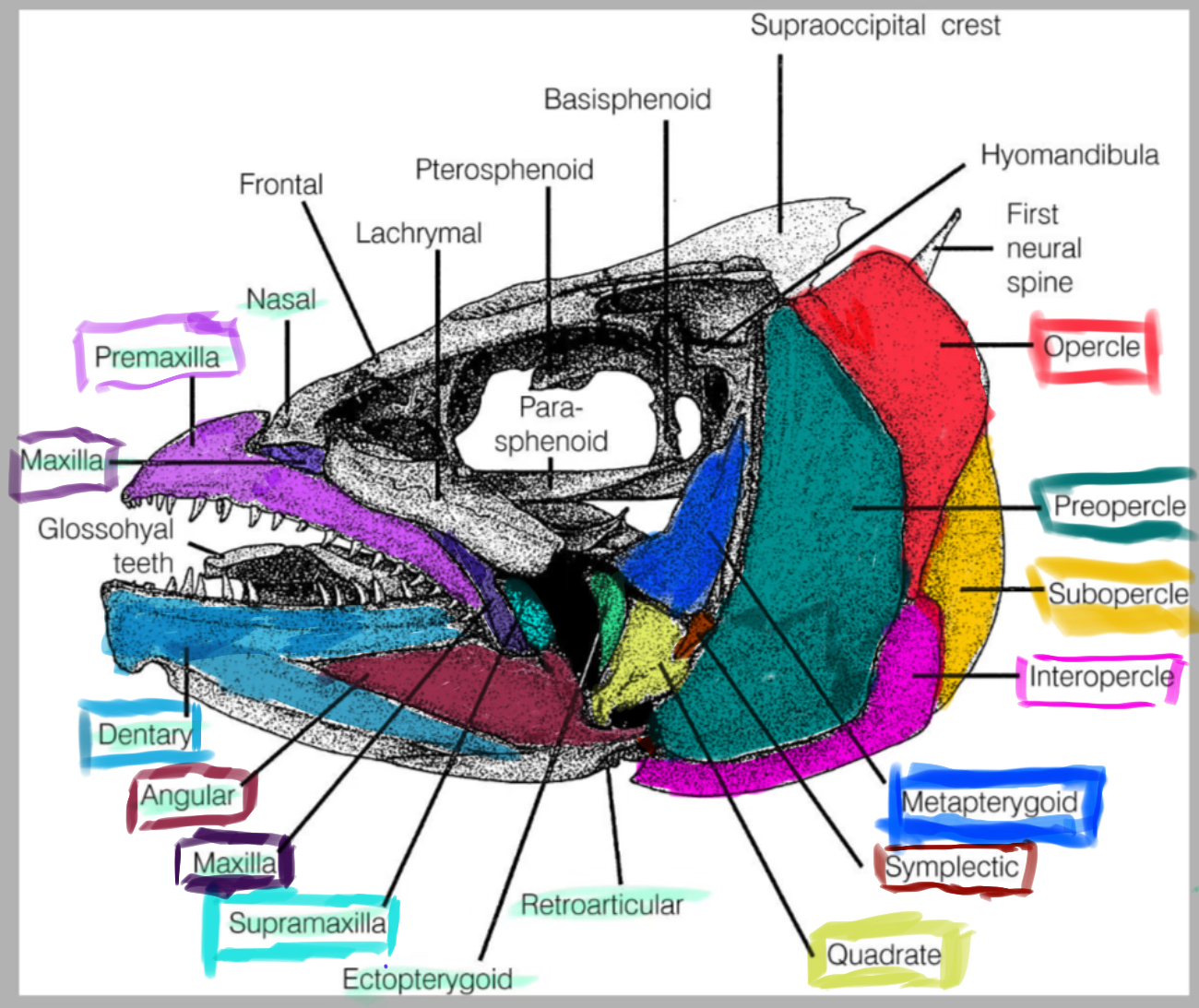
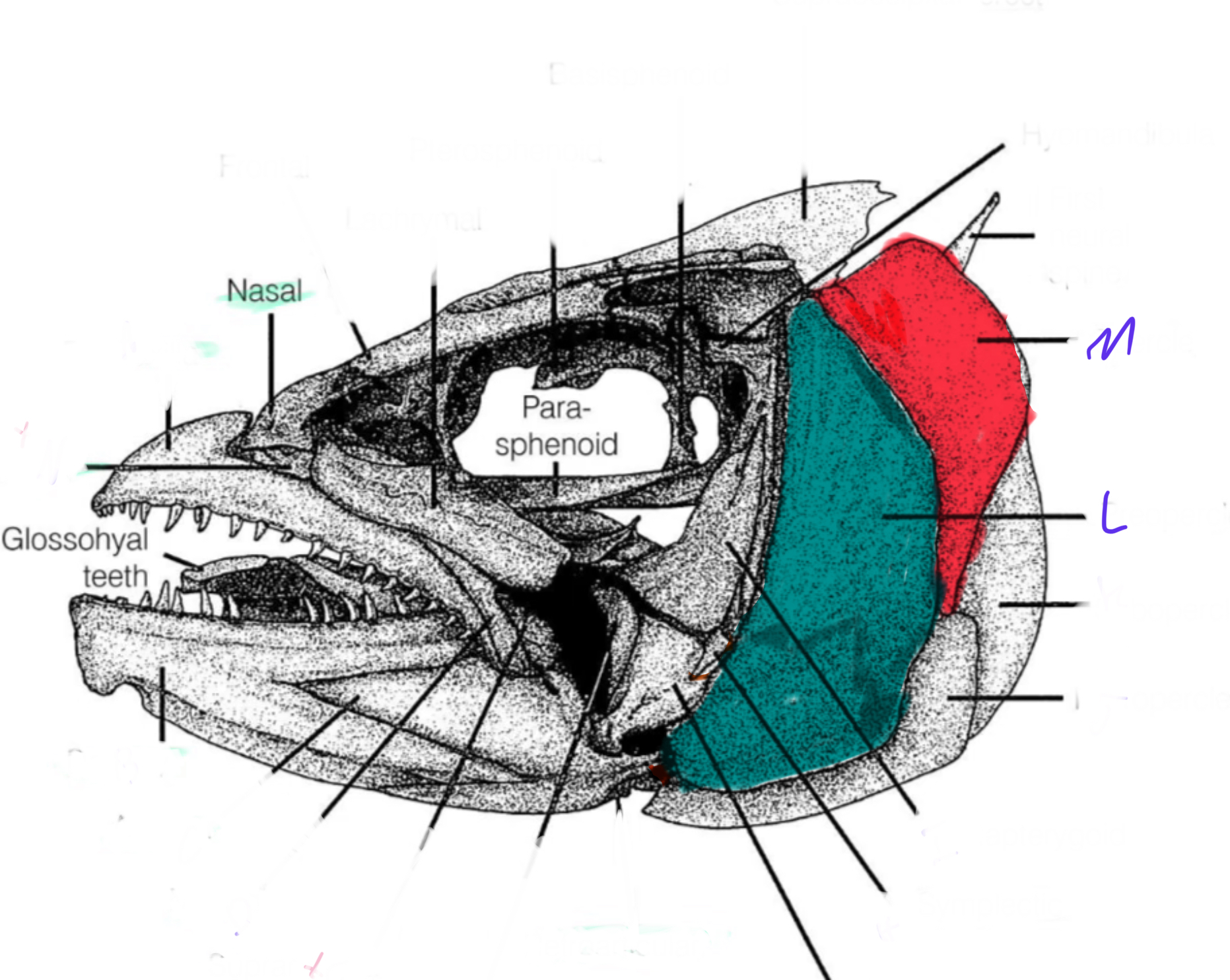
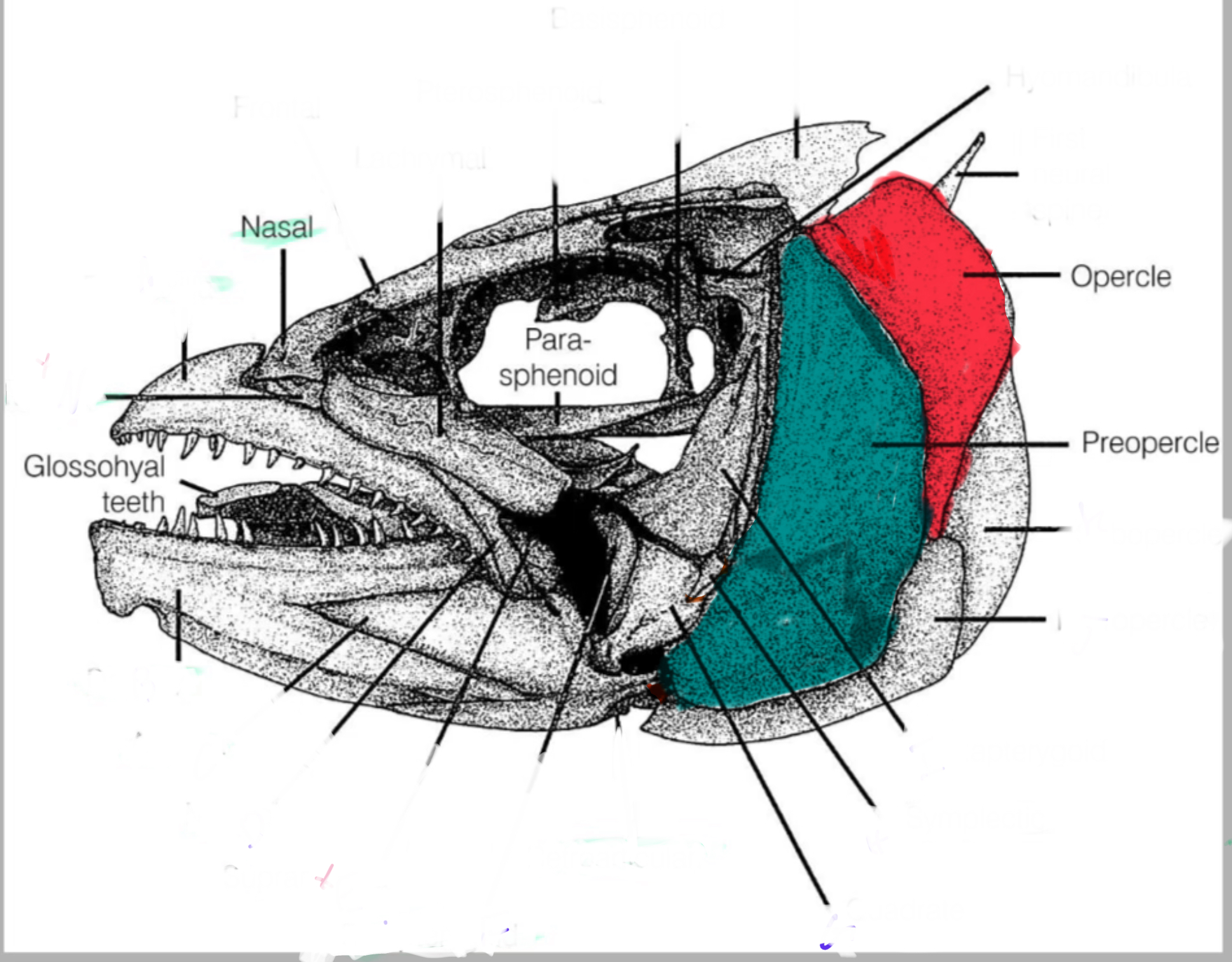
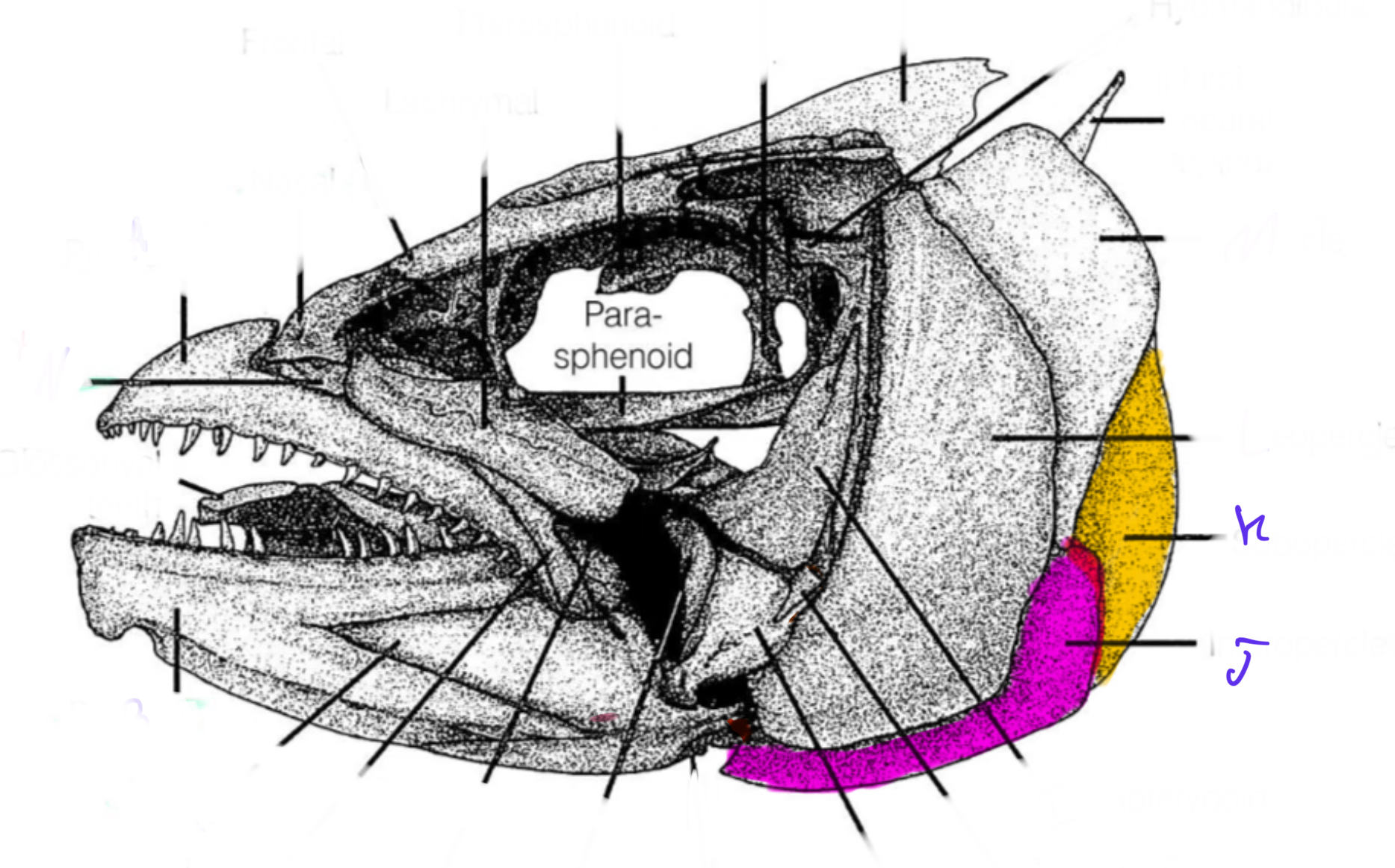
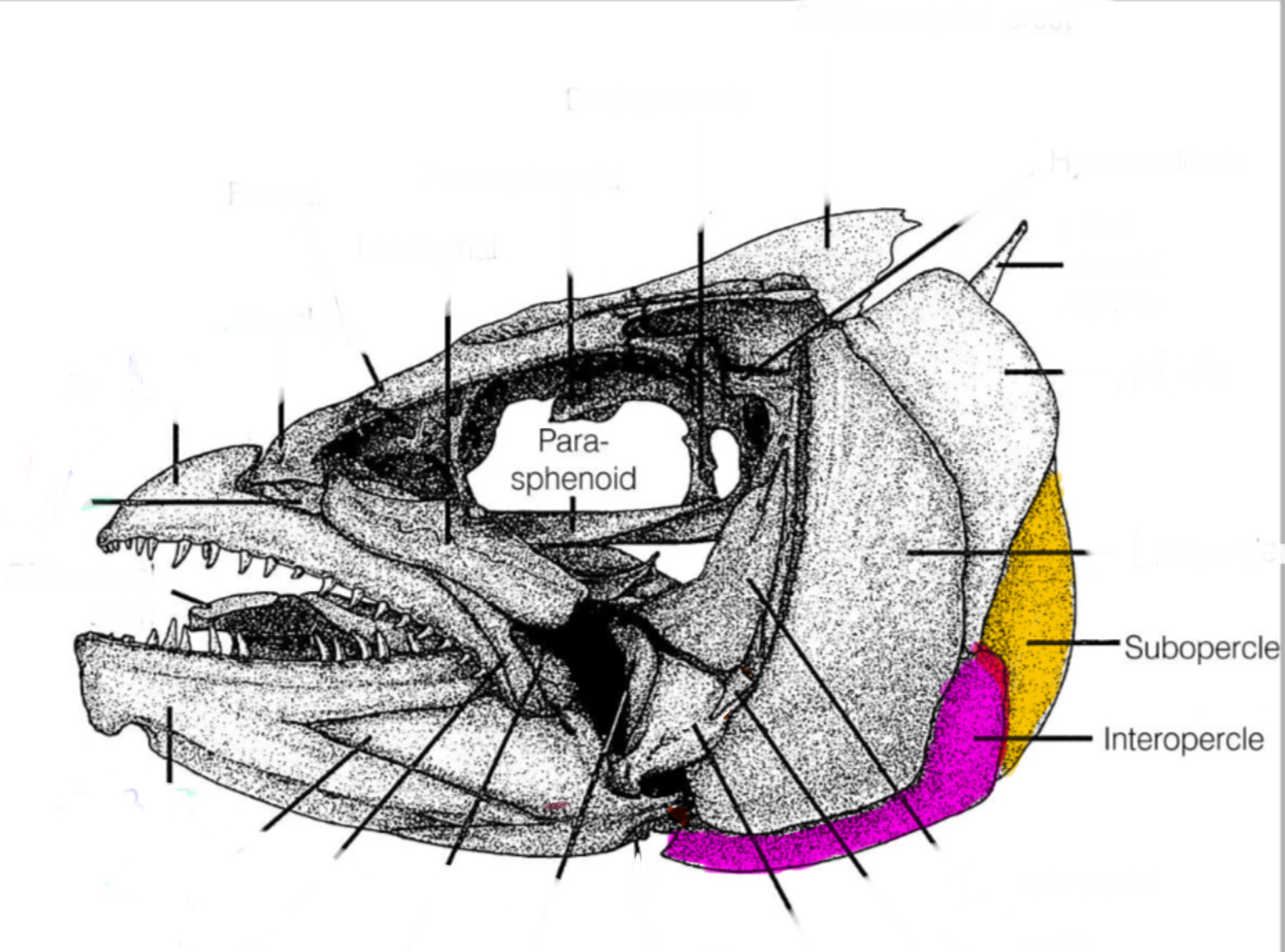
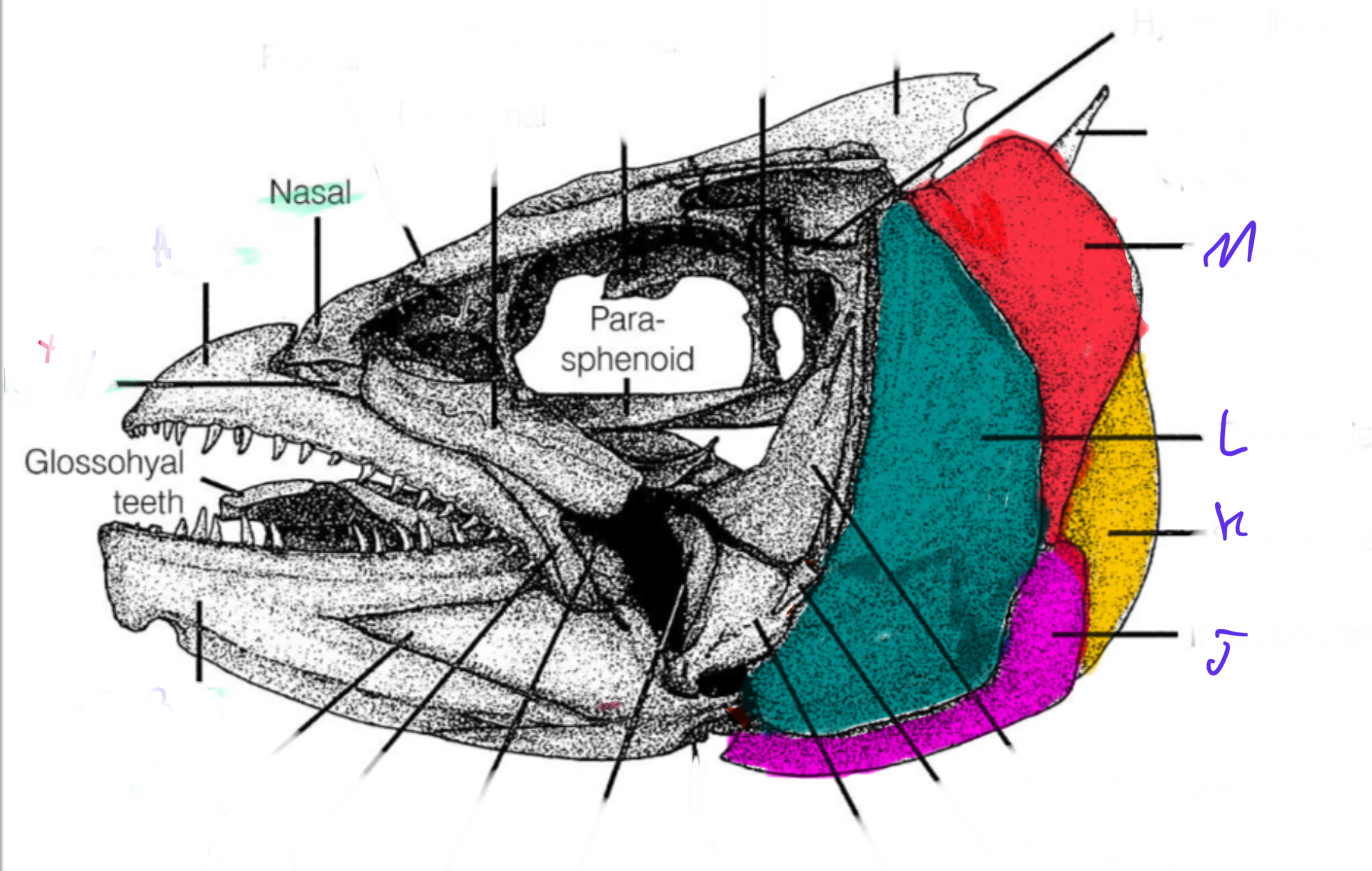
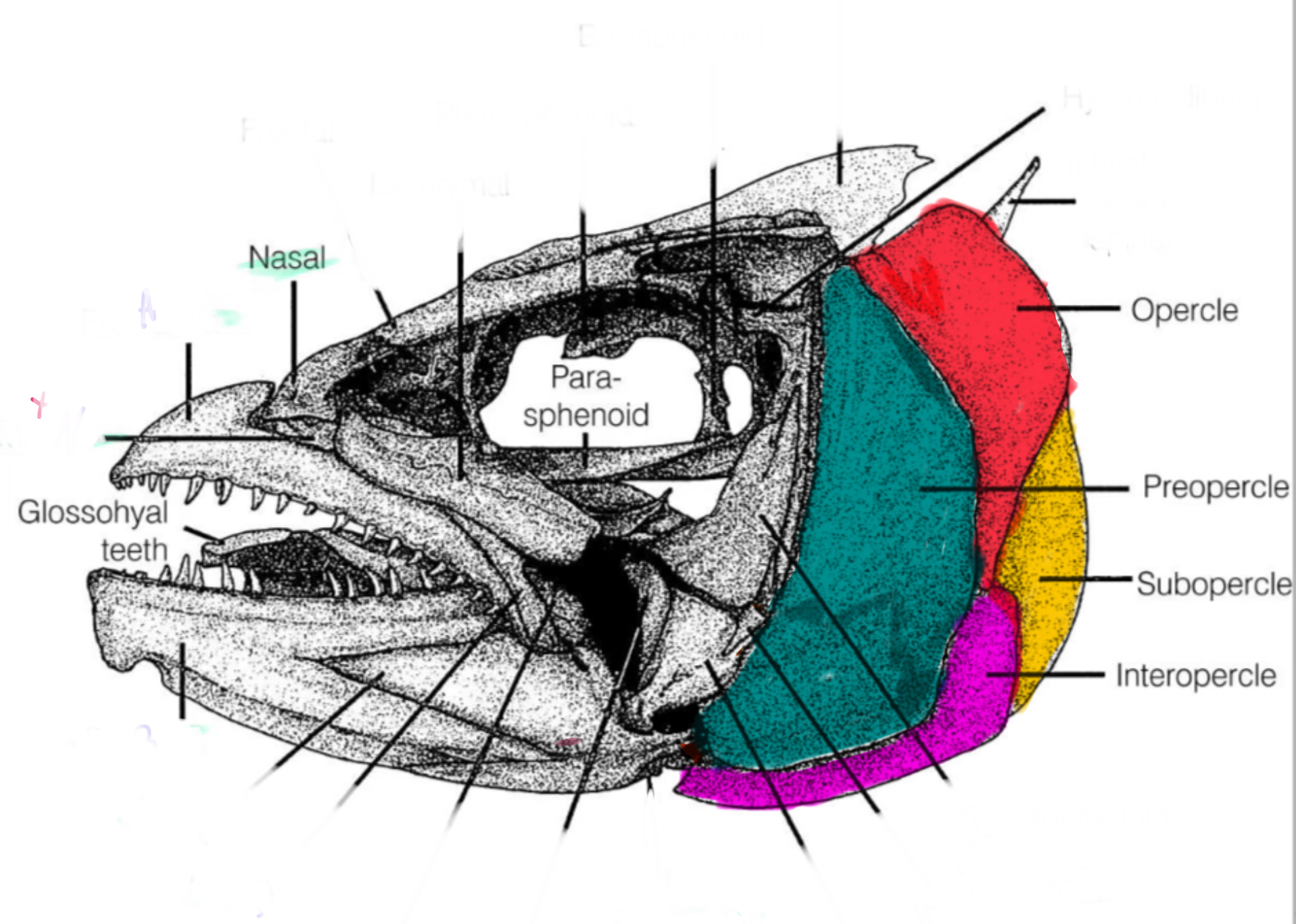
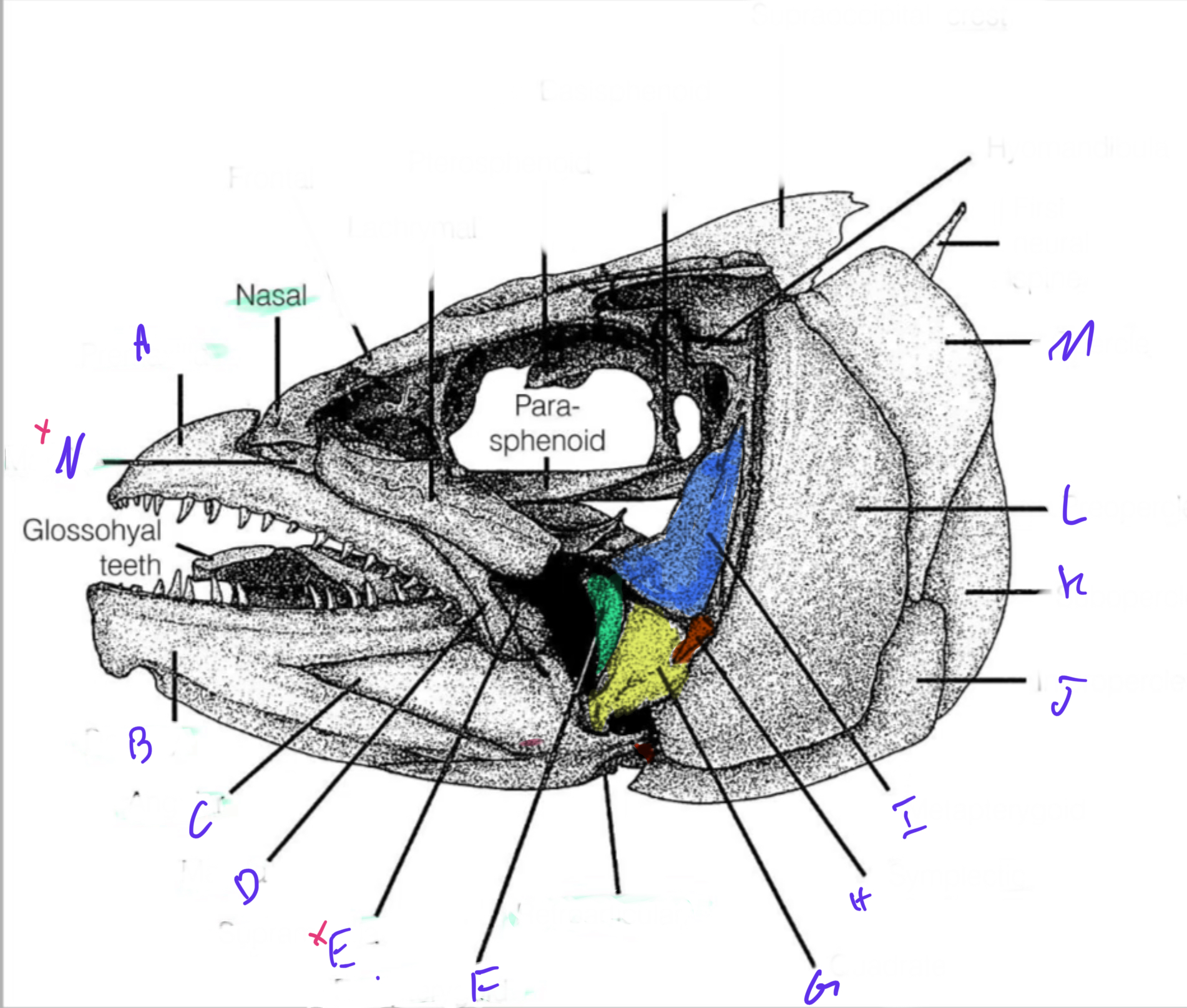
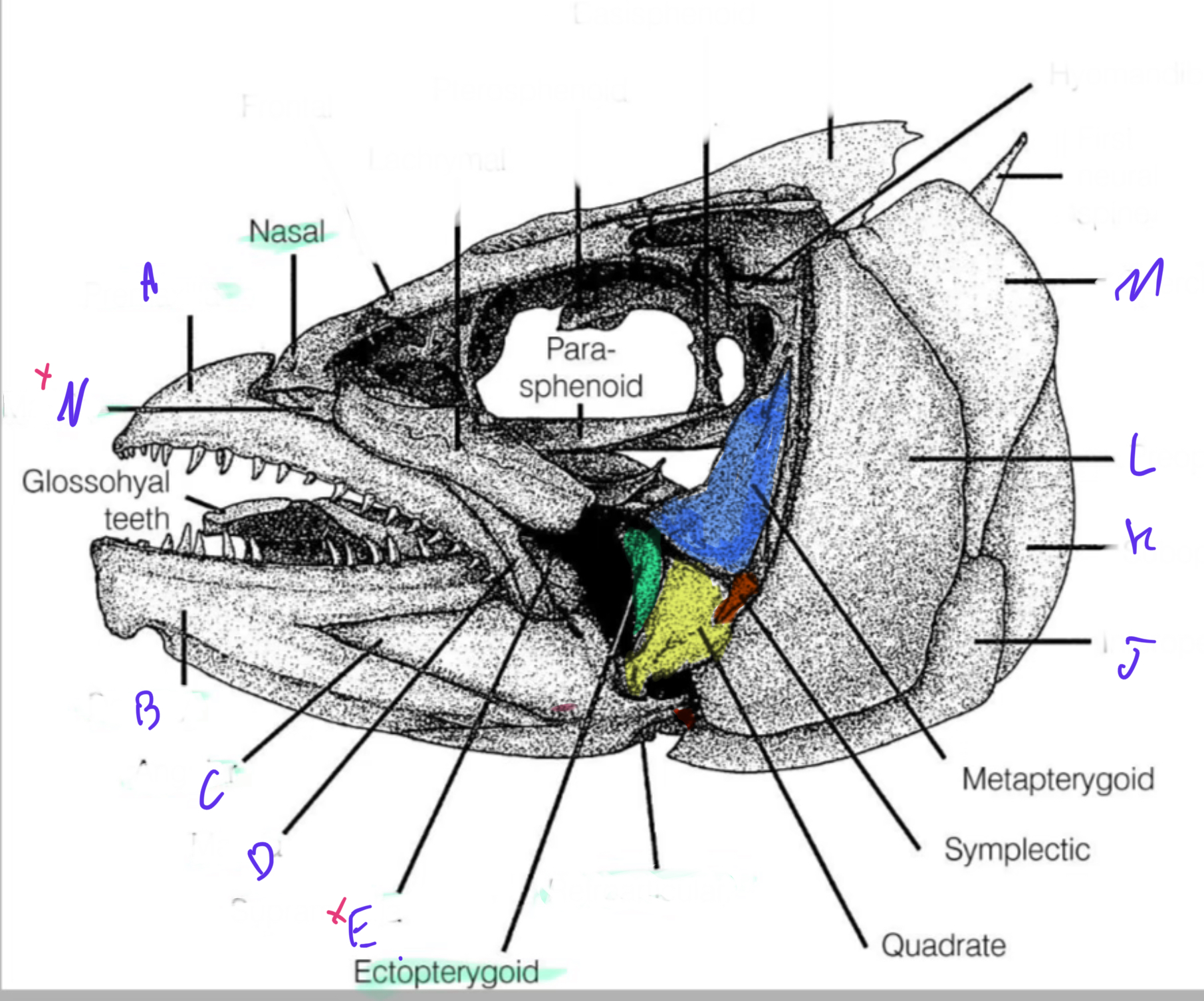
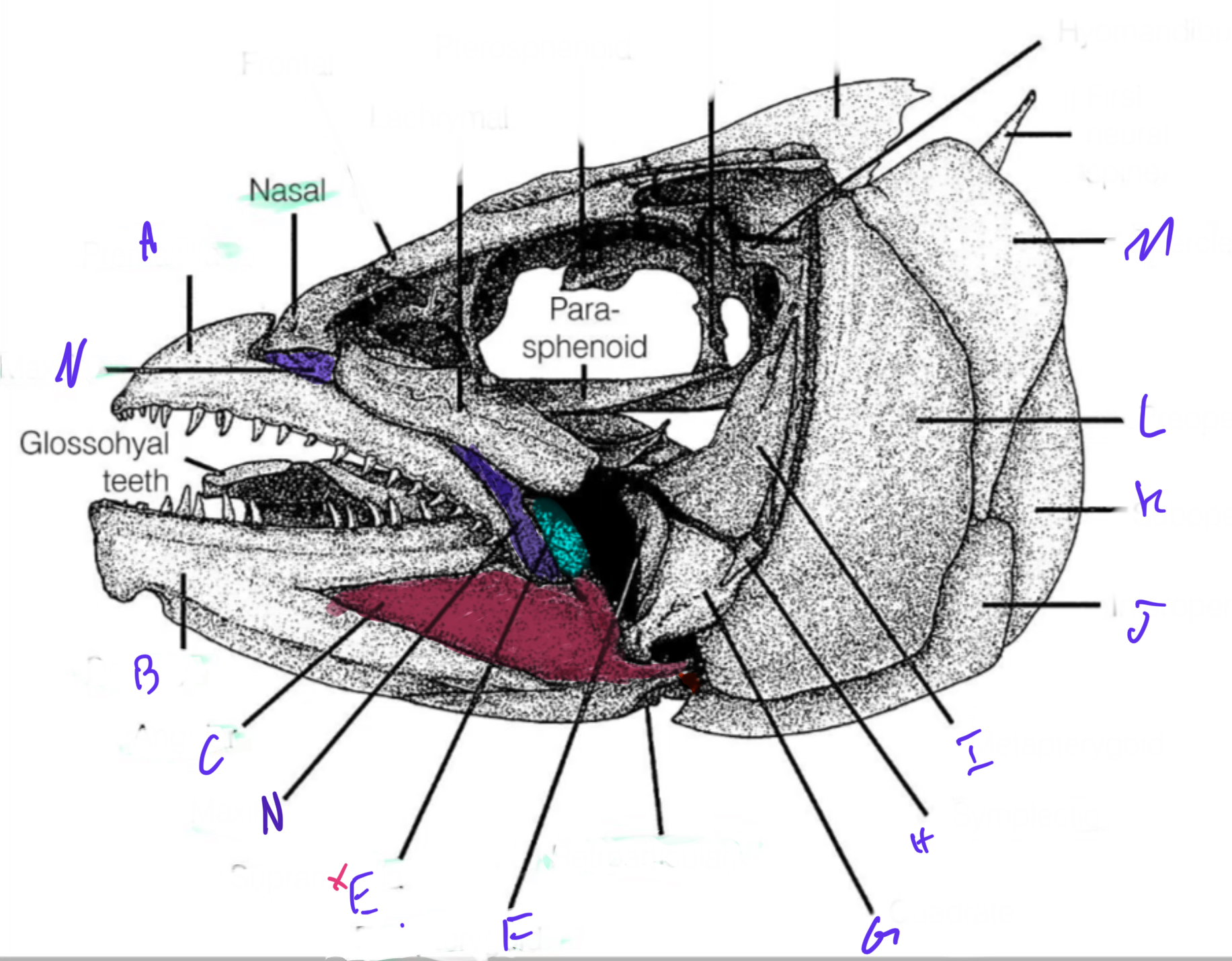
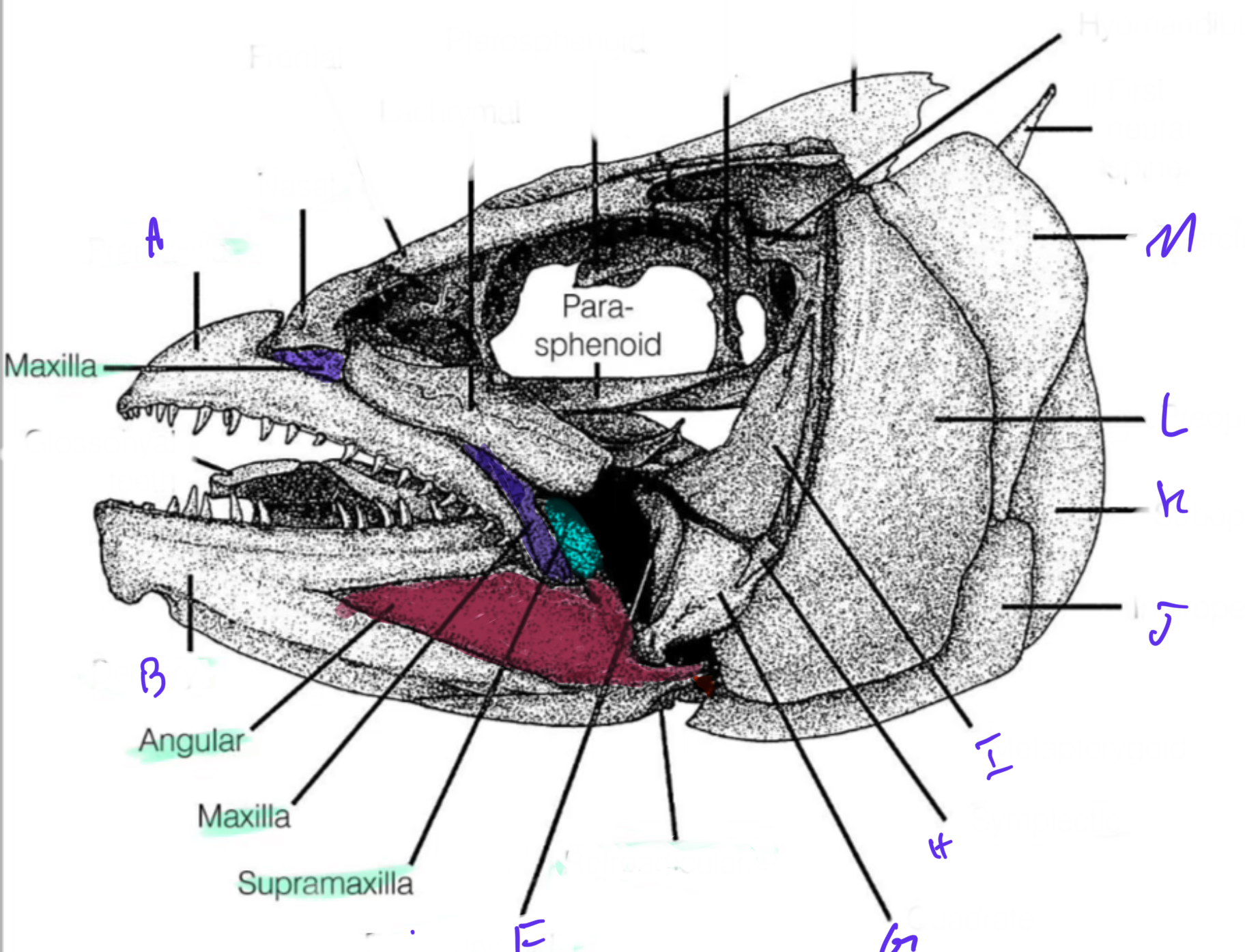
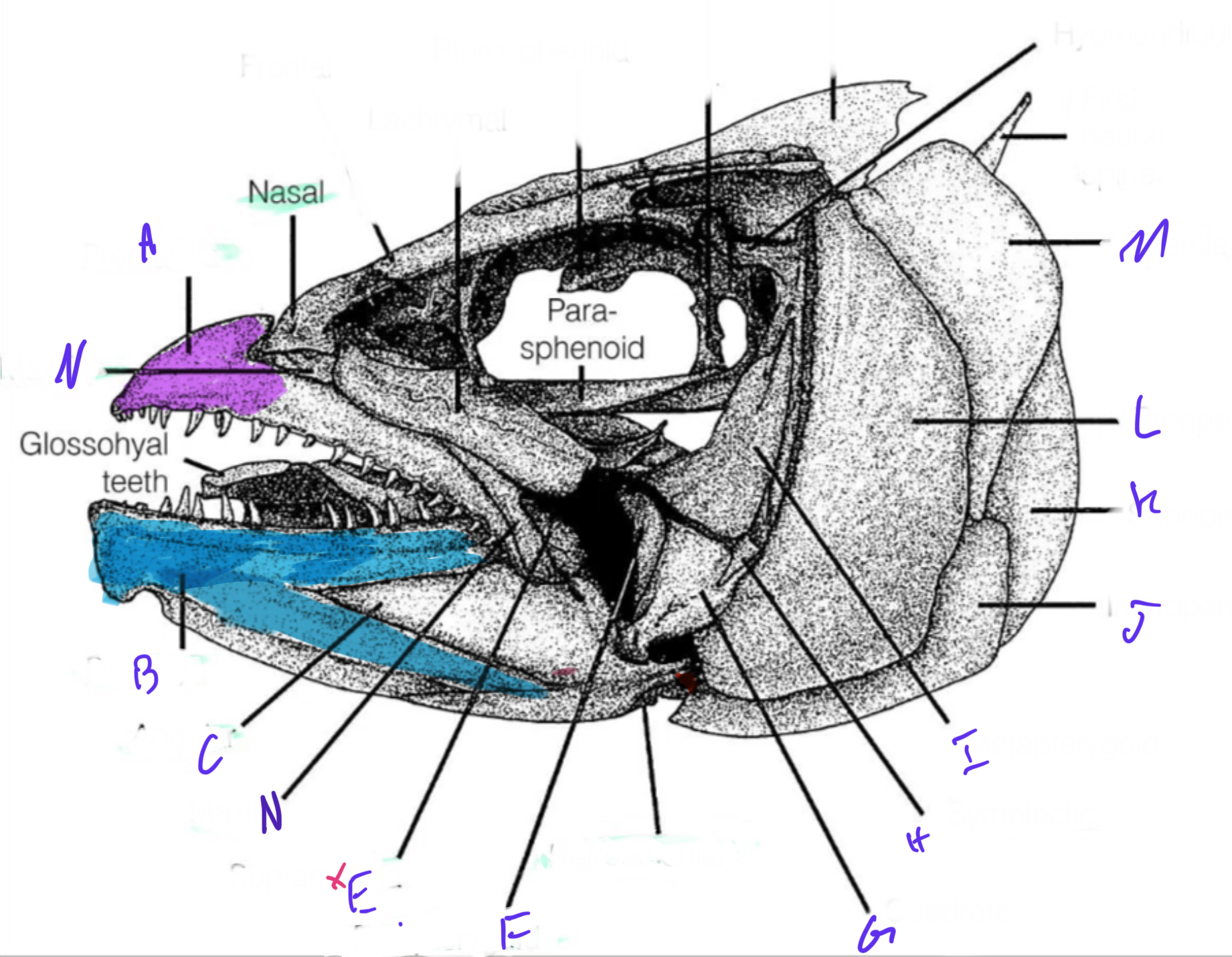
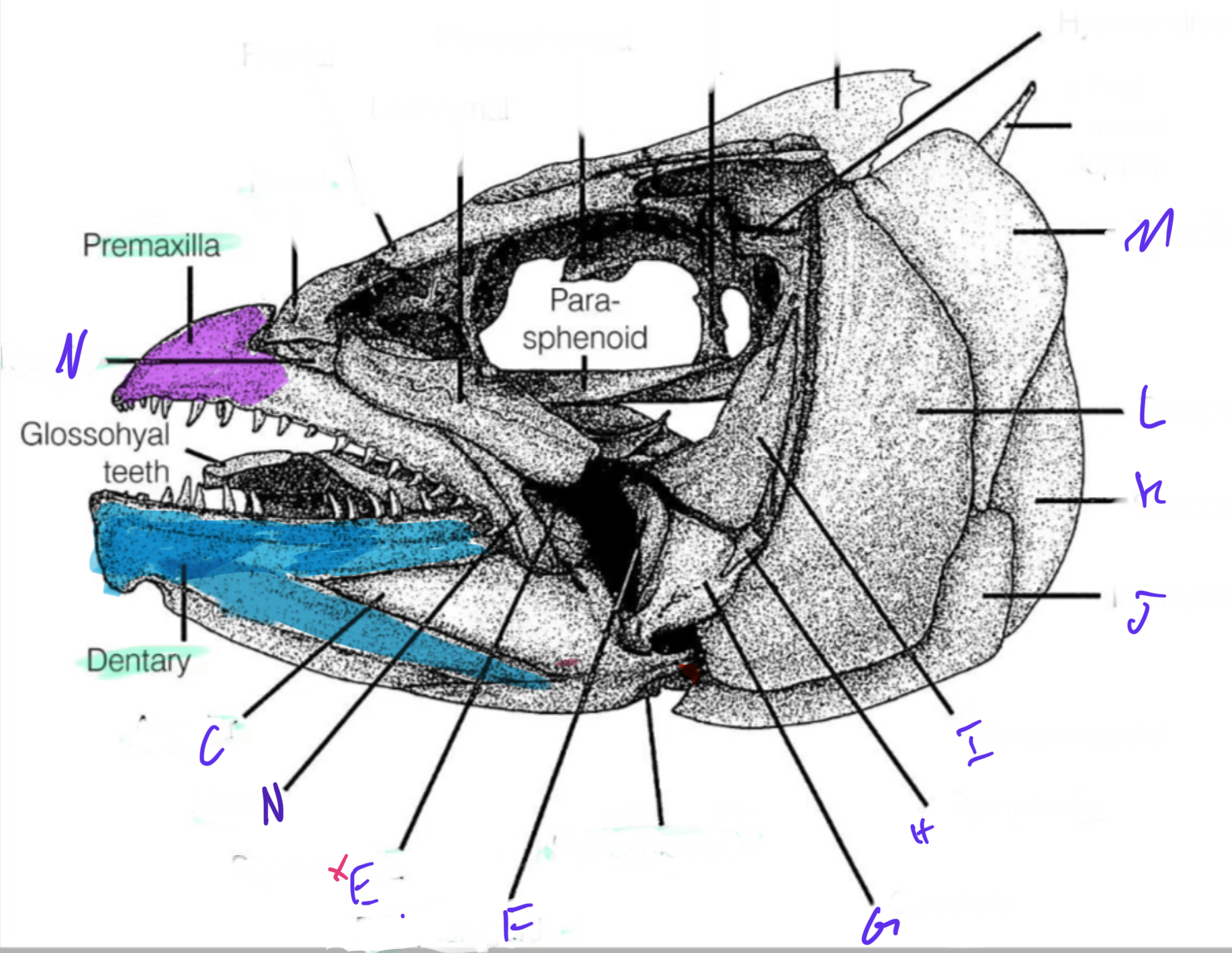


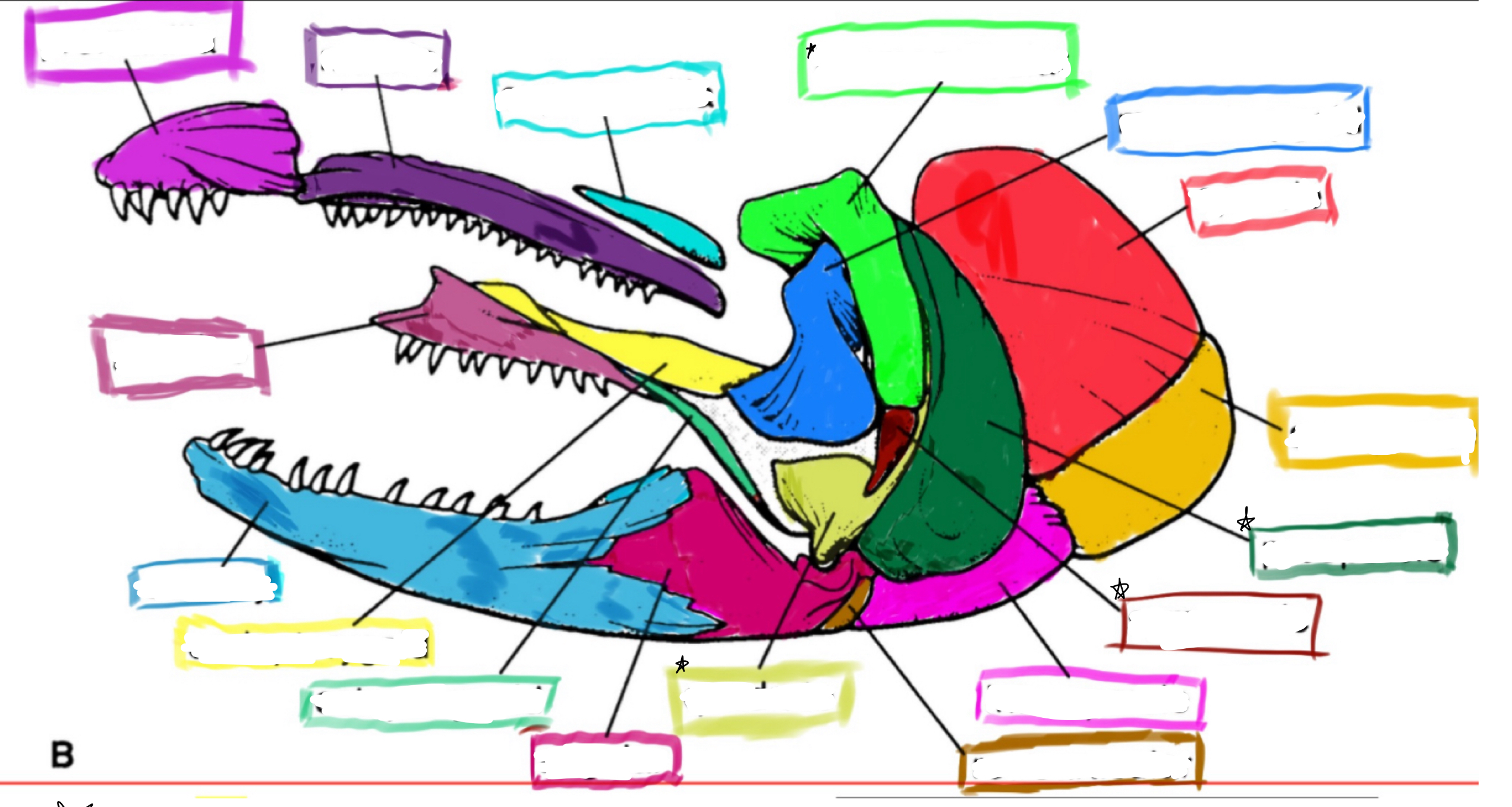
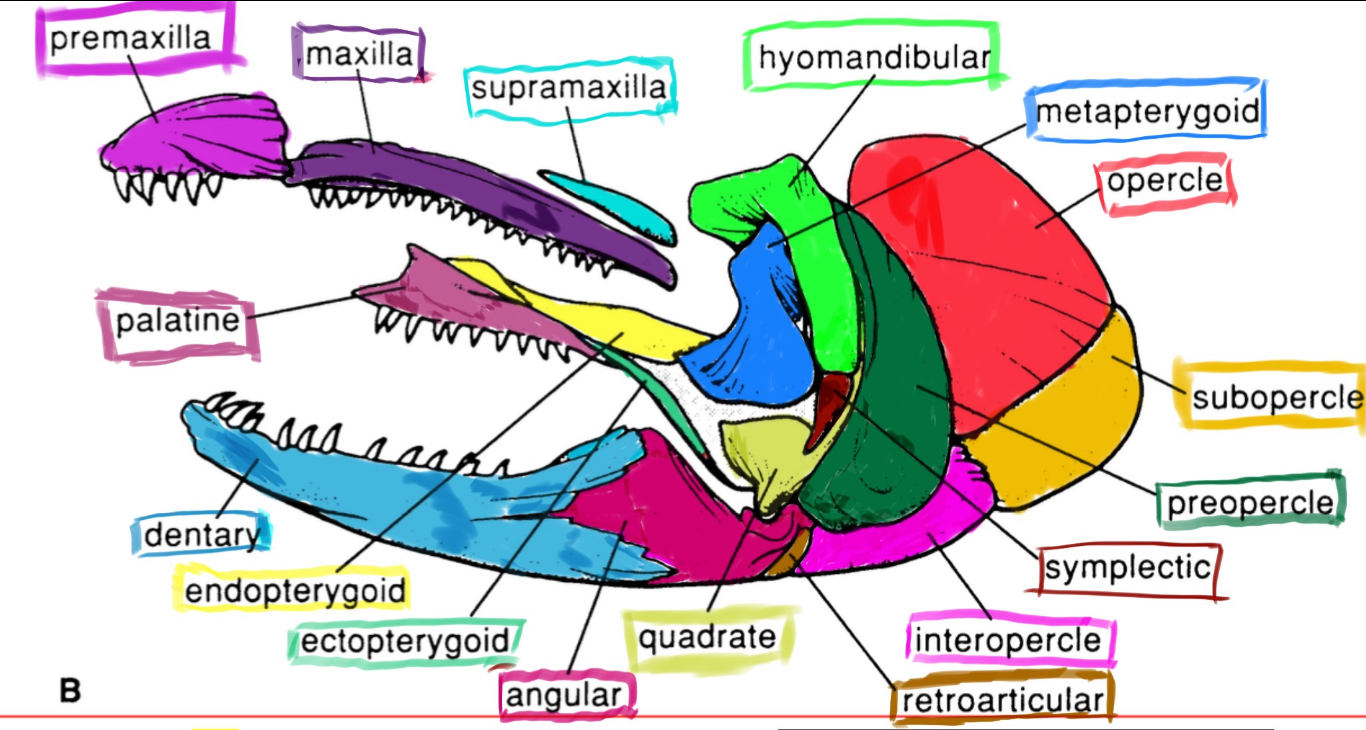
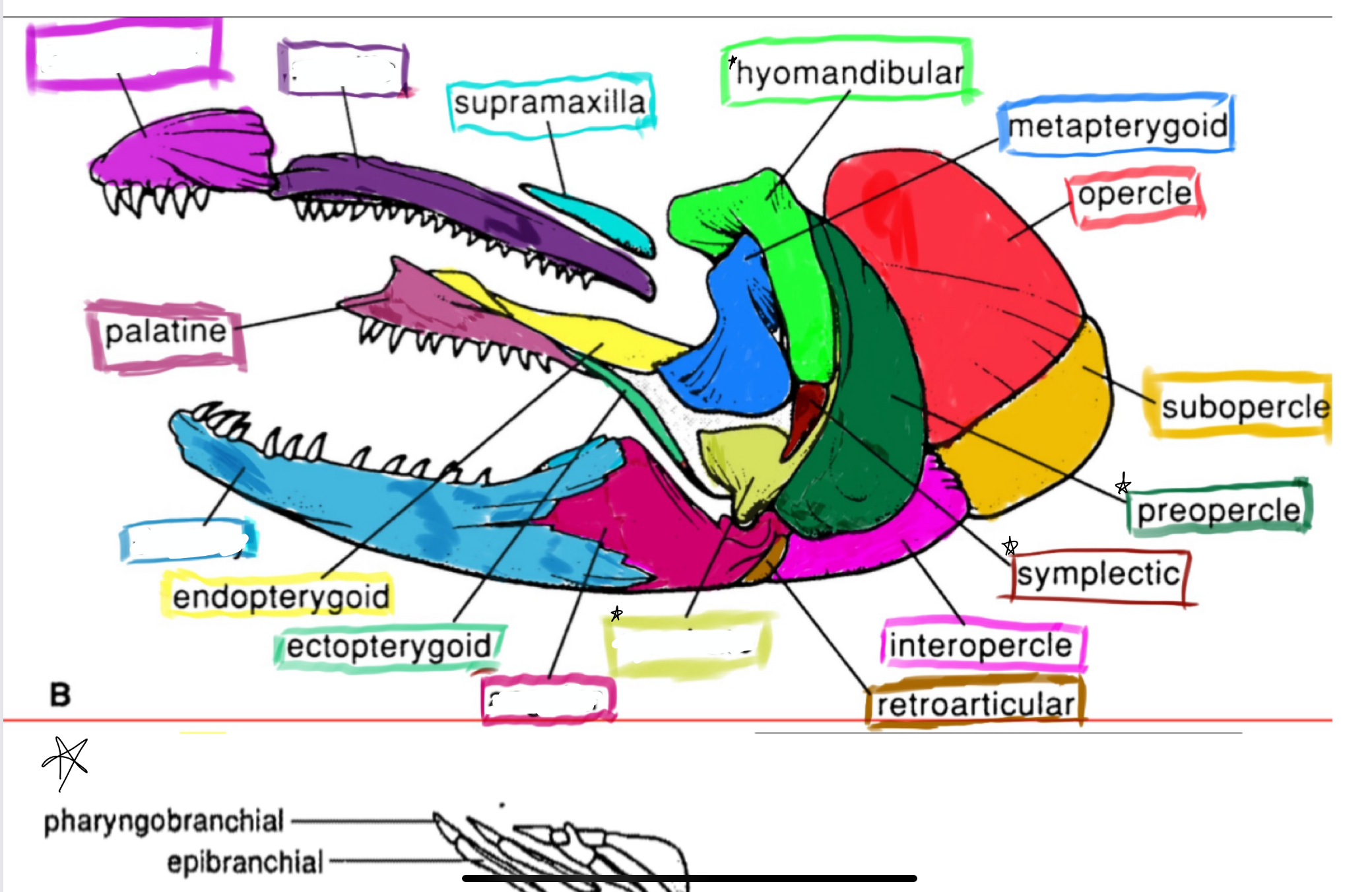
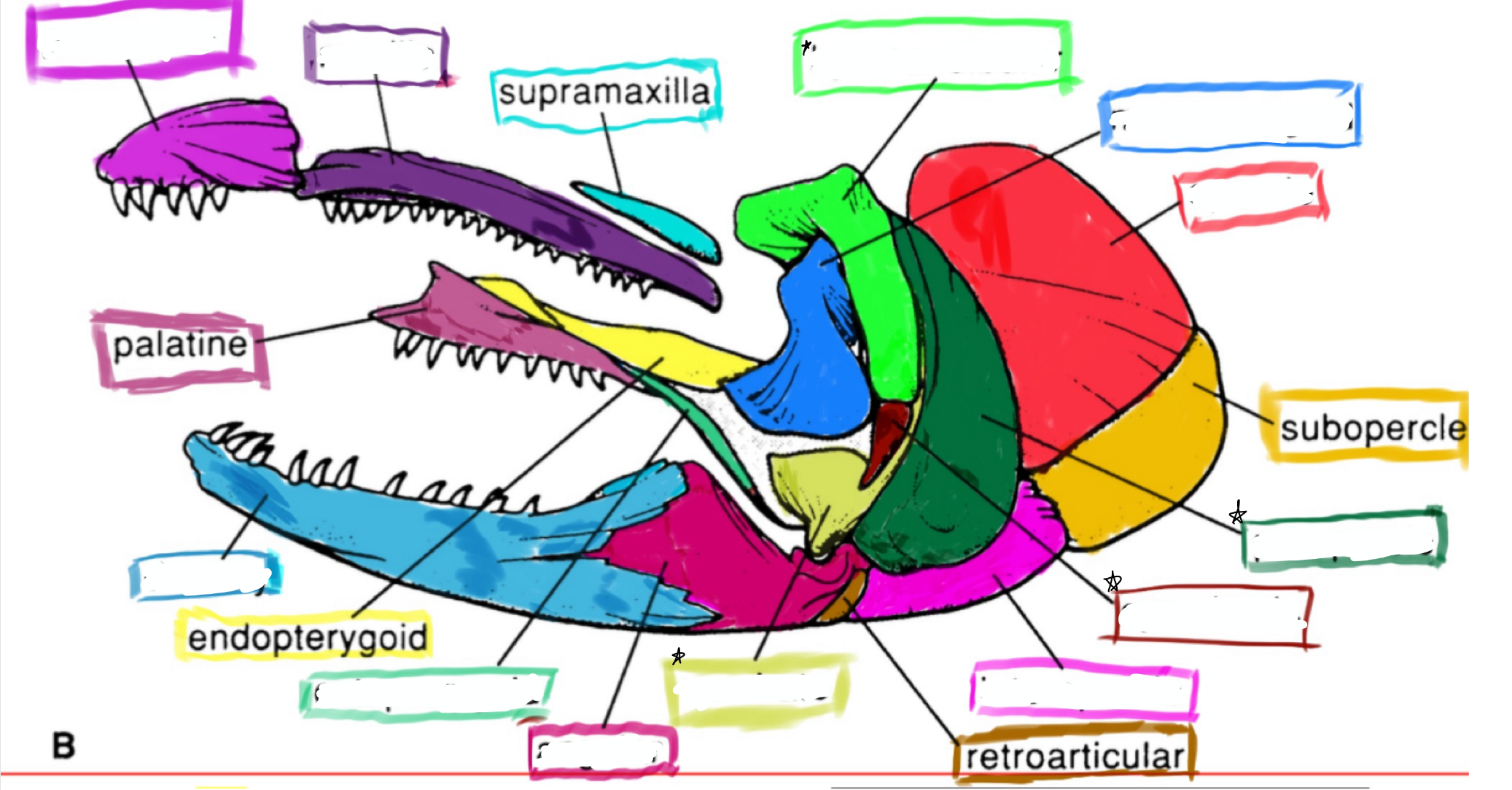
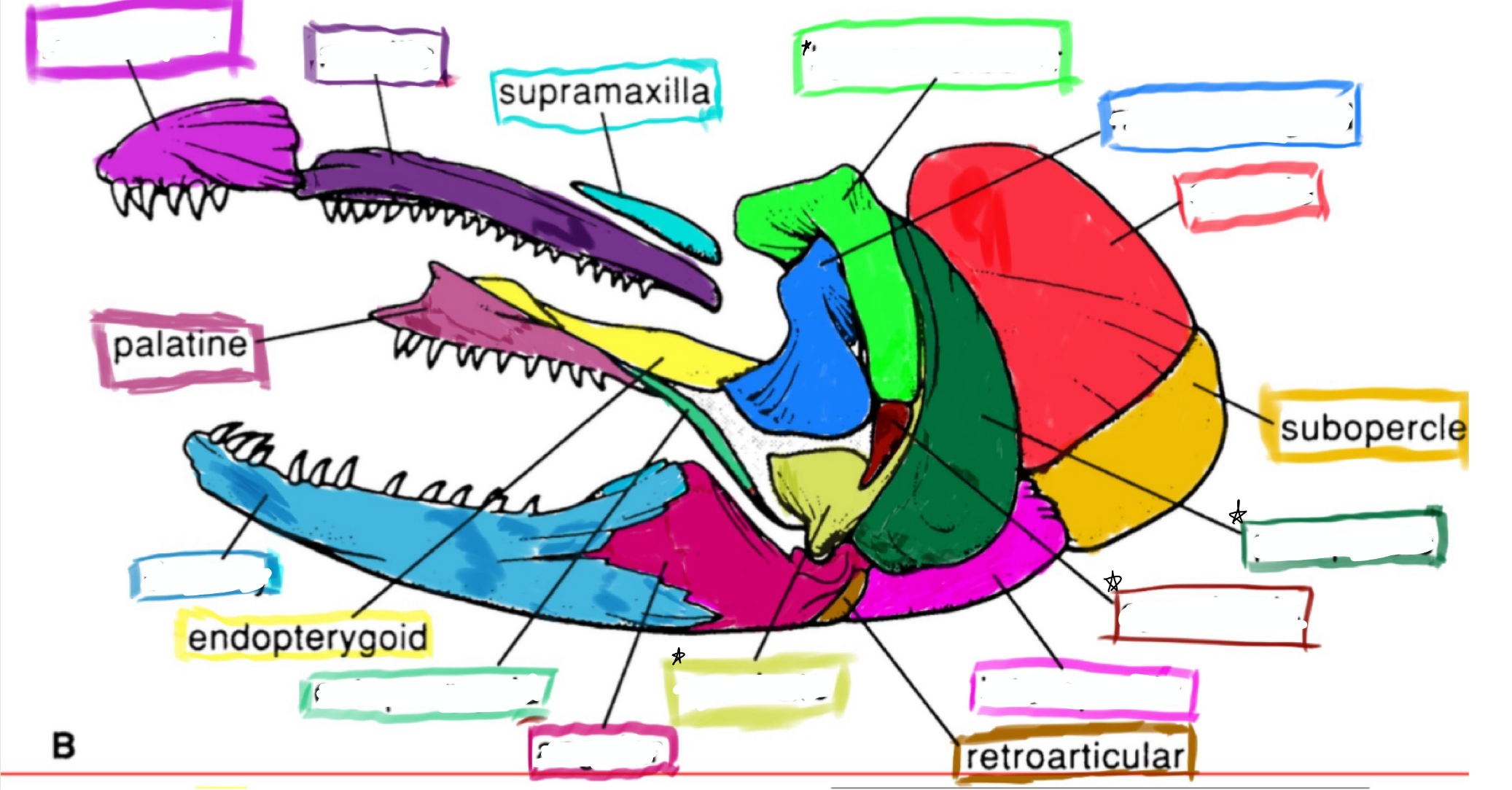
Premaxilla
The upper jaw bone that typically bears teeth in many advanced fishes.
Dentary
The primary tooth-bearing bone of the lower jaw in fishes.
Maxilla
A bone of the upper jaw in fishes, often posterior to the premaxilla, which can move to expand the mouth cavity during feeding. It may or may not bear teeth.
Palatine Bone
A paired bone in the roof of the mouth, usually bearing teeth, and part of the palate and suspensorium in fishes.
Pterygoid Bones
A complex of bones (including ectopterygoid, endopterygoid, metapterygoid) that form part of the suspensorium, connecting the palatine and hyomandibular bones and allowing for jaw protrusion and rotation.
Quadrate Bone
A key bone in the suspensorium, forming the articulation point for the lower jaw (dentary) at the posterior angle of the mouth.
Articular Bone
A bone of the lower jaw, articulating with the quadrate in the suspensorium and often fused with the dentary in many teleosts.
Retroarticular Bone
A small bone located posterior and ventral to the articular bone in the lower jaw, often involved in muscle attachment.
Angular Bone
A bone associated with the articulation region of the lower jaw, often fused with other bones like the prearticular.
Suspensorium
A complex of bones that connect the jaws to the cranium allowing for effective jaw movement.
Opercular apparatus
A set of bones that cover and protect the gills, also involved in feeding mechanics.
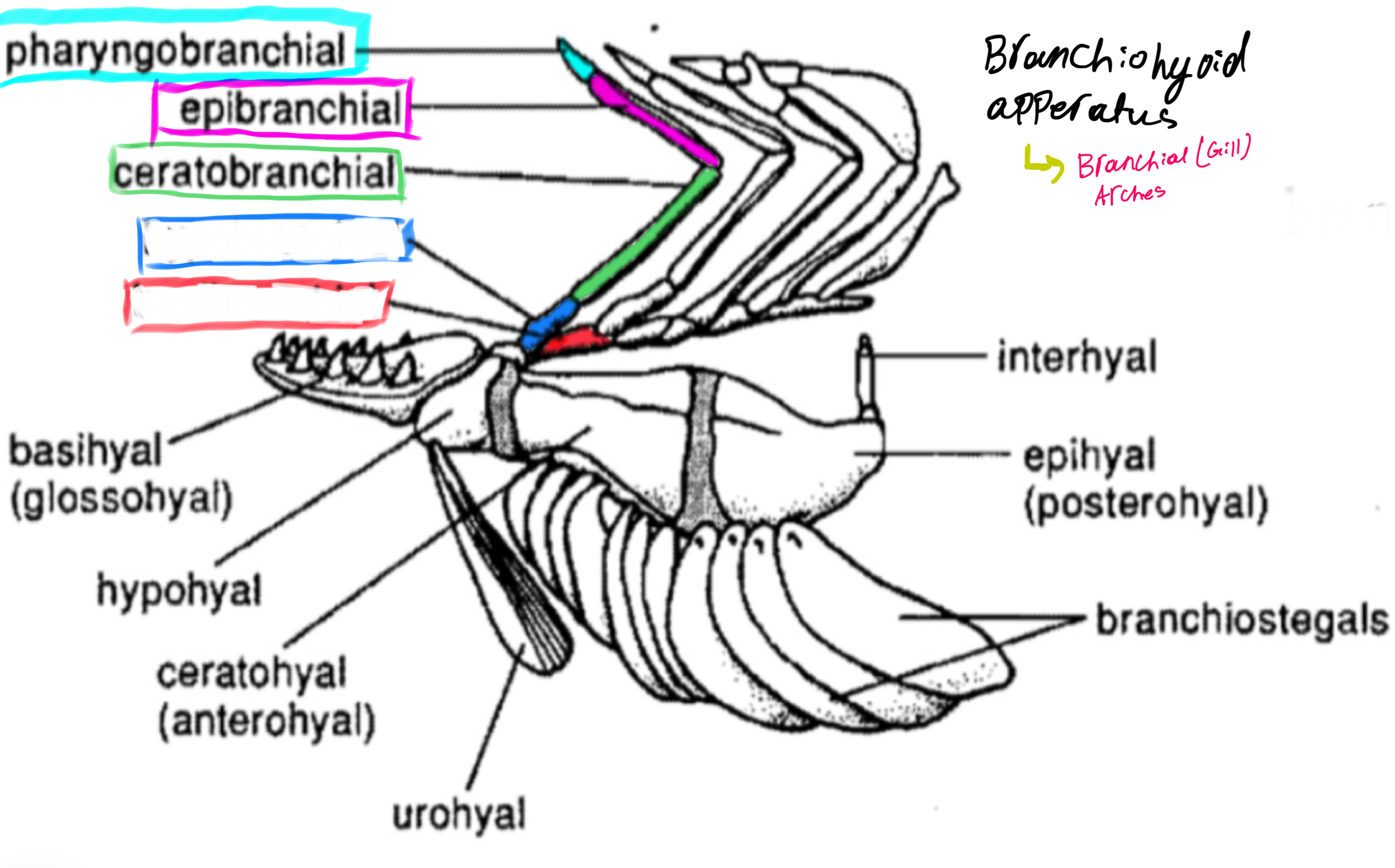

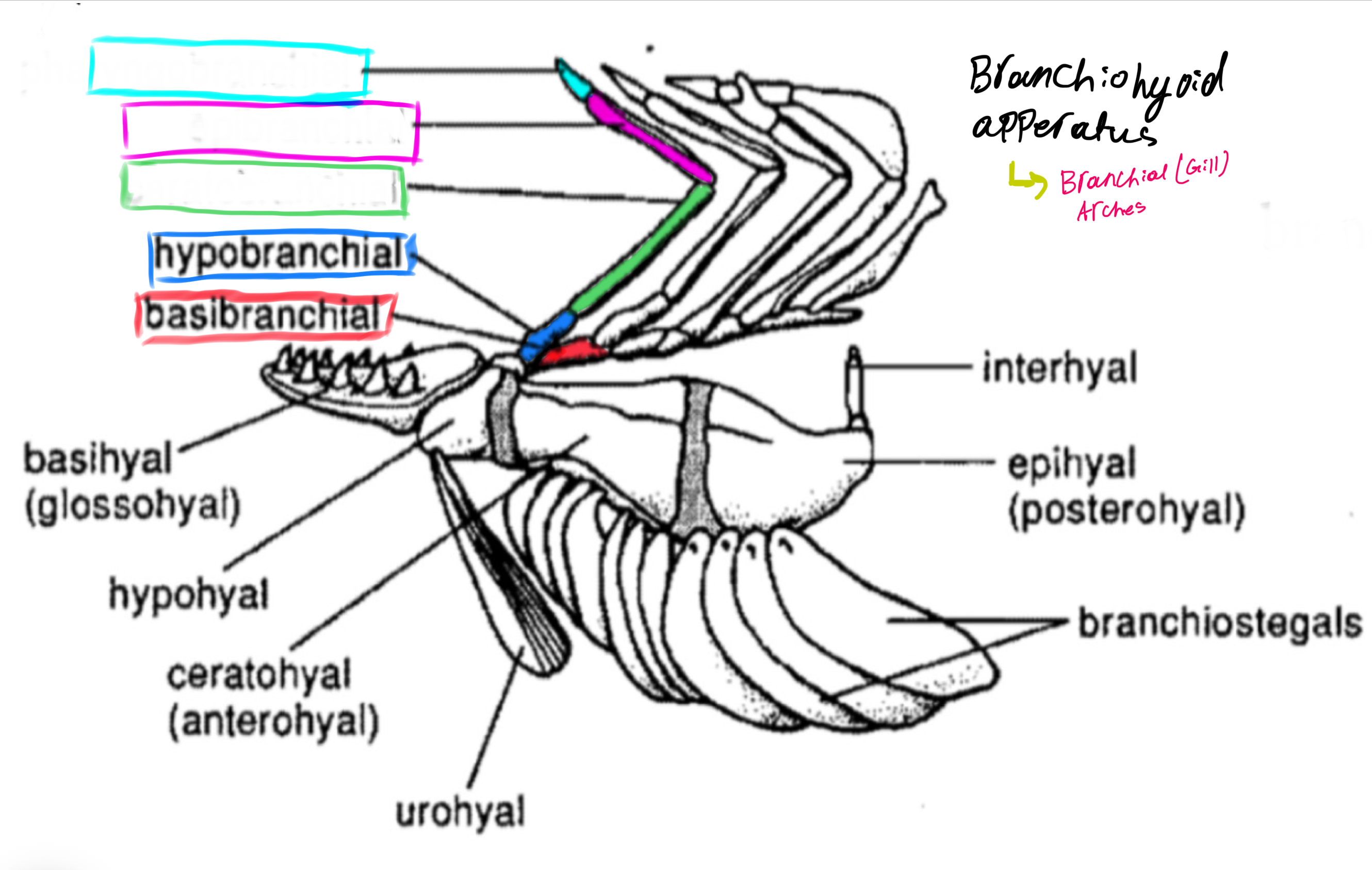
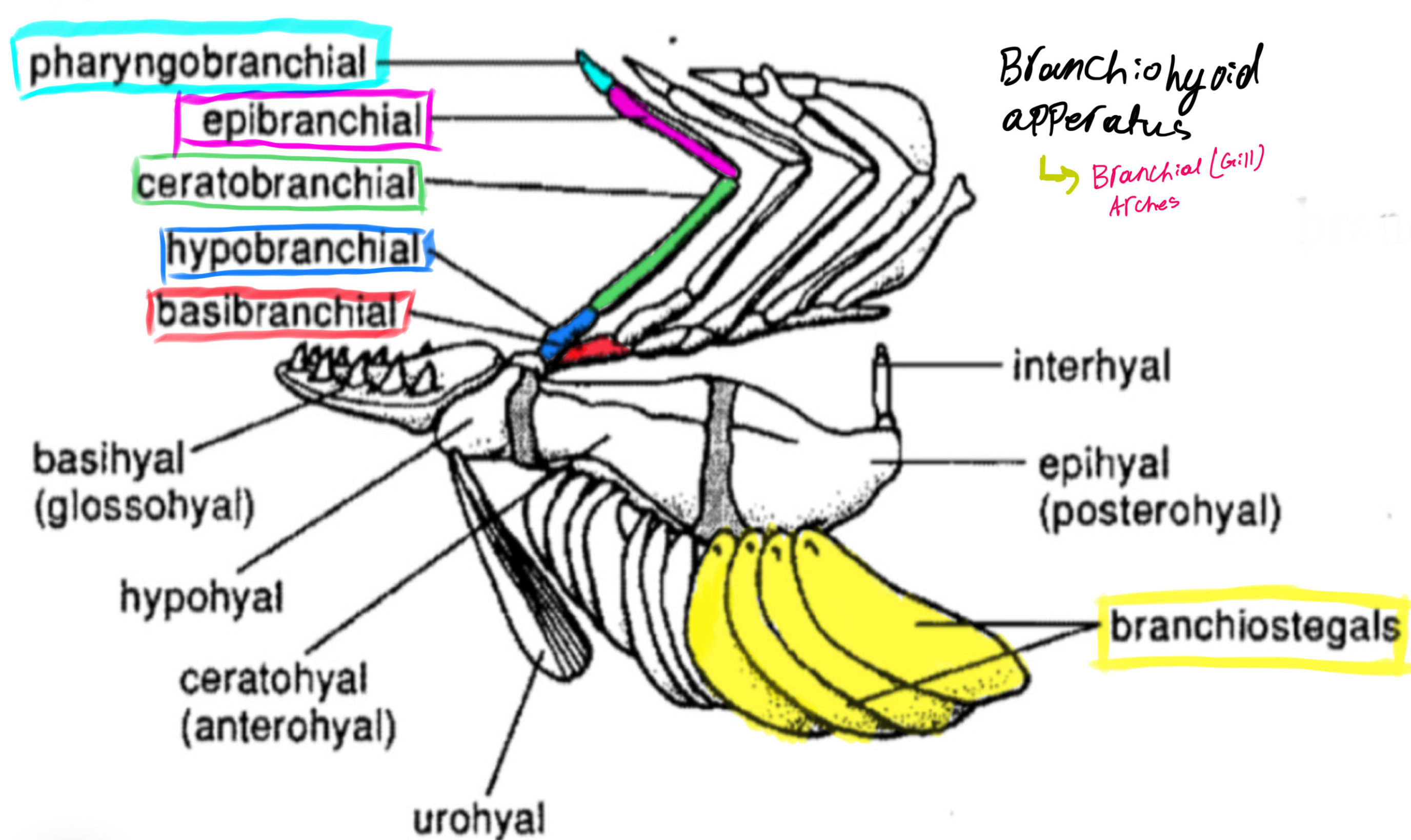
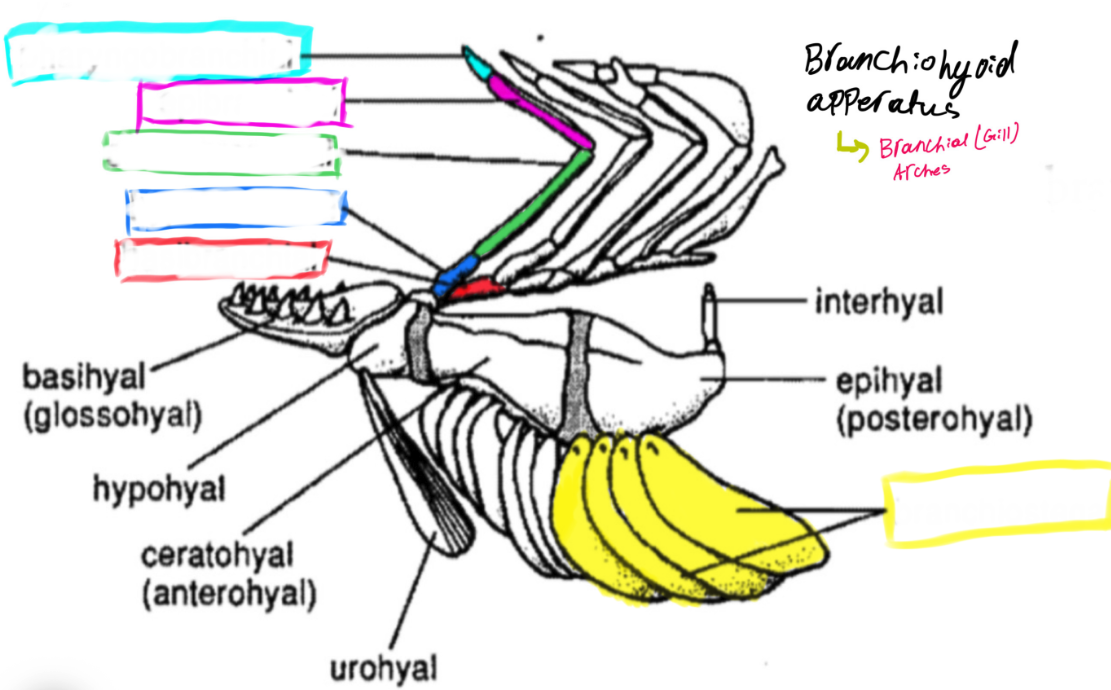
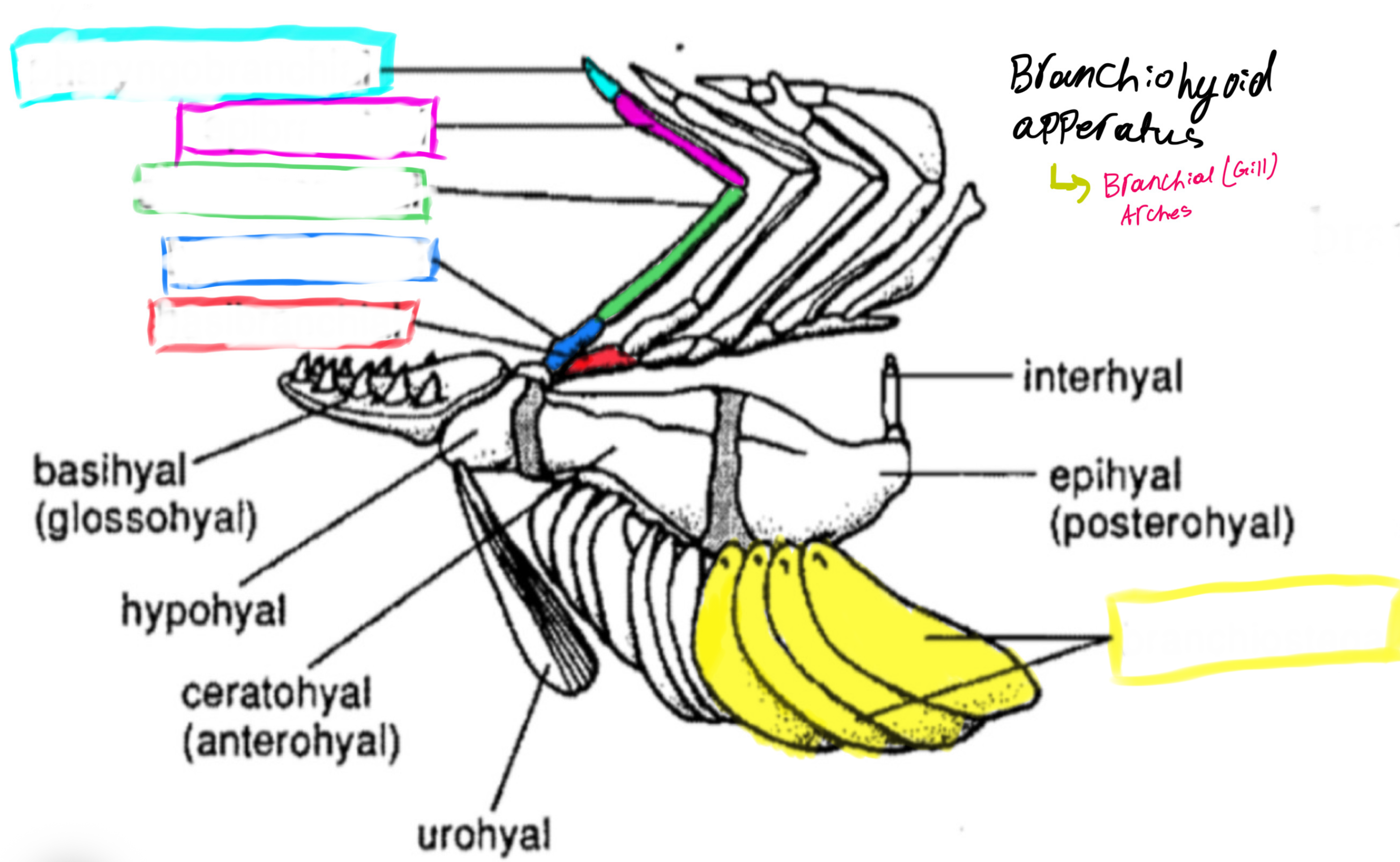
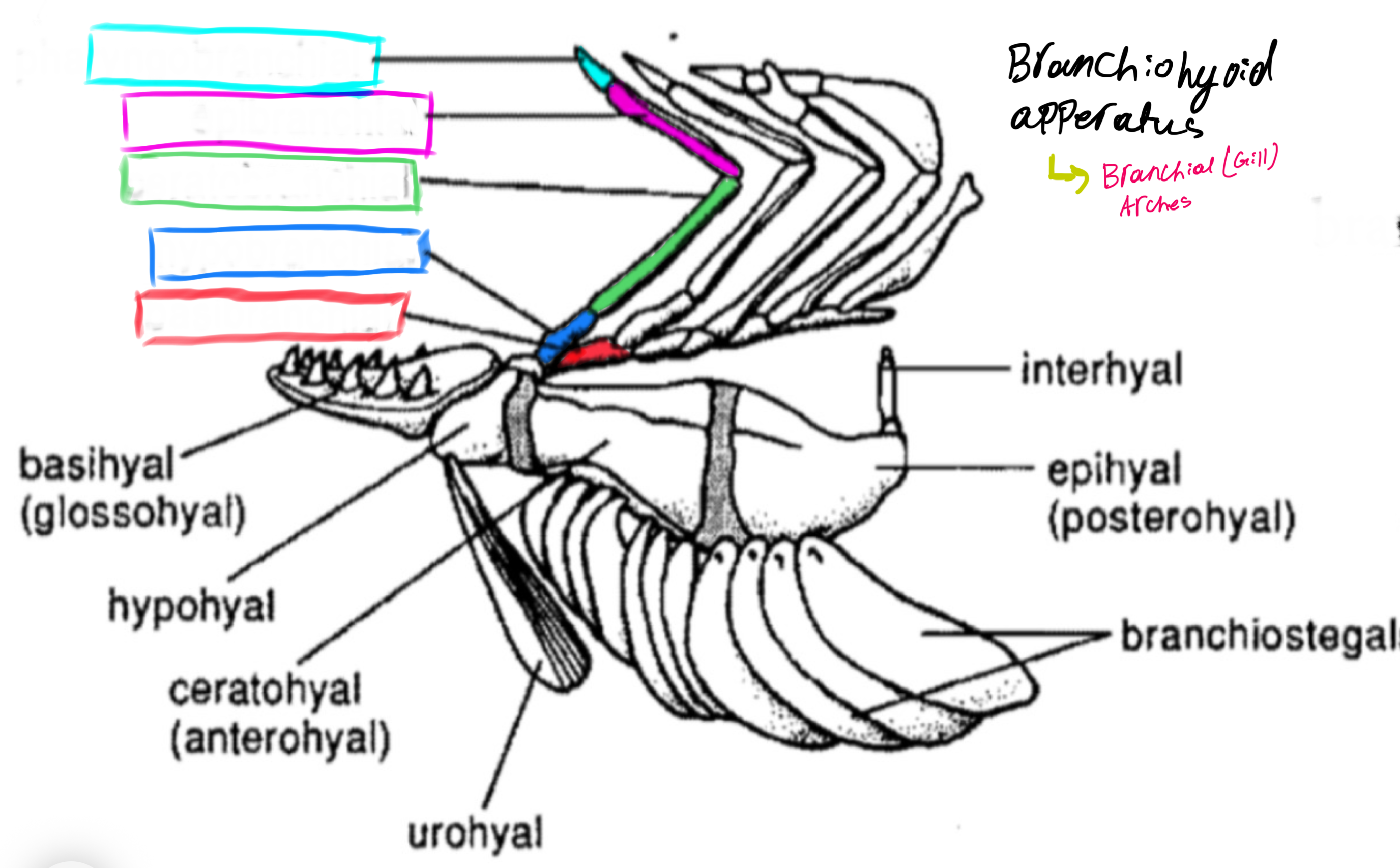
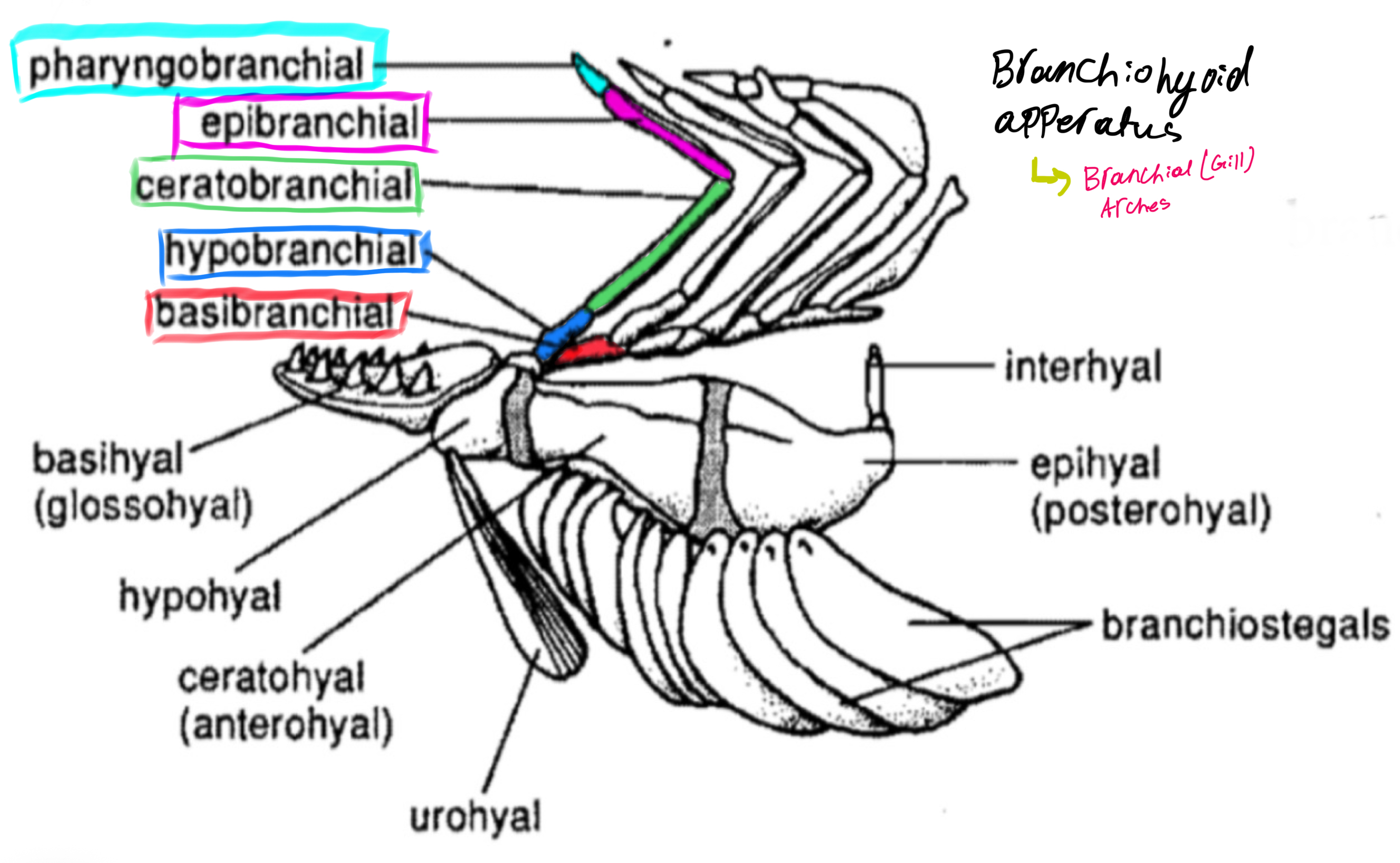
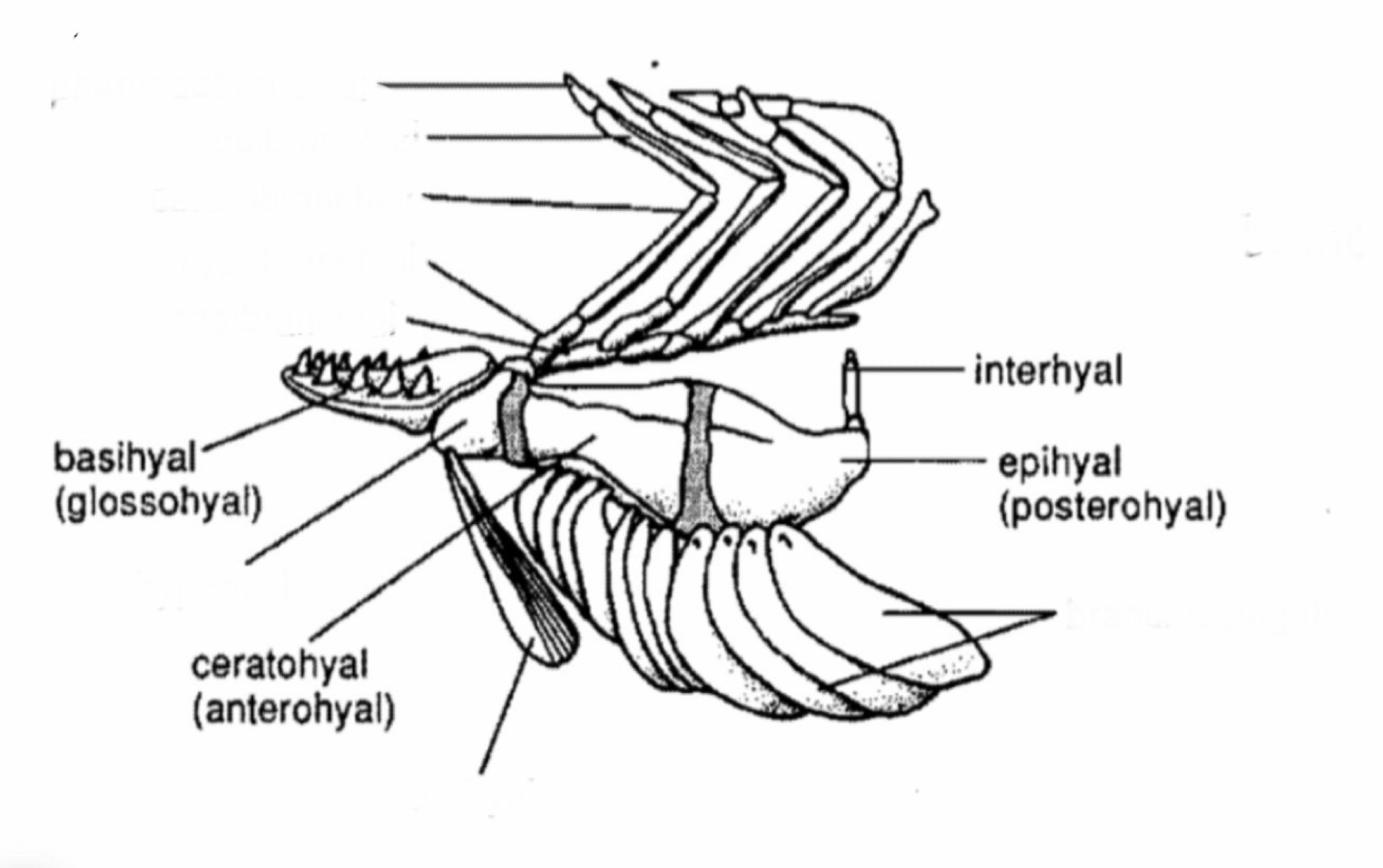
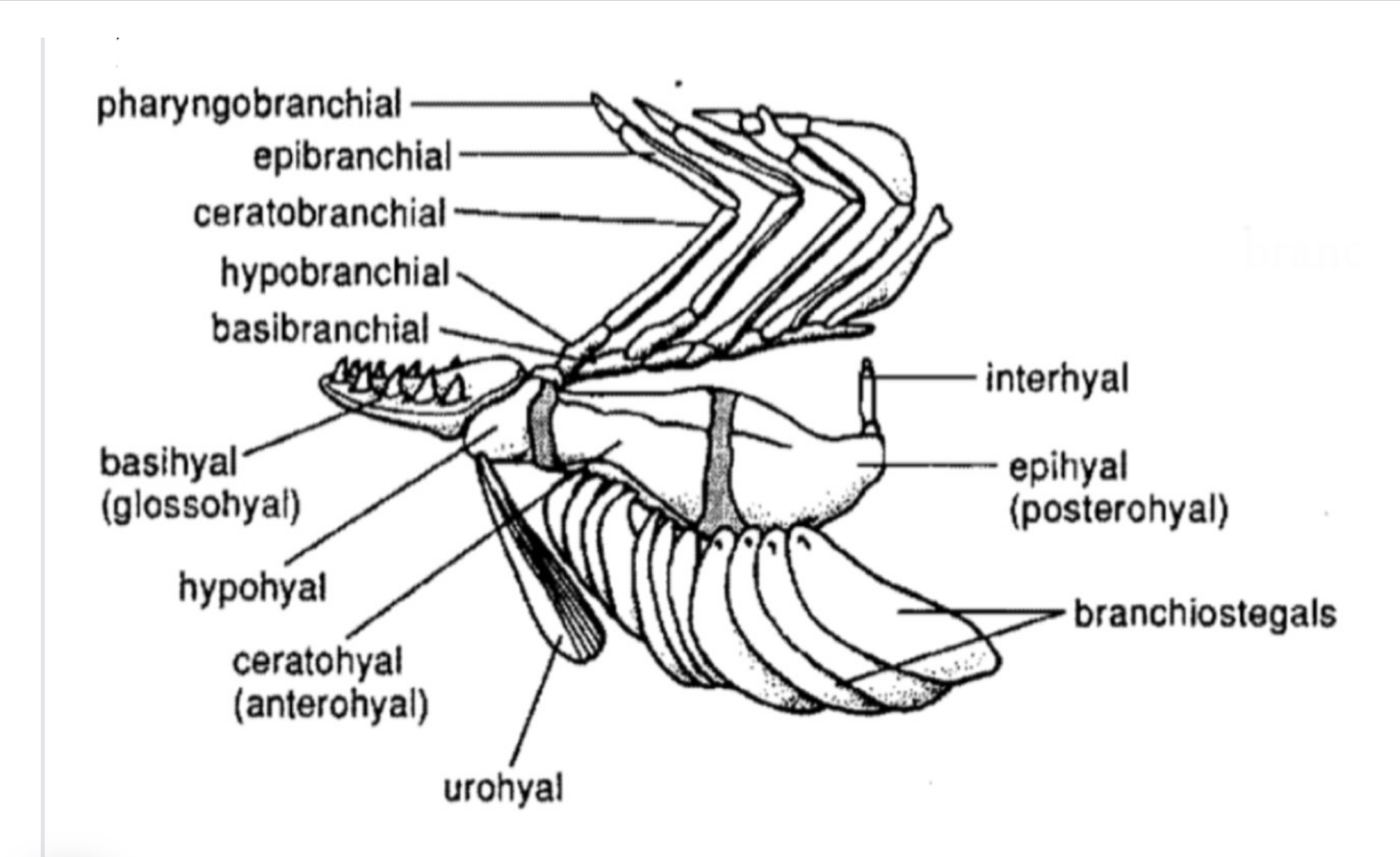
Branchial arch structure
The arrangement of gill arches that support gill filaments and are involved in respiration.
Pharyngeal Jaws (Pharyngeal Arches)
Modified branchial arches deep in the throat of some fishes (e.g., cichlids, carp) that bear teeth and are used for processing food after it has been captured by the oral jaws.
Gill rakers
Structures that trap food particles in the gills of fishes.
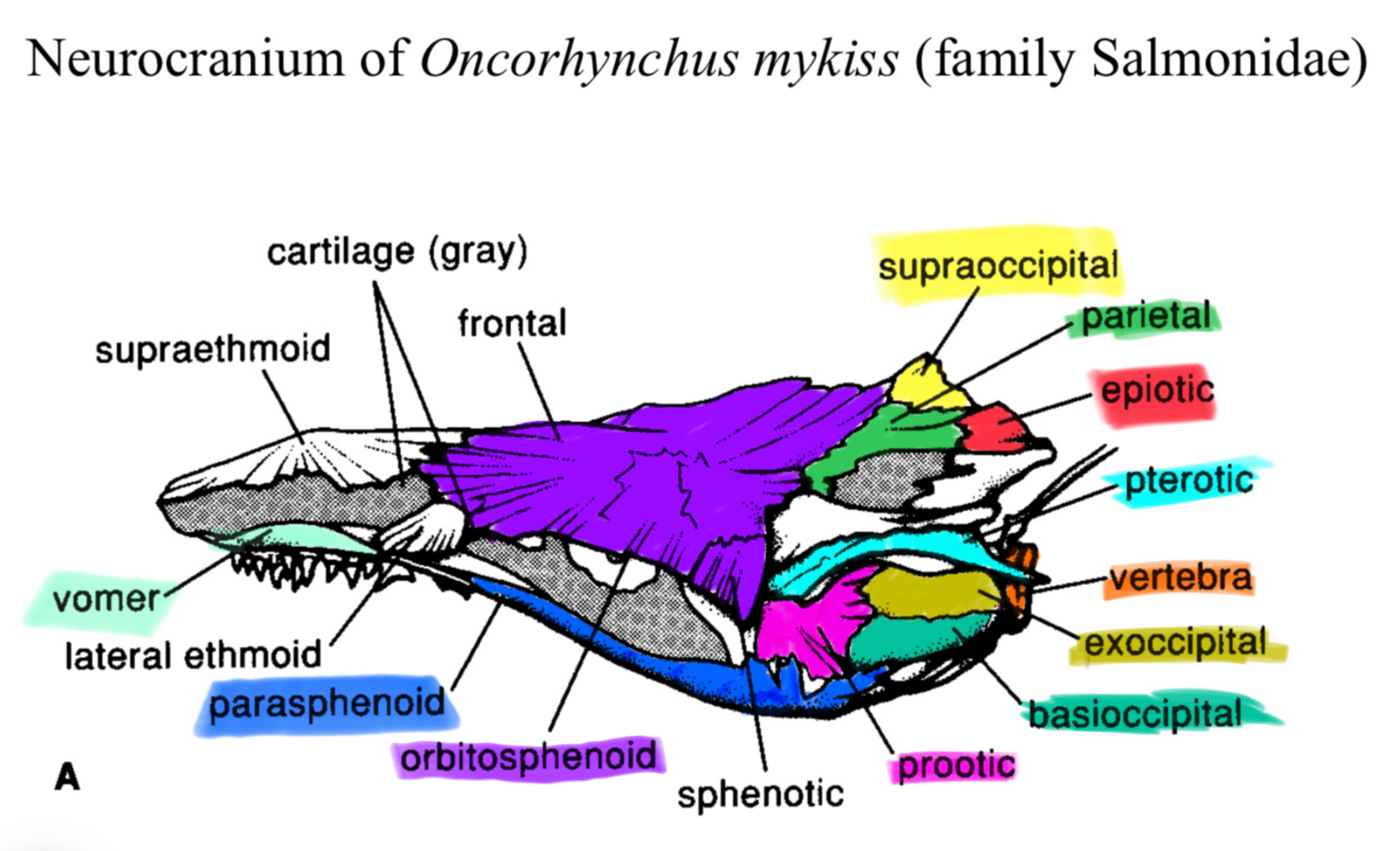
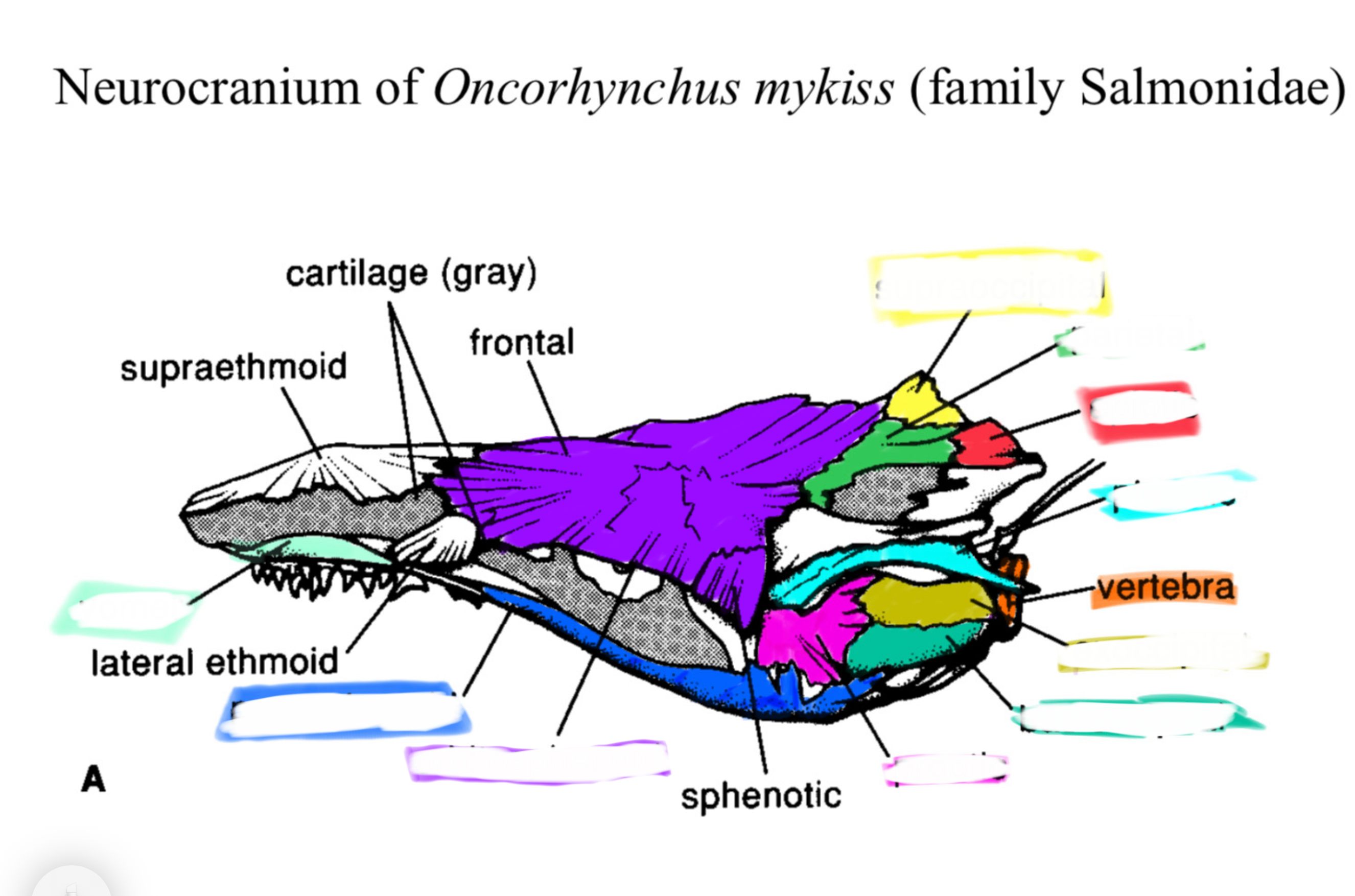
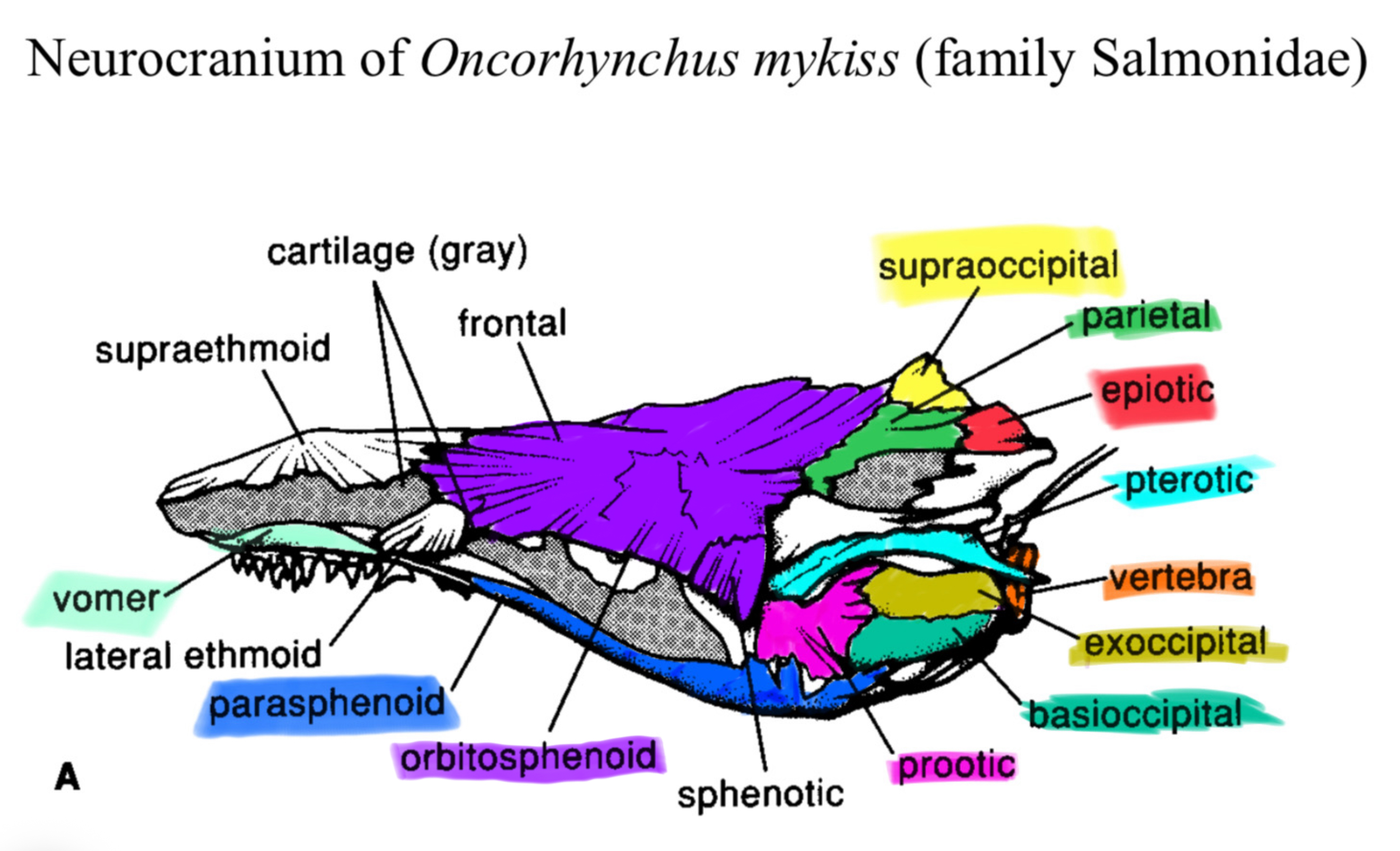
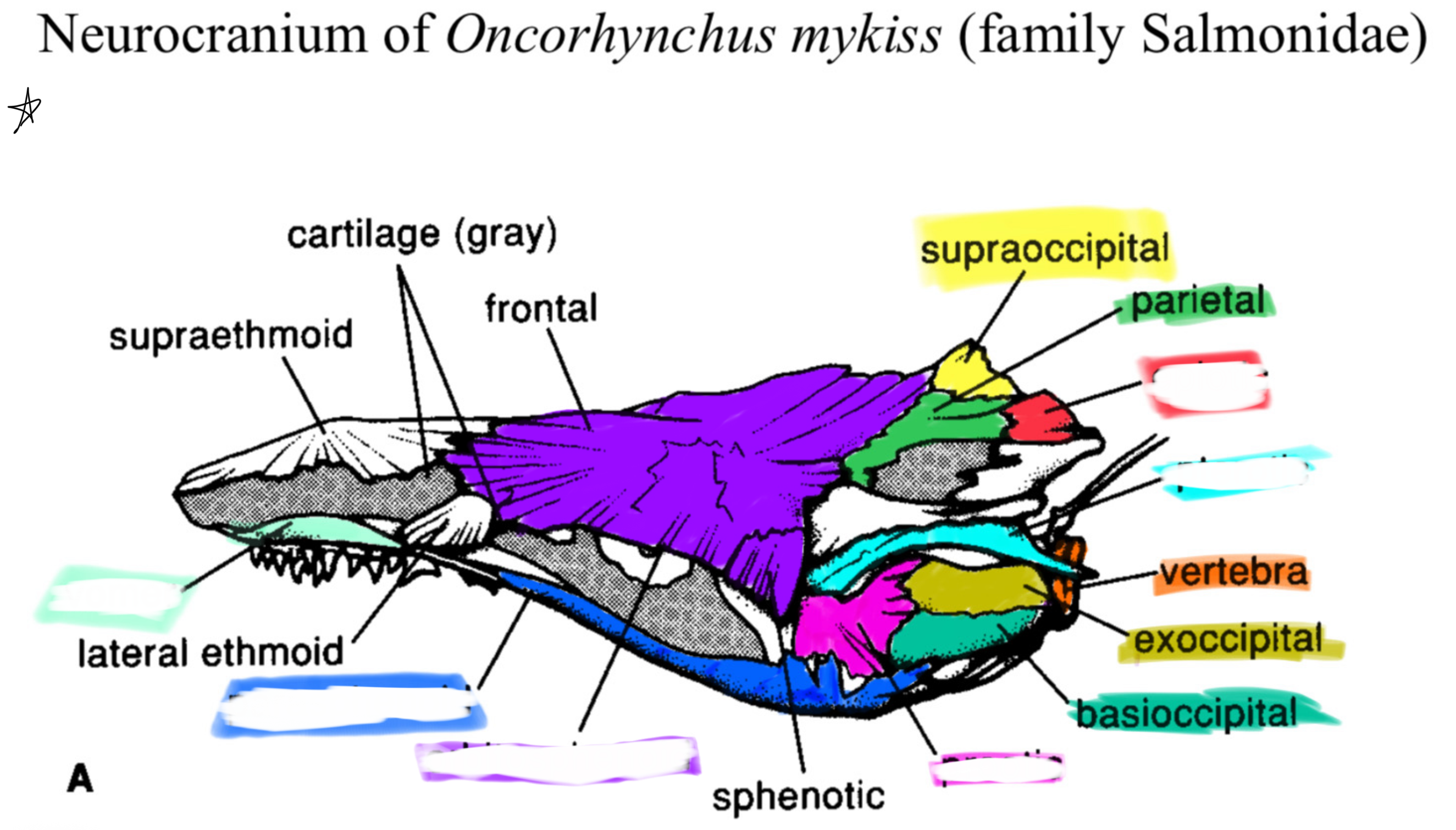
Neurocranium
The part of the skull that encases the brain in fishes.
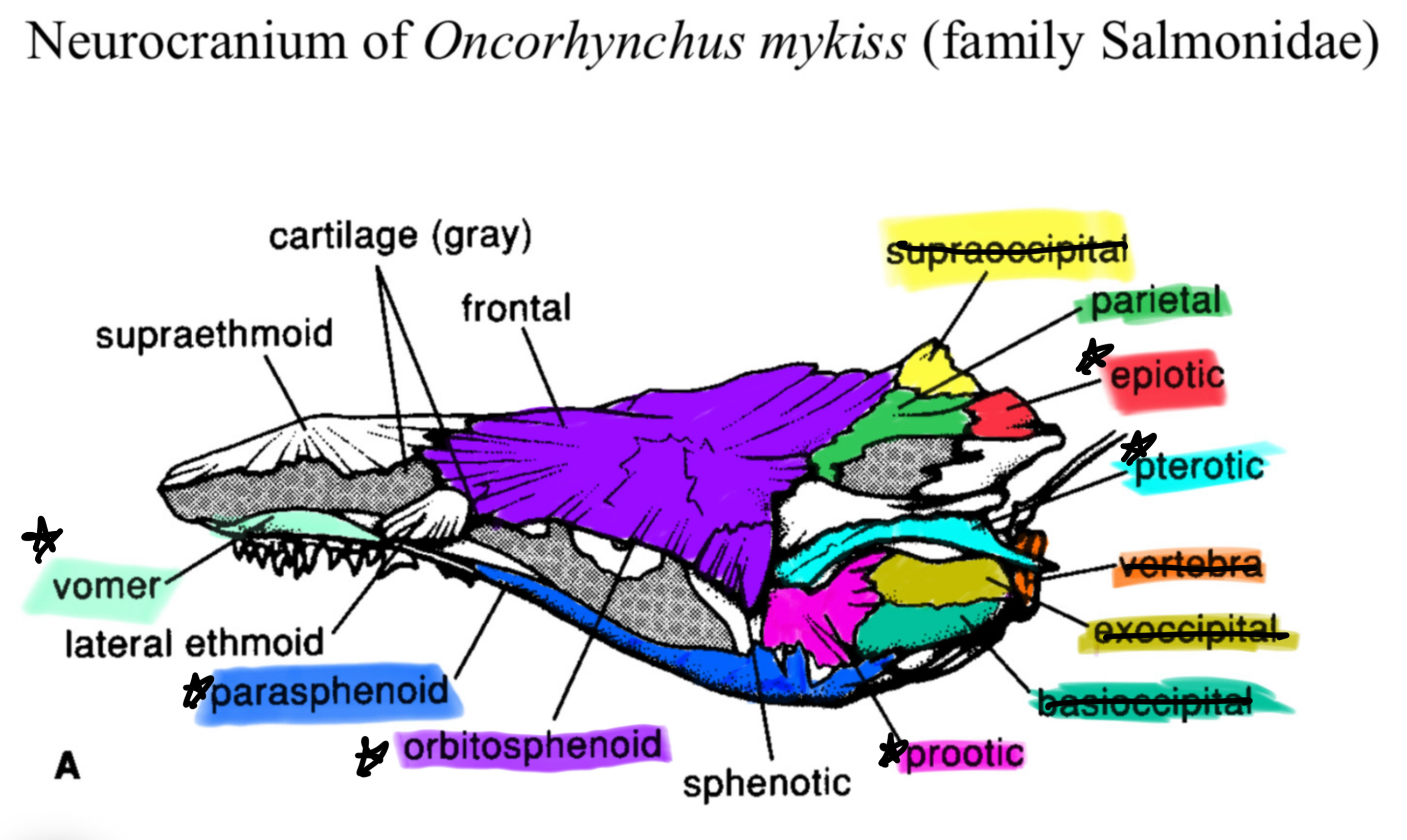
Vomer Bone
An unpaired bone located at the anterior-most part of the neurocranium, forming the roof of the mouth and often bearing teeth.
Parasphenoid Bone
A large, elongated, unpaired bone forming the floor of the neurocranium, often extending posteriorly beneath the braincase.
Otic Region (Neurocranium)
The posterior part of the neurocranium that houses the organs of hearing and balance (otic capsules) and is composed of bones like the prootic, pterotic, epiotic, and sphenotic.
Otoliths (Ear Stones)
Calcium carbonate concretions located within the membranous labyrinth of the inner ear, used for hearing, balance, and orientation. Their growth rings can be used to determine a fish's age.
Otolith Location
Otoliths are specifically located in the saccule, utricle, and lagena chambers of the inner ear in fishes.
Main Function of Otoliths
To detect sound vibrations (hearing), sense acceleration and gravity (balance and orientation), and provide a chronometric record of age and growth through their layered structure.
Molariform teeth
Flattened teeth used for grinding, typically located posteriorly.
Postcranial osteology
The study of the bony structures found in the body excluding the head.
Vertebral Column (Fish)
The axial skeleton of a fish, composed of numerous vertebrae, providing support, flexibility, and protection for the spinal cord. It includes the trunk and caudal regions.
Centrum (Vertebra)
The main body or spool-shaped part of a vertebra, supporting the axis of the body and providing articulating surfaces for adjacent vertebrae.
Neural Arch (Vertebra)
An arch of bone that projects dorsally from the centrum, enclosing and protecting the spinal cord (neural canal).
Neural Spine
A dorsal projection from the neural arch, serving for muscle attachment and providing structural support.
Haemal Arch (Vertebra)
The ventral arch of a vertebra in the caudal region that encloses and protects blood vessels.
projects ventrally from the centrum in the caudal vertebrae, enclosing and protecting the caudal artery and vein (haemal canal).
Haemal Spine
A ventral projection from the haemal arch, serving for muscle attachment and providing structural support in the tail region.
Pleural Ribs
Bones that articulate with the centra of trunk vertebrae, projecting ventrally into the muscle tissue, providing attachment sites for muscles and supporting inner organs.
Ventral ribs attached to the vertebral column in the trunk region, protecting internal organs.
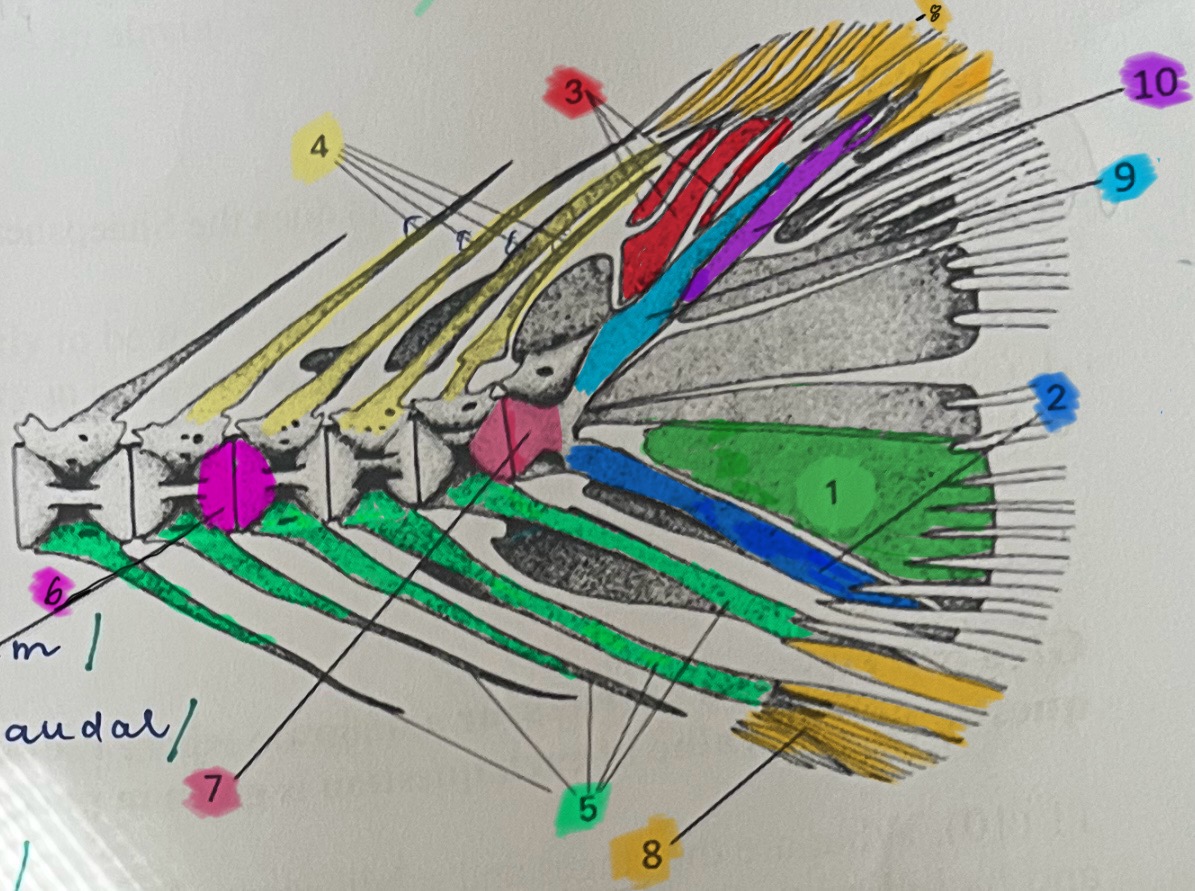
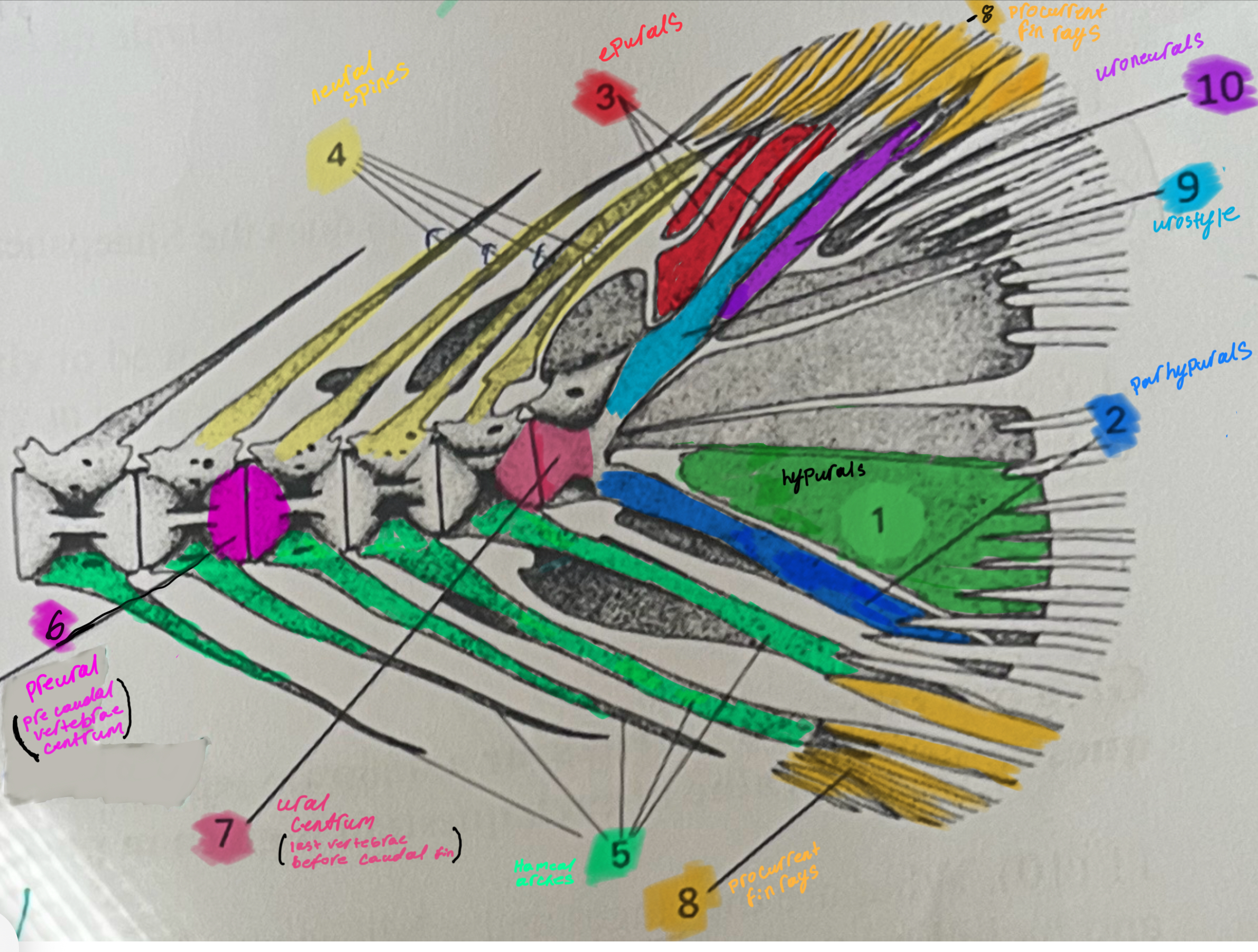
Caudal Skeleton (Fish)
The complex bony structure at the posterior end of the vertebral column that supports the caudal fin, composed of specialized terminal vertebrae and associated bones.
Hypurals
Ventral bones supporting the caudal fin rays.
Flattened, plate-like bones that articulate with the urostyle and ural centra, providing a broad surface for the attachment of caudal fin rays.
Epurals
Small, free-floating bones located dorsal to the urostyle, contributing to the support of the dorsal caudal fin rays.
located dorsal to the urostyle (or last vertebral centra) in the caudal fin, providing support for the dorsal fin rays.
Urostyle
A fused bony structure derived from the last vertebra, providing support to the caudal fin.
Uroneurals
Elongated, paired bones positioned dorsally to the urostyle and ural centra, considered modified neural arches, contributing to caudal fin support.
Ural Centrum
The last few vertebral centra that are typically highly modified or fused (e.g., into the urostyle) to form the structural base of the caudal fin.


Pterygiophores
Endoskeletal elements (bones or cartilages) embedded in the body wall that support the fin rays of median fins (dorsal and anal fins), connecting them to the axial skeleton.
Fin Ray Structure
Individual elements supporting the fins; they can be either:
Spines: Hard, unsegmented, unbranched, and often pointed.
Soft Rays: Flexible, segmented, and typically branched.
Description and Location of the Urostyle
A dorsal spine-like element that extends from the ural centrum.
Associated Bones of the Caudal Fin
Includes hypurals, uroneurals, and epurals which support the caudal fin rays.
Vertebral Structures Supporting Caudal Fin
Dorsal (neural spines) and ventral (hemal spines) vertebral structures that contribute to the caudal fin’s support.
Role of Posterior Vertebral Symmetry in Swimming
Supports powerful, efficient swimming due to symmetry in posterior vertebrae and associated musculature.
Function of Caudal Muscle Mass
Enables propulsion and locomotion due to solid muscle mass above and below the vertebral column.
has a trilled diphycercal caudal fin
Sargopterygii
features of typical soft rays in bony fish
segmented and unbranched
 Note
Note  Flashcards (27)