BOC Chemistry Study Guide: Focus on Lipids & Lipoproteins (Pages 194-210)
 Call Kai
 Learn
Learn Practice Test
 Spaced Repetition
 Match
Match Flashcards
 Knowt Play
1/16

There's no tags or description
Looks like no tags are added yet.
Name | Mastery | Learn | Test | Matching | Spaced | Call with Kai |
|---|
No analytics yet
Send a link to your students to track their progress
17 Terms
194. (MLS ONLY) High levels of which lipoprotein class are associated with decreased risk of
accelerated atherosclerosis?
a chylomicrons
b VLDL
c LDL
d HDL
d HDL
(MLS ONLY) The most consistent analytical error involved in the routine determination of HDL-cholesterol is caused by:
a incomplete precipitation of LDL-cholesterol
b coprecipitation of HDL- and LDL-cholesterol
c inaccurate protein estimation of HDL-cholesterol
d a small concentration of apoB-containing lipoproteins after precipitation
d a small concentration of apoB-containing lipoproteins after precipitation
(MLS ONLY) If the LDL-cholesterol is to be calculated by the Friedewald formula, what are the 2 measurements that need to be carried out by the same chemical procedure?
a total cholesterol and HDL-cholesterol
b total cholesterol and triglyceride
c triglyceride and chylomicrons
d apolipoprotein A and apolipoprotein B
a total cholesterol and HDL-cholesterol
(MLS ONLY) The chemical composition of HDL-cholesterol corresponds to:
Triglyceride Cholesterol Protein
a 60% 15% 10%
b 10% 45% 25%
c 5% 15% 50%
d 85% 5% 2%
c 5% 15% 50%
(MLS ONLY) In familial hypercholesterolemia, the hallmark finding is an elevation of:
a low-density lipoproteins
b chylomicrons
c high-density lipoproteins
d apolipoprotein A1
a low-density lipoproteins
(MLS ONLY) Premature atherosclerosis can occur when which of the following becomes elevated?
a chylomicrons
b prostaglandins
c low-density lipoproteins
d high-density lipoproteins
a chylomicrons
(MLS ONLY) Transportation of 60%-75% of the plasma cholesterol is performed by:
a chylomicrons
b very low-density lipoproteins
c low-density lipoproteins
d high-density lipoproteins
c low-density lipoproteins
(MLS ONLY) Which of the following diseases results from a familial absence of high density lipoprotein?
a Krabbe disease
b Gaucher disease
c Tangier disease
d Tay-Sachs disease
c Tangier disease
A 1-year-old girl with a hyperlipoproteinemia and lipase deficiency has the following lipid profile
cholesterol: 300 mg/dL (7.77 mmol/L)
LDL: increased
HDL: decreased
triglycerides: 200 mg/dL (2.26 mmol/L)
chylomicrons: present
A serum specimen for this patient that was refrigerated overnight would most likely be:
a clear
b cloudy
c creamy layer over cloudy serum
d creamy layer over clear serum
d creamy layer over clear serum
(MLS ONLY) Which of the following lipid results would be expected to be falsely elevated on a serum specimen, from a nonfasting patient?
a cholesterol
b triglyceride
c HDL
d LDL
b triglyceride
(MLS ONLY) A 9-month-old boy from Israel has gradually lost the ability to sit up, and develops seizures. He has an increased amount of a phospholipid called GM2-ganglioside in his neurons, and he lacks the enzyme hexosaminidase A in his leukocytes. These findings suggest:
a Neimann-Pick disease
b Tay-Sachs disease
c phenylketonuria
d Hurler syndrome
b Tay-Sachs disease
(MLS ONLY) In amniotic fluid, the procedure used to determine fetal lung maturity is:
a lecithin/sphingomyelin ratio
b creatinine
c measurement of absorbance at 450nm
d alpha-fetoprotein
a lecithin/sphingomyelin ratio
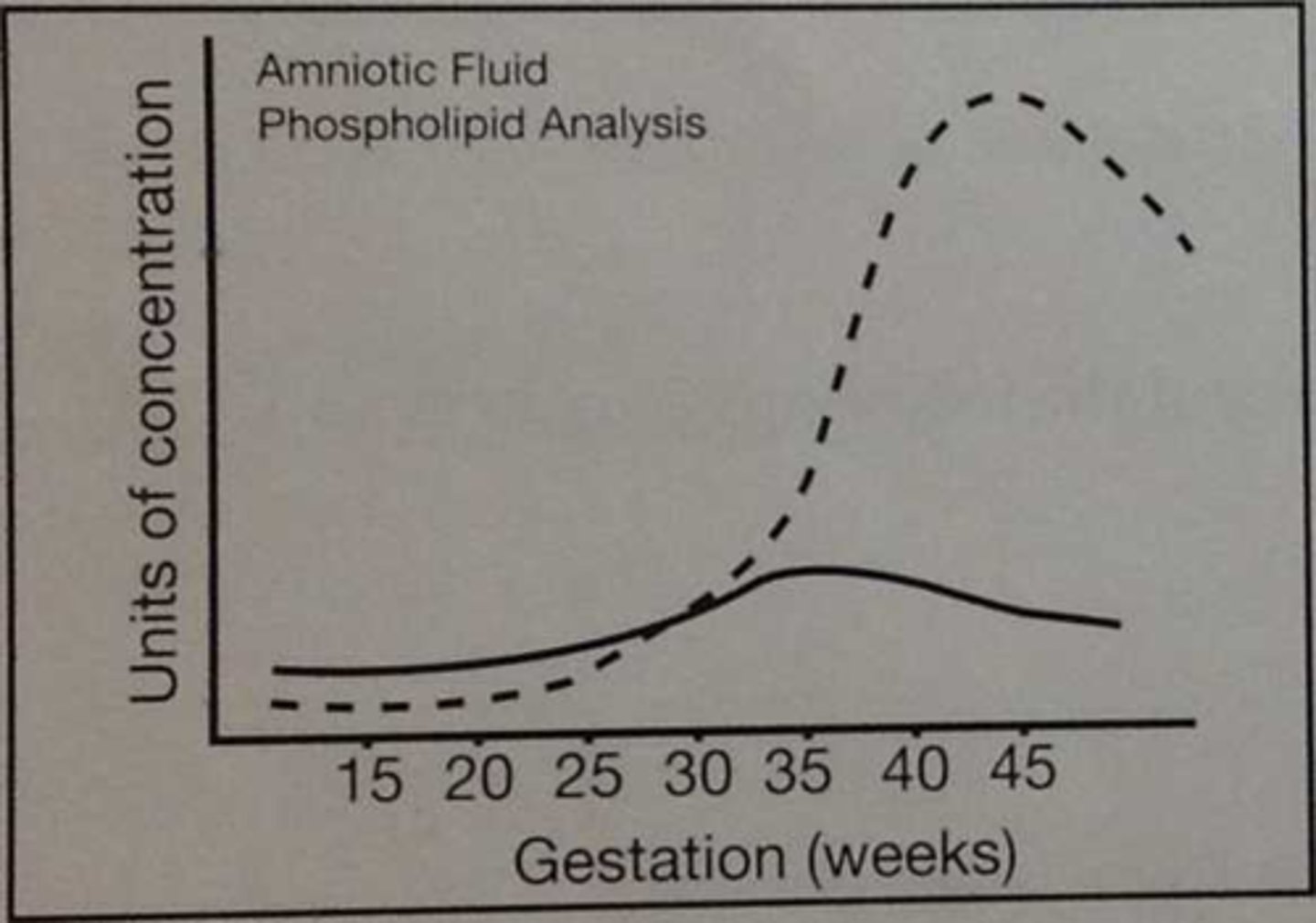
(MLS ONLY) Refer to the following illustration:
(IMAGE)
The class of phospholipid surfactants represented by the dotted line on the amniotic fluid anaiy shown above is thought to originate in what fetal organ system?
a cardiovascular
b pulmonary
c hepatic
d placental
b pulmonary
(MLS ONLY) A fasting serum sample from an asymptomatic 43-year-old woman is examined visually and chemically with the following results:
initial appearance of serum: milky
appearance of serum after overnight refrigeration: cream layer over turbid serum triglyceride level: 2,000 mg/dL (22.6 mmol L)
cholesterol level: 550 mg/dL (14.25 mmol L)
This sample contains predominantly:
a chylomicrons, alone
b chylomicrons and very low-density lipoproteins (VLDL)
c very low-density lipoproteins (VLDL) and low-density lipoproteins (LDL)
d high-density lipoproteins (HDL)
b chylomicrons and very low-density lipoproteins (VLDL)
Chylomicrons are present in which of the following dyslipidemias?
a familial hypercholesterolemia
b hypertriglyceridemia
c deficiency in lipoprotein lipase activity
d familial hypoalphalipoproteinemia
c deficiency in lipoprotein lipase activity
(MLS ONLY) The function of the major lipid components of the very low-density lipoproteins (VLDL) is to transport:
a cholesterol from peripheral cells to the liver
b cholesterol and phospholipids to peripheral cells
c exogenous triglycerides
d endogenous triglycerides
d endogenous triglycerides
210. Turbidity in serum suggests elevation of:
a cholesterol
b total protein
c chylomicrons
d albumin
c chylomicrons

