APES REVIEW
 Note
Note Call Kai
 Learn
Learn Practice Test
 Spaced Repetition
 Match
Match Flashcards
 Knowt Play
1/52

There's no tags or description
Looks like no tags are added yet.
Name | Mastery | Learn | Test | Matching | Spaced | Call with Kai | Chat |
|---|
No analytics yet
Send a link to your students to track their progress
53 Terms
Resource Partitioning
The process by which species divide resources to avoid competition and enhance survival.
Parasitism
An interaction where one organism lives on or in another organism (host), benefiting at the host's expense (e.g., ticks feeding on a mammal's blood).
Predator/Prey
An interaction where one animal (predator) kills and consumes another animal (prey) (e.g., a lion hunting a zebra).
Mutualism
An interaction between two species that benefits both, increasing their chances of survival (e.g., bees pollinating flowers while collecting nectar).
Commensalism
An interaction where one species benefits and the other is neither helped nor harmed (e.g., barnacles on a turtle's shell).
Ecosystem
A complex network of living organisms interacting with each other and their physical environment in a specific area.
Biome
A geographic region characterized by specific plants and animals adapted to the climate and environment of that region.
Terrestrial Biome
A geographic region of land categorized by a particular combination of annual precipitation, average annual temperature, and distinctive plant growth
Tundra
A cold and treeless biome with low-growing vegetation
Taiga (Boreal Forest)
A forest biome made up of mostly evergreen trees that can tolerate cold winters and short growing seasons. (Also known as Boreal Forest)
Temperate Forest
A coastal biome typified by moderate temperatures and high precipitation
Temperate Grassland
A biome characterized by cold, harsh winters, and hot, dry summers. Known as cold desert.
Hot Desert
A biome characterized by hot temperatures, extremely dry conditions, and sparse vegetation
Savanna
A biome marked by warm temperatures and distinct wet and dry seasons. (Tropical Seasonal Forest)
Tropical Rainforest
A biome near the equator, with warm weather and lots of rainfall. Found in Central and South America
Chaparral
A biome with dry summers, wet winters, moderate rainfall, and frequent wildfires.
Mediterranean Forest
A biome with moderate rainfall, wet winters, dry summers, and diverse plant species.
Freshwater Aquatic Biomes
An aquatic region characterized by a combination of salinity, depth, and water flow.
Three types: include lakes, rivers, and wetlands, characterized by low salt concentration.
Saltwater (Marine) Biomes
Five types include oceans, coral reefs, estuaries, intertidal zones, and deep-sea environments.
Food Web
A model showing how energy and matter move through interconnected food chains in an ecosystem.
Energy Flow
The transfer of energy through an ecosystem, typically represented by food webs and energy pyramids.
Laws of Thermodynamics
Principles governing energy flow, including conservation of energy and matter, impacting ecosystems.
Gross Primary Productivity (GPP)
The total amount of energy produced by photosynthesis in an ecosystem.
Net Primary Productivity (NPP)
The amount of energy available to consumers after accounting for plant respiration.
10% Rule
The principle that only about 10% of energy at one trophic level is converted to the next higher trophic level.
Lake Zones
Different areas in lakes, including littoral, limnetic, profundal, and benthic zones, each with distinct characteristics.
Phytoplankton
Floating algae that live in the limnetic zone of lakes, contributing to primary productivity.
Benthic Zone
The bottom layer of a lake, pond, or ocean, where organisms live on or in the sediment.
Symbiosis
two species living in a close and long-term association ith each other in an ecosystem
Competition exclusion principle
tells us that two species can't have exactly the same niche in a habitat and stably coexist.
Herbivory
An interaction in which an animal consumes plants or algae
Oligotrophic
Describes a lake with low levels of phytoplankton due to low amounts of nutrients in the water
Mesotrophic
Lake with low levels of fertility
Eutrophic
Lake with high levels of fertility
Greenhouse Gases
Gases in the Earth’s atmosphere that trap heat near the surface
Intertidal zone
A narrow band of coastline that exists between levels of high and low tide
Littoral Zone
Shallow zone of soil and water in lakes and ponds near the shore where most algae and plants grow
Limnetic Zone
A zone of open water in lakes and ponds as deep as the sunlight can penetrate
Tertiary Consumers
A carnivore that eats secondary consumers
GPP
the amount of chemical energy, typically expressed as carbon biomass, that primary producers create in a given length of time.
NPP = GPP - Respiration
NPP
the amount of biomass or carbon produced by primary producers per unit area and time, obtained by subtracting plant respiratory costs (Rp) from gross primary productivity (GPP) or total photosynthesis.
Streams and Rivers
characterized by flowing fresh water that originates from underground springs, or runoff from precipitation
Lakes and Ponds
Contain standing water, some of it too deep to support emergent vegetation. Plants that are rooted to the bottom and emerge above the water's surface.
Freshwater Wetlands
Aquatic biomes that are submerged by water for at least part of each year, but shallow enough to support emergent vegetation.
Estuaries and Salt Marshes
Areas along the coast where freshwater mixes with saltwater. Productive place for plants and Algae, plants help take out the contaminants in the water.
Mangrove Swamps
Occur along the tropical and subtropical coasts, containing trees whose roots submerge in water. Salt tolerant.
Intertidal Zones
A narrow band of coastline that exists between levels of high and low tide. Steep rocky areas.
Coral Reefs
Found in warm shallow waters beyond the shoreline in tropical regions, most diverse marine biome.
Open Ocean
Contains deep ocean water that is located away from the shoreline where sunlight doesn’t reach the ocean bottom.
Water Cycle
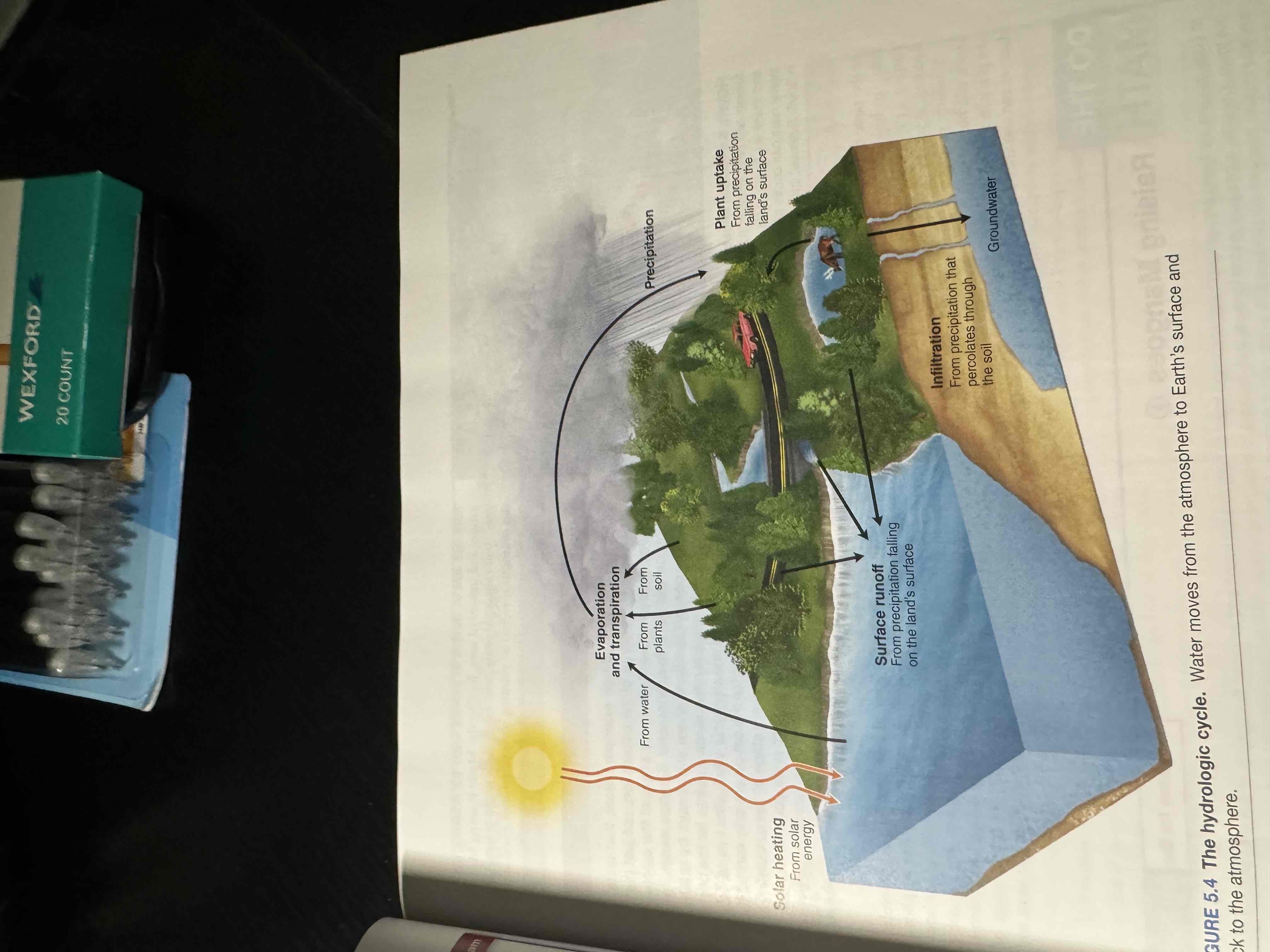
First Law of Thermodynamics
A theory with no known exception that states that energy is neither created nor destroyed but it can change from one form to another
Second Law of Thermodynamics
A theory with no known exception that states when energy is transformed, the quantity of energy remains the same, but its ability to do work diminishes,
Watershed
All the land in an area that drains into a particular stream, river, lake, or wetland.