1.2 - ACELLULAR MICROBES: VIRUSES, SATELLITES, VIROIDS, PRIONS
 Studied by 0 people
 Call with Kai
 Learn
Learn Practice Test
 Spaced Repetition
 Match
Match Flashcards
 Knowt Play
1/111

There's no tags or description
Looks like no tags are added yet.
Name | Mastery | Learn | Test | Matching | Spaced | Call with Kai |
|---|
No study sessions yet.
112 Terms
what are most viruses
bacteriophages
what are acellular entities
viruses
satellites
viroids
prions
What are acellular entities?
Infectious agents are not made of cells that lack metabolism and require a host to replicate.
What are viruses made of?
Nucleic acid (DNA or RNA) surrounded by a protein coat
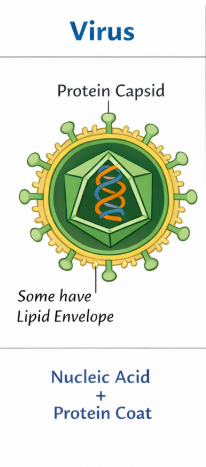
Why can’t viruses reproduce independently?
They lack metabolic and replication machinery
What are satellites made of
nucleoc acids and proteins coat sometimes
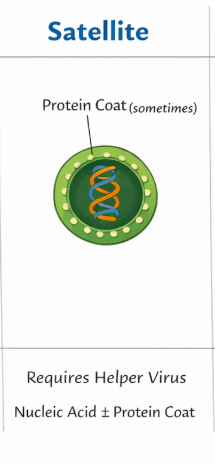
what are satellites
Require a helper virus to infect and replicate ususally in plants
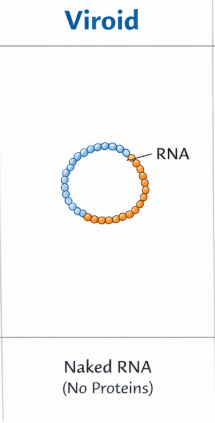
what are viroids made of
Circular single-stranded RNA which lack proteins
what are viroids
interfere with host gene expression
what are prions made of
made of only proteins
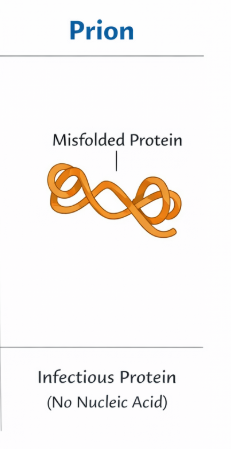
why are prions infectious
because they cause normal proteins to misfold
what can prions lead to
spongiform encephalopathies ( brain disease)
examples of Prions
BSE ( mad cow disease)
Scrapie (Sheeo)
CJD (humans)
Why are viruses considered emerging and evolving threats?
Viruses mutate rapidly, allowing them to evolve, adapt to new hosts, and emerge as new pathogens
How can viruses be useful in therapy?
Viruses can be used in gene therapy, vaccine development, and phage therapy to treat bacterial infections.
What role do viruses play in aquatic ecosystems?
influencing population control and nutrient cycling.
How do viruses affect organic matter in ecosystems
Viral infection causes cell lysis, converting particulate organic matter into dissolved organic matter.
How do viruses contribute to global nutrient cycles?
Viruses play a role in the global carbon and nitrogen cycles by releasing nutrients back into the environment
How do viruses influence evolution?
transfer genes between bacteria via horizontal gene transfer (transduction).
Why are viruses important in molecular biology research?
Viruses serve as model systems and are sources of key enzymes, such as reverse transcriptase (RT).
what does it mean if viruses are obligate intracellular pathogens
they are incapable of replication outisde host cells
Why can’t viruses replicate outside host cells?
They lack the metabolism and cellular machinery needed for replication.
How do viruses replicate differently from cells?
Viruses are assembled from separate components rather than growing and dividing.
What are the main parts assembled during viral replication?
Nucleic acid and protein subunits are synthesised separately and then assembled into virions.
Why do viruses depend on host ribosomes?
Viruses lack the genetic information needed for protein synthesis.
What host processes do viruses hijack?
Protein synthesis, energy production, and replication machinery
What is a virion?
A virion is the complete, infectious form of a virus outside a host cell.
What is the typical size of a virion?
Virions are approximately 10–400 nm in diameter.
Why can virions only be seen using electron microscopy?
They are too small to be resolved by light microscopy.
What structure is found in all virions?
A nucleocapsid.
What is a nucleocapsid?
It consists of viral nucleic acid (DNA or RNA) surrounded by a protein capsid - forms the essential structural core
What is the function of the capsid?
It protects the viral genome and helps transfer it into the host cell - functions as the protein coat of the virus
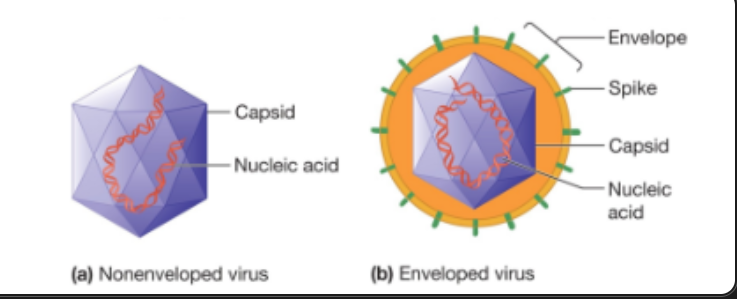
what are capsids made up of
protein subunits called protomers.
what are the names of the 3 capsid structures
hellical
Icosahedral
Complx
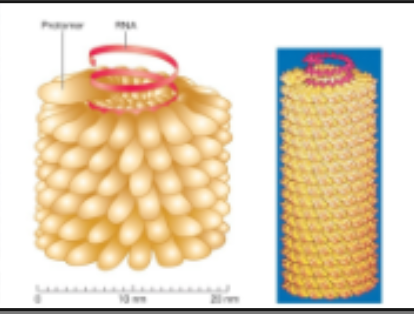
describe the strcutre of a hellical capsid
hollow tubes with protein walls, with its size determined by the nucleic acid length
A piece of coiled RNA surrounded by repeated of a protein sub unit called a protomer.
describe to structure of a iscosahedral capsid
An icosahedral capsid is a viral protein shell shaped like a regular polyhedron with 20 identical triangular faces and 12 corners (vertices
Why do viruses use an icosahedral shape?
: The icosahedral shape is strong, stable, and efficient, allowing the virus to enclose its genome using the fewest protein subunits.
what is a capsomer
ring or knob-shaped protein units, made of either 5 or 6 protomers.
Capsomer, made up of 5 subunits is called a
Pentamers
Capsomer made up of 6 subunits is called a
Haxamer
describe a complex caspisd
head resembles a icoshedral and a tail is helical.
they have tail fibers
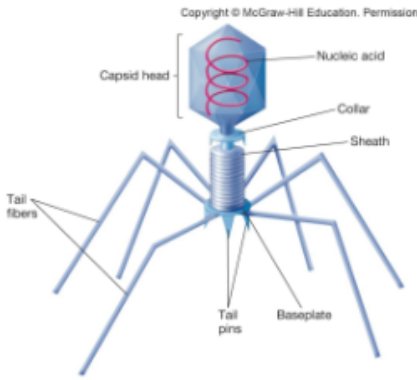
binal symmetry is
when the head resembles a icoshedral and a tail is helical.
Do all virions have envelopes?
No. Only some viruses are enveloped.
what is the envolpe
outer, flexible, lipid membranous layer which surrounds the nuclear capsid
where do viral envelopes come from
the host celll plasma membrane when undergoing replication
some viruses have enzymes packaged inside them what do these do ?
They subvert the immune system to trick the host immune system so that it doesn’t work properly.
What is the role of spike proteins?
Spike proteins bind to host cell receptors, enabling viral entry
What is the main function of viral DNA or RNA?
Viral nucleic acid functions as hereditary material, not as an enzyme.
Can viral genomes encode proteins?
Ye, but these proteins are made by host ribosomes.
What else do viral genomes contain besides genes?
They contain regulatory elements that conswhen and how viral genes are expressed in the host
What structural forms can viral genomes take?
Viral genomes can be single- or double-stranded, linear or circular, and segmented or non-segmented
how can we classify viruses
disease, host, morphology, serology and sequence
what is the most important and widely used system to classify viruses based on
the type of genome and how the virus replicates.
what does the Baltimore Classification System (BCS) groups viruses according to:
Whether the genome is DNA or RNA
Whether it is single- or double-stranded
How the virus produces mRNA
how many classes of vruses are there according to the BCS
7
BCS - class 1
dsDNA viruses
Genome: Double-stranded DNA
Replication similar to host DNA
mRNA made using host or viral RNA polymerase
DNA → mRNA
BCS - class 2
ssDNA viruses
Genome: Single-stranded DNA
First converted into double-stranded DNA
Then transcribed into mRNA
ssDNA → dsDNA → mRNA
BCS - group 3
dsRNA viruses
Genome: Double-stranded RNA
Host cannot read dsRNA
Virus carries RNA-dependent RNA polymerase
Enzyme makes mRNA from dsRNA
dsRNA → mRNA (using viral enzyme)
BCS - group 4
Positive-sense ssRNA viruses
Genome: RNA (+)
Genome itself acts as mRNA
Can be translated immediately
RNA (+) = mRNA
BCS - group 5
Negative-sense ssRNA viruses
Genome: RNA (−)
Cannot be translated directly
Must be copied into RNA (+) first
Virus carries RNA-dependent RNA polymerase
RNA (−) → RNA (+) → mRNA
BCS - group 6
RNA reverse-transcribing viruses
Genome: RNA (+)
Uses reverse transcriptase
RNA → DNA → integrated into host genome
Host then produces mRNA
RNA → DNA → mRNA
BCS - group 7
DNA reverse-transcribing viruses
Genome: dsDNA
DNA is transcribed into RNA
RNA is reverse-transcribed back into DNA
mRNA produced during this cycle
DNA → RNA → DNA → mRNA
what are the 6 stages in the viral replication cycle
attachment
penetration/uncoating
transcription and translation
replication
Assembly
Release
stage 1 of the viral replication cycle
Attachment via specific host receptor binding
Trigger the ability to enter the cell
Stage 2 of the viral replication cycle
Penetration/uncoating of the nucleocapsid.
Exposing their nucleic acid in the cytoplasm of the host
Stage 3 of the viral replication cycle
Transcription and translation of viral proteins.
Stage 4 of the viral replication cycle
Replication of the viral genome. so the cell makes lots of copy of the viral genome and proteins
Stage 5 of the viral replication cycle
Assembly of viral progeny(Little baby virueses)
Stage 6 of the viral replication cycle
Release from the host cell.
Must avoid overcoming the host immune response.
what human receptor does SARS-CoV-2 spike protein attaches to
ACE2.
How do animal viruses enter host cells?
Animal viruses enter host cells by attaching to specific receptors and entering either by membrane fusion or receptor-mediated endocytosis.
What determines how a virus enters a host cell?
Whether the virus is enveloped or non-enveloped determines its entry mechanism.
How do enveloped viruses enter cells via membrane fusion
Viral fusion proteins cause the viral envelope to fuse directly with the host cell membrane, allowing the nucleocapsid to enter the cytoplasm.
What is receptor-mediated endocytosis in enveloped viruses?
The virus binds to a host receptor, triggering the host to engulf it into an endosome.
What happens to enveloped viruses inside the endosome?
Fusion proteins cause the viral envelope to fuse with the endosomal membrane, releasing the viral genome into the cytoplasm
How do non-enveloped viruses enter host cells?
They usually enter by receptor-mediated endocytosis or by direct injection of their nucleic acid.
What happens after endocytosis of non-enveloped viruses?
The virus undergoes uncoating, where the capsid breaks down and releases the viral genome.
Why don’t non-enveloped viruses use membrane fusion?
They lack a lipid envelope, so they cannot fuse with host membranes.
Why is receptor-mediated endocytosis important for viruses?
It allows viruses to exploit a normal host cell process to gain entry into the cell.
What do 5′ and 3′ mean in DNA and RNA strands?
They describe the direction of the nucleotide backbone, based on the carbon numbering in the sugar molecule.
How are the two strands of DNA oriented?
One strand runs 5′ → 3′, and the other runs 3′ → 5′ in opposite directions
Which DNA strand resembles mRNA?
The 5′ → 3′ strand, because it has the same orientation and coding information as mRNA (except T instead of U).
What is meant by “positive-sense” RNA?
Positive-sense RNA has the same sequence and orientation as mRNA, so it can be directly translated by ribosomes.
Why can’t negative-sense RNA be translated by ribosomes?
Ribosomes can only read positive-sense (mRNA-like) sequences, not complementary RNA.
How do negative-sense RNA viruses make proteins?
They must first convert their genome into positive-sense RNA using RNA-dependent RNA polymerase.
What is a viral replication factory?
A specialised membrane-bound area inside a host cell where viruses replicate and assemble
Which host organelle is commonly used to form viral replication factories?
The endoplasmic reticulum (ER).
How do viruses form replication factories?
They induce expansion and rearrangement of host cell membranes to create protected compartments.
Why do viruses use membrane-bound replication complexes?
To protect viral components from host immune detection
How do replication factories improve viral replication?
They concentrate viral genomes, proteins, and enzymes in one location.
How do replication factories help viruses evade the immune response?
Membranes shield viral nucleic acids from immune sensors inside the cell
What processes occur inside viral replication factories?
Genome replication
protein synthesis coordination
virus assembly.
Who makes viral proteins inside an infected cell?
Host ribosomes translate viral mRNA to produce viral proteins.
Where does bacteriophage assembly occur?
In the cytoplasm of the bacterial cell
Why does bacteriophage assembly occur in the cytoplasm?
Bacteria do not have a nucleus
hat is the first major structure assembled in a bacteriophage?
The prohead (empty capsid precursor).
What happens after the prohead is formed?
The viral DNA is packaged into the prohead.
What structure is added after DNA packaging in a bacteriophage?
The base plate.
Which components form the bacteriophage tail?
Base plate proteins, the tube, and the sheath.
What is the final component added to the bacteriophage?
Tail fibres, which help the phage attach to bacterial cells.
 Note
Note  Flashcards (34)