Main Terms to know for Intro to Entrepreneurship Midterm
 Call Kai
 Learn
Learn Practice Test
 Spaced Repetition
 Match
Match Flashcards
 Knowt Play
1/32

Earn XP
Description and Tags
I hope this helps
Name | Mastery | Learn | Test | Matching | Spaced | Call with Kai |
|---|
No analytics yet
Send a link to your students to track their progress
33 Terms
Key Partners
The network of suppliers and partners that provide resources or expertise to make the business model work.
Key Activities
The essential actions a business must engage in to create value and serve customers.
Key Resources
The critical assets (physical, intellectual, human, or financial) required to deliver the value proposition.
Cost Structure
The expenses incurred to operate the business model, including fixed and variable costs.
Value Propositions
The unique value that distinguishes a company from competitors and fulfills customer needs or problems.
Customer Relationships
The types of interactions established with customers to enhance satisfaction, retention, and loyalty.
Channels
The communication, distribution, and sales pathways used to reach customers with the value proposition.
Customer Segments
The different groups of people or organizations an enterprise aims to reach (e.g., mass, niche, or segmented).
Revenue Streams
The cash a company captures from each segment by balancing value, price, and volume.
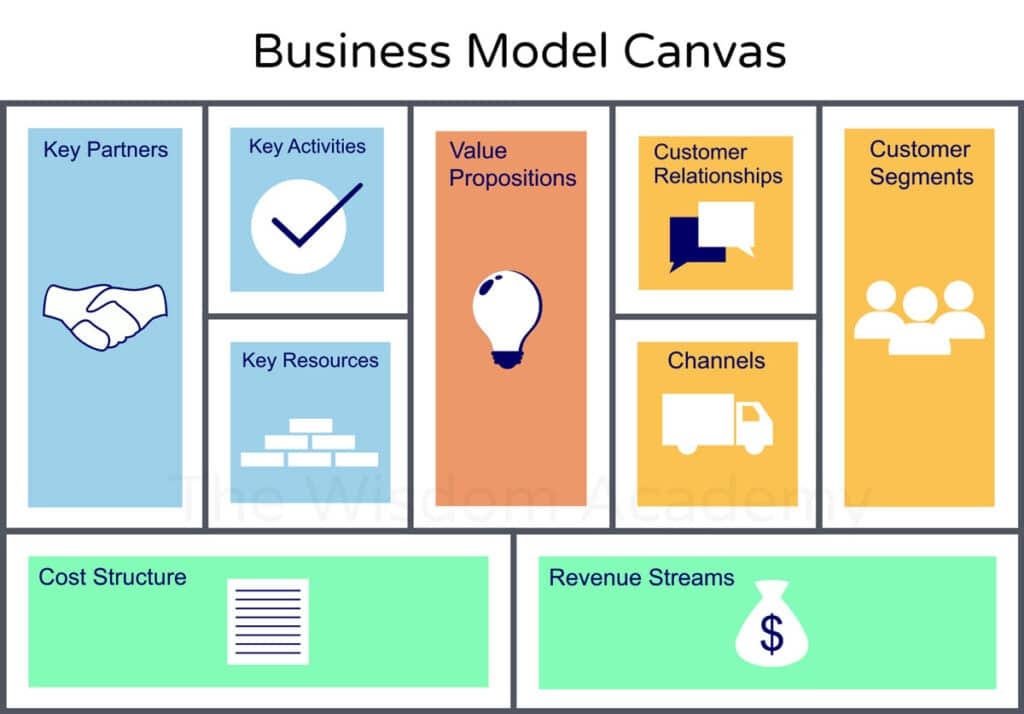
The 9 BMC Components
1. Value Propositions, 2. Customer Segments, 3. Channels, 4. Customer Relationships, 5. Key Activities, 6. Key Resources, 7. Key Partners, 8. Cost Structure, 9. Revenue Streams.
Entrepreneurship as a Practice
A method of learning that emphasizes action and 'doing' over just innate personality traits or planning.
Deliberate Practice
High-stakes repetition with focused feedback to improve specific entrepreneurial skills.
Entrepreneurial Mindset
The ability to quickly sense, act, and get organized under uncertain conditions.
Human Capital
The stock of skills, knowledge, and experience possessed by an individual.
Fixed vs. Growth Mindset
____ _____ believes abilities are static; ____ ______ believes abilities can be developed through dedication.
Passion vs. Purpose
_____ is an intense positive emotion; ______ is the stable 'Why' that connects your work to others over time.
Wicked Problems
Complex, interconnected social challenges that are difficult to solve (e.g., poverty, climate change).
Social Purpose Ventures
Businesses created by social entrepreneurs to resolve a social problem and make a profit.
B Corporation
A private certification for for-profit companies meeting high standards of social and environmental performance.
Triple Bottom Line
An accounting framework focusing on three parts: People, Planet, and Profit.
Opportunity Recognition
The process of identifying a way to solve a problem or fill a market gap that others have missed.
Entrepreneurial Alertness
The ability to notice opportunities in the environment without active searching.
Gap Opportunity
Noticing a 'hole' in the market where a need is not being met by existing products.
Five Steps to Design Thinking
A human-centered approach to innovation using 5 stages: Empathize, Define, Ideate, Prototype, Test.
Divergent vs Convergent Thinking
______ expands the number of possible ideas; ______ narrows them down to the best one.
Iteration
The non-linear process of returning to earlier stages in design or business based on new feedback.
Fixed vs. Variable Costs
____ costs stay the same regardless of sales ex: Rent); _____ ____change with production volume, exp: materials
Customer Discovery
The process of identifying who your customers are and if the problem you're solving is real.
Customer Validation
Proving that your solution works and that customers are actually willing to pay for it.
Jobs-to-be-Done (JTBD)
A framework focusing on the specific 'job' a customer is trying to accomplish when they hire a product.
Early Adopters
The first customers who take a risk on a new product because they have the problem most acutely.
Customer Persona
A detailed, semi-fictional representation of your ideal customer based on data and research.
Theory of Change
A methodology for planning and evaluation used to map out how specific actions lead to social change.

