12. Ecosystem
 Call Kai
 Learn
Learn Practice Test
 Spaced Repetition
 Match
Match Flashcards
 Knowt Play
1/87

Earn XP
Description and Tags
Very brief revision of this NCERT chapter because it's really easy and honestly I can't be bothered anymore. Question mode: Flashcards only. Answer mode: Answer with Definition. Recommended study mode: Spaced Repetition but with something as easy as this why even bother. Good luck for exams anyway! Oh right, suitable for IAT, NEET, NEST, etc. Usually it would contain almost every line from NCERT but this chapter felt like a waste of time so sorry about that.
Name | Mastery | Learn | Test | Matching | Spaced | Call with Kai | Chat |
|---|
No analytics yet
Send a link to your students to track their progress
88 Terms
What is the name of the global ecosystem?
Biosphere
Since the biosphere is too much big and complex to be studied at one time, it is convenient to divide it into three basic categories, which are?
terrestrial
aquatic
man-made
Interaction of biotic and abiotic components result in a physical structure that is characteristic for each type of ecosystem.
True or false?
True.
What are the two processes by which we can obtain a species composition of an ecosystem?
identification of species
enumeration of species
Vertical distribution of different species occupying different levels is called ____________.
Vertical distribution of different species occupying different levels is called stratification.
What is stratification?
Vertical distribution of different species occupying different levels is called stratification.
In a forest, what can be found in the top, middle, and bottom strata?
top strata: trees
middle strata: shrubs
bottom strata: herbs and grasses
The components of the ecosystem are seen to function as a unit when you consider which aspects of it? (there are 4)
productivity
decomposition
energy flow
nutrient cycling
What are the abiotic components present in a pond?
The abiotic component is the water with all the dissolved inorganic and organic substances and the rich soil deposit at the bottom of the pond. The solar input, the cycle of temperature, day-length and other climatic conditions regulate the rate of function of the entire pond.
Wha are the autotrophic components present in a pond?
The autotrophic components include the phytoplankton, some algae and the floating, submerged and marginal plants found at the edges.
What are the heterotrophic components (consumers) present in a pond?
The consumers are represented by the zooplankton, the free swimming and bottom dwelling forms.
What are the heterotrophic components (decomposers) present in pond?
The decomposers are the fungi, bacteria and flagellates especially abundant in the bottom of the pond.
There is _____________ movement of energy towards the higher trophic levels and its dissipation and loss as heat to the environment.
(unidirectional / bidirectional)
There is unidirectional movement of energy towards the higher trophic levels and its dissipation and loss as heat to the environment.
Why can a pond be considered as a functional unit of nature as an aquatic ecosystem?
It is a self-sustainable unit that exhibits all aspects of an ecosystem that functions as a unit (productivity, decomposition, energy flow, nutrient cycling).
A constant input of _____________ is the basic requirement for any ecosystem to function and sustain.
A constant input of solar energy is the basic requirement for any ecosystem to function and sustain.
___________ __________ is defined as the amount of biomass or organic matter produced per unit area over a time period by plants during photosynthesis.
Primary production is defined as the amount of biomass or organic matter produced per unit area over a time period by plants during photosynthesis.
What is primary production?
Primary production is defined as the amount of biomass or organic matter produced per unit area over a time period by plants during photosynthesis.
What are the two units of primary production?
g m−2 or kcal m−2
What is Productivity defined as (in terms of ecosystem)?
The rate of biomass production is called productivity.
The rate of biomass production is called __________.
The rate of biomass production is called productivity.
What are the two units of productivity?
g m−2 yr−1 or kcal m−2 yr−1
The rate of biomass production is called productivity. What are its two types?
gross primary productivity (GPP)
net primary productivity (NPP)
What is gross primary productivity?
Gross primary productivity of an ecosystem is the rate of production of organic matter during photosynthesis.
What is net primary productivity? (2 definitions)
Gross primary productivity minus respiration losses in plants (R), is the net primary productivity (NPP).
Net primary productivity is the available biomass for the consumption to heterotrophs.
What is secondary productivity?
Secondary productivity is defined as the rate of formation of new organic matter by consumers.
Why does primary productivity vary in different types of ecosystems?
It is dependent on the species inhabiting a particular area as well as other environmental factors.
The annual net primary productivity of the whole biosphere is approximately how much?
170 billion tons of (dry weight) organic matter
The annual net primary productivity of the whole biosphere is approximately 170 billion tons (dry weight) of organic matter.
Of this, how much is the productivity of the oceans?
55 billion tons
What are the two reasons that earthworms are referred to as the “farmer’s friend”?
they help in the breakdown of complex organic matter
they help in loosening the soil
What is decomposition?
The break down of complex organic matter into inorganic substances like carbon dioxide, water and nutrients.
Decomposers break down complex organic matter into inorganic substances like carbon dioxide, water and nutrients and the process is called _______________.
Decomposers break down complex organic matter into inorganic substances like carbon dioxide, water and nutrients and the process is called decomposition.
What sort of objects constitute “detritus”?
Dead plant remains such as leaves, bark, flowers and dead remains of animals, including fecal matter, constitute detritus.
What is “detritus” in relation to decomposition?
detritus is the raw material for decomposition.
What are the five important steps in the process of decomposition?
fragmentation
leaching
catabolism
humification
mineralisation
What are detritivores?
Detritivores break down detritus into smaller particles.
What is fragmentation (as a process of decomposition)?
Detritivores (e.g., earthworm) break down detritus into smaller particles. This process is called fragmentation.
What is leaching (as a process of decomposition)?
By the process of leaching, water-soluble inorganic nutrients go down into the soil horizon and get precipitated as unavailable salts.
What is catabolism (as a process of decomposition)?
Bacterial and fungal enzymes degrade detritus into simpler inorganic substances. This process is called as catabolism.
What is humification (as a process of decomposition)?
Humification to accumulation of a dark coloured amorphous substance called humus.
What is humus?
humus is a dark coloured amorphous substance that is highly resistant to microbial action and undergoes decomposition at an extremely slow rate.
Humus is colloidal in nature. How is this useful in maintaining an ecosystem?
Being colloidal in nature it serves as a reservoir of nutrients.
What is mineralisation (as a process of decomposition?
The humus (that is formed as a result of humification) is further degraded by some microbes and release of inorganic nutrients occur by the process known as mineralisation.
The important steps in the process of decomposition are fragmentation, leaching, catabolism, humification and mineralisation.
Out of these, which occur simultaneously and which occur one after the other?
fragmentation, leaching, catabolism occur simultaneously
mineralisation follows after humification
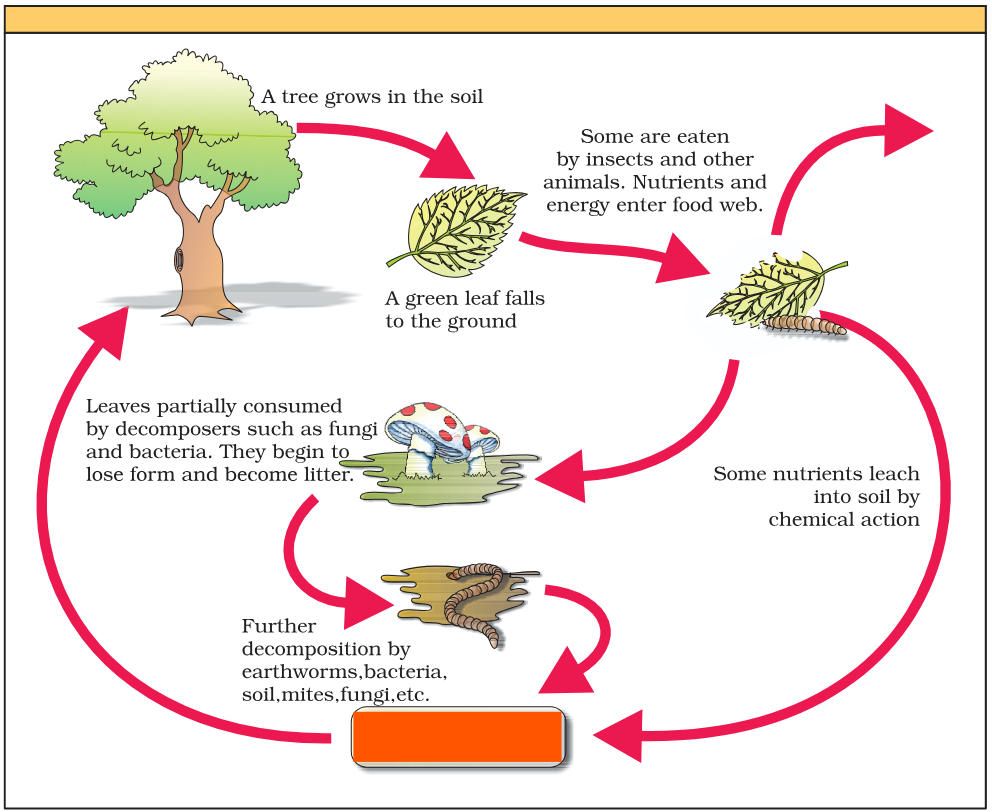
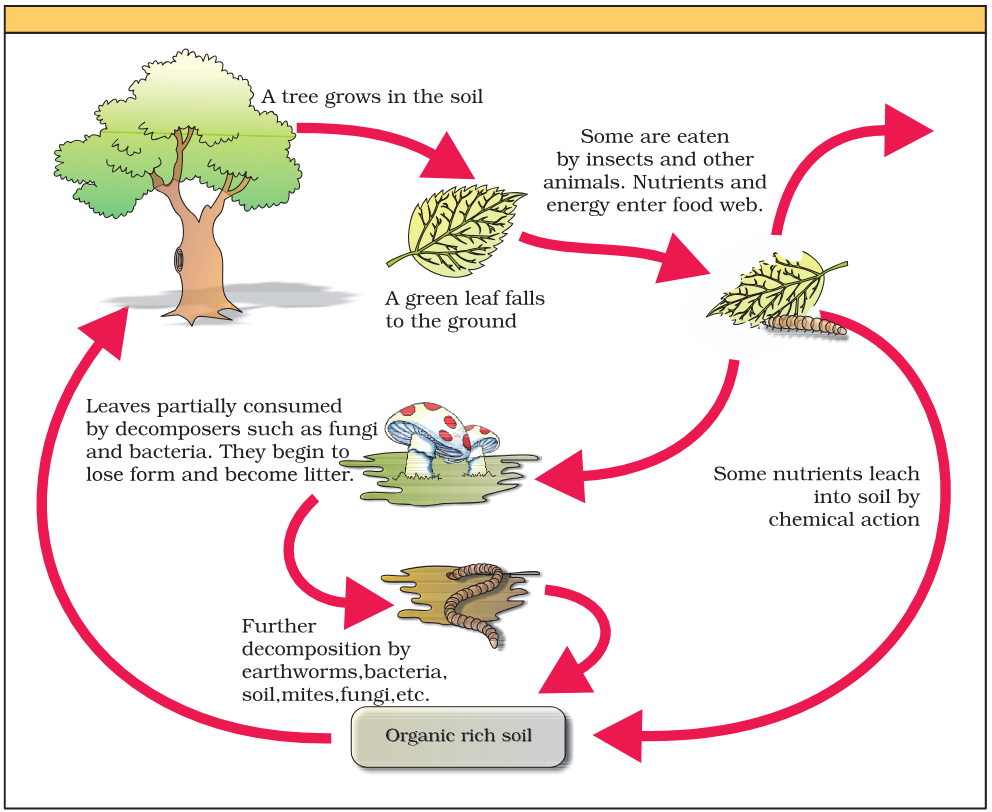
What is the orange part
Organic-and-inorganic rich soil
Decomposition is an __________ process.
(aerobic / anaerobic)
Decomposition is an aerobic process.
Decomposition is largely an oxygen-requiring process. What are the two things the rate of decomposition depends on?
chemical composition of detritus
climatic factors.
In a particular climatic condition, decomposition rate is _________ if detritus is rich in lignin and chitin.
(quicker / slower)
In a particular climatic condition, decomposition rate is slower if detritus is rich in lignin and chitin.
In a particular climatic condition, decomposition rate is ________ if detritus is rich in nitrogen and water-soluble substances like sugars.
(quicker / slower)
In a particular climatic condition, decomposition rate is quicker if detritus is rich in nitrogen and water-soluble substances like sugars.
___________ and ____ _______ are the most important climatic factors that regulate decomposition through their effects on the activities of soil microbes.
Temperature and soil moisture are the most important climatic factors that regulate decomposition through their effects on the activities of soil microbes.
Warm and moist environment _________ decomposition whereas low temperature and anaerobiosis _________ decomposition resulting in build up of organic materials.
(favour / inhibit)
Warm and moist environment favour decomposition whereas low temperature and anaerobiosis inhibit decomposition resulting in build up of organic materials.
Except for the deep sea hydro-thermal ecosystem, _______ is the only source of energy for all ecosystems on Earth.
Except for the deep sea hydro-thermal ecosystem, sun is the only source of energy for all ecosystems on Earth.
Of the incident solar radiation less than ______ per cent of it is photosynthetically active radiation (PAR).
(what percent?)
Of the incident solar radiation less than 50 per cent of it is photosynthetically active radiation (PAR).
Plants capture only _________ per cent of the PAR and this small amount of energy sustains the entire living world.
(what percent?)
Plants capture only 2-10 per cent of the PAR and this small amount of energy sustains the entire living world.
All organisms are dependent for their food on ___________, either directly or indirectly.
(producers / consumers)
All organisms are dependent for their food on producers, either directly or indirectly.
The green plant in the ecosystem are called __________.
(producers / consumers)
The green plant in the ecosystem are called producers.
What are the main producers in terrestrial ecosystems?
herbaceous and woody plants
What are the main producers in aquatic ecosystems?
phytoplankton, algae, and higher plants
Death of organism is the beginning of which food chain?
Detritus food chain
Primary consumers are ________________.
(carnivores / herbivores / omnivores)
herbivores
What is a GFC and DFC?
GFC: grazing food chain
DFC: detritus food chain
The detritus food chain (DFC) begins with what?
dead organic matter
The detritus food chain (DFC) begins with dead organic matter. It is made up of ____________ which are heterotrophic organisms, mainly fungi and bacteria.
The detritus food chain (DFC) begins with dead organic matter. It is made up of decomposers which are heterotrophic organisms, mainly fungi and bacteria.
decomposers are also known as ___________.
saprotrophs
How do decomposers digest dead organic matter?
Decomposers secrete digestive enzymes that breakdown dead and waste materials into simple, inorganic materials, which are subsequently absorbed by them.
In an aquatic ecosystem, _________ is the major conduit for energy flow.
(GFC, DFC)
GFC
In a terrestrial ecosystem, _________ is the major conduit for energy flow.
DFC
Organisms occupy a place in the natural surroundings or in a community according to their feeding relationship with other organisms. Based on the source of their nutrition or food, organisms occupy a specific place in the food chain that is known as their _________ level.
Organisms occupy a place in the natural surroundings or in a community according to their feeding relationship with other organisms. Based on the source of their nutrition or food, organisms occupy a specific place in the food chain that is known as their trophic level.
Producers belong to the _____ trophic level.
(first / last)
Producers belong to the first trophic level.
An important point to note is that the amount of energy __________ at successive trophic levels.
(increases / decreases)
An important point to note is that the amount of energy decreases at successive trophic levels.
What is “standing crop”?
Each trophic level has a certain mass of living material at a particular time called as the standing crop.
Each trophic level has a certain mass of living material at a particular time called as the ____________.
Each trophic level has a certain mass of living material at a particular time called as the standing crop.
How is “standing crop” measured?
The standing crop is measured as the mass of living organisms (biomass) or the number in a unit area.
The biomass of a species is expressed in terms of fresh or dry weight. Measurement of biomass in terms of _____ weight is more accurate.
(fresh / dry)
The biomass of a species is expressed in terms of fresh or dry weight. Measurement of biomass in terms of dry weight is more accurate.
The number of trophic levels in the grazing food chain is restricted as the transfer of energy follows 10 per cent law, which is?
Only 10 per cent of the energy is transferred to each trophic level from the lower trophic level.

producer

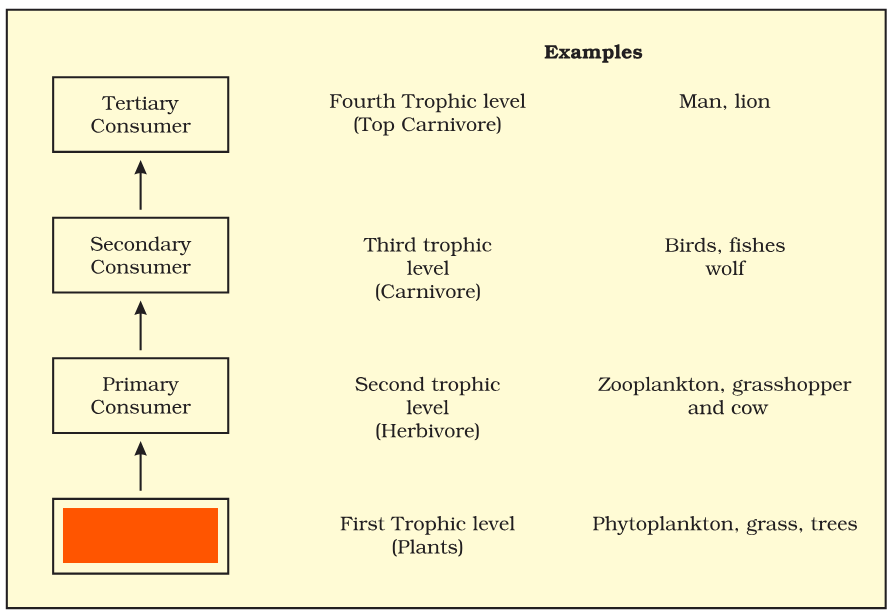
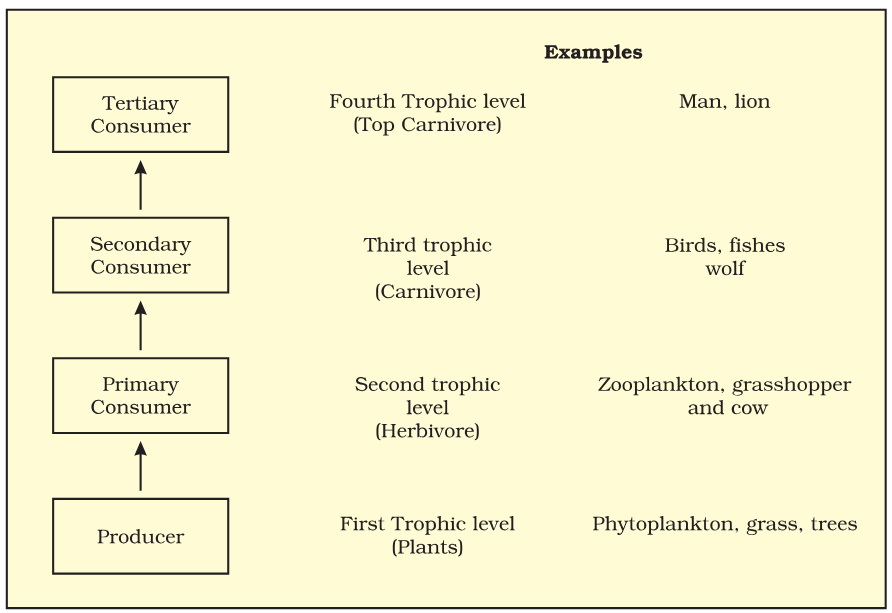
What are the three types of ecological pyramids that are usually studied?
pyramid of number
pyramid of biomass
pyramid of energy
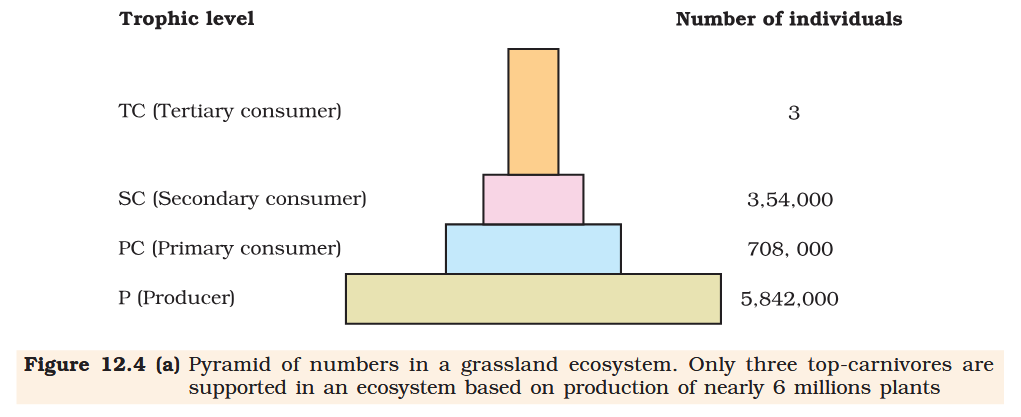
What does P stand for?
Producer
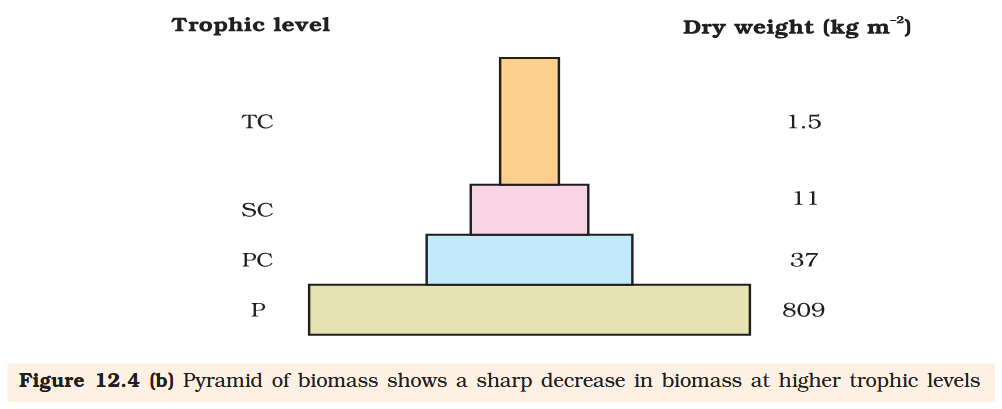
What does P stand for?
Producer
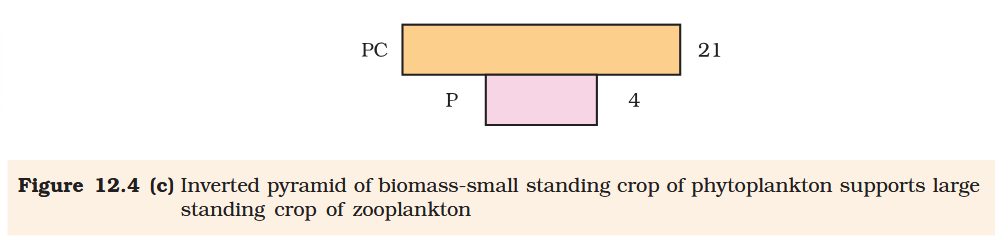
What does P stand for?
Producer
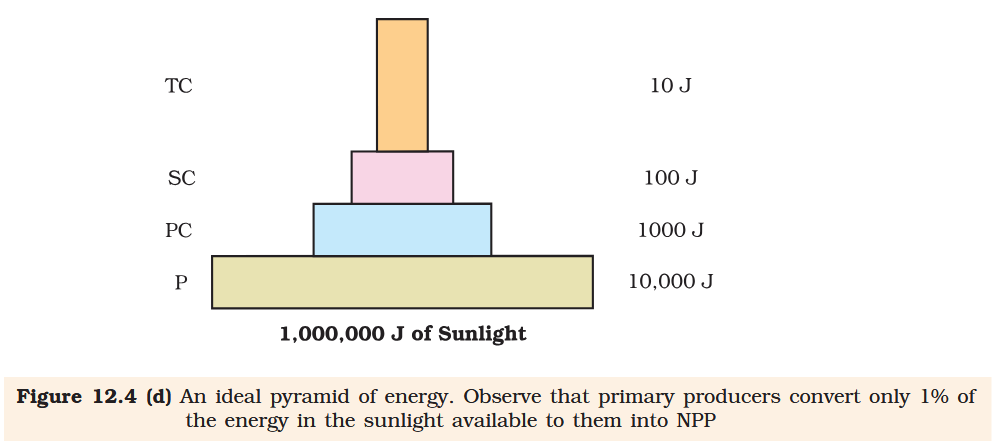
What does TC stand for?
Tertiary consumer
Any calculations of energy content, biomass or numbers, has to include all organisms at that trophic level. No generalisations we make will be true if we take only a few individuals at any trophic level into account.
Why is that?
The sum of 2,3,4 = 9
The sum of 2,3,4,5 = 14
big difference
A given species may occupy more than one trophic level in the same ecosystem at the same time.
True or false?
True
A trophic level can represent a functional level with species.
True or false?
False.
One must remember that the trophic level represents a functional level, not a species as such.
The pyramid of biomass in sea is generally inverted because the biomass of fishes far exceeds that of phytoplankton.
True or false?
True
Pyramids of biomass can be upright or inverted.
True or false?
True.
Pyramids of energy can be upright or inverted.
True or false?
False.
Pyramid of energy is always upright, can never be inverted, because when energy flows from a particular trophic level to the next trophic level, some energy is always lost as heat at each step.
What are the three shortcomings of ecological pyramids?
There are certain limitations of ecological pyramids such a:
It does not take into account the same species belonging to two or more trophic levels.
It assumes a simple food chain, something that almost never exists in nature; it does not accommodate a food web.
Saprophytes are not given any place in ecological pyramids even though they play a vital role in the ecosystem.