Immunology Exam 1

0.0(0)
studied byStudied by 1 person
0.0(0)
call with kaiCall with Kai
learnLearn
examPractice Test
spaced repetitionSpaced Repetition
heart puzzleMatch
flashcardsFlashcards
GameKnowt Play
Card Sorting

1/59

flashcard set

Earn XP

Description and Tags

Topics 1-3

Name
Mastery
Learn
Test
Matching
Spaced
Call with Kai

No study sessions yet.

60 Terms

1
New cards

Immune System

  • definition

  • pathogenesis

  • Protects multicellular organisms from pathogens,
    disease-causing organisms that invade a host’s tissues/cells

  • Pathogenesis: means by which a pathogen causes disease
    - A condition of an organism that impairs normal physiological function

2
New cards

Immune System Composition

Cells

  • Identify/attack pathogens, secrete anti-pathogen molecules

Tissues

  • Form barriers, secrete hormones & promote development of immune cells

Molecules

  • Dissolve in body fluids, bind and neutralize pathogens, signal cells

3
New cards

What are the four classes of pathogens?

  1. bacteria

  2. viruses

  3. fungi

  4. helminth (worms)

4
New cards

Pathogen class: Bacteria

  • cell type

  • pathogenesis

  • notes

  • complications

  • Type: unicellular prokaryote

  • Pathogenesis: colonize tissues and/or release toxins

  • Notes: Many foreign molecules make for easy recognition

  • Complications: hard to distinguish normal flora from pathogens.

5
New cards

Pathogen class: Virus

  • type

  • pathogenesis

  • notes

  • complications

  • Type: non-cellular parasite

  • Pathogenesis: insert DNA/RNA into host cells to create more viral particles.

  • Notes: Immune system must destroy both viral particles and infected host cells

  • Complications: many are enveloped with host cell membranes and molecules.

6
New cards

Pathogen class: Fungi

  • type

  • pathogenesis

  • notes

  • complications

  • Type: multicellular eukaryote

  • Pathogenesis: colonize tissues and digest them

  • Notes: Hyphae are resilient and infections often persist.

  • Complications: Physically tough hyphae and eukaryotic cell structure.

7
New cards

Pathogen class: Helminth (worms)

  • type

  • pathogenesis

  • notes

  • complications

  • Type: multicellular eukaryote

  • Pathogenesis: attach to vessels or gut and absorb nutrients

  • Notes: animal cell composition is similar to host

  • Complications: macroscopic structure; cannot be phagocytosed.

8
New cards

Leukocytes

  • what are they? what do they respond to? are they specific?

  • do they travel through the body?

  • what are lymphocytes?

  • The major cells used to combat pathogens are leukocytes (aka white blood cells) → a group of several types of cells, each with a specific role

  • Many leukocytes “patrol” body tissues in search of foreign entities and react to their presence with a generalized “attack” response

  • Lymphocytes are a subtype of leukocyte that recognize and react to specific pathogens and generate a focused (adaptive) immune response designed for total suppression/clearance of the pathogen

9
New cards

Innate Immune System

  • what does it involve?

  • when is it present in the body?

  • PAMPs? what recognizes them?

  • PRRs

  • Incorporates physical barriers, chemical deterrents (anti-microbial enzymes) and cells/molecules that seek and destroy non-self entities they encounter

  • Innate immune system components are generally always present, regardless of whether an active infection is occurring → a “perimeter defense”

  • Pathogen Associated Molecular Patterns (PAMPs) are non-mammalian molecules commonly found in broad groups of pathogens

  • Many leukocytes possess Pattern Recognition Receptors (PRRs) that bind PAMPs and trigger an attack

10
New cards

What are examples of PAMPs?

  • Lipopolysaccharide (LPS) on a bacteria

  • peptidoglycan

  • Mannose polymers → bacteria, fungi, helminths

11
New cards

Adaptive Immune System

  • Acts only in response to an infection; sometimes called acquired immunity

  • Does not respond immediately like innate immunity → takes several days, but response is more precise, long-lasting and completely clears pathogen

  • The adaptive immune system responds to antigens (Ag) → species/strain-specific molecules (usually proteins) on a particular pathogen

  • Two types of lymphocyte (subtype of leukocyte) respond to antigens and promote adaptive immunity
<ul><li><p><span><span>Acts only in response to an infection; sometimes called </span><strong><span>acquired immunity</span></strong></span></p></li><li><p><span><span>Does not respond immediately like innate immunity → takes several days, but response is more precise, long-lasting and completely clears pathogen</span></span></p></li><li><p style="text-align: left;"><span><span>The adaptive immune system responds to </span><strong><span>antigens (Ag)</span></strong><span> → species/strain-specific molecules (usually proteins) on a particular pathogen</span></span></p></li><li><p style="text-align: left;"><span><span>Two types of </span><strong><span>lymphocyte</span></strong><span> (subtype of leukocyte) respond to antigens and promote adaptive immunity</span></span></p></li></ul><p></p>
12
New cards

Antigens and Antibodies

  • Antigens (Ag) are usually macromolecules (proteins, polysaccharides, lipids, nucleic acids) found on the cell/capsid surface or secreted by the pathogen

  • Antigens are specific/unique to a given pathogen

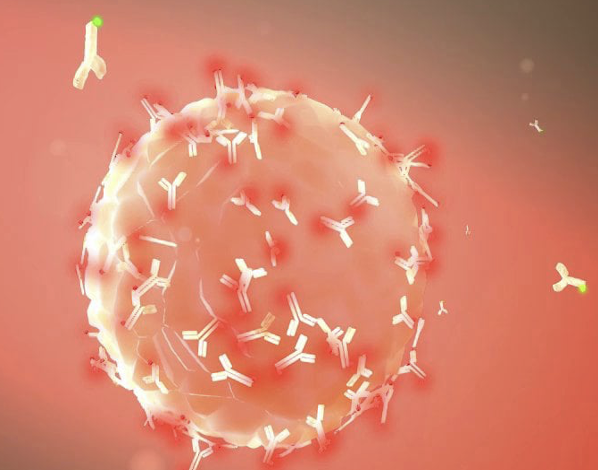
  • Antibodies (Ab) are Y-shaped proteins that bind to specific antigens; the “tips” of the Y-shape are Ag-binding sites

  • This“tags” the pathogen for recognition by other leukocytes & other immune system elements

  • As more pathogen is encountered, more Ab is produced

  • Ab can “smother” a pathogen (blocks receptors/channels), while tagging it as a target
<ul><li><p><span><strong><span>Antigens (Ag) </span></strong><span>are usually macromolecules (</span><u><span>proteins</span></u><span>, polysaccharides, lipids, nucleic acids) found on the cell/</span><strong><span>capsid</span></strong><span> surface or secreted by the pathogen</span></span></p></li><li><p><span><span>Antigens are specific/unique to a given pathogen</span></span></p></li><li><p><span><strong><span>Antibodies (Ab)</span></strong><span> are Y-shaped proteins that bind to specific antigens; the “tips” of the Y-shape are Ag-binding sites</span></span></p></li><li><p style="text-align: left;"><span><span>This“tags” the pathogen for recognition by other leukocytes &amp; other immune system elements</span></span></p></li><li><p><span><span>As more pathogen is encountered, more Ab is produced</span></span></p></li><li><p><span><span>Ab can “smother” a pathogen (blocks receptors/channels), while tagging it as a target</span></span></p></li></ul><p></p>
13
New cards

Antigen Recognition and Effector Response

  • Antigens are unique to a given pathogen; this is critical so ach pathogen can be identified specifically and so the effector response that follows can be tailored to best eliminate said pathogen

  • the adaptive immune system must also ignore normal flora
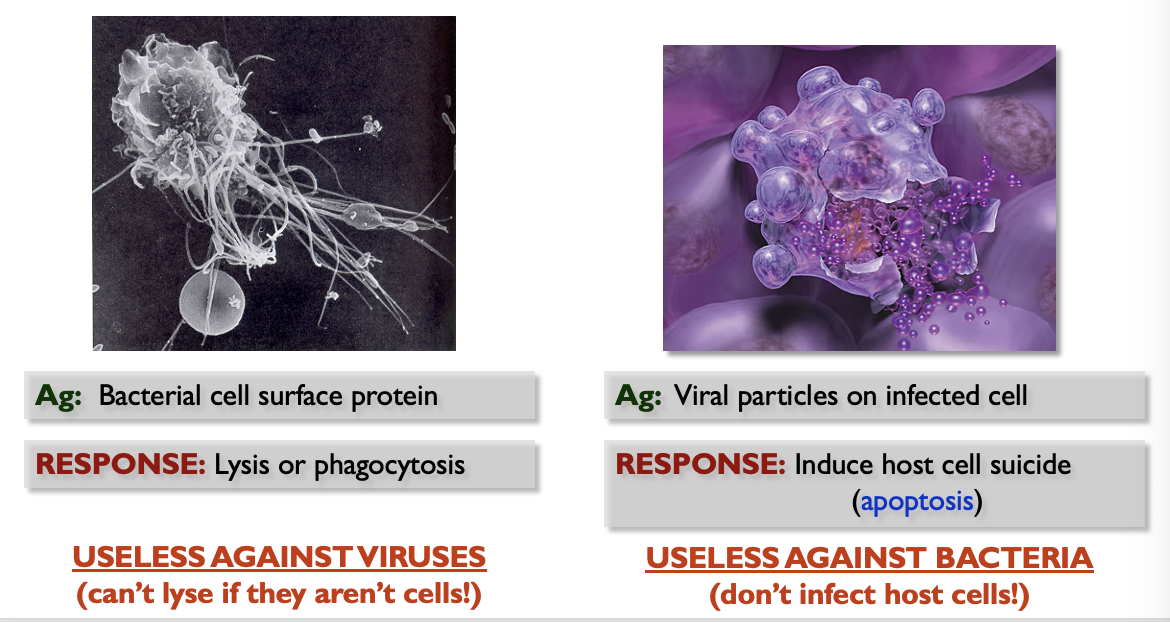
<ul><li><p>Antigens are unique to a given pathogen; this is critical so ach pathogen can be identified specifically and so the <strong>effector response</strong> that follows can be tailored to best eliminate said pathogen</p></li><li><p>the adaptive immune system must also ignore <strong>normal flora</strong></p></li></ul><p></p>
14
New cards

Adaptive Immunity Overview

  • responds to specific pathogens

  • has 4 main characteristics

Antigen Specificity

  • subtle differences between antigens are distinguishable; Ab often will not bind to an Ag with even a single aa difference

  • Pathogens that mutate rapidly can easily change alleles by one codon

Diversity

  • Billions of types of producible Ab; each binds a given Ag

  • contrasts strongly with generic PAMPs

Immunological Memory

  • memory lymphocytes are retained and respond quickly to repeat infections

Self/Non-Self Recognition

  • Lymphocytes that produce Ab that bind self-molecules as Ag are destroyed (this is critical so the IS doesn’t attack host)

15
New cards

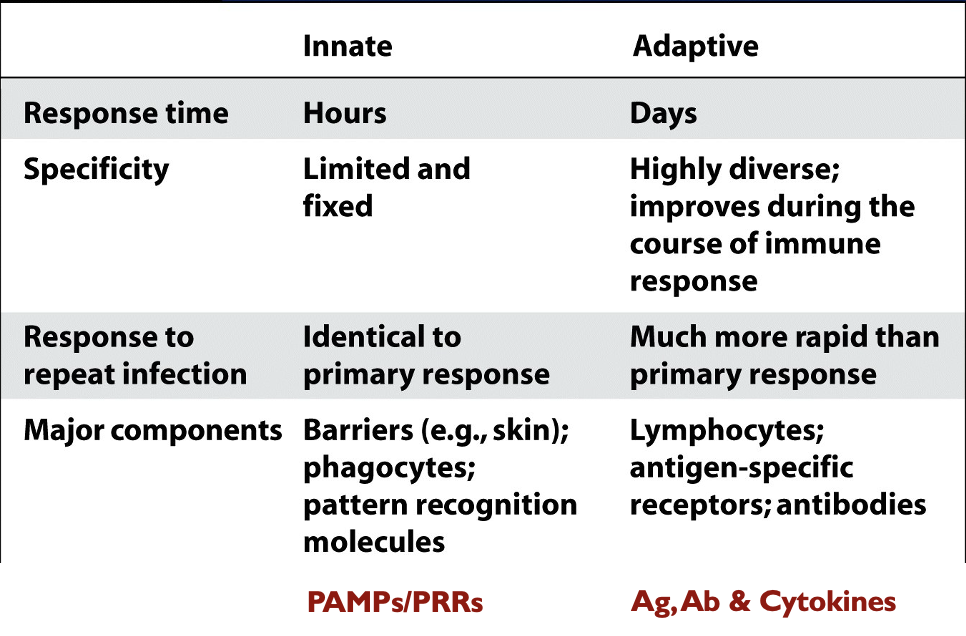
Innate vs Adaptive Immunity

knowt flashcard image
16
New cards

Toxins as Antigens

  • Antigens are often on the surface of a pathogen, but many secreted toxins (microbial or animal) are also antigens

  • Antivenins are made from blood serum from animals that have generated large concentrations of antibodies that bind and neutralize

  • Serum sickness: other animal proteins in the antivenin are antigens that trigger an immune response

  • tetanus, diphtheria, and cholera cause disease by releasing toxins
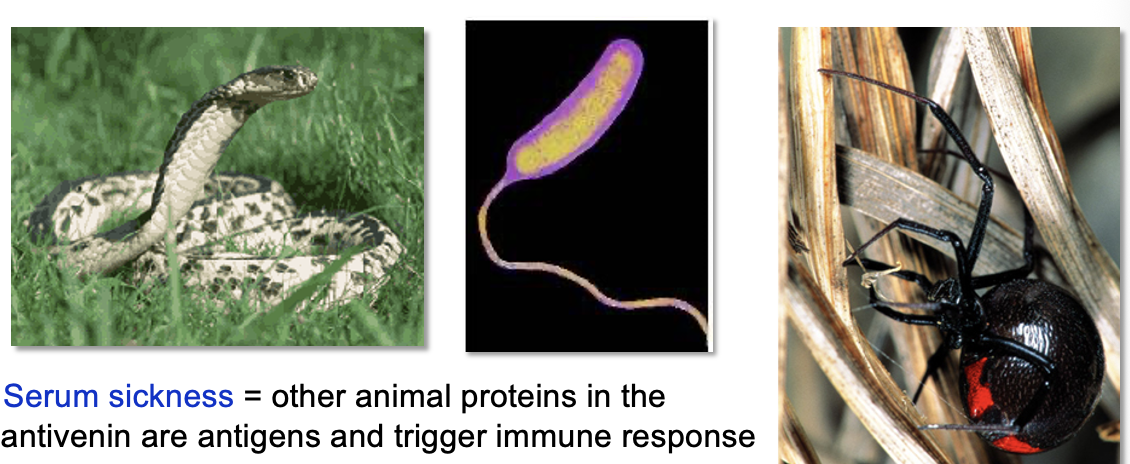
<ul><li><p>Antigens are often on the surface of a pathogen, but many secreted <strong>toxins</strong> (microbial or animal) are also antigens</p></li><li><p><strong>Antivenins</strong> are made from blood serum from animals that have generated large concentrations of antibodies that bind and neutralize</p></li><li><p><strong>Serum sickness</strong>: other animal proteins in the antivenin are antigens that trigger an immune response</p></li><li><p>tetanus, diphtheria, and cholera cause disease by releasing toxins</p></li></ul><p></p>
17
New cards

Basic Ab Structure

  • Antibodies are Y-shaped molecules consisting of four polypeptide chains (2 heavy, 2 light) that are bound together by disulfide bonds

  • Antibodies are hetero-tetramers w/ Ag Fab binding sites at the tips of the “Y”

  • The binding site of each Ab has a specific amino acid sequence that makes it chemically compatible with a specific Ag, like enzyme/substrate binding

  • Fc region of Ab “stem” can bind to receptors on leukocytes, triggering effector responses
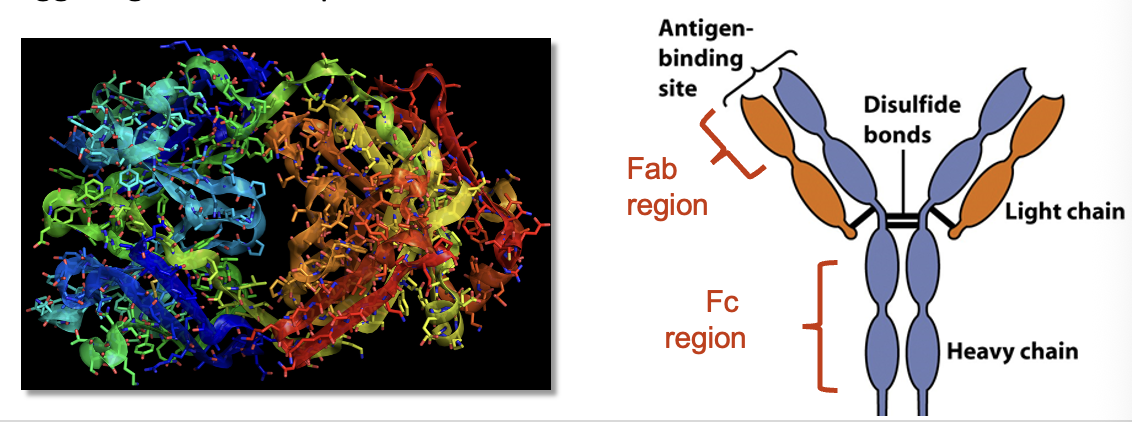
<ul><li><p>Antibodies are Y-shaped molecules consisting of <strong>four polypeptide chains</strong> (2 heavy, 2 light) that are bound together by <strong>disulfide bonds</strong></p></li><li><p>Antibodies are hetero-tetramers w/ Ag <strong>Fab</strong> binding sites at the tips of the “Y”</p></li><li><p>The binding site of each Ab has a specific amino acid sequence that makes it chemically compatible with a specific Ag, like enzyme/substrate binding</p></li><li><p><strong>Fc region</strong> of Ab “stem” can bind to receptors on leukocytes, triggering effector responses</p></li></ul><p></p>
18
New cards

Lymphocyte Overview

  • two types

B-lymphocytes

  • mature in the bone marrow

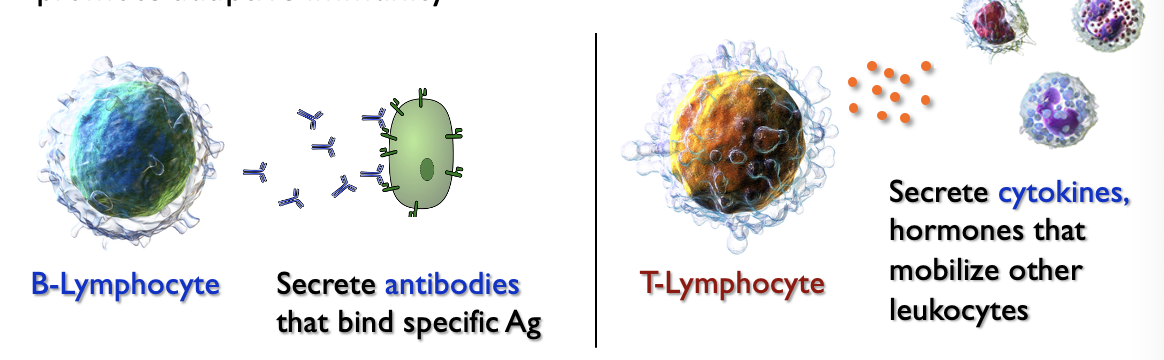
  • React to antigens and secrete antibodies

T-lymphocytes

  • mature in the thymus gland

two types

  • Helper - secrete cytokines

  • Killer - induce apoptosis in infected cells
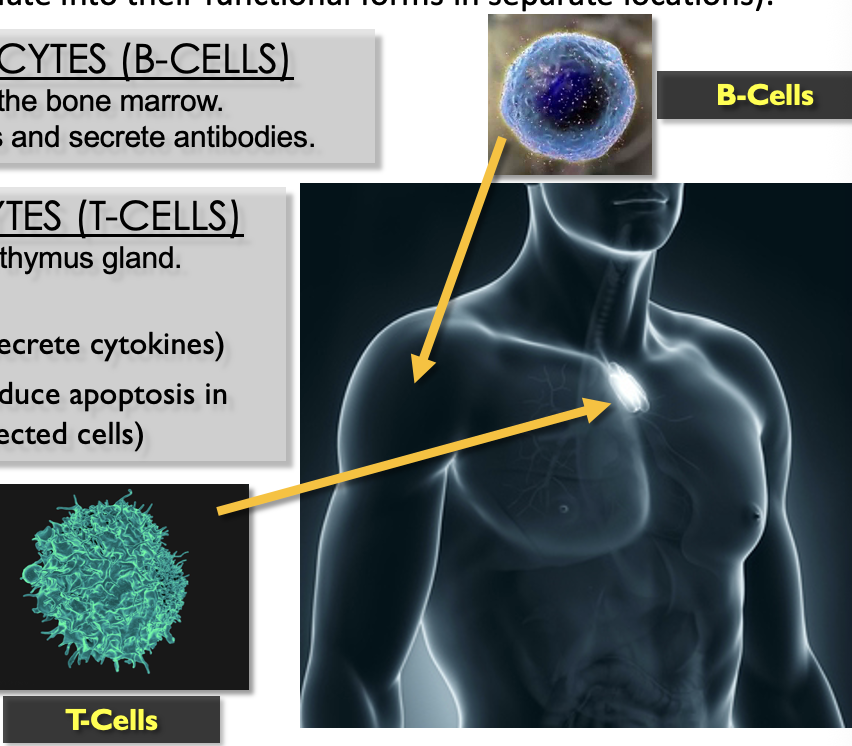
<ul><li><p>two types</p></li></ul><p><strong>B-lymphocytes</strong></p><ul><li><p>mature in the bone marrow</p></li><li><p>React to antigens and secrete antibodies</p></li></ul><p><strong>T-lymphocytes</strong></p><ul><li><p>mature in the thymus gland</p></li></ul><p>two types</p><ul><li><p>Helper - secrete cytokines</p></li><li><p>Killer - induce apoptosis in infected cells</p></li></ul><p></p>
19
New cards

Clonal Selection & Expansion

  • through “controlled mutation” of receptor genes, each lymphocyte in the immune system creates a receptor that recognizes a different Ag

  • upon infection, the specific lymphocyte binds Ag and undergoes mitosis for several days, resulting in an “army” of lymphocytes against that Ag

  • This process is called clonal selection because all the daughter lymphocytes produced are genetically identical (recognize same Ag) as the original
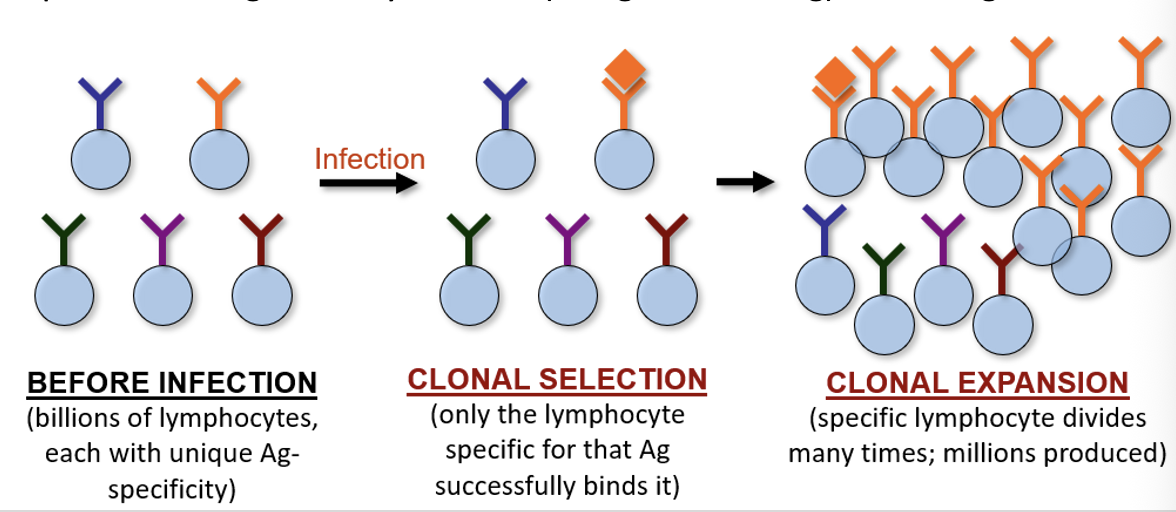
<ul><li><p>through “controlled mutation” of receptor genes, each lymphocyte in the immune system creates a receptor that recognizes a different Ag</p></li><li><p>upon infection, the specific lymphocyte binds Ag and undergoes mitosis for several days, resulting in an “army” of lymphocytes against that Ag</p></li><li><p>This process is called <strong>clonal selection</strong> because all the daughter lymphocytes produced are genetically identical (recognize same Ag) as the original</p></li></ul><p></p>
20
New cards

Clonal Selection in B-Cells

  • B-cells have an Ag-receptor called the B-Cell Receptor (BCR)

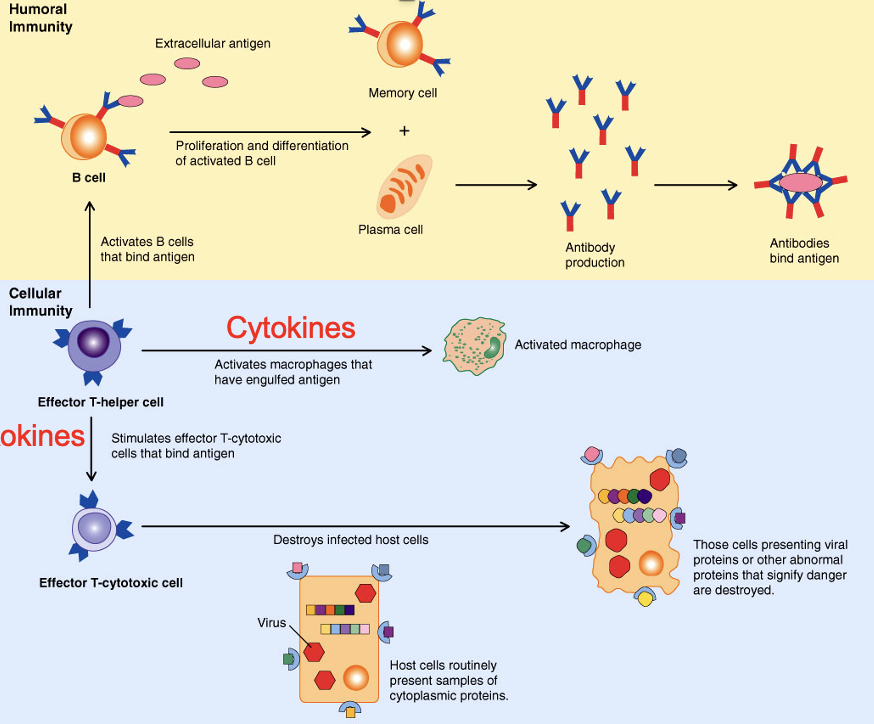
  • When Ag binds, the B-cell proliferates and daughter cells differentiate into plasma cells that secrete Ab into lymph and bloodstream

  • BCR and Ab have the same structure/gene, but BCR is membrane-bound

  • A smaller number of memory cells are dormant and remain after infection
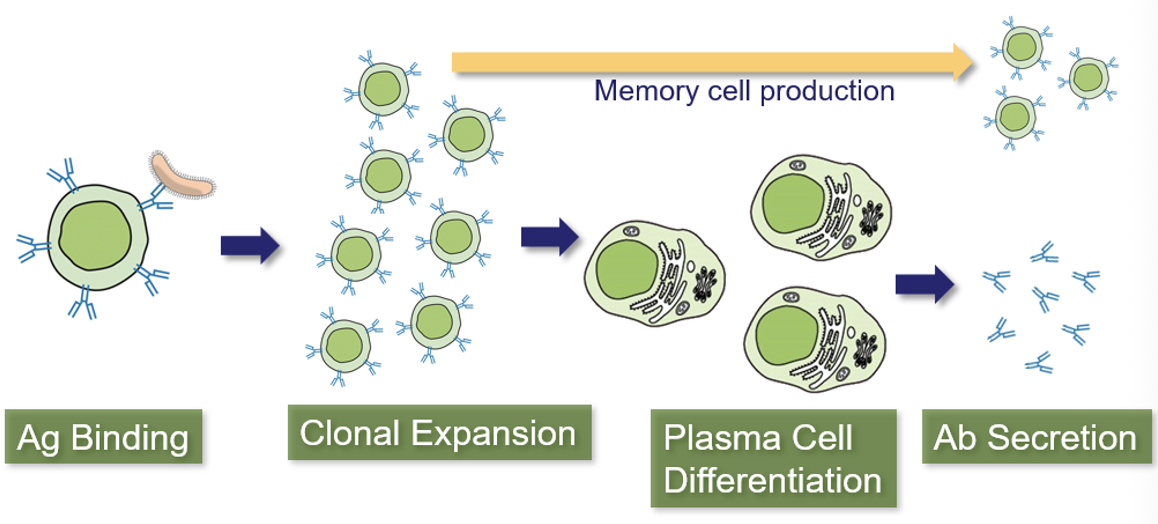
<ul><li><p>B-cells have an Ag-receptor called the <strong>B-Cell Receptor (BCR)</strong></p></li><li><p>When Ag binds, the B-cell proliferates and daughter cells differentiate into <strong>plasma cells</strong> that secrete Ab into lymph and bloodstream</p></li><li><p>BCR and Ab have the same structure/gene, but BCR is membrane-bound</p></li><li><p>A smaller number of <strong>memory cells</strong> are dormant and remain after infection</p></li></ul><p></p>
21
New cards

Clonal Selection in Helper T-Cells

  • Helper T-cells (TH) have an Ag-receptor called the T-Cell Receptor (TCR)

  • When Ag binds, T-cells proliferate and begin secreting cytokines

  • T-cells cannot bind Ag alone; it must be presented by a leukocyte that has phagocytosed the Ag and “presents” Ag particles on its surface

  • This Ag-Presentation is important because it prevents T-cells from reacting to Ag that hasn’t been confirmed by another cell
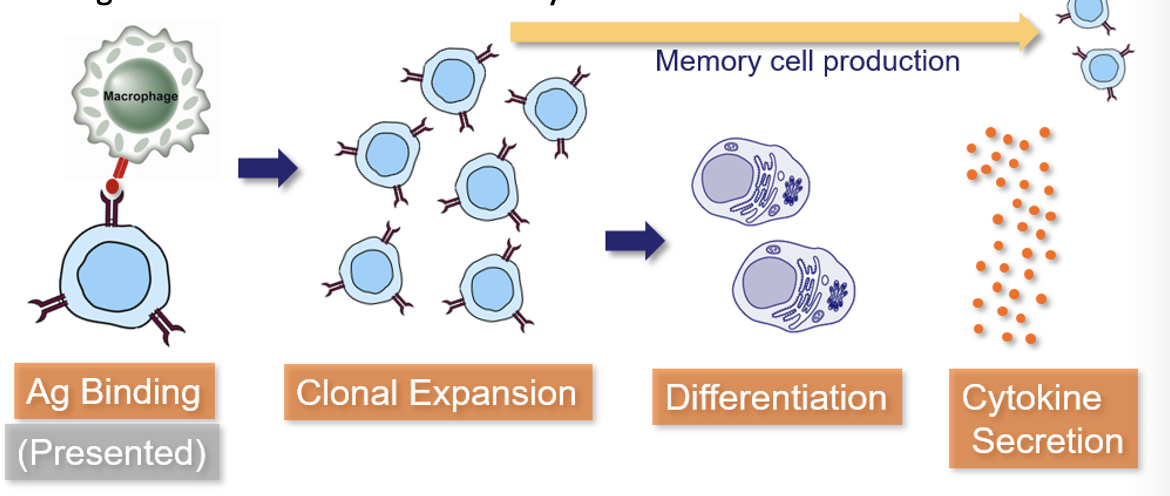
<ul><li><p>Helper T-cells (T<sub>H</sub>) have an Ag-receptor called the T-Cell Receptor (TCR)</p></li><li><p>When Ag binds, T-cells proliferate and begin secreting cytokines</p></li><li><p>T-cells cannot bind Ag alone; it must be presented by a leukocyte that has phagocytosed the Ag and “presents” Ag particles on its surface</p></li><li><p>This Ag-Presentation is important because it prevents T-cells from reacting to Ag that hasn’t been confirmed by another cell</p></li></ul><p></p>
22
New cards

Cytotoxic T-Cells

  • Killer T-cells (TC) respond to the cytokines released by TH cells and convert into active cytotoxic T-lymphocytes (CTLs)

  • CTLs identify and destroy virally-infected host cells

  • Virally-infected cells display viral Ag particles on their cell surface

  • CTL bind to the Ag complex on infected cells and induce apoptosis to prevent the spread of virus
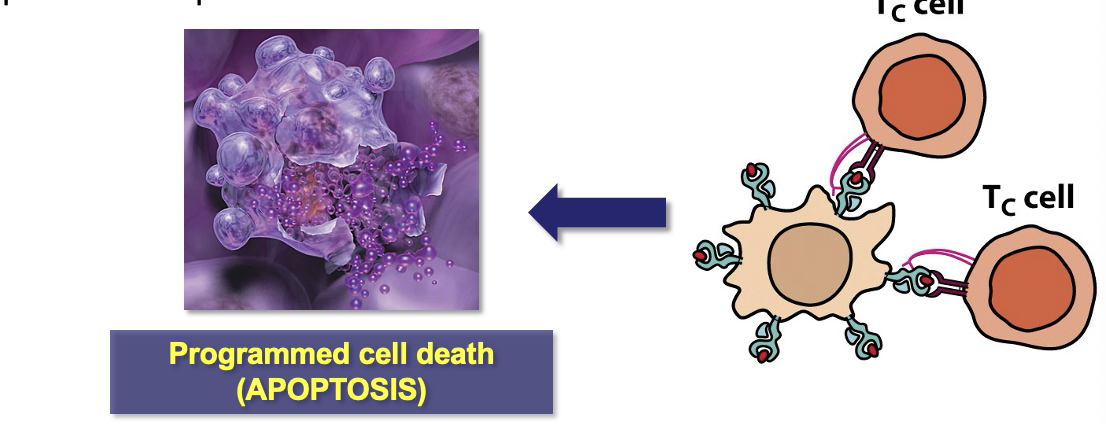
<ul><li><p>Killer T-cells (T<sub>C</sub>) respond to the cytokines released by T<sub>H</sub> cells and convert into active cytotoxic T-lymphocytes (CTLs)</p></li><li><p>CTLs identify and destroy virally-infected host cells</p></li><li><p>Virally-infected cells display viral Ag particles on their cell surface</p></li><li><p>CTL bind to the Ag complex on infected cells and induce apoptosis to prevent the spread of virus</p></li></ul><p></p>
23
New cards

Humoral and Cell-Mediated Immunity

Adaptive immunity results from B-cell induced humoral immunity because it and T-cell driven cell-mediated immunity
<p><span><span>Adaptive immunity results from B-cell induced humoral immunity because it and T-cell driven cell-mediated immunity</span></span></p>
24
New cards

Immunological Memory

  • When the immune system detects an Ag, large concentrations of Ab are produced against the Ag and cytokines mobilize leukocytes

  • Memory cells remain dormant in the body after infection but are rapidly activated generated upon re-infection

  • This secondary immune response generally eliminates the pathogen before any symptoms develop; thus it’s true immunity

  • The immunological memory can eventually fade a memory cells undergo apoptosis after years of dormancy → Why we need booster shots

  • Vaccines are solutions of non-infectious Ag that induce an immune response (and memory) without causing a disease state

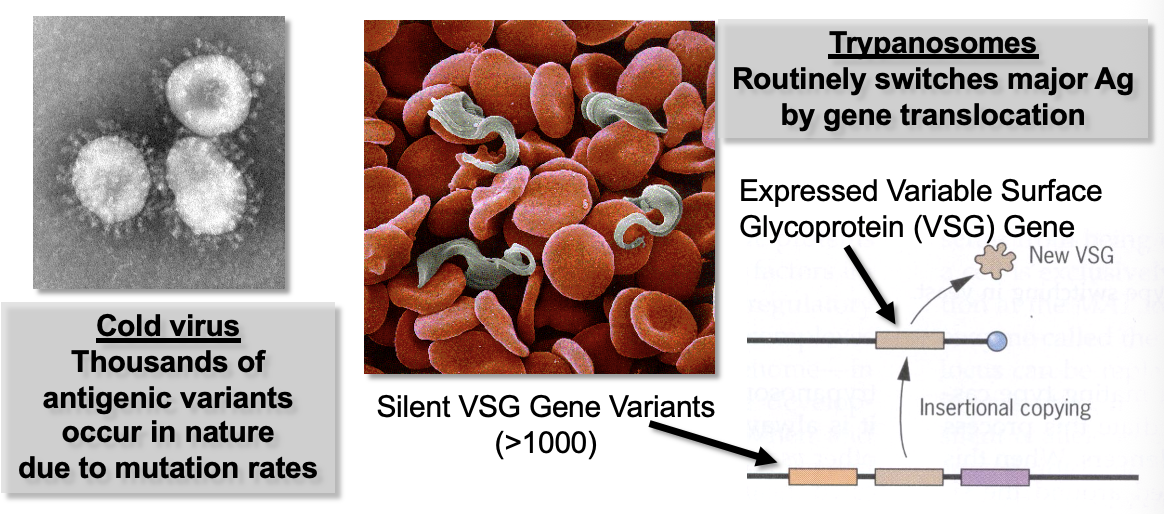
  • Some vaccinations/infections provide lifelong immunity (chickenpox) while other pathogens (cold virus, sleeping sickness) resist immune memory

  • Length of memory is related to the pathogen and severity of infection

  • Weak infections produce fewer memory cells

  • Some pathogens have adapted strategies to evade or “out-mutate” immunity
<ul><li><p>When the immune system detects an Ag, large concentrations of Ab are produced against the Ag and cytokines mobilize leukocytes</p></li><li><p><strong>Memory cells</strong> remain dormant in the body after infection but are rapidly activated generated upon re-infection</p></li><li><p>This <strong>secondary immune response</strong> generally eliminates the pathogen before any symptoms develop; thus it’s true <strong>immunity</strong></p></li><li><p>The <strong>immunological memory</strong> can eventually fade a memory cells undergo apoptosis after years of dormancy → Why we need booster shots</p></li><li><p><strong>Vaccines</strong> are solutions of non-infectious Ag that induce an immune response (and memory) without causing a disease state</p></li><li><p>Some vaccinations/infections provide lifelong immunity (chickenpox) while other pathogens (cold virus, sleeping sickness) resist immune memory</p></li><li><p>Length of memory is related to the pathogen and severity of infection</p></li><li><p>Weak infections produce fewer memory cells</p></li><li><p>Some pathogens have adapted strategies to evade or “out-mutate” immunity</p></li></ul><p></p>
25
New cards

Active Immunity

  • the person/animal’s immune system develops their own immune cells and antibodies in response to a pathogen

  • the patient is challenged with Ag, generating lymphocytes & memory cells

  • Vaccines and infection generate active immunity

26
New cards

Passive Immunity

  • A subject is provided antibodies against a specific antigen directly (don’t produce any themselves)

  • Antisera (injectable Ab solutions) or antivenins are emergency treatments of infections of poisonings (e.g. tetanus) or for immunocompromised patients

  • Mothers provide maternal antibodies through placenta and breast milk

  • Passive immunity does not generate immunological memory because the host immune system is not generating the response (no memory cells)

27
New cards

Immune Response and Memory

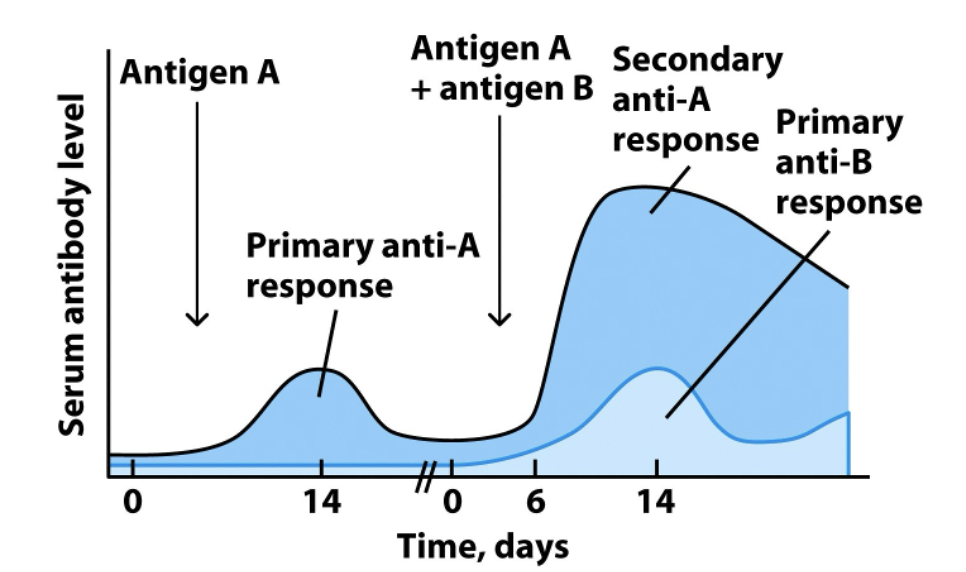
  • Due to clonal expansion and the production of memory cells, a greater amount of antibody will be produced (and with shorter lag time) on the second exposure to a given antigen

  • Lymphocytes produced through clonal expansion are specific to a given Ag, so they can’t help fight off a different pathogen
<ul><li><p>Due to clonal expansion and the production of memory cells, a greater amount of antibody will be produced (and with shorter lag time) on the second exposure to a given antigen</p></li><li><p>Lymphocytes produced through clonal expansion are specific to a given Ag, so they can’t help fight off a different pathogen</p></li></ul><p></p>
28
New cards

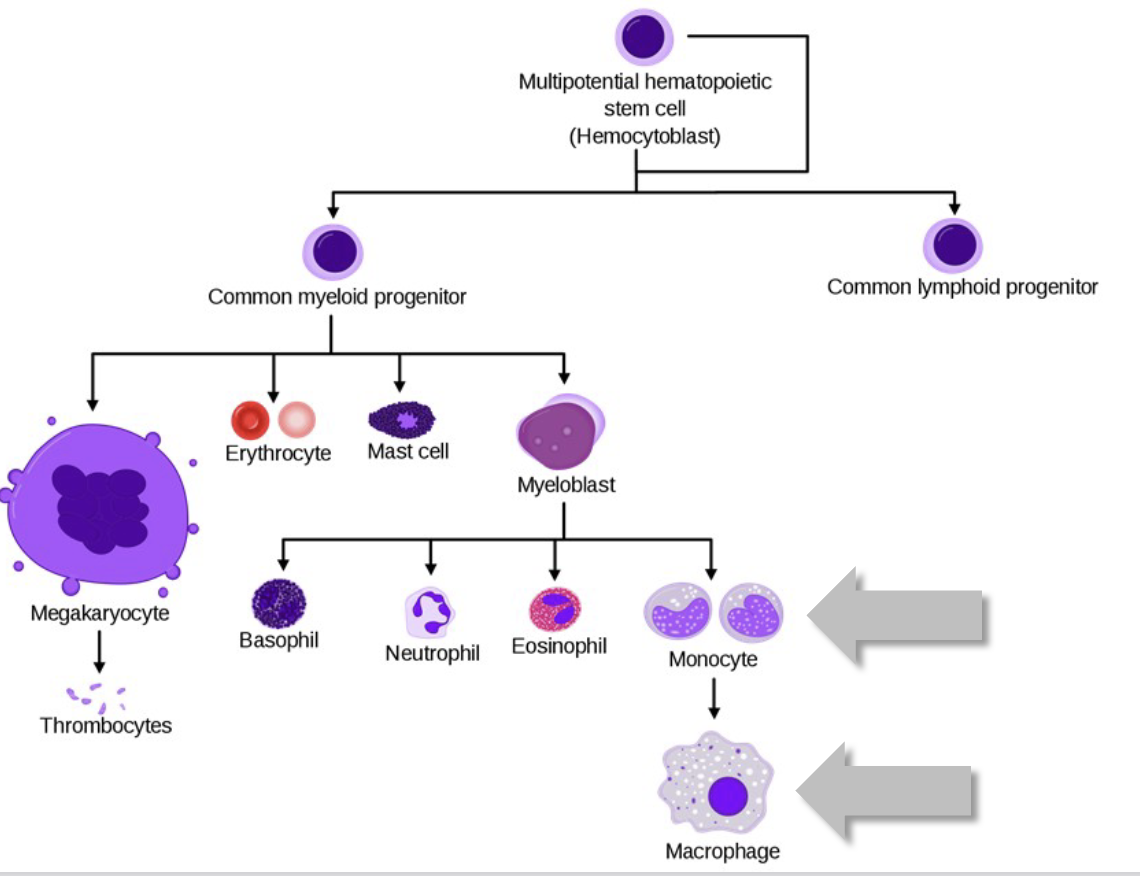
Blood cells

  • where are they derived from?

  • what is the major distinguishing step for HSCs?

  • do HSCs ever run out?

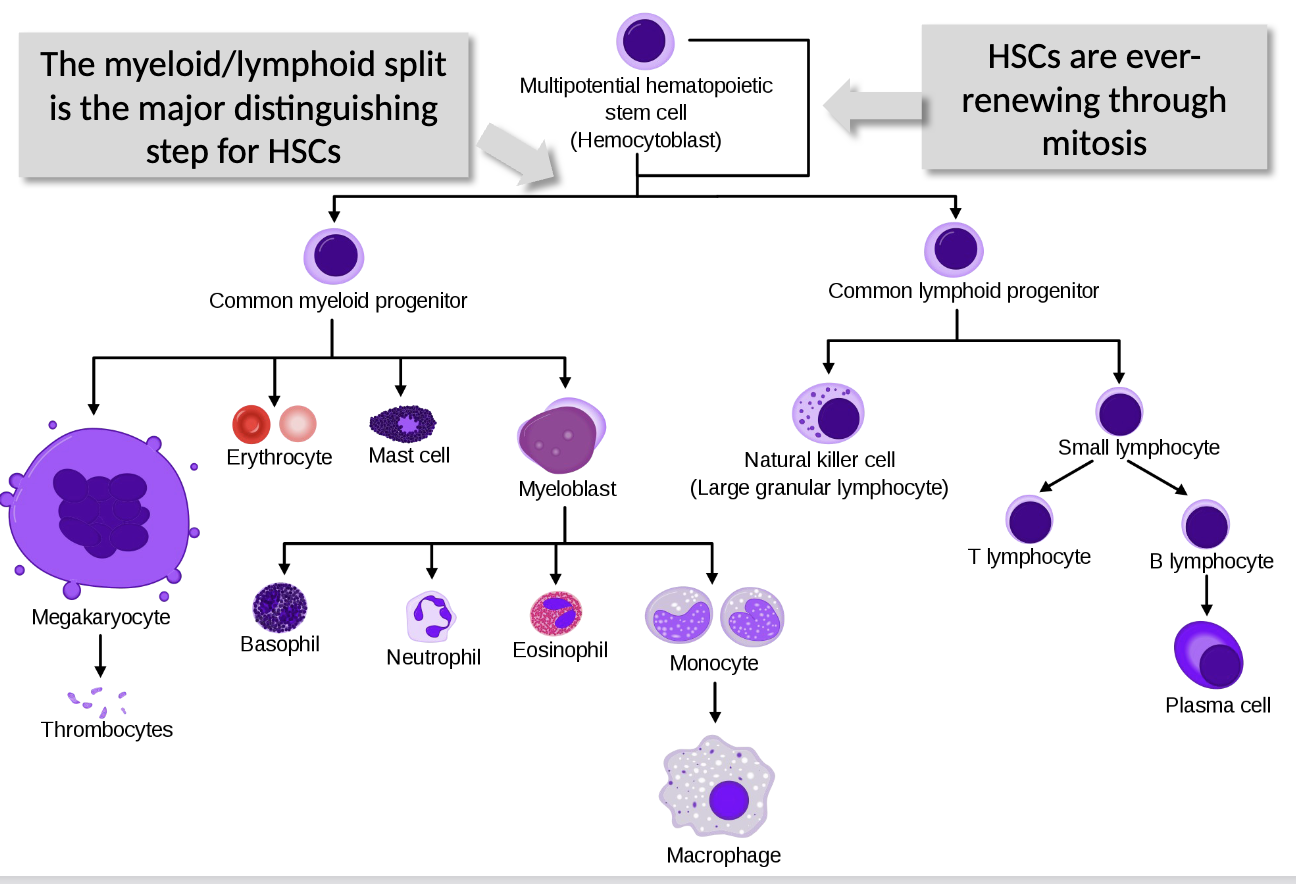
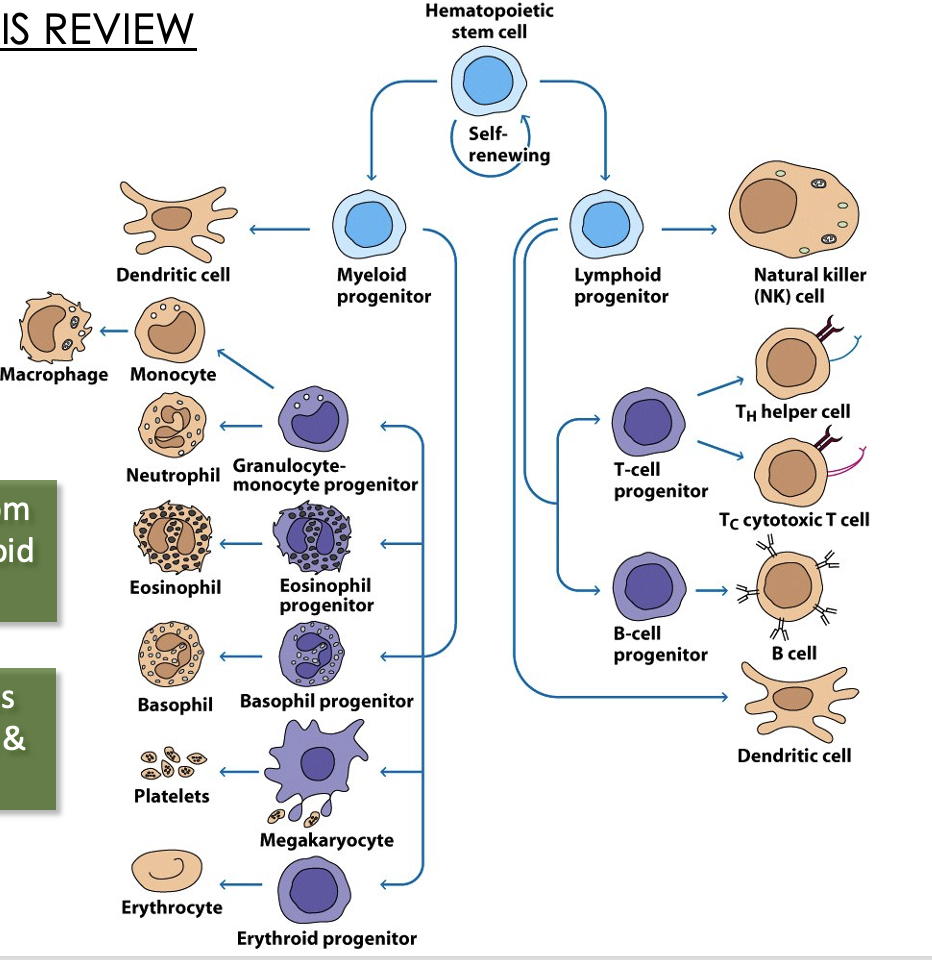
  • all blood cells derive from hematopoietic stem cells (HSCs) in bone marrow, and differentiate into erythrocytes and leukocytes through hematopoiesis

  • the myeloid/lymphoid split is the major distinguishing step for HSCs

  • HSCs are ever-renewing through mitosis
<ul><li><p>all blood cells derive from <strong>hematopoietic stem cells (HSCs)</strong> in bone marrow, and differentiate into erythrocytes and leukocytes through <strong>hematopoiesis</strong></p></li><li><p>the myeloid/lymphoid split is the major distinguishing step for HSCs</p></li><li><p>HSCs are ever-renewing through mitosis</p></li></ul><p></p>
29
New cards

Myeloid progenitors

  • what do they differentiate into?

  • what are erythrocytes?

  • what are megakaryocytes?

  • does either cell have a direct role in immunity?

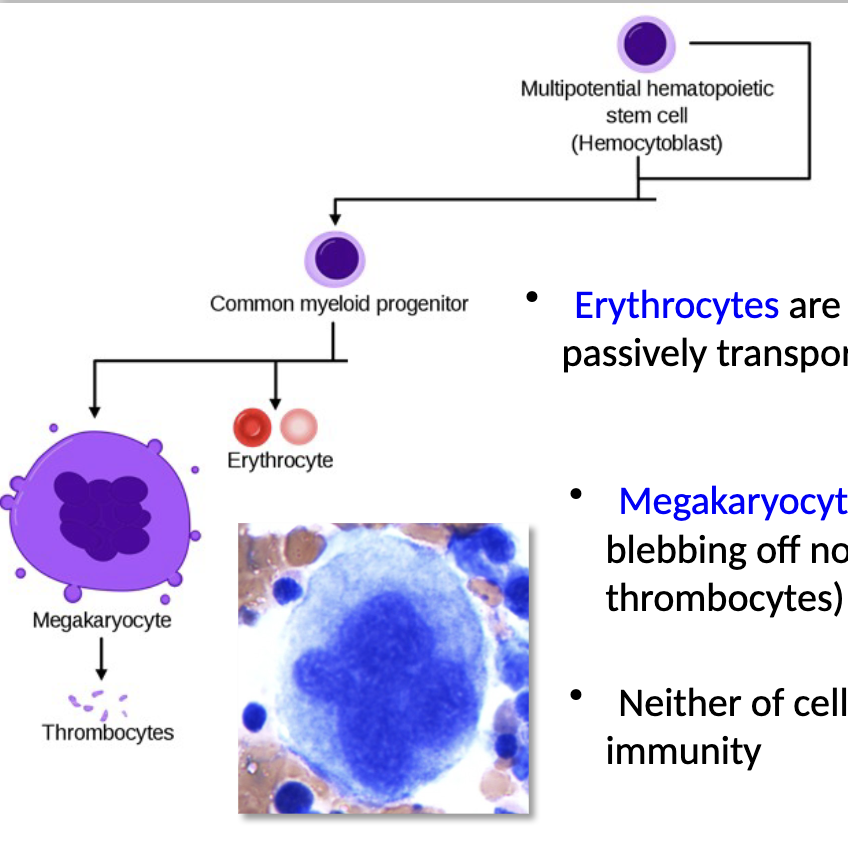
  • myeloid progenitors can differentiate into erythrocytes (RBCs) and megakaryocytes

  • erythrocytes are non-nucleated cells that passively transport O2 bound to hemoglobin

  • megakaryocytes respond to wounds by blebbing off non-nucleated platelets (aka thrombocytes) that form blood clots

  • neither of cell type has a direct role in immunity
<ul><li><p>myeloid progenitors can differentiate into erythrocytes (RBCs) and megakaryocytes</p></li><li><p><strong>erythrocytes</strong> are non-nucleated cells that passively transport O<sub>2</sub> bound to hemoglobin</p></li><li><p><strong>megakaryocytes</strong> respond to wounds by blebbing off non-nucleated platelets (aka thrombocytes) that form blood clots</p></li><li><p>neither of cell type has a direct role in immunity</p></li></ul><p></p>
30
New cards

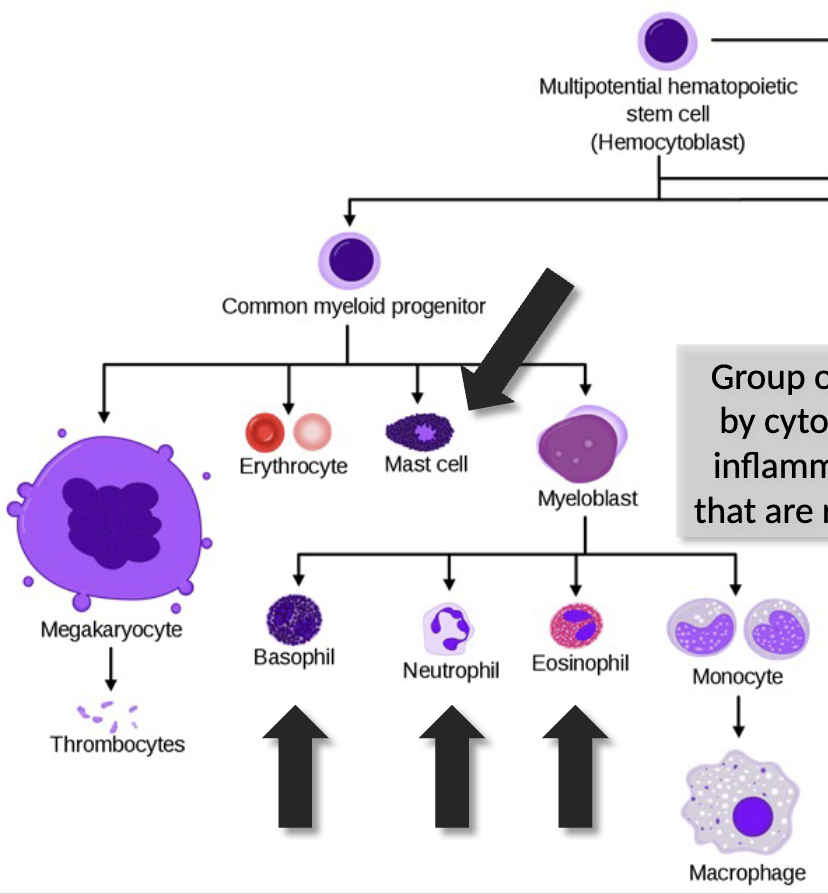
Myeloid lineage leukocytes

  • what do they function as? where?

  • what do they respond to?

  • what can they detect and trigger?

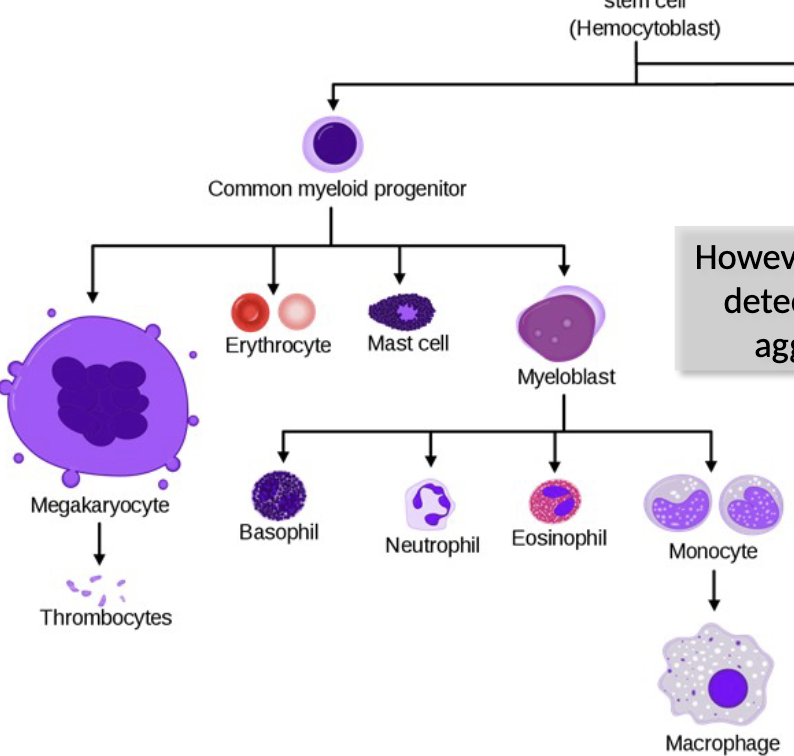
  • function in the innate immune, as “first responders” to
    infection, recognizing and responding to PAMPs with their PRRs

  • However, each also has receptors that detect Ab bound to Ag and trigger aggressive effector responses

  • So these function in both innate & adaptive immunity
<ul><li><p><span><span>function in the innate immune, as “first responders” to</span></span><br><span><span>infection, recognizing and responding to PAMPs with their PRRs</span></span></p></li><li><p><span style="color: rgb(0, 0, 0);"><span>However, each also has receptors that detect Ab bound to Ag and trigger aggressive effector responses</span></span></p></li><li><p><span style="color: rgb(0, 0, 0);"><span>So these function in both innate &amp; adaptive immunity</span></span></p></li></ul><p></p>
31
New cards
<p>Mononuclear Phagocytes</p><ul><li><p>how do these cells begin? what do they become?</p></li><li><p>what happens when they convert?</p></li><li><p>morphology?</p></li></ul><p></p>

Mononuclear Phagocytes

  • how do these cells begin? what do they become?

  • what happens when they convert?

  • morphology?

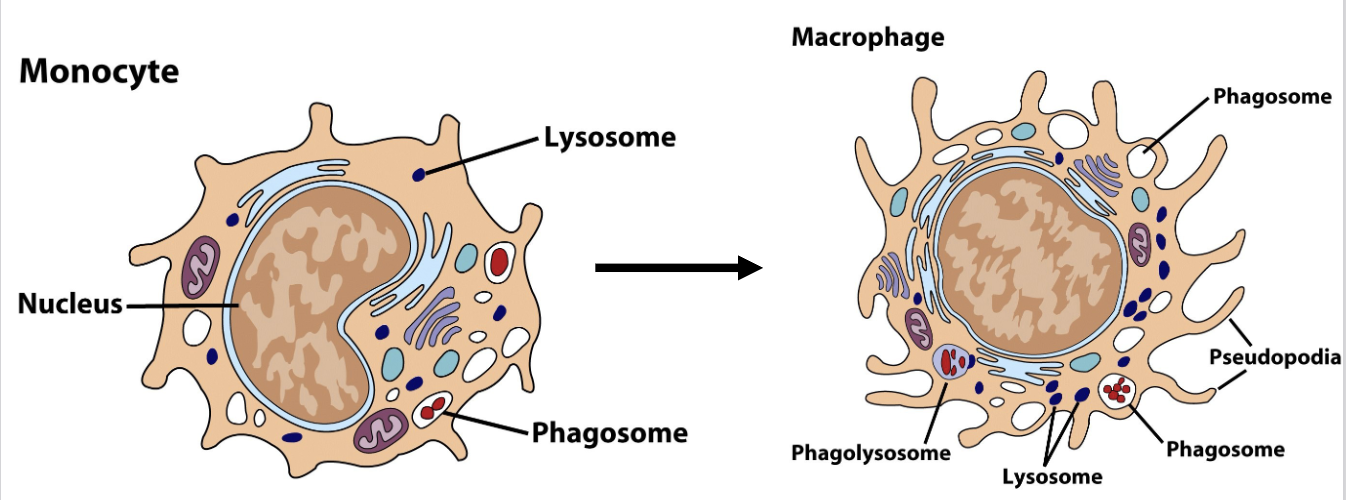
  • these cells begin as monocytes, circulating in blood for ~8 hours, then differentiating into amoeboid macrophages that “crawl” through tissues

  • When monocytes convert to macrophages, they become 5-10X bigger, gain more organelles, longer pseudopods and increased phagocytic capabilities

  • Macrophages can be immobile/fixed in a particular tissue or “wandering

  • Morphology = mononuclear with lots of pseudopods; 5-10% of blood cells
<ul><li><p>these cells begin as <strong>monocytes</strong>, circulating in blood for ~8 hours, then differentiating into amoeboid <strong>macrophages</strong> that “crawl” through tissues</p></li><li><p><span style="color: rgb(0, 0, 0);"><span>When monocytes convert to macrophages, they become 5-10X bigger, gain more organelles, longer pseudopods and increased phagocytic capabilities</span></span></p></li><li><p><span style="color: rgb(0, 0, 0);"><span>Macrophages can be </span><strong><span>immobile/fixed</span></strong><span> in a particular tissue or “</span><strong><span>wandering</span></strong><span>”</span></span></p></li><li><p><span style="color: rgb(0, 0, 0);"><span>Morphology = mononuclear with lots of pseudopods; 5-10% of blood cells</span></span></p></li></ul><p></p>
32
New cards

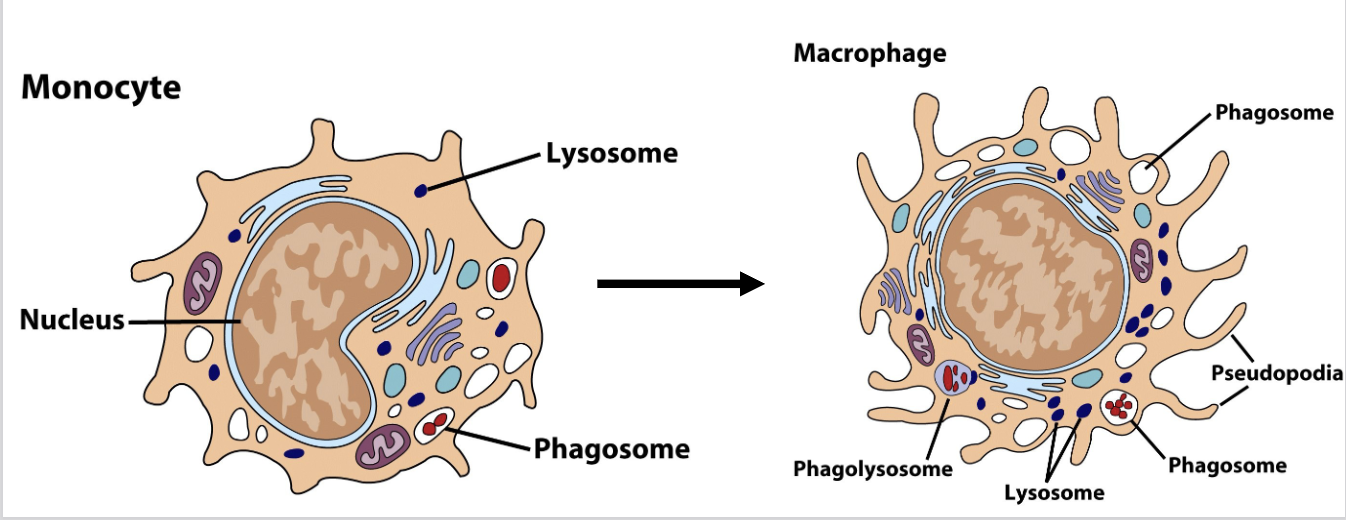
What are the differences in morphology between monocytes and macrophages?

Monocytes

  • bean-shaped nucleus

  • small pseudopods

  • a few lysosomes

  • phagosomes

Macrophage

  • round nucleus

  • aggressive, large pseudopods

  • many lysosomes

  • larger? phagosomes

  • phagolysosome

<p>Monocytes</p><ul><li><p>bean-shaped nucleus</p></li><li><p>small pseudopods</p></li><li><p>a few lysosomes</p></li><li><p>phagosomes</p></li></ul><p>Macrophage</p><ul><li><p>round nucleus</p></li><li><p>aggressive, large pseudopods</p></li><li><p>many lysosomes</p></li><li><p>larger? phagosomes</p></li><li><p>phagolysosome</p></li></ul><p></p>
33
New cards

Macrophages

  • what is primary role?

  • what triggers phagocytosis?

  • Fc receptors?

  • how do cytokines effect activity?

  • primary role is phagocytosis of pathogens, triggered by contact of pathogen with MØ pseudopods

  • MØ PRRs can bind to PAMPs, triggering phagocytosis as part of innate immune system response

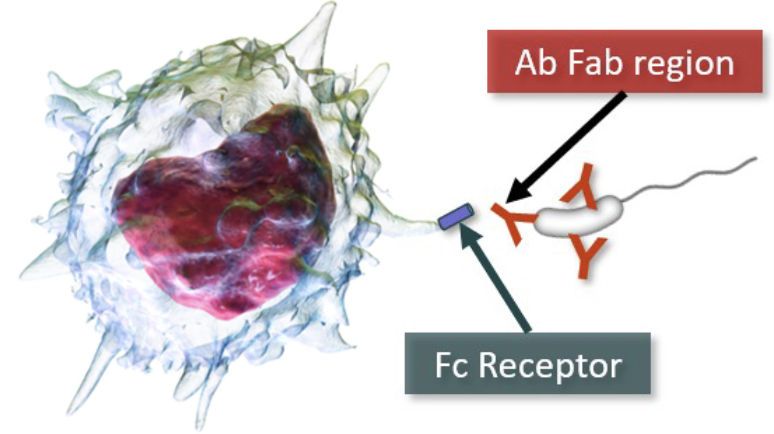
  • MØ also have Fc receptors that bind Ab bound to Ag and induce phagocytosis more effectively than PRRs

  • Cytokines greatly increase MØ activity, aggressiveness, and pseudopod action.
<ul><li><p>primary role is phagocytosis of pathogens, triggered by contact of pathogen with MØ pseudopods</p></li><li><p>MØ PRRs can bind to PAMPs, triggering phagocytosis as part of innate immune system response</p></li><li><p>MØ also have <strong>Fc receptors</strong> that bind Ab bound to Ag and induce phagocytosis more effectively than PRRs</p></li><li><p>Cytokines greatly increase MØ activity, aggressiveness, and pseudopod action.</p></li></ul><p></p>
34
New cards

Macrophages and Antigen Presentation

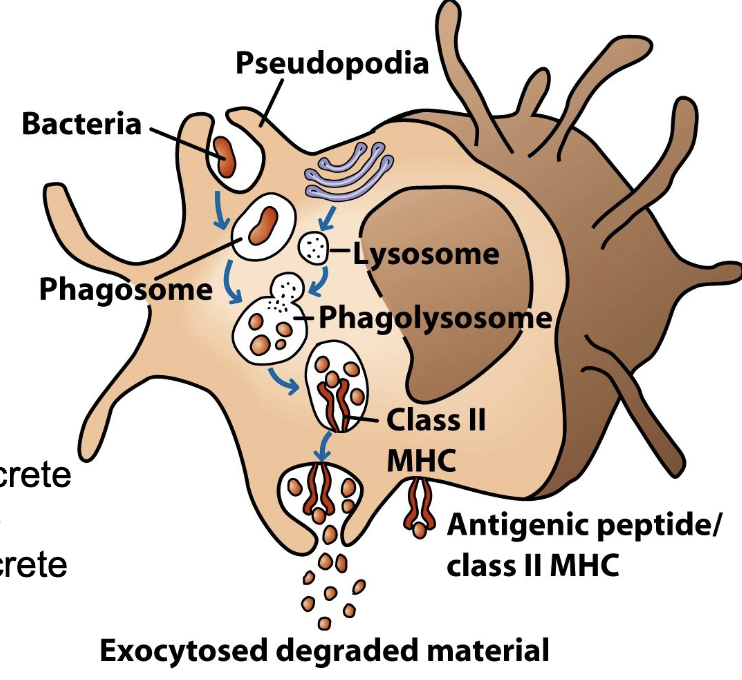
  • When MØ ingest pathogens, they fuse the phagosome/endosome with a lysosome to digest pathogen molecules

  • Remaining peptide fragments are bound into a Major Histocompatibility Complex (MHC) receptor and “displayed” to T-cells to initiate adaptive immunity

  • MØ displaying MHC/Ag are called Ag-Presenting Cells or APCs

  • APC MØs become more activated after engulfing pathogen and/or in response to cytokines

  • Increase phagocytic activity, secrete inflammatory molecules, produce antimicrobial substances and secrete chemokines that attract more leukocytes
<ul><li><p><span style="color: rgb(0, 0, 0);"><span>When </span></span><span style="color: rgb(0, 0, 0);"><span>MØ ingest pathogens, </span></span><span style="color: rgb(0, 0, 0);"><span>they fuse the </span><strong><span>phagosome</span></strong><span>/endosome with a </span><strong><span>lysosome</span></strong><span> to digest pathogen molecules</span></span></p></li><li><p><span style="color: rgb(0, 0, 0);"><span>Remaining peptide fragments are bound into a </span><strong><span>Major Histocompatibility Complex (MHC)</span></strong><span> receptor and “displayed” to T-cells to initiate adaptive immunity</span></span></p></li><li><p><span><span>MØ displaying MHC/Ag are called </span><strong><span>Ag-Presenting Cells or APCs</span></strong></span></p></li><li><p><span style="color: rgb(0, 0, 0);"><span>APC MØs become more activated after engulfing pathogen and/or in response to cytokines</span></span></p></li><li><p><span style="color: rgb(0, 0, 0);"><span>Increase phagocytic activity, secrete inflammatory molecules, produce antimicrobial substances and secrete </span><strong><span>chemokines</span></strong><span> that attract more leukocytes</span></span></p></li></ul><p></p>
35
New cards

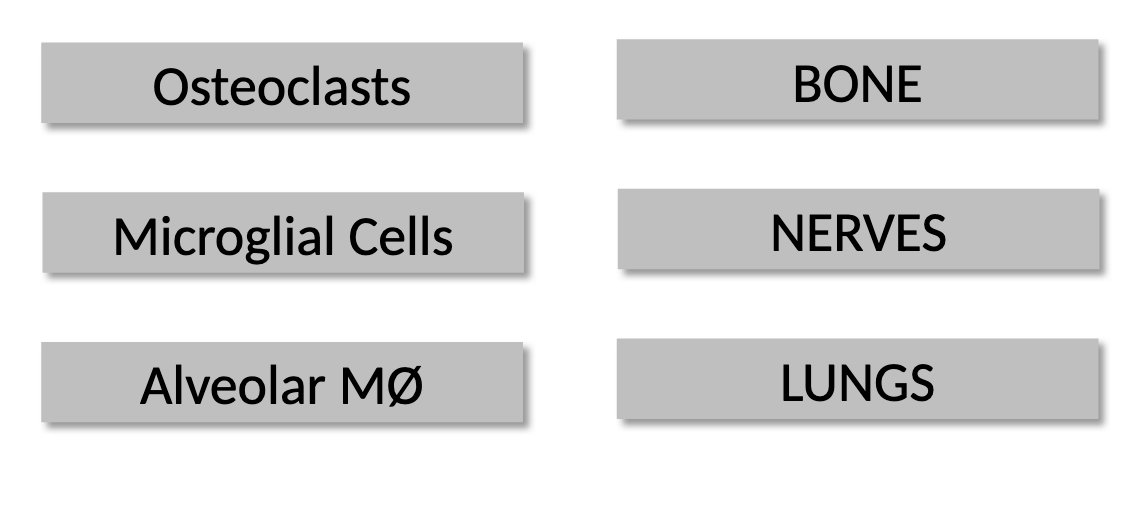
Are there many types of macrophages?

yes, they are given specific names based on function and tissue location
<p>yes, they are given specific names based on function and tissue location</p>
36
New cards

Granulocytes

A group of four cell types characterized by cytoplasmic granules of enzymes

  • inflammatory molecules and hormones that are released in response to infection.
<p>A group of four cell types characterized by cytoplasmic granules of <u>enzymes</u></p><ul><li><p>inflammatory molecules and hormones that are released in response to infection.</p></li></ul><p></p>
37
New cards

Neutrophils

  • how common are they?

  • morphology?

  • how do they engage with pathogens?

  • what do they respond to?

  • line of defense?

  • lifespan?

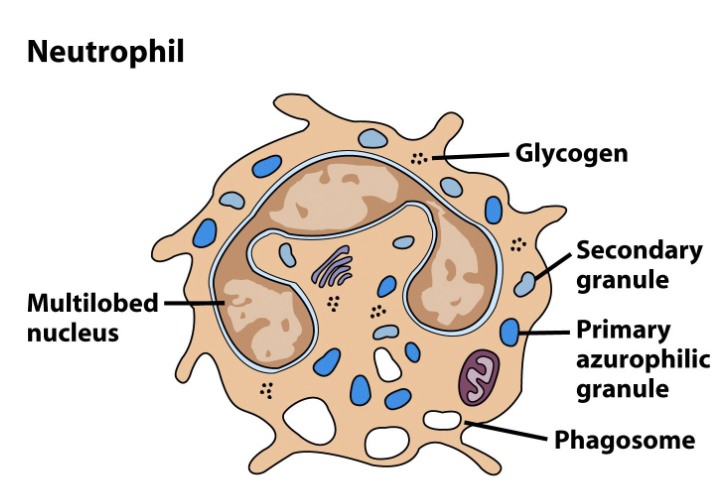
  • Most numerous leukocyte (50%-70%) and numbers increase quickly in response to infection (leukocytosis → high “white blood cell count”)

  • Morphology = multi-lobed nucleus (3-5 lobes) with granules & pseudopods

  • Engage pathogens via rapid and efficient phagocytosis and exocytosis of antimicrobial compounds, including lysozyme

  • Highly responsive to chemokines released by other leukocytes or by damaged tissues; neutrophils arrive at a damaged site within minutes

  • Simple, efficient and disposable, neutrophils are the first line of defense and use “swarm tactics” against pathogens

  • Very short lifespan (1-2 days) but produced in high numbers
<ul><li><p>Most numerous leukocyte (50%-70%) and numbers increase quickly in response to infection (<strong>leukocytosis</strong> → high “white blood cell count”)</p></li><li><p>Morphology = <strong>multi-lobed nucleus</strong> (3-5 lobes) with granules &amp; pseudopods</p></li><li><p>Engage pathogens via rapid and efficient phagocytosis and <strong>exocytosis</strong> of antimicrobial compounds, including lysozyme</p></li><li><p>Highly responsive to chemokines released by other leukocytes or by damaged tissues; neutrophils arrive at a damaged site within minutes</p></li><li><p>Simple, efficient and disposable, neutrophils are the first line of defense and use “swarm tactics” against pathogens</p></li><li><p>Very short lifespan (1-2 days) but produced in high numbers</p></li></ul><p></p>
38
New cards

Eosinophils

  • common?

  • what are they designed to fight?

  • morphology?

  • phagocytic activity?

  • allergies?

  • present in low numbers (1%-3%); motile leukocytes designed to fight multicellular parasites (helminths) by releasing digestive enzymes onto them

  • Morphology: bilobed nucleus & granules

  • Very minor phagocytic activity; not often employed

  • Cause of allergies in areas free of worm parasites
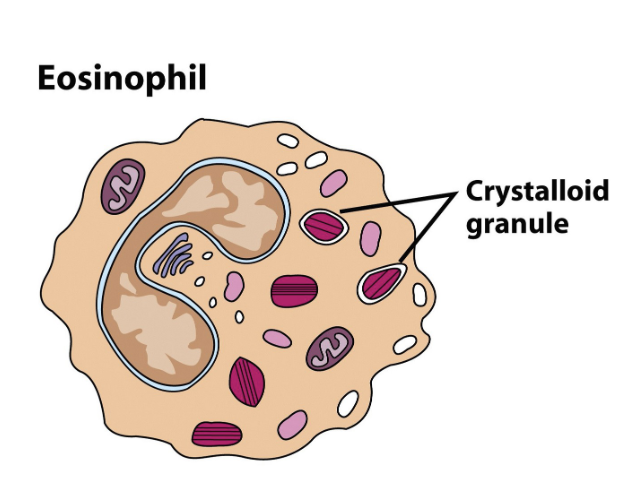
<ul><li><p>present in low numbers (1%-3%); motile leukocytes designed to fight multicellular parasites (helminths) by releasing digestive enzymes onto them</p></li><li><p>Morphology: bilobed nucleus &amp; granules</p></li><li><p>Very minor phagocytic activity; not often employed</p></li><li><p>Cause of allergies in areas free of worm parasites</p></li></ul><p></p>
39
New cards

Basophils

  • function?

  • what do they respond to?

  • regulatory?

  • Morphology?

  • common?

  • Release granules of inflammatory chemicals, serotonin & histamine, which increases vasodilation & blood flow to an area (recruits more leukocytes)

  • Responds in particular to helminths and ectoparasites (ticks); in their
    absence reacts to pollen & other allergens

  • Seems to be more of a regulatory cell, designed to attract & direct other leukocytes

  • MORPHOLOGY = Comma-shaped nucleus and granules, no pseudopods

  • Least common leukocyte (0.5-1.0% of total WBCs)
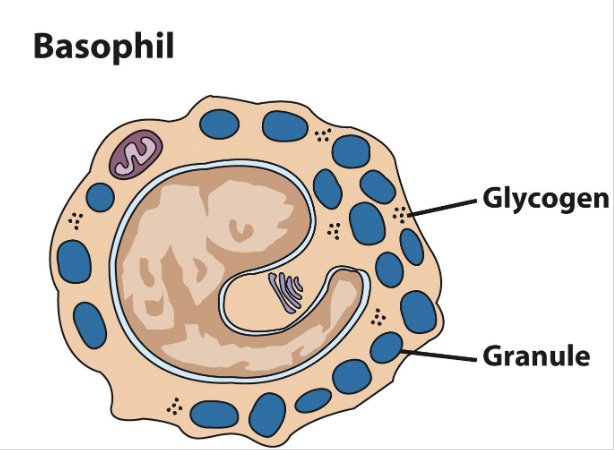
<ul><li><p><span style="color: rgb(0, 0, 0);"><span>Release granules of inflammatory chemicals, serotonin &amp; </span><strong><span>histamine</span></strong><span>, which increases vasodilation &amp; blood flow to an area (recruits more leukocytes)</span></span></p></li><li><p><span style="color: rgb(0, 0, 0);"><span>Responds in particular to helminths and ectoparasites (ticks); in their</span><span><br></span><span>absence reacts to pollen &amp; other allergens</span></span></p></li><li><p><span style="color: rgb(0, 0, 0);"><span>Seems to be more of a regulatory cell, designed to attract &amp; direct other leukocytes</span></span></p></li><li><p><span style="color: rgb(0, 0, 0);"><strong><span>MORPHOLOGY</span></strong><span> = Comma-shaped nucleus and granules, no pseudopods</span></span></p></li><li><p><span style="color: rgb(0, 0, 0);"><span>Least common leukocyte (0.5-1.0% of total WBCs)</span></span></p></li></ul><p></p>
40
New cards

Mast Cells

  • function?

  • function of the granules?

  • what do they cause? what can they aid in?

  • Morphology?

  • Circulate in the blood as undifferentiated cells, then enter the tissues and “implant” in a fixed location

  • Have cytoplasmic granules containing histamine, which are released in response to either chemical signals or physical stimulation (nerve signals)

  • Cause anaphylaxis, itchiness, hives, etc.

  • Also aid in wound healing and other processes

  • Morphology: mononuclear, very high concentrations of granules, pseudopods (sensory, not phagocytic)
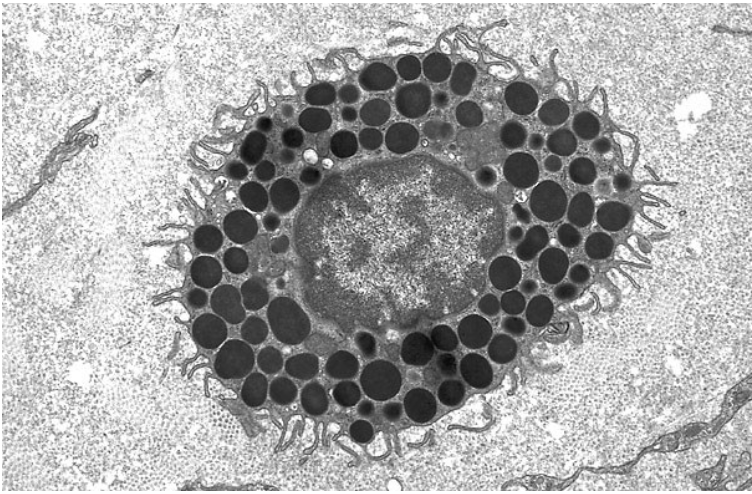
<ul><li><p>Circulate in the blood as undifferentiated cells, then enter the tissues and “implant” in a fixed location</p></li><li><p>Have cytoplasmic granules containing histamine, which are released in response to either chemical signals or physical stimulation (nerve signals)</p></li><li><p>Cause anaphylaxis, itchiness, hives, etc.</p></li><li><p>Also aid in wound healing and other processes</p></li><li><p><strong>Morphology</strong>: mononuclear, very high concentrations of granules, pseudopods (sensory, not phagocytic)</p></li></ul><p></p>
41
New cards

Lymphoid Cells

  • how many types stem from these?

  • how common are they?

  • three types of cells that stem from a common progenitor

  • collectively 20%-40% of blood WBCs and 99% of lymph WBCs

  • 1 trillion cells circulating in average adult human - lymphoid cells = 1% of cells in human body
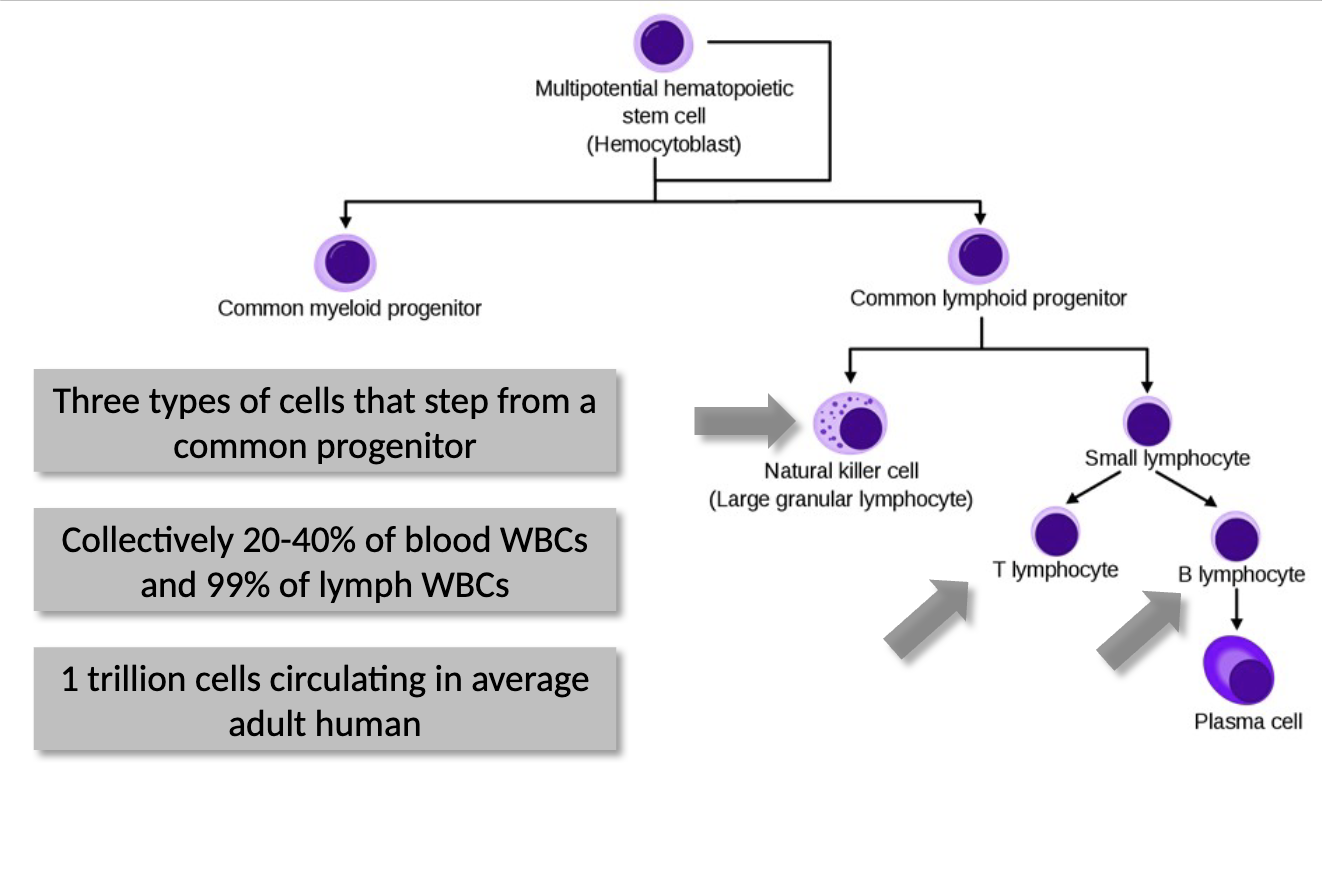
<ul><li><p>three types of cells that stem from a common progenitor</p></li><li><p>collectively 20%-40% of blood WBCs and 99% of lymph WBCs</p></li><li><p>1 trillion cells circulating in average adult human - lymphoid cells = 1% of cells in human body</p></li></ul><p></p>
42
New cards

B-Cells

  • where do they originate? when do they get their receptor assigned?

  • defining feature?

  • Naïve B-cell function?

  • plasma cell function?

  • memory cells?

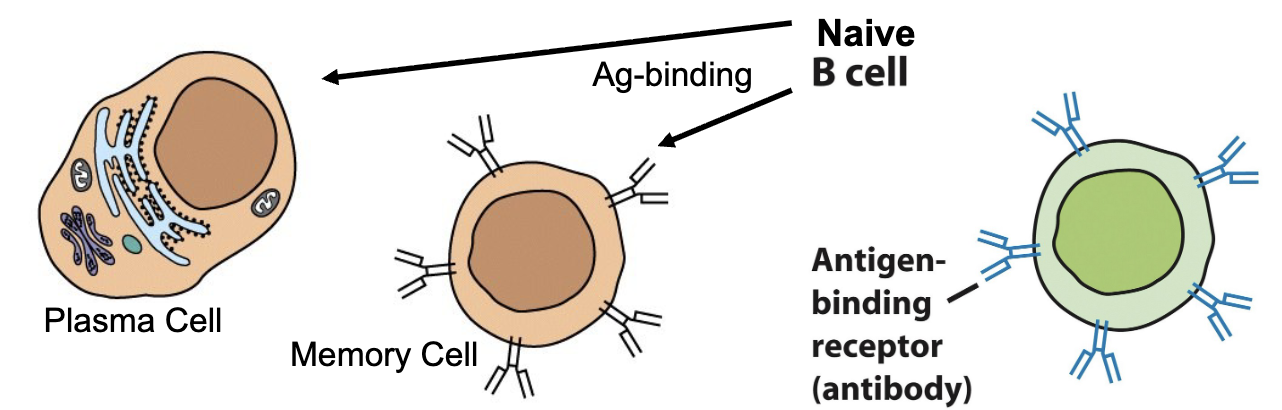
  • B-cells mature in the bone marrow; assigned their specific B-cell receptor

  • Defining feature = BCR (membrane-bound Ab, 150,000 per cell) can only be detectable chemically, not visibly

  • Naïve B-cells bind Ag, clonally expand via mitosis, and differentiate into plasma cells and memory cells

  • Plasma cells secrete 1000 Ab/sec, but have no membrane-bound Ab (live for 1-2 weeks, then apoptosis)

  • Memory cells are morphologically indistinguishable from naïve B-cells
<ul><li><p>B-cells mature in the bone marrow; assigned their specific <strong>B-cell receptor</strong></p></li><li><p>Defining feature = BCR (membrane-bound Ab, 150,000 per cell) can only be detectable chemically, not visibly</p></li><li><p><strong>Naïve B-cells </strong>bind Ag, clonally expand via mitosis, and differentiate into plasma cells and memory cells</p></li><li><p>Plasma cells secrete 1000 Ab/sec, but have no membrane-bound Ab (live for 1-2 weeks, then apoptosis)</p></li><li><p>Memory cells are morphologically indistinguishable from naïve B-cells</p></li></ul><p></p>
43
New cards
<p>B-cell and T-cell Morphology</p><ul><li><p>size? why?</p></li><li><p>cost-saver?</p></li><li><p>what phase are they stuck in?</p></li></ul><p></p>

B-cell and T-cell Morphology

  • size? why?

  • cost-saver?

  • what phase are they stuck in?

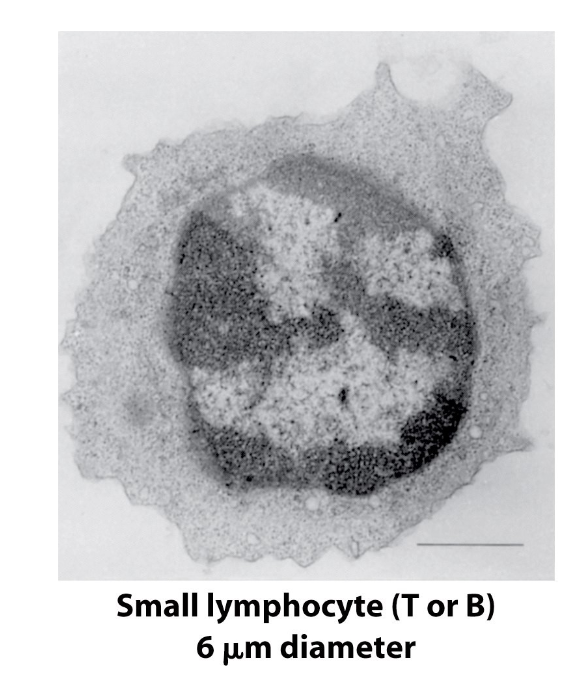
  • Naïve B-cells and T-cells are morphologically indistinguishable from each other, but are often called small lymphocytes because of their small size (~6 um)

  • This size is due to low # of organelles and generally low infrastructure (cell is mostly nucleus)

  • A cost-saving mechanism → no need to develop many organelles because naïve cells are dormant until they bind Ag

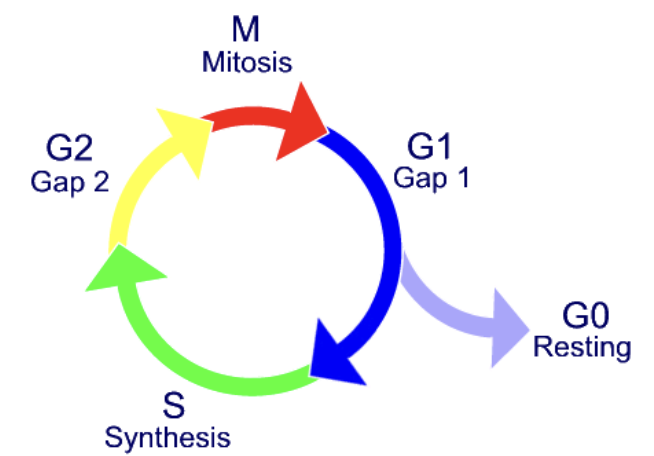
  • Naïve cells are stuck in G0 phase

<ul><li><p>Naïve B-cells and T-cells are morphologically indistinguishable from each other, but are often called <strong>small lymphocytes</strong> because of their small size (<strong>~6 um</strong>)</p></li><li><p>This size is due to low # of organelles and generally low infrastructure (cell is mostly nucleus)</p></li><li><p>A cost-saving mechanism → no need to develop many organelles because naïve cells are dormant until they bind Ag</p></li><li><p>Naïve cells are stuck in <strong>G<sub>0</sub> phase</strong></p></li></ul><p></p>
44
New cards
<p>Lymphocyte Differentiation</p><ul><li><p>what happens when small lymphocytes encounter Ag?</p></li><li><p>what do lymphoblasts do? What happens when they stop dividing?</p></li><li><p>what do effector cells have more of?</p></li></ul><p></p>

Lymphocyte Differentiation

  • what happens when small lymphocytes encounter Ag?

  • what do lymphoblasts do? What happens when they stop dividing?

  • what do effector cells have more of?

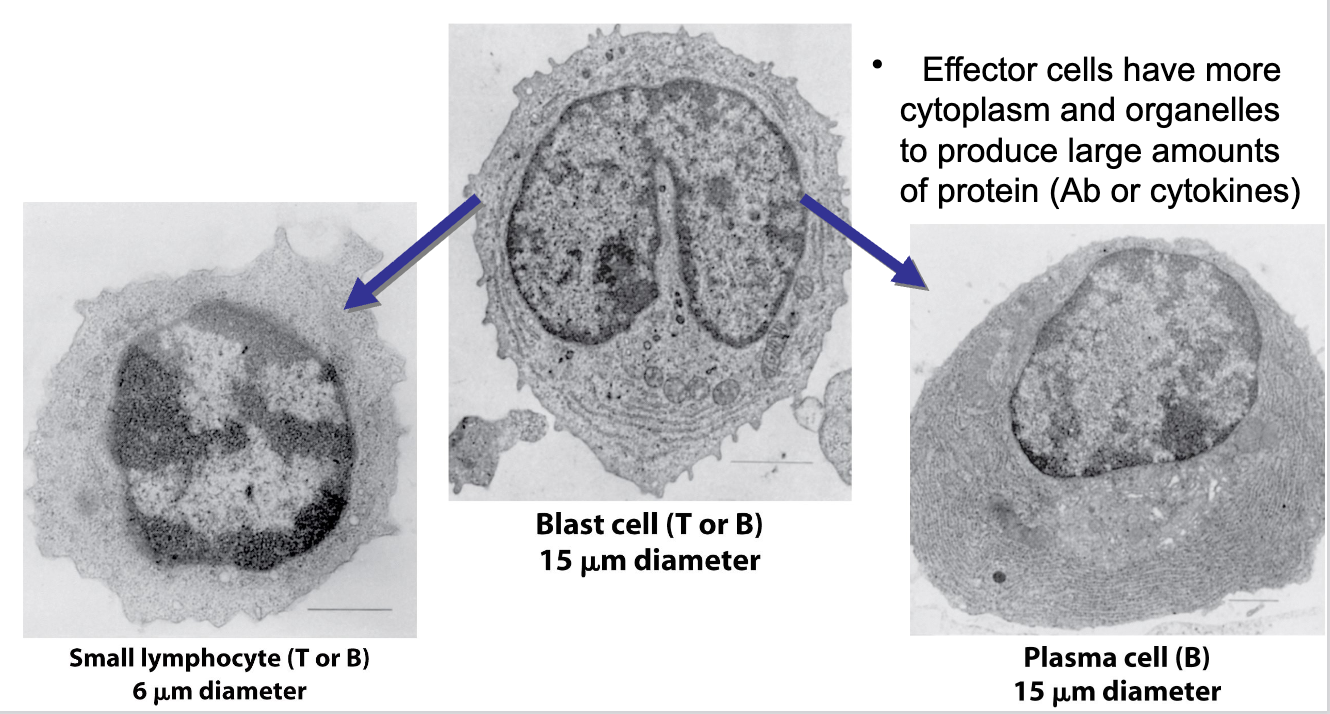
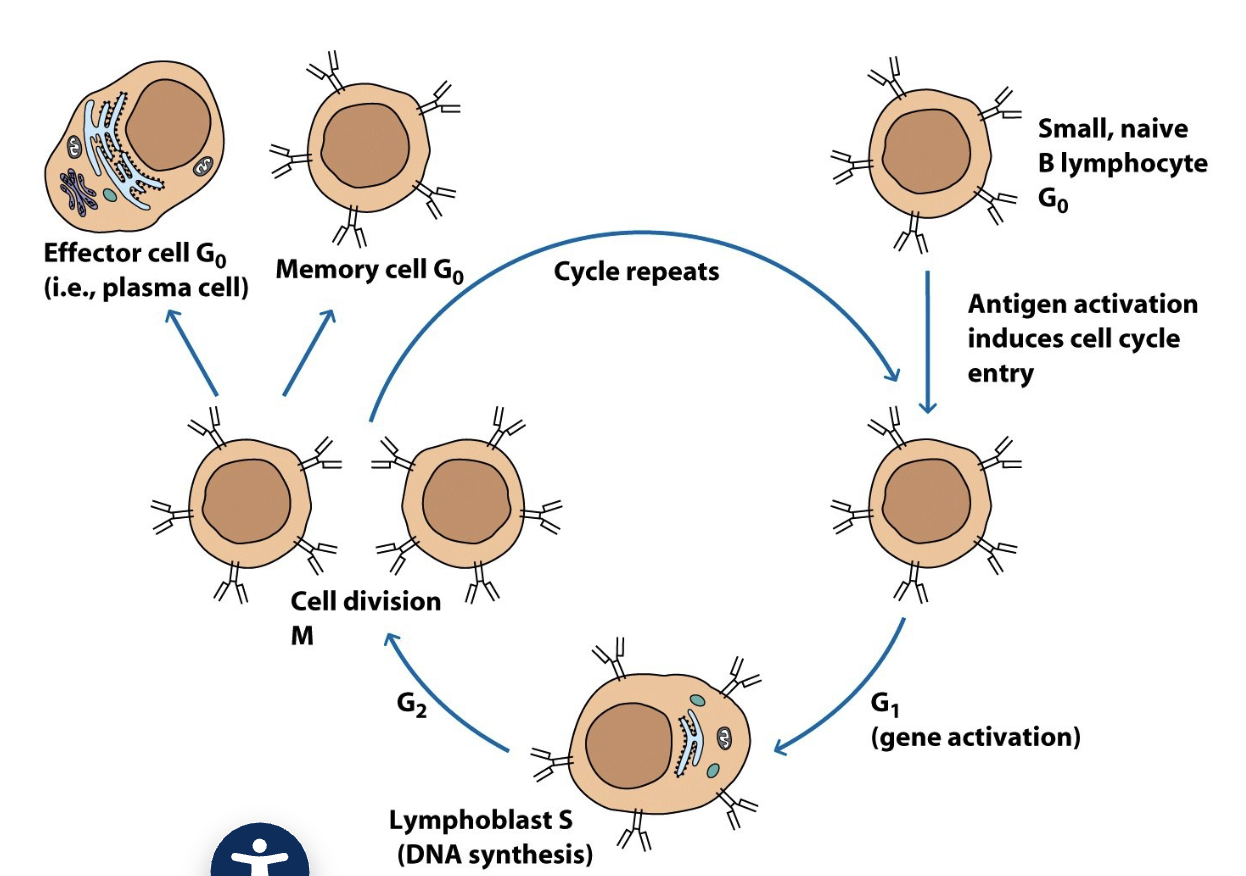
  • when small lymphocytes encounter Ag, they reenter the cell cycle and grow into a larger lymphoblast (~15 um) that has more extensive organelles

  • the lymphoblast divides many times and some cells cease dividing, becoming effector cells (plasma cell, or cytokine-secreting effector T-cell)

  • Effector cells have more cytoplasm and organelles to produce large amounts of protein (Ab or cytokines)

  • image applies to both B-cells and T-cells
<ul><li><p>when small lymphocytes encounter Ag, they reenter the cell cycle and grow into a larger <strong>lymphoblast</strong> (<strong>~15 um</strong>) that has more extensive organelles</p></li><li><p>the lymphoblast divides many times and some cells cease dividing, becoming <strong>effector cells</strong> (plasma cell, or cytokine-secreting <strong>effector T-cell</strong>)</p></li><li><p>Effector cells have more cytoplasm and organelles to produce large amounts of protein (Ab or cytokines)</p></li><li><p>image applies to both B-cells and T-cells</p></li></ul><p></p>
45
New cards

T-cells

  • difference between naïve T-cells and B-cells?

  • where do T-cells mature? where is the TCR assigned?

  • How do TCRs bind?

  • How many MHC classes are there?

  • Naïve T-cells are similar to B-cells in many ways except that they have the TCR instead of membrane-bound Ab

  • A T-cell matures in the thymus gland and is assigned its Ag-specific TCR

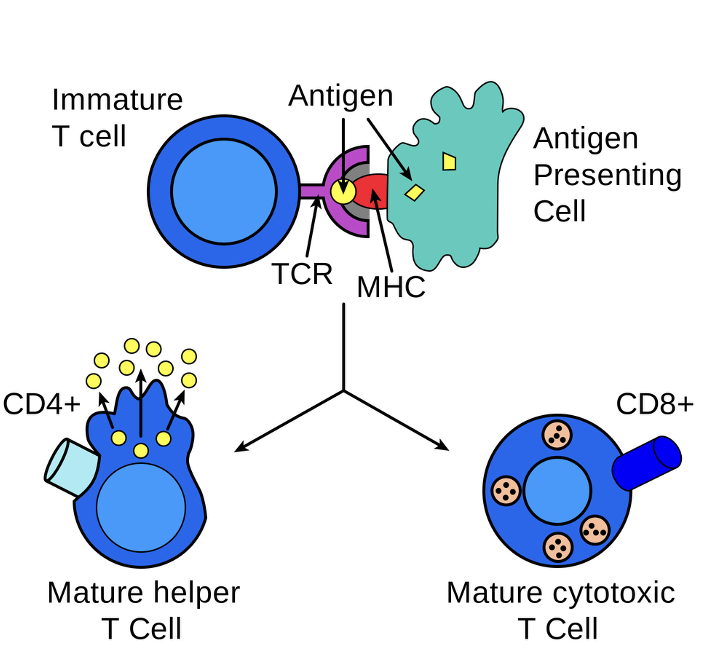
  • TCR can only bind Ag peptide fragments presented in an MHC receptor by an Ag-Presenting Cell (APC)

  • There are 2 classes of MHC receptors, one for TH cells and one for TC cells.

46
New cards

MHC Class I

  • expressed by (nearly) all animal cells.

  • When a cell becomes infected with a virus, it displays viral Ag bound by MHC-I as a “warning”.

  • TC cells detect these Ag/MHC-I complexes

47
New cards

MHC Class II

  • Expressed only by antigen presenting cells (APCs).

  • when certain leukocytes engulfs a pathogen, it displays Ag bound by MHC-II on its surface and is called an APC

48
New cards

T-Cells

  • what do TH cells bind to and do?

  • what do TC cells bind to and do?

  • which glycoproteins do each type of T-cell use? what are their functions?

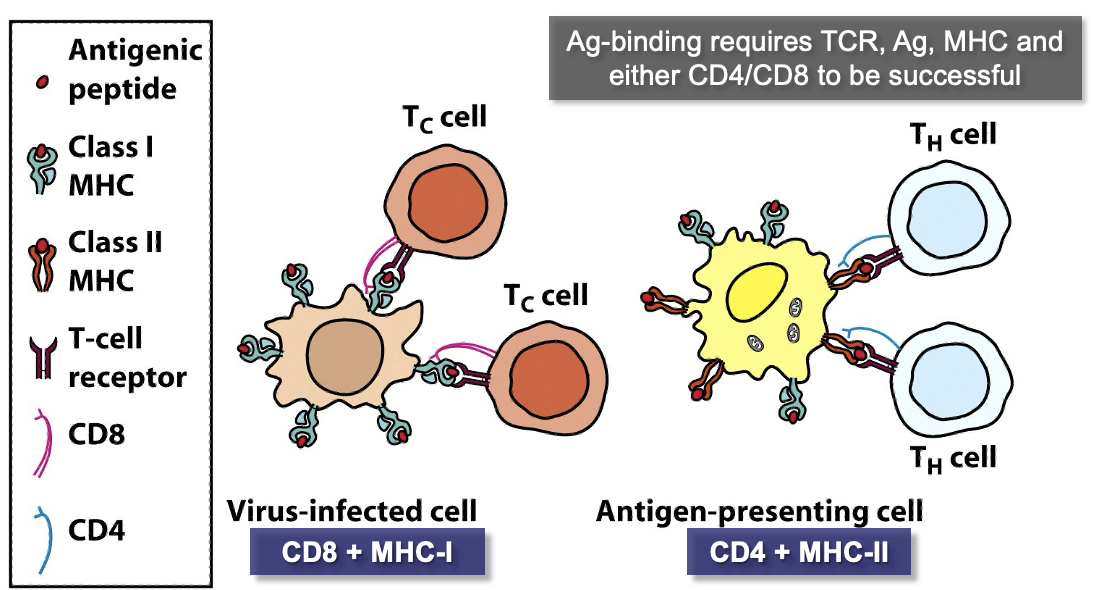
  • TH cells bind Ag/MHC-II on APCs, then start secreting cytokines

  • TC cells bind to Ag/MHC-I on virally infected cells; then differentiate into CTLs and initiate apoptosis in infected cells

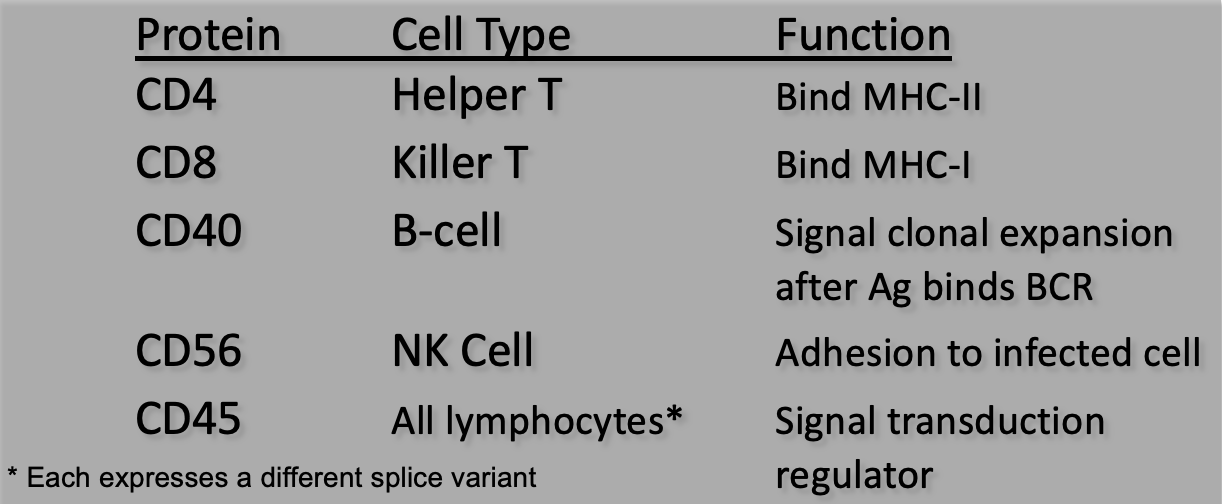
  • TH cells have the glycoprotein CD4 that enables them to recognize Ag bound to MHC-II only; TC cells have CD8 that recognizes only MHC-I
<ul><li><p><span><span>T</span><sub><span>H</span></sub><span> cells bind </span><strong><span>Ag/MHC-II</span></strong><span> on APCs, then start secreting cytokines</span></span></p></li><li><p><span><span>T</span><sub><span>C</span></sub><span> cells bind to </span><strong><span>Ag/MHC-I </span></strong><span>on virally infected cells; then differentiate into CTLs and initiate apoptosis in infected cells</span></span></p></li><li><p><span><span>T</span><sub><span>H</span></sub><span> cells have the glycoprotein </span><strong><span>CD4</span></strong><span> that enables them to recognize Ag bound to MHC-II only; T</span><sub><span>C</span></sub><span> cells have </span><strong><span>CD8</span></strong><span> that recognizes only MHC-I</span></span></p></li></ul><p></p>
49
New cards

T-Cell Subtypes

  • what are TH cell subtypes typically involved in? what do they secrete?

  • What do regulatory T-cells secrete? what are they important for?

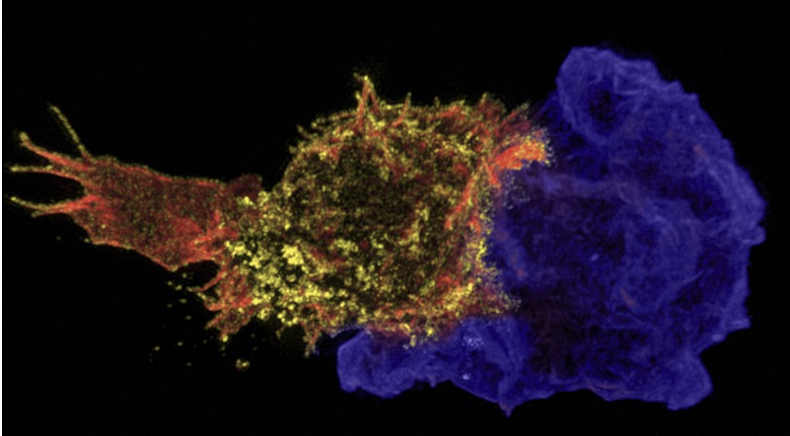
  • TC cells have only one major type, but TH cells have multiple subtypes

  • Several subtypes are involved in response to specific types of pathogens & secrete types of pro-inflammatory cytokines suited to fighting a certain pathogen

  • Regulatory T-cells secrete anti-inflammatory cytokines and are important in ended an immune response or preventing an improper immune reaction
<ul><li><p><span><span>T</span><sub><span>C</span></sub><span> cells have only one major type, but T</span><sub><span>H</span></sub><span> cells have multiple subtypes</span></span></p></li><li><p><span><span>Several subtypes are involved in response to specific types of pathogens &amp; secrete types of </span><strong><span>pro-inflammatory cytokines</span></strong><span> suited to fighting a certain pathogen</span></span></p></li><li><p><span><span>Regulatory T-cells secrete </span><strong><span>anti-inflammatory cytokines</span></strong><span> and are important in ended an immune response or preventing an improper immune reaction</span></span></p></li></ul><p></p><p></p>
50
New cards

Ag-Presenting Cells

  • what 3 types of cells can be APCs?

  • What do B-cells present to?

  • what do MØs present to?

  • Only three types of cells can be APCs: Macrophages (MØs), B-cells & Dendritic Cells (DCs)

  • B-cells bind Ag & present it to T-cells before they undergo expansion & differentiation into plasma cells

  • MØs present to T-cells after phagocytosis, DCs after pinocytosis

  • Most Ag is presented in MHC-II to a TH cell, but viral Ag is presented in MHC-I to “kickstart” TC expansion & differentiation into CTLs
<ul><li><p><span><span>Only </span><u><span>three types of cells</span></u><span> can be APCs: Macrophages (MØs), B-cells &amp; Dendritic Cells (DCs)</span></span></p></li><li><p><span><span>B-cells bind Ag &amp; present it to T-cells before they undergo expansion &amp; differentiation into plasma cells</span></span></p></li><li><p><span><span>MØs present to T-cells after phagocytosis, DCs after pinocytosis</span></span></p></li><li><p><span><span>Most Ag is presented in MHC-II to a T</span><sub><span>H</span></sub><span> cell, but viral Ag is presented in MHC-I to “kickstart” T</span><sub><span>C</span></sub><span> expansion &amp; differentiation into CTLs</span></span></p></li></ul><p></p>
51
New cards

Lymphocyte Cell Surface Molecules

  • are the surface proteins the same at every stage?

  • what are the surface proteins denoted as?

  • what functions do CD proteins serve?

  • are they specific to one cell type?

  • Lymphocytes of a particular type, at a given stage of development, have specific glycoproteins on their cell surface

  • These proteins are denoted CD for cluster of differentiation (old term)

  • Each CD protein has a specific cell function (often signaling)

  • Some CD proteins are specific to one cell type, others are found on several
<ul><li><p><span><span>Lymphocytes of a particular type, at a given stage of development, have specific glycoproteins on their cell surface</span></span></p></li><li><p><span><span>These proteins are denoted CD for </span><u><span>c</span></u><span>luster of </span><u><span>d</span></u><span>ifferentiation (old term)</span></span></p></li></ul><ul><li><p><span><span>Each CD protein has a specific cell function (often signaling)</span></span></p></li><li><p><span><span>Some CD proteins are specific to one cell type, others are found on several</span></span></p></li></ul><p></p>
52
New cards

Natural Killer Cells

  • do they bind specific Ag?

  • what is their function?

  • what are the two methods of detection?

  • what are natural killer t-cells?

  • Although lymphoid cells, these do not bind specific Ag and are part of the innate immune system

  • NK cells roam & perform “surveillance” to detect abnormal cells (virally) infected or cancerous) & destroy them

  • Two methods of detection:

  1. Detect abnormalities on the cell’s surface (lack of normal receptors like MHC-I, or tumor-specific markers)

  2. Bind antiviral or anti-tumor antibodies on the cell surface

  • Morphology = large, granular lymphocyte, pseudopods for “touching” cell surfaces

  • Natural Killer T-cells (NKT) are a subgroup with TCRs that detect lipid and glycolipid Ag
53
New cards
<p>Dendritic Cells</p><ul><li><p>what kind of extensions do they have?</p></li><li><p>where are they found? what is their function?</p></li><li><p>how do they handle pathogens?</p></li><li><p>what happens when they engulf pathogens?</p></li><li><p>where do they present Ag?</p></li></ul><p></p>

Dendritic Cells

  • what kind of extensions do they have?

  • where are they found? what is their function?

  • how do they handle pathogens?

  • what happens when they engulf pathogens?

  • where do they present Ag?

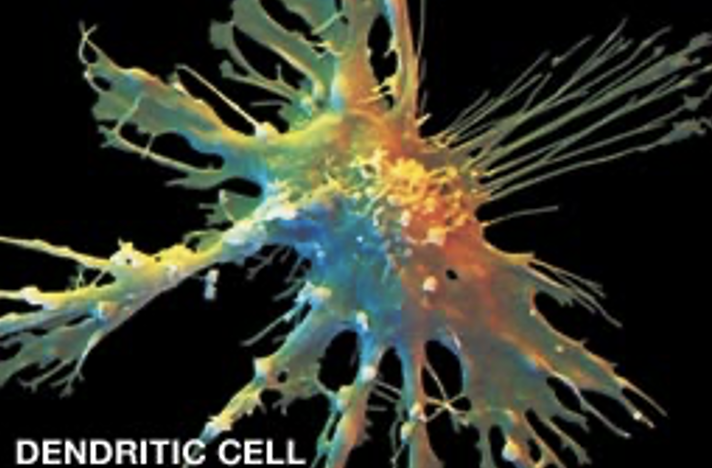
  • Have long, membranous extensions, similar to nerve cell dendrites; very flexible and able to extend/retract

  • Found in the tissues of major organs, filtering/sampling blood & lymph as it flows through tissues

  • Engulf pathogens by phagocytosis or pinocytosis (can “drink” its own volume in fluids every hour)

  • When they engulf pathogens, dendritic cells become APCs

  • As APCs, they move from tissues into the bloodstream

  • Move to the lymphoid tissues (e.g. lymph nodes) to present Ag to T-cells

54
New cards

Hematopoiesis

  • DCs can derive from myeloid or lymphoid progenitors

  • Subtle differences btw myeloid and lymphoid DCs
<ul><li><p>DCs can derive from myeloid or lymphoid progenitors</p></li><li><p>Subtle differences btw myeloid and lymphoid DCs</p></li></ul><p></p>
55
New cards

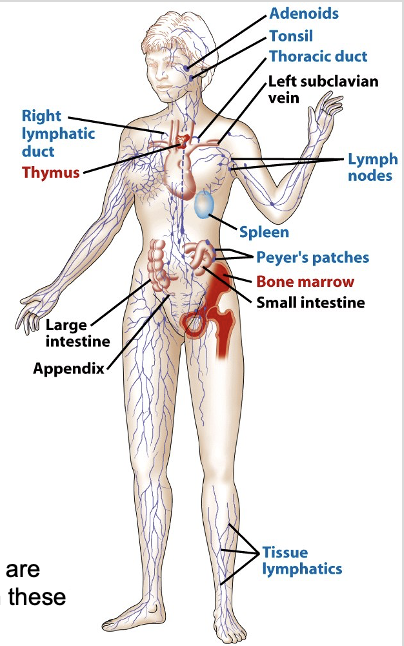
Immune System Organs

  • what are the primary lymphoid organs? the secondary?

  • what are their functions?

  • why are the blood and lymphatic system important?

PRIMARY LYMPHOID ORGANS: are sites where lymphocytes mature and gain their specific Ag-receptors

  • bone marrow

  • thymus

SECONDARY LYMPHOID ORGANS: provide sites where lymphocytes and Ag are forced together

  • lymph nodes

  • spleen

  • mucosal lymphoid tissue

  • The blood stream and lymphatic system are critical for moving cells & Ag to and from these organs
<p><span><strong><span>PRIMARY LYMPHOID ORGANS:</span></strong><span> are sites where lymphocytes mature and gain their specific Ag-receptors</span></span></p><ul><li><p>bone marrow</p></li><li><p>thymus</p></li></ul><p><span><strong><span>SECONDARY LYMPHOID ORGANS:</span></strong><span> provide sites where lymphocytes and Ag are forced together</span></span></p><ul><li><p>lymph nodes</p></li><li><p>spleen</p></li><li><p>mucosal lymphoid tissue</p></li></ul><p></p><ul><li><p><span><span>The blood stream and lymphatic system are critical for moving cells &amp; Ag to and from these organs</span></span></p></li></ul><p></p>
56
New cards

Bone Marrow

  • what are stromal cells? function?

  • what are osteoblasts? function?

  • where do differentiated cells go?

  • what is unique about immune cell cytoskeletons?

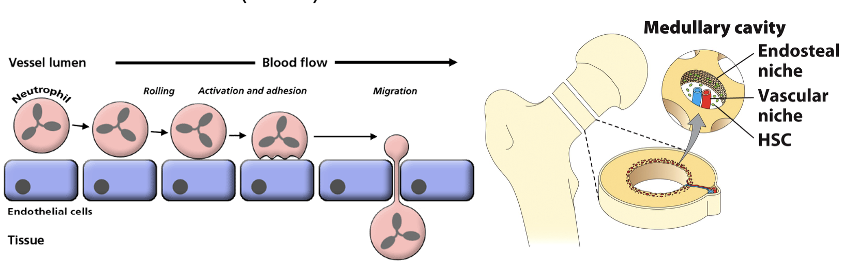
  • Stromal cells express soluble cytokines & membrane-bound proteins that promote HSC proliferation & differentiation (a stem cell niche)

  • Osteoblasts in the endosteal niche produce bone tissue and also direct the mitosis & differentiation of HSCs

  • As cells differentiate, they migrate into the vascular niche and enter blood vessels

  • Immune cells have very pliable cytoskeletons to extravasate in and out of blood vessels; cell adhesion molecules (CAMs) assist
<ul><li><p><span><strong><span>Stromal cells</span></strong><span> express soluble cytokines &amp; membrane-bound proteins that promote HSC proliferation &amp; differentiation (a </span><strong><span>stem cell niche</span></strong><span>)</span></span></p></li><li><p><span><strong><span>Osteoblasts</span></strong><span> in the </span><strong><span>endosteal niche</span></strong><span> produce bone tissue and also direct the mitosis &amp; differentiation of HSCs</span></span></p></li><li><p><span><span>As cells differentiate, they migrate into the </span><strong><span>vascular niche </span></strong><span>and enter blood vessels</span></span></p></li><li><p><span><span>Immune cells have very pliable cytoskeletons to </span><strong><span>extravasate</span></strong><span> in and out of blood vessels; </span><strong><span>cell adhesion molecules (CAMs) </span></strong><span>assist</span></span></p></li></ul><p></p>
57
New cards

Bone Marrow

  • what are reticular cells? function?

  • what are sympathetic neurons?

  • where do all leukocytes (except T-cells) mature?

  • how does maturation occur?

  • How do B-cells develop? where do they mature?

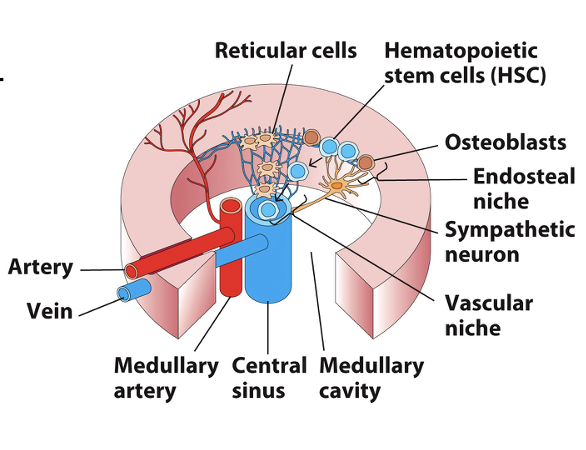
  • Reticular cells form connections between osteoblasts of the endosteal niche and endothelial cells lining blood vessels

  • Sympathetic neurons stimulate/regulate release of blood cells

  • All leukocytes, except T-cells, fully mature in bone marrow

  • Maturation occurs on a gradient as cells proceed towards blood vessels

  • B-cells are assigned their specific Ag-receptor (BCR) as they develop & self-reactive B-cells are destroyed

  • B-cell maturation occurs in the bone marrow for humans and mice, but not other animals

  • Fetal spleen and gut lymphoid tissue are common sites
<ul><li><p><span><strong><span>Reticular cells</span></strong><span> form connections between osteoblasts of the endosteal niche and endothelial cells lining blood vessels</span></span></p></li><li><p><span><strong><span>Sympathetic neurons</span></strong><span> stimulate/regulate release of blood cells</span></span></p></li><li><p><span><span>All leukocytes, except T-cells, fully mature in bone marrow</span></span></p></li><li><p><span><span>Maturation occurs on a gradient as cells proceed towards blood vessels</span></span></p></li></ul><ul><li><p><span><span>B-cells are assigned their specific Ag-receptor (BCR) as they develop &amp; self-reactive B-cells are destroyed</span></span></p></li><li><p><span><span>B-cell maturation occurs in the bone marrow for humans and mice, but not other animals</span></span></p></li><li><p><span><span>Fetal spleen and gut lymphoid tissue are common sites</span></span></p></li></ul><p></p>
58
New cards

Thymus Gland

  • what is the thymus

  • what are T-cells produced from?

  • what are lobules made of?

  • what are thymocytes? where are they? why do they diminish?

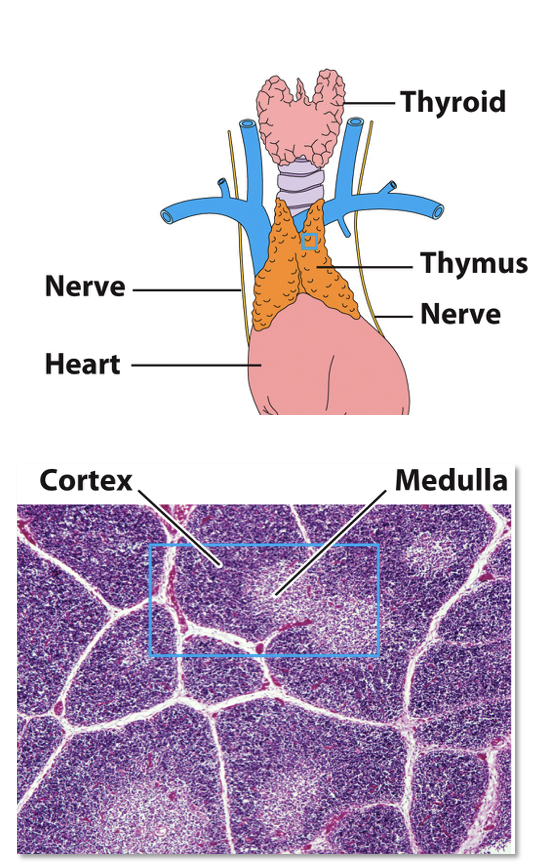
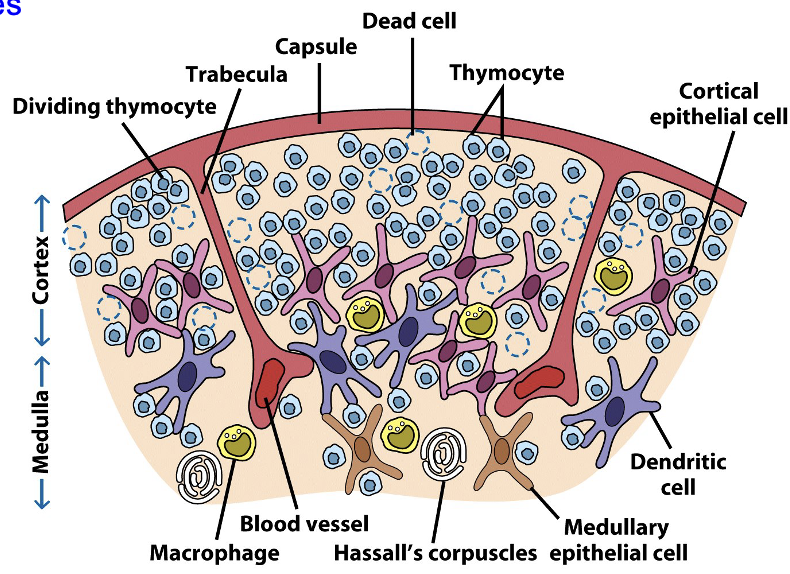
  • Bi-lobed, surrounded by a capsule and divided into lobules

  • T-cells are produced from HSCs in the bone marrow, but mature here

  • Each lobule has an outer cortex, containing many immature T-cells (thymocytes), and an inner medulla, which contains sparse thymocytes

  • Thymocytes arrive in the cortex and then migrate inward to the medulla, departing via medullary blood vessels

  • Thymocyte numbers diminish due to negative selection that destroys those that are potentially self-reactive
<ul><li><p><span><span>Bi-lobed, surrounded by a capsule and divided into </span><strong><span>lobules</span></strong></span></p></li><li><p><span><span>T-cells are produced from HSCs in the bone marrow, but mature here</span></span></p></li><li><p><span><span>Each lobule has an outer </span><strong><span>cortex</span></strong><span>, containing many immature T-cells (</span><strong><span>thymocytes</span></strong><span>), and an inner </span><strong><span>medulla</span></strong><span>, which contains sparse thymocytes</span></span></p></li><li><p><span><span>Thymocytes arrive in the cortex and then migrate inward to the medulla, departing via medullary blood vessels</span></span></p></li><li><p><span><span>Thymocyte numbers diminish due to </span><strong><span>negative selection </span></strong><span>that destroys those that are potentially self-reactive</span></span></p></li></ul><p></p>
59
New cards

Thymus Gland

  • what happens as T-cells mature?

  • what do cortical and medullary thymic epithelial cells do?

  • what happens to self-reactive thymocytes?

  • what do Hassall’s corpuscles do?

  • As T-cells mature in the thymus, they begin expressing their Ag-specific TCR

  • Cortical and medullary thymic epithelial cells (TECs) & dendritic cells interact with thymocytes, promoting development & testing them for self-reactivity

  • Self-reactive thymocytes undergo apoptosis and macrophages engulf the resulting apoptotic bodies

  • Surviving thymocytes development into fully mature T-cells

  • Hassall’s corpuscles secrete cytokines to aid development and possibly test thymocytes for self-tolerance
<ul><li><p><span><span>As T-cells mature in the thymus, they begin expressing their Ag-specific TCR</span></span></p></li></ul><ul><li><p><span><strong><span>Cortical</span></strong><span> and </span><strong><span>medullary thymic epithelial cells (TECs)</span></strong><span> &amp; dendritic cells interact with thymocytes, promoting development &amp; testing them for self-reactivity</span></span></p></li><li><p><span><span>Self-reactive thymocytes undergo apoptosis and macrophages engulf the resulting </span><strong><span>apoptotic bodies</span></strong></span></p></li><li><p><span><span>Surviving thymocytes development into fully </span><strong><span>mature T-cells</span></strong></span></p></li><li><p><span><strong><span>Hassall’s corpuscles</span></strong><span> secrete cytokines to aid development and possibly test thymocytes for self-tolerance</span></span></p></li></ul><p></p>
60
New cards

T-Cell Maturation Overview

  • 95% of thymocytes fail selection, either because the TCR doesn’t bind Ag/MHC properly or because it cross-reacts with self-Ag

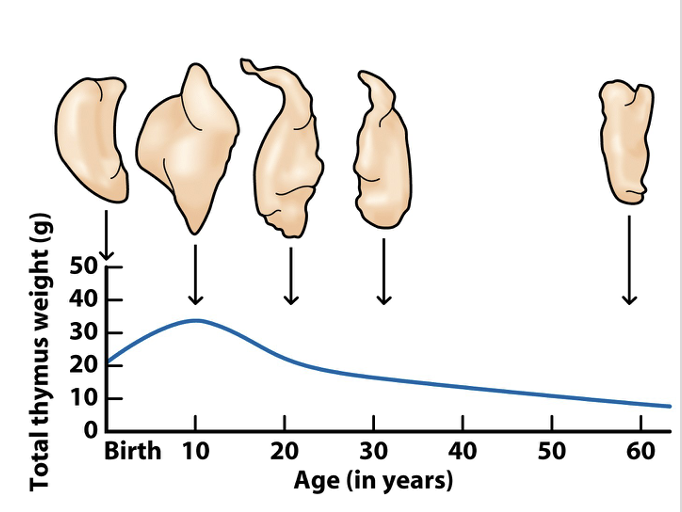
  • The thymus atrophies with age and T-cell production slows (at age 65, only 2% T-cell production)

  • The thymus is one of several glands (e.g. tonsils, appendix) once thought to be vestigial & useless because function wasn’t understood
<ul><li><p><span><span>95% of thymocytes fail selection, either because the TCR doesn’t bind Ag/MHC properly or because it cross-reacts with </span><strong><span>self-Ag</span></strong></span></p></li><li><p><span><span>The thymus atrophies with age and T-cell production slows (at age 65, only 2% T-cell production)</span></span></p></li><li><p style="text-align: left;"><span><span>The thymus is one of several glands (e.g. tonsils, appendix) once thought to be vestigial &amp; useless because function wasn’t understood</span></span></p></li></ul><p></p>

Explore top flashcards

WHAP - UNIT 7
Updated 310d ago
flashcards Flashcards (164)
Cations & Anions
Updated 159d ago
flashcards Flashcards (62)
Chapter1-Unit1
Updated 990d ago
flashcards Flashcards (25)
Anatomy 1
Updated 360d ago
flashcards Flashcards (134)
Q1 VOCAB
Updated 844d ago
flashcards Flashcards (122)
WHAP - UNIT 7
Updated 310d ago
flashcards Flashcards (164)
Cations & Anions
Updated 159d ago
flashcards Flashcards (62)
Chapter1-Unit1
Updated 990d ago
flashcards Flashcards (25)
Anatomy 1
Updated 360d ago
flashcards Flashcards (134)
Q1 VOCAB
Updated 844d ago
flashcards Flashcards (122)