P-Memory
 Call Kai
 Learn
Learn Practice Test
 Spaced Repetition
 Match
Match Flashcards
 Knowt Play
1/94

Earn XP
Description and Tags
Name | Mastery | Learn | Test | Matching | Spaced | Call with Kai |
|---|
No analytics yet
Send a link to your students to track their progress
95 Terms
definition of memory
the process of retaining information after the original stimulus has passed through the processes of encoding storage and retrieval
definition of encoding
putting something into a code, used to store in memory, creating a memory trace
definition of storage
as a result of encoding, information is stored in memory
definition of retrieval
recovering stored information from the memory system
who made the multistore model of memory?
Atkinson and Shiffrin 1968
what are the stages of the multistore model of memory?
environmental stimulus
sensory register
2.1 attention
2.2 lost through trace decay
short term memory
3.1 stays through maintenance rehearsal
3.2 lost through interference displacement
long term memory
4.1 elaborative rehearsal
4.2 information retrieval
4.3 lost through cue retrieval failure
sensory register
takes information from one of the sense organs and holds it there
sensory register encoding
sense specific: iconic(visual), echoic(auditory), gustatory(taste), haptic(tactile), olfactory(smell)
sensory register duration
fractions of a second after stimulus is unavailable
sensory register capacity
all sensory information
sensory register - key research
Crowder 1993 - iconic duration few milliseconds, echoic 2-3 seconds
Sperling 1960 - grid of letters <1s, recalled avg. 4, up to 10, duration<=2
Walsh+Thomas 1978 - iconic avg. 500 milliseconds, decrease with age
short term memory
temporary storage of information
stm encoding
Baddeley ‘66:
P- 75 ppts, acoustically similar/dissimilar list, semantically similar/dissimilar list F- number of substitution errors higher for acoustically similar, no difference for semantic
C- information encoded acoustically
stm duration
Peterson & Peterson ‘59:
A- information not rehearsed is lost rapidly
P- 24 ppt, Brown-Peterson technique, 3 consonant trigram, count back in 3s from random 3 digit number for intervals of 3 up to 18 until serial recall
F- 18s, <10% recall
C- duration 18-20s
stm capacity
LIMITED
Jacobs ‘87: P- random digits and letters, serial recall, 445F ppts; F- 5 to 9
Miller ‘56: 7±2, chunk=one space
Simon ‘74: chunking confirmed, number of chunks varies on material
long term memory
permanent store with unlimited capacity
ltm encoding
Baddeley ‘66: most errors with semantically similar, acoustic no different
conclusion: information encoded semantically
ltm duration
Bahrick ‘75:
A- duration of VLTM
P- 392 American students 17-74, uses year books
tests: free recall names, photo recognition, name recognition, match face and name
F- 90% accurate recognition, after 48yrs 80% name and 40% face; free recall 60% after 15yrs, 30% after 48yrs
C- duration potentially forever, recognition is better than recall
ltm capacity
UNLIMITED
Anokhin ‘78: potentially 1×1010.5km of 0s neural connections
Types of long term memory
Cohen and Squire 1980
procedural
declarative
Tulving 1972
episodic
semantic
Procedural LTM
Knowing how
e.g. motor skills, cognitive skills, brushing teeth
only consciously recalled during early stages of learning
Declarative LTM
Knowing that
e.g. your name, places, events
memory for specific information
Episodic LTM
Personal information about the world and what you have experienced.
Semantic LTM
Knowledge about the world, rules, language etc.
Tulving 1972 study
6 ppts, given small radioactive dose for brain scan
episodic memories activated the frontal cortex(emotional expression/personality)
procedural memories activated the posterior regions(planned movement, spatial reasoning, attention)
Issues: included Tulving and his wife, bias and lacks generalisability
Clive Wearing case study
viral infection damaged hippocampus
lost ability to transfer memories from STM to LTM
procedural memory intact but no episodic
supports separate memory spans and movement of information from STM to LTM
challenges multistore model of memory and LTM as only one store
KF case study
motorcycle injury
STM damaged (2 digit span), LTM normal
challenge as words better remembered if presented visually (encoded accoustically)
supports prior research (5-9 items)
HM case study
damaged hippocampus
couldn’t form new LTM - thought he was 27 every day
kept procedural but no episodic
supports elaborative rehearsal and duration of 20s
supports Cohen and Squire’s representation of procedural and declarative as different stores
What is a case study?
a detailed study of one individual or event
uses questions, interviews, personality tests, experiments
Strengths of case studies
rick in detail - relates to real person rather than an average
allows psychologists to study unique behaviours that otherwise could not be studied
one study is enough to contradict a theory
complex study so many factors can be studied at once, experiments control many variables to look at one factor
Limitations of case studies
difficult to generalise from individual cases as each have unique characteristics
researchers get to know individuals well - loss of objectivity
relies on retrospective data/information from individuals past may be hard to verify - especially for memory
ethical issues (e.g. confidentiality), many cases are easily identifiable
cannot replicate case studies
forgetting
failure to retrieve memories
interference theory
cue dependent forgetting
Interference theory
forgetting due to information in LTM becoming confused with or disrupted by other information during coding, leading to inaccurate recall. Likely to occur when memories are similar.
Proactive interference
occurs when information stored previously interferes with an attempt to recall something new
e.g. the memory of an old phone number disrupts attempts to recall a new phone number
OLD DISRUPTS NEW
Retroactive interference
works backwards in time
occurs when coding new information disrupts information stored previously
e.g. a new car registration prevents you from recalling your old one
NEW DISRUPTS OLD
Interference theory → Baddeley and Hitch 1977
ppts had many rugby union games and had to remember as many of the teams as possible
tested by assessing how recall was affected by the number of games played, trace decay theory was tested by assessing the amount of time that had passed in between each game played
forgetting was more due to the number of games played rather than time passed between games, supporting interference theory rather than decay theory
Interference theory - evaluation
only really explains forgetting when two sets of information are similar (rugby team names), does not comprehensively explain forgetting in every day life
uses lab experiments so lacks mundane realism and ecological validity
cognitive processes are ignored
more research to support context dependent forgetting and other, IT cannot explain all examples of forgetting
Cue-dependent forgetting
occurs when information is still in the LTM but cannot be accessed
sees recall as dependent on retrieval cues - like labels on a filing cabinet
recall dependent upon accessing the information by remembering the retrieval cue under which the information is stored
CDF - context dependent failure
occurs with external retrieval cues (space, sound, general environment)
forgetting occurs when the external environment is different at recall from how it was at coding
context dependent failure - research
Abernethy 1940
ppts after learning material recalled it less well when tested by an unfamiliar teacher in an unfamiliar room than opposite
Godden and Baddeley 1975
they got divers to learn material either on dry land or while underwater
found to be worse when it occurred in a different context to coding
ppts in the underwater condition recalled words better when underwater than on dry land and vice versa
CDF - state dependent forgetting
occurs with internal retrieval cues
when individuals internal environment is dissimilar at recall to when information was encoded (e.g. emotional state, substances, injury)
State dependent forgetting - research
Overton 1972
ppts learn material when drunk/sober, found recall was worse when ppts were in a different internal state at recall than at coding
kind of unethical
Goodwin 1969
found when people encoded information when they were drunk, they were more likely to recall it in the same state e.g. hidden money
Schmidt et al. 2000s
real life, access influence of retroactive interference upon the memory of street names learned in childhood - 211ppts, 11-79yrs
remember the street name, information taken (no. of times moved), 25% never moved, 1 moved x40
positive association between number of times moved house and number of street names forgotten
new street names = more old forgotten
RETROACTIVE INTERFERENCE
CDF - evaluation
lab based, not like everyday memory tasks such as ones based on procedural memory
G&B findings only occurred when divers had free recall, no effect on recognition and hence not a full explanation
CDF supports idea that states the more deeply information is process when coded, the more links and associations will be created between items in LTM - decreases chance of forgetting as more cues will be available
real life application by police as they reconstruct the crime scene to reinstate context and hence also state, and teaching
Repression as an explanation for forgetting
memories banished into the unconscious mind due to their emotionally damaging nature
recovered memories tend to be ‘false memory syndrome’
Williams 1994 - repression in women who were childhood SA victims, 38% no recall,, 16% reported ‘recovered’ memories, earlier the age=less likely to remember → unknown if diagnosis of abuse were correct
Karon and Widener 1997, ww2 vets repressed battlefield trauma and recovered later
Bradley and Baddeley 1990 - anxiety and aroused depress STM but enhance LTM, initially repressed but disappears overtime
Working model of memory
Baddeley and Hitch 1974
Central executive
Phonological loop
Visuospatial sketchpad
The episodic buffer
KEY IDEA: dual tasking
Central executive
attention system
attends/inhibits selectively
process from any sense
involved in higher order mental processes
Central executive
Mikaye 2000
support role/function of the CE
suggests that the CE is not just one central system as it has three separate functions(inhibition, shifting, updating) hence adding another dimension to understanding
Wilson et al.
found damage to frontal lobe can lead to BADs, involves problems with planning and organising
phonological loop
Inner ear
holds speech based information for 1-2 seconds
Inner voice
rehearses verbal information before decay in 1.5-2 seconds, can be maintained by process
Phonological loop - research
Larsen, Baddeley and Andrade (2000s) gave ppts a list of words, one w similar sounds and one w dissimilar, found recall of similar was 25% worse, suggesting speech based rehearsal processes for visually presented lists
KF because he could remember words presented visually but not auditorily; suggests damage
Visuospatial sketchpad
Visual cache
visual material about form or colour
Inner scribe
spatial relations and rehearses/transfers information to the visual cache/central executive
Visuospatial sketchpad - research
Smith and Jonides
one spatial stim → right hemisphere
one visual stim → left hemisphere
Logie et al. 1989
complex video game(space fortress), involved manoeuvring a space ship
found performance was much worse when they had to perform another visuospatial task
Montello et al. 1999
found males outperformed females in spatial processing but not visual (processed more spatial whilst walking around)
Episodic buffer
added in 2000s
Integration and brief storage of information from other components before transfer to the LTM
Buffer
hold temporarily (modality free)
Episodic
binds things together into chunks/episodes
Episodic buffer - research
Alkhalifa 2009
report on patient with severely impaired LTM who demonstrated STM capacity, 25 prose items hence far exceeding the PL and VSS, supporting existence of an EB which holds items until recalled
Dual tasking
if two tasks use the same component, they cannot be performed successfully
if two tasks use different components, they can be performed successfully
Eyewitness testimony
legal term for evidence given in a court or police investigation by someone who has witnessed a crime or accident and recounts the details from memory
Reliability of eyewitness testimony
innocent project claims EWT is the greatest factor in wrongful convictions as it is the most persuasive to jurors (least to everyone else)
DNA testing led to 334 post-conviction exonerations in the US
Psychological factors of EWT
reconstructive memory and errors
anxiety and stress (weapon focus and personality)
post information blending (misleading information and leading questions)
Three stages of EWT
Encode: may be partial
Storage: memories may be modified whilst in storage
Retrieval: reconstruction of memories may be influenced
Reconstructive memories and errors
Information is not stored exactly as presented, we attempt to make sense of information and fit it into schemas
Reconstructive memories and errors: schemas
organised pack of information about the world, events, or people stored in the LTM (cognitive shortcuts
effective as they remove the need to store similar information more than once but affects the reliability of EWT
witnesses aren’t only recalling facts as they happened, reconstruction biased by schemas active at the time of recall
Barlett 1932
memory is an active process in which what we remember depends on the information we were exposed to at the time of learning and our relevant schematic knowledge
participant recall showed detailed changed to fir the norms of British culture, story became shorter with each recall as ‘unimportant information’ was omitted, changed order of story and added details/emotions
overall remembered main themes but changed unfamiliar elements
concluded that memory is: suggestable, fragile, can be reconstructed
leading question
a questioned phrased in such a way as to prompt a particular kind of answer
misleading information
information that suggests a desired response
post event discussion
information added to a memory after the event has occurred
What did Loftus suggest about new information affecting EWT
suggested any new information about the crime (media, witness statements, leading questions) had the potential to distort their recall of events
Loftus and Palmer 1974 Experiment AIM
investigate how information provided to a witness after an event influences their memory
Loftus and Palmer 1974 Experiment 1 PROCEDURE/FINDINGS
P: 45 student participants shown short video clips, 5 groups of 9 all asked:
‘about how fast were the cars going when they [smashed/collided/bumped/hit/contacted] each other’
DV: estimation of speed, IV: verb used
F: Smashed=40.8mph, collided=39.3mph, bumped=38.1mph, hit=34.0mph, contacted=31.8mph
Loftus and Palmer 1974 Experiment 1 DISCUSSION
suggest two explanations:
response bias - different speed estimates occurred because the critical word influences/biases a persons response
memory altered - critical word changes memory so they actually ‘see’ the accident differently (more or less severe)
Loftus and Palmer 1974 Experiment 2 PROCEDURE/FINDINGS
P: 150 student participants shown short film that showed multi-vehicle car accident and were then asked questions about it, 3 groups of 50
two asked ‘how fast were the cars going when they [hit/smashed into] each other’
one not asked about the speed
one week later all asked ‘did you see any broken glass?’ (there was none)
F: ‘Yes’ - smashed=32%, hit=14%, control=12%
Loftus and Palmer 1974 Experiment 2 DISCUSSION
not due to response bias as all participants were asked, therefore suggesting that the leading question altered the participants memory of the event
suggest two kinds of information goes into a persons memory for an event: person’s own perception and information supplied after (reconstructive hypothesis)
support: Loftus and Zanni 1975, ‘did you see [a/the] broken headlight’ = 7%/17%
Loftus and Palmer 1974 - evaluation - ecological validity
low as lab study, participants knew they were taking part
lacks mundane realism as there would be element of surprise/lack of focus in real life
real life would cause an increase in emotions: fear, shock, etc. that isn’t experienced watching a video, there may be a victim
might be asked questions about a real crash until some time later
Loftus and Palmer 1974 - evaluation - participants
were all psychology students hence not representative of general population (age, driving experience, attention and testing)
Loftus and Palmer 1974 - evaluation - usefulness
police and legal system, how witnesses are questioned
teachers asking/ setting questions
Loftus and Palmer 1974 - evaluation - other issues
how easy it is to estimate speed, may be easier for some (police or taxi drivers)
driver of car isn’t mentioned (elderly or young)
type of car e.g. Porsche/smart car
ethical - if participant recently involved in a car accident
Post event discussion
Gabbert et al. 2003 studied ppts in pairs, each watched videos of a crime from different POVs, found 71% of ppts mistakenly recalled aspects they couldn’t see but picked up on in discussion
How could anxiety effect EWT
state-dependent forgetting
repression as a defence mechanism
overwhelm - too much input leaves too many gaps for distortion
focus - fill in later/don’t remember
info that is attended/not attended to, but people have different normal levels of anxiety
Anxiety - situational and dispositional factors
Situational: context induced anxiety
Dispositional: state of the person prior to event
Loftus: Weapon focus
eyewitnesses exposed to aspects of the scene that pose a direct threat
Loftus: office situation PROCEDURE
Condition 1: ppts overheard a hostile argument followed by person emerging w a knife/letter opener in blood
Condition 2: heard harmless conversation followed by person emerging holding a pen w greasy hands
Loftus: office situation FINDINGS
33% in weapon condition could identify culprit vs 49% in the other
believed anxiety elicited by the weapon narrowed the focus of attention to the weapon
Loftus: office situation EVALUATION
high ecological validity as it mirrors real life (bad comparison though)
ethical issues: weren’t aware before, may have thought it was real, past trauma
Loftus: corner shop PROCEDURE/FINDINGS/CONCLUSIONS
asked to watch one of two sequences:
a person pointing a gun at a cashier and receiving some cash
a person passing a cheque to the cashier and receiving some cash
witness looked more at the gun than the cheque; as a result memory details unrelated to the gun/cheque were poorer in the weapon condition
heightened anxiety and stress has a negative impact on eyewitness identification accuracy
Weapon focus - EVALUATION
person may use something as a weapon that does not cause anxiety
could have more to do with state-dependent forgetting
weapon versus check is not equal comparison as cheque is not expected
individual differences - experience/stress/job
Pickel found no evidence of weapon focus when a weapon is expected
Valentine studied 300 line ups and found that presence of a weapon had no effect on probability EW identifies suspect
Stressful situations - Deffenbacher 2004
Meta-analysis of studies on the effects of anxiety and stress on EW memory
effects on face ID: 54% correct for low stress conditions and 42% correct for high stress conditions
effects on recall of culprit/crime scene details and actions of main characters: 64% correct for low and 52% correct for high
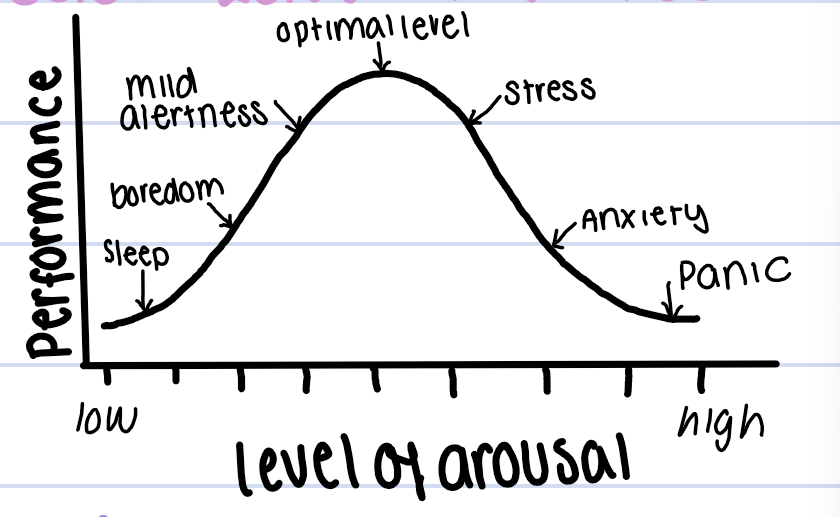
Stressful situations - Yerkes-Dodson Law
Inverted U theory of arousal
Research: Bothwell studied IDs between groups of low/high neuroticism combined w low/high stress situations
Low neuroticism: low50%, high75%
high neuroticism: low68%, high 32%
Evaluation of lab experiments for EWT
focus on one aspect
watching videos - detached
no consequences
not the victim
demand characteristics
large group, experimenter/guidance present
Evaluation of lab experiments for EWT : if real
many things going on, lack of focus
watching in real time - emotional involvement
may be the victim
responsible for self
act naturally without demand characteristics
Ihlebaek → one field, one video → recalled more from video
Yuille and Cutshall → witnesses to shooting (one dead one injured), reinterviewed months later and found same accuracy as prior witness statement
Cognitive interviews: Devlin Report
EW accounts to police interrupted repeatedly by interviewer
questions designed to find truth caused lapses in concentration, caused memory blending
informed home office guidelines:
Free recall → open questions → specific questions
Cognitive interviews: Geiselman 1985 - IDEA and AIM
argued interview techniques should account for basic characteristics of memory:
effectiveness of retrieval depends on the extent which the information contained is similar to information stored in memory trace
retrieval cues may permit access to any given memory
AIM: improve effectiveness of interviewers and apply results of psychological research which show that memory is not like a video camera but an active process
Cognitive interviews: Geiselman 1985 - FOUR STAGES
Context Reinstatement:
recall the scene, the weather, thoughts and feelings
details act as cues for recall
Report Everything:
every detail you can. even if it seems irrelevant or trivial
may not realise relevance, might prompt significant information
Recall from Changed POV:
describe event as it would have been seem from a different POV
encourages many retrieval paths
Recall in reverse order:
describe event in reverse order
when forward, reconstructed with scheme; when reversed more accurate
Cognitive interviews: Geiselman 1985 - EXPERIMENT
testing effectiveness through comparison with standard police interviews
P: showed police training videos of violent crimes to group of 89 students, interviewed by police 48 hours later
CI - 45 minutes, SPI - 15 minutes
F: SPI avg.29.9 correct vs CI avg.41.4 correct
Enhanced cognitive interview: Fisher et al. - METHOD
minimise distractions → quiet and contained
Encourage slow speech → helps to think
Allow pauses for recollection → lack of pressure means less falling back on schemas
Tailor language to suit witness → comfort
Follow up with interpretive comment → ‘is this what you meant?’
Reduce anxiety → e.g. sofa or tea
Avoid judgemental/personal comments → social desirability, leads witness away from information that may be important
Review statements → confirm content and presentation
Enhanced cognitive interview: Fisher et al. - FINDINGS
Lab experiment findings:
ECI more effective
ECI avg.57.5 correct vs CI avg.39.6 correct
BUT more incorrect statements (as there were more overall)
Training Miami police findings:
Number of pieces of information increased by 46%
where possible, information was proven to be 90% accurate
CI and ECI evaluation
Holliday 2003 produced modified cognitive interview → stresses building trusting relationships, removed ‘change of POV’ as children too young to effectively empathise
4-5/9-10 year olds, MPI >accurate than SPI
Milne and Bull 2002, ‘report everything’ and ‘context reinstatement’ are key techniques, suggests modification for focus
proven to be successful in getting more pieces of info
ECI>CI
increase in incorrect information concerning
less effective at enhancing recall when used after longer period of time
several components → unsure if all successfully contribute
doesn’t reduce negative effects of misleading information
expensive to train police
time consuming