lec 4-2 protein synthesis
 Studied by 0 people
 Call with Kai
 Learn
Learn Practice Test
 Spaced Repetition
 Match
Match Flashcards
 Knowt Play
1/36

There's no tags or description
Looks like no tags are added yet.
Name | Mastery | Learn | Test | Matching | Spaced | Call with Kai |
|---|
No analytics yet
Send a link to your students to track their progress
37 Terms
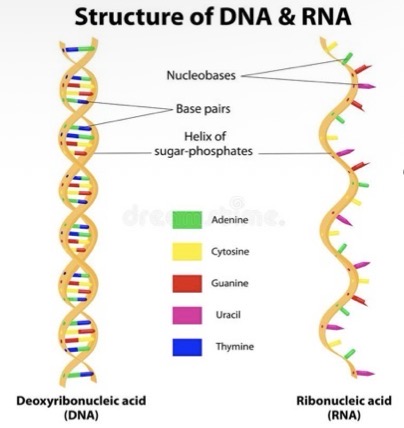
3 differences between DNA and RNA (pics slide 2-4)
DNA has thiamine, RNA has uracil
DNA is double stranded, RNA is single stranded
DNA has deoxyribose sugar and RNA has ribose sugar
Where does transcription and translation happen?
Transcription: nucleus
Translation: cytoplasm
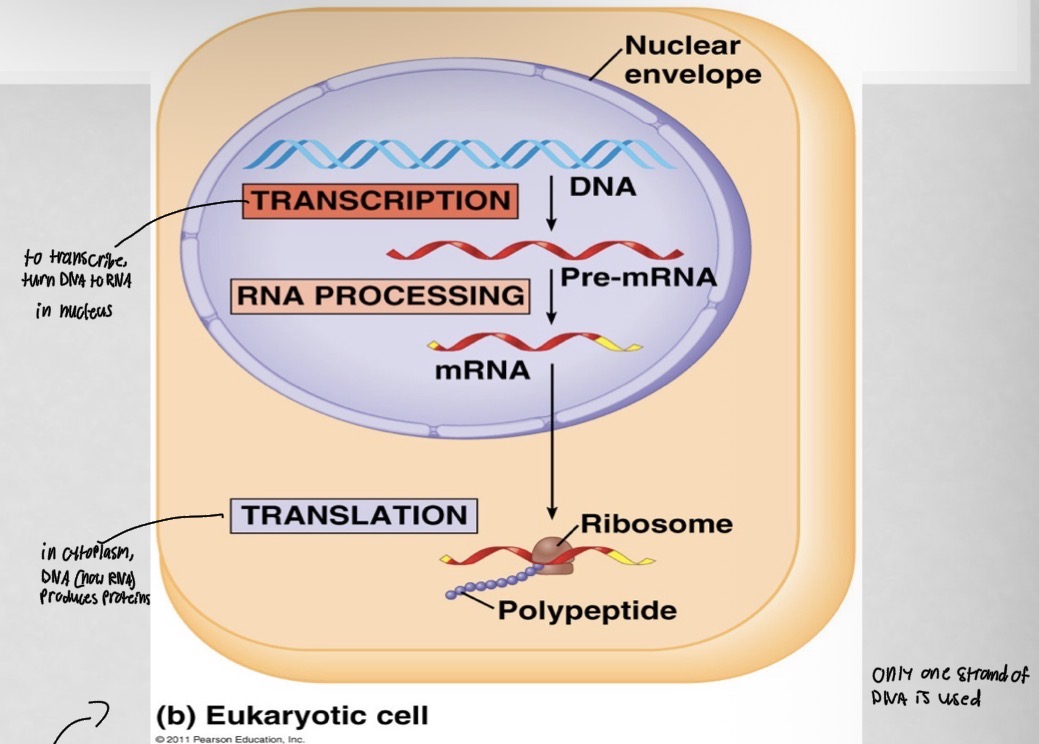
How does DNA become RNA?
Transcription, one DNA strand serves as a template
How does RNA become mRNA?
The RNA is first formed as pre-RNA and has to undergo processing before it becomes mRNA. Processing requires 2 steps
Steps for mRNA to become a protein
The mRNA then leaves the nucleus and enters the cytoplasm
The RNA is translated to produce proteins, a complex multi-step process utilizing ribosomes
How are proteins produced?
The DNA sequence predicts the mRNA sequence which in turn will determine how the protein is produced
What are the units on DNA called?
Genes, determine the exact protein to be produced
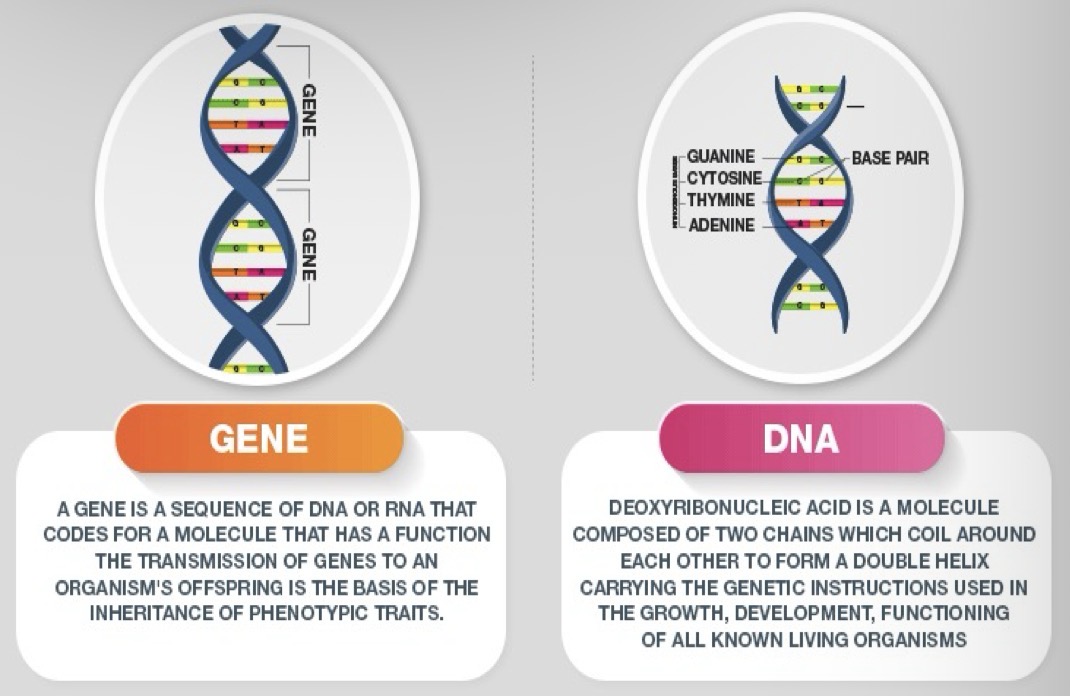
What makes up proteins? How are they influenced by DNA?
Amino acids
the DNA sequence determines which amino acids are produced through the genetic code
About how many genes are there in humans?
21,000
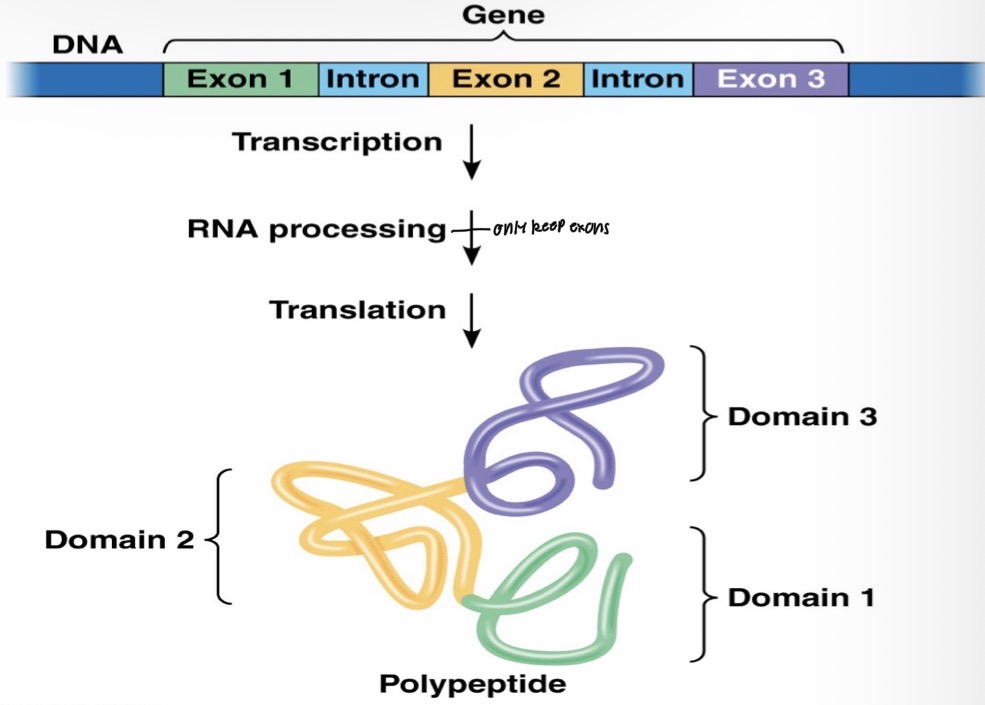
What starts the process of DNA —> RNA? What is splicing? (Splicing pic slide 21)
promoter
Splicing cuts out introns (therefore half size)
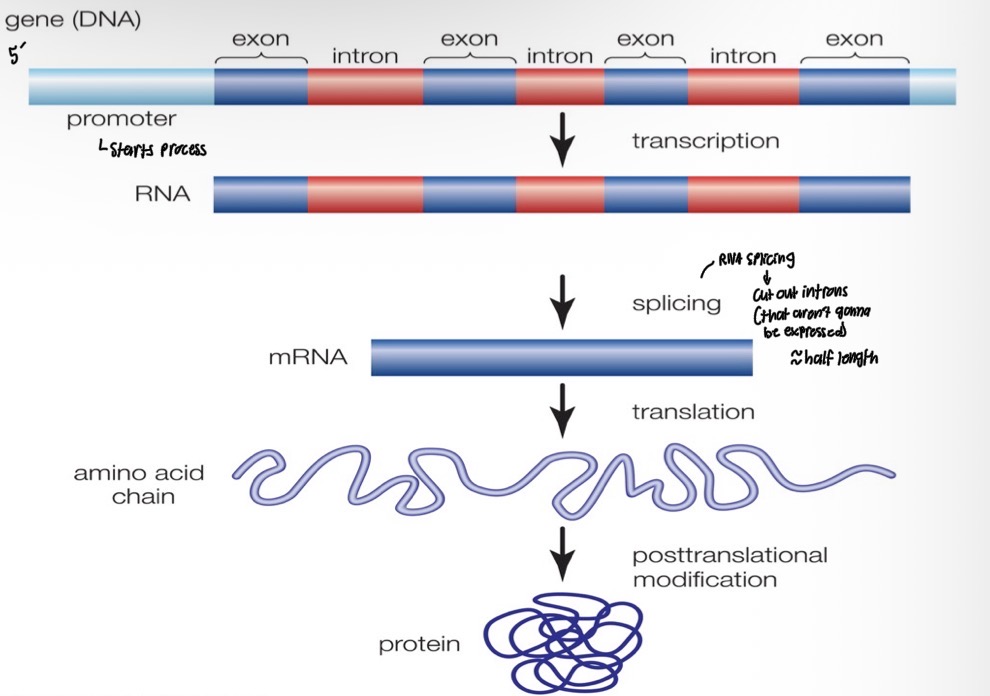
Which are expressed, which aren’t: exons and introns (pics slide13-16)
EXONS =EXPRESSED SEQUENCES
INTRONS = INTERVENING SEQUENCES
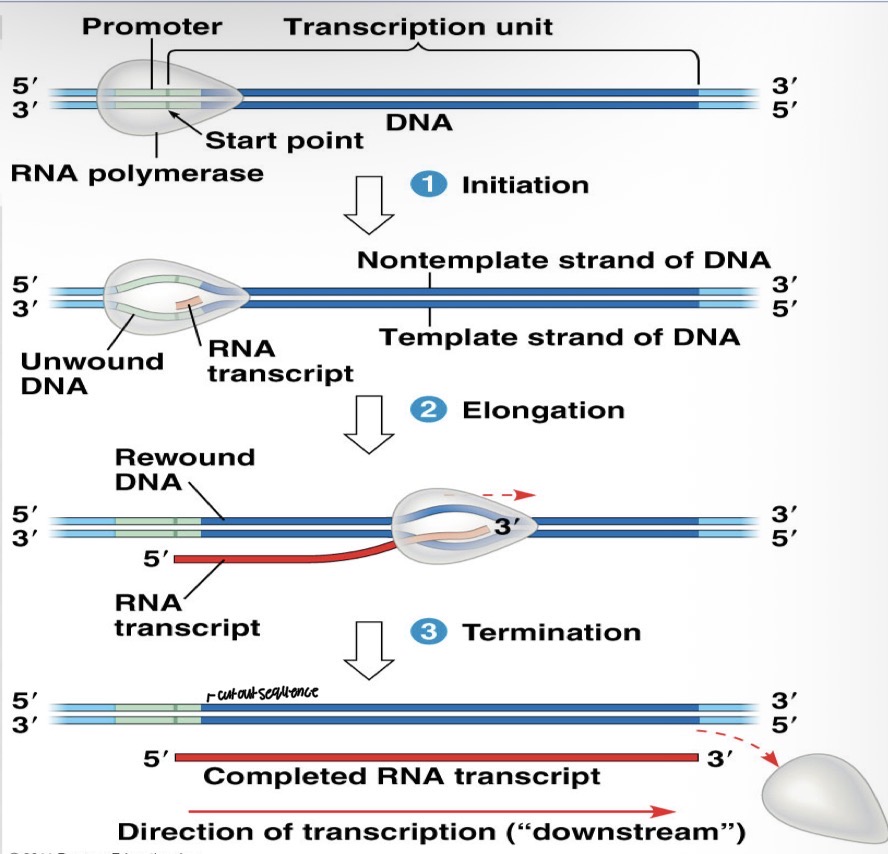
Transcription: what does it produce and where does it start?
This process involves “reading” the DNA strand to produce a complementary mRNA strand
At the extreme 5’ end of the DNA molecule is a promoter sequence that contains a TATA sequence
What does RNA polymerase II do? Then what does RNA polymerase do?
The enzyme RNA polymerase II together with transcription factors bind to the promoter region to form a transcription initiation complex
The RNA polymerase adds nucleotides at a rate of 40 per sec to begin a new mRNA strand in the 5’ to 3’ direction.
When does transcription end?
when the polymerase reaches the polyadenylation signal (AAUAAA)
What is RNA processing?
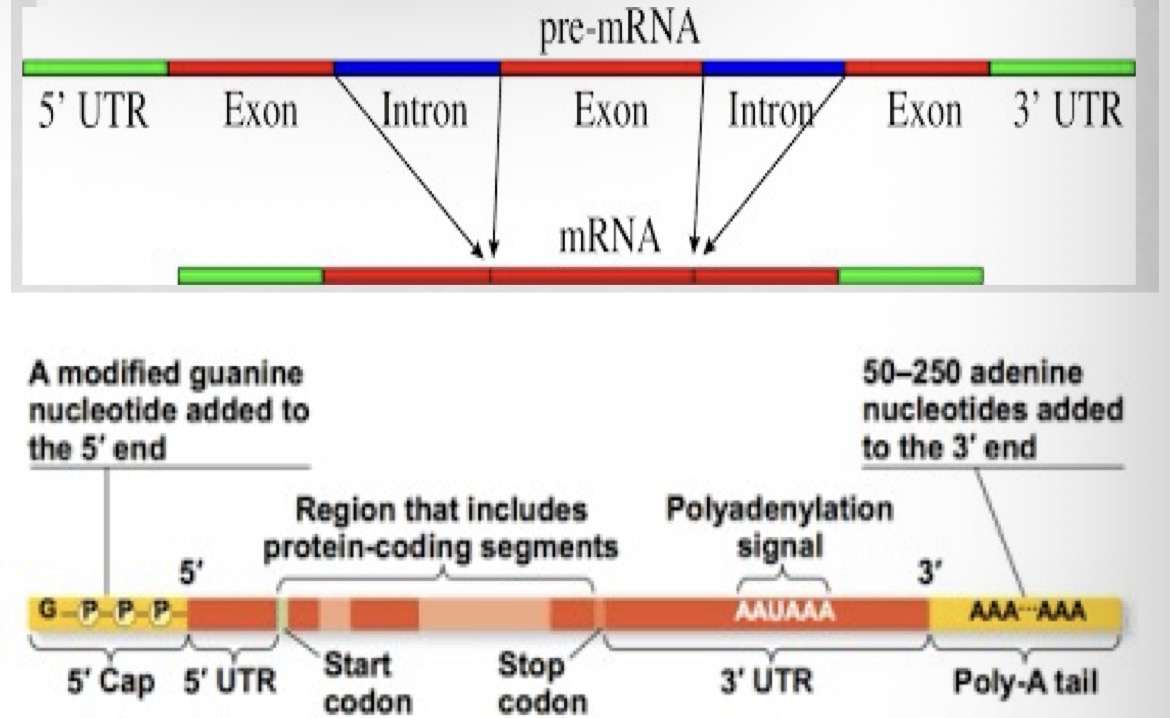
adding a 5’ CAP region to protect mRNA from degradation and provides site for ribosomes to attach
Adding a Poly-A tail to help transport out of the nucleus and provides greater protection to the mRNA
What are spliceosomes?
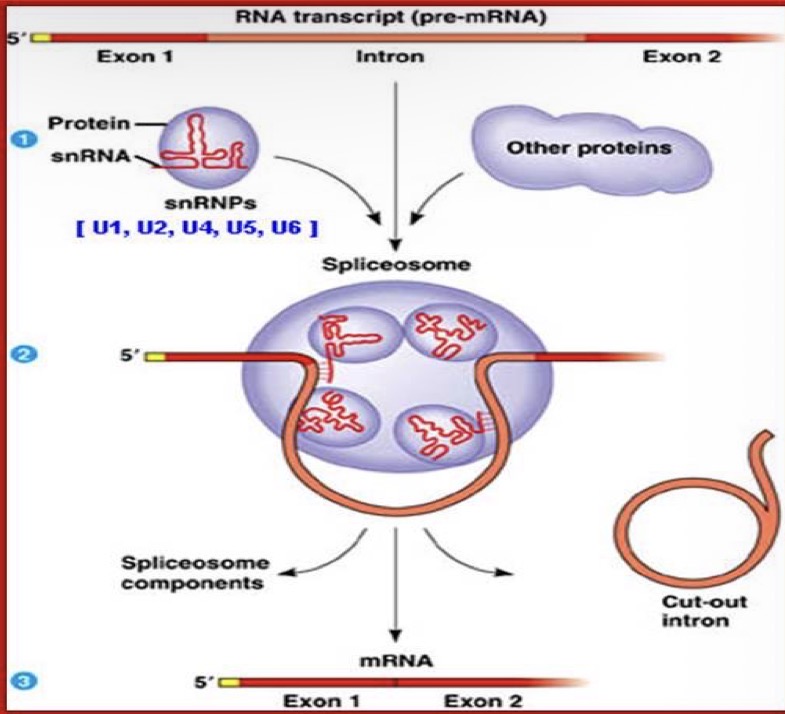
Cluster of enzymes that cut out introns and fuse exons
Where is RNA processing completed and what happens?
The 5’ G-P-P-P region protects the mRNA from being degraded by enzymes in the cytoplasm. It also provides a site to signal ribosomes where to attach
The poly-A tail (AAA- AAA) inhibits mRNA degradation and facilitates export out of the nucleus
A DNA gene sequence that is 27,000 nucleotides long may produce an mRNA molecule that is only 1,200 nucleotides long
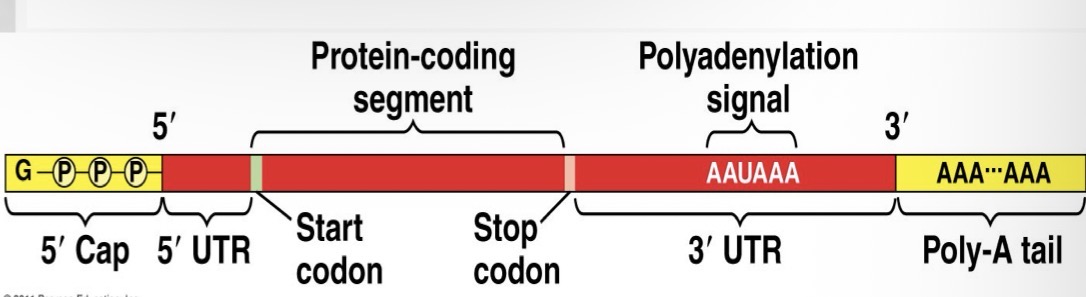
Complete: What is RNA processing?
RNA processing involves converting the pre-mRNA into RNA that can leave the nucleus and enter the cytoplasm where it can be translated
There are three steps : adding a 5’ cap region and a Poly-AAA tail and then splicing out introns.
Splicing is removal of intervening sequences (introns) that are not expressed and merging together exons (expressed sequences) to form the mature mRNA
The mRNA can now leave the nucleus
How do you make proteins?
The mature mRNA leaves the nucleus and ends up in the cytoplasm
The mRNA must be read according to the Dictionary of the Genetic Code. This specifies which amino acids will form the new protein
How many amino acids are specified by the Genetic Code?
20
3 factors of the Genetic Code
This triplet code is universal – found in all living organisms
The code is “redundant” –the same amino acid can be coded by different codons
The code is “unambiguous” – one codon will never give rise to more than one amino acid
How many start and stop codons are there? What are they? (Pics slide 28-30)
1 start: AUG
3 stops: UAA, UAG, UGA
What are ribosomes made up of, what do they contain?
small and large sub-units
ribosomal RNA (rRNA) that helps it function
What’s the most abundant type of nucleic acid in the cell?
rRNA because ribosomes are very abundant in the cell
What are the 3 sites on ribosomes?
APE
A site, P site, E site
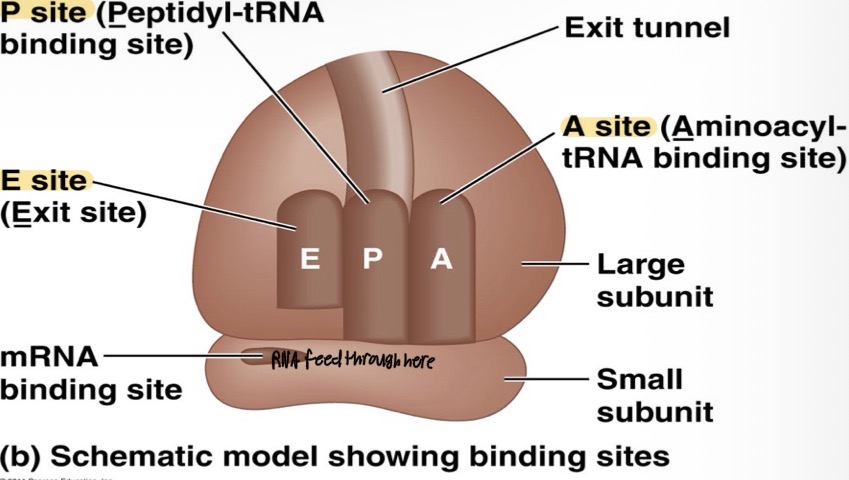
What’s the first step in translation?
Initiation:
small sub-unit of ribosome binds to the 5’ cap region of mRNA
An initiator transfer RNA molecule (t-RNA) arrives at the P-
site (peptidyl-tRNA binding site) carrying a methionine amino acid which is encoded by the “start” codon. Energy
is required (GTP)
On the t-RNA molecules are “anti-codon” sites which correspond to each codon on the mRNA.
Therefore, for each of the 20 amino acids, there are 20 different t-RNA molecules that correspond to the codons.
The large subunit of the ribosome binds to the small subunit to form the translation initiation complex
What do T-RNA molecules have on each end?
amino acid attachment site at one end and an anti-codon site at the other end
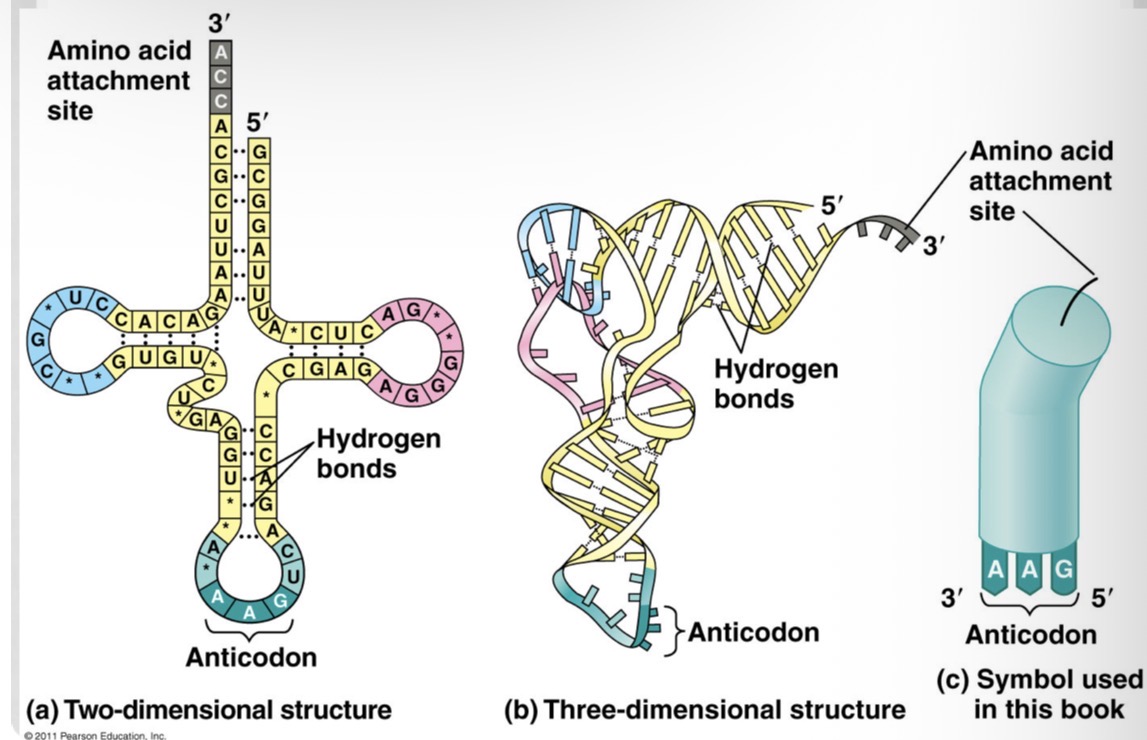
What happens each time a codon is read from the mRNA molecule
a corresponding t-RNA molecule arrives, carrying the corresponding amino acid as specified by the Dictionary of the genetic code
What does the t-RNA carrying the amino acid do?
arrives at the A- site on the ribosome
The attachment of the amino acid to the correct t-RNA is achieved by the action of an enzyme called “Aminoacyl-tRNA synthetase”
What happens during elongation? (Slide 39-41)
The corresponding t-RNA carrying the amino acid arrives at the A-site (Amino-acyl t-RNA binding site)
The amino acid is transferred from the t-RNA sitting at the P-site to the A-site and a bond (peptide bond) is formed with the existing amino acid(s). This results in a polypeptide forming each time a new amino acid is added
The t-RNA in the P-site transfers to the E-site (exit). The t-RNA in the A-site moves to the P-site to make room for a new t-RNA. The cycle continues.
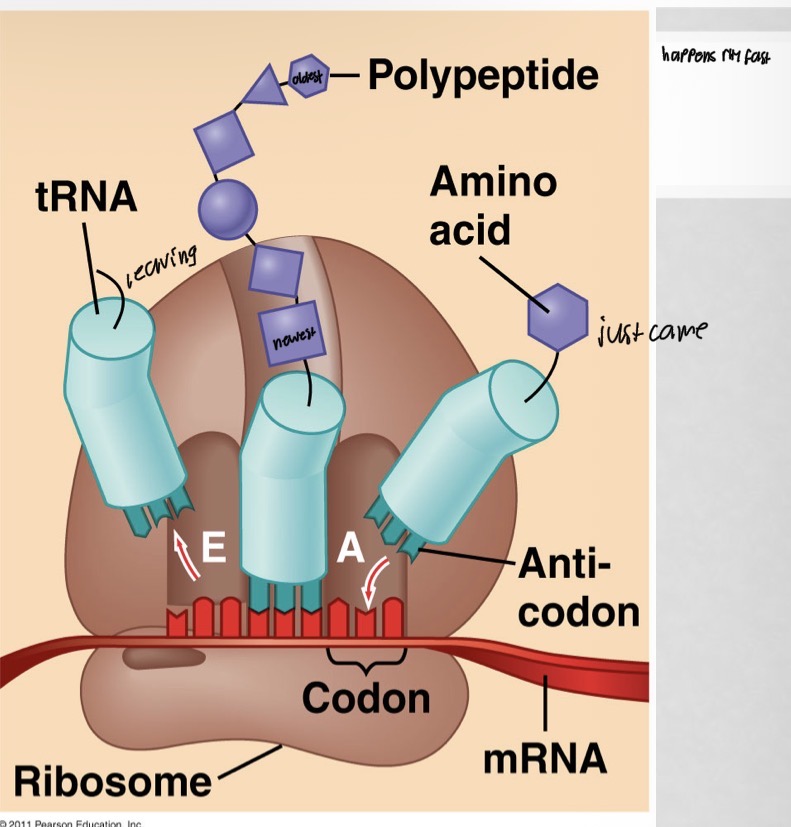
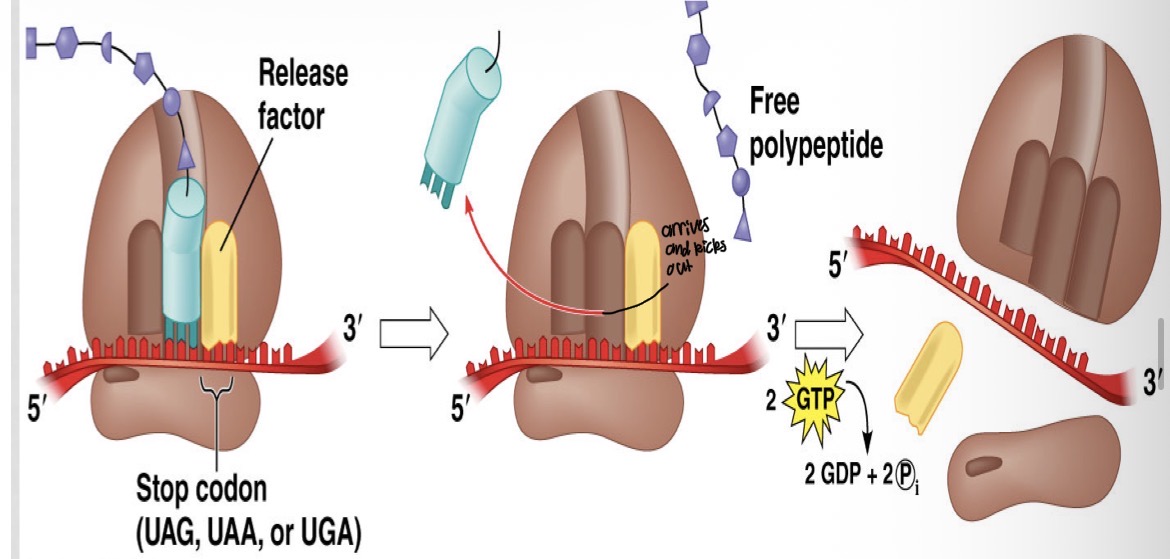
What happens during termination? (Summary pic slide 44)
At the point of termination of the translation, a stop codon (UAA, UAG, UGA) is reached
This codes for a “release factor” which is a water molecule
This causes the polypeptide chain to be released and the last t-RNA molecule leaves the ribosome complex
The small and large subunits separate from each other
The formation of a polypeptide (protein molecule) in an energy requiring process (GTP)
It takes about 1 minute for a cell to produce a new polypeptide
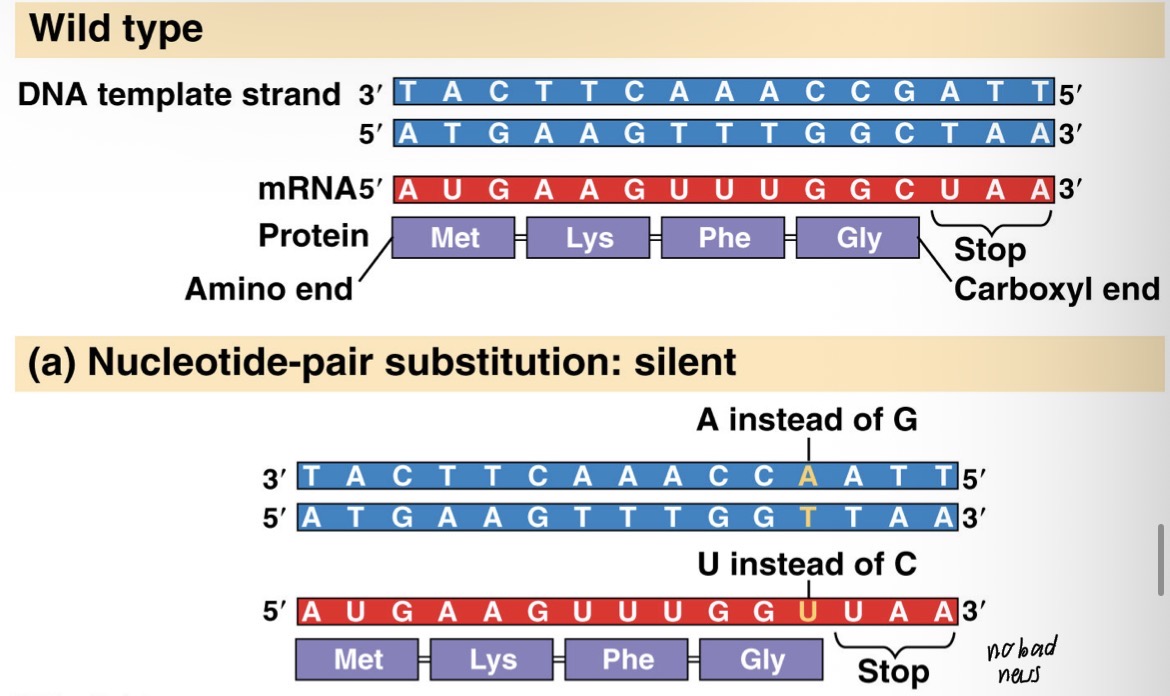
Silent mutation
Change in one letter, same outcome
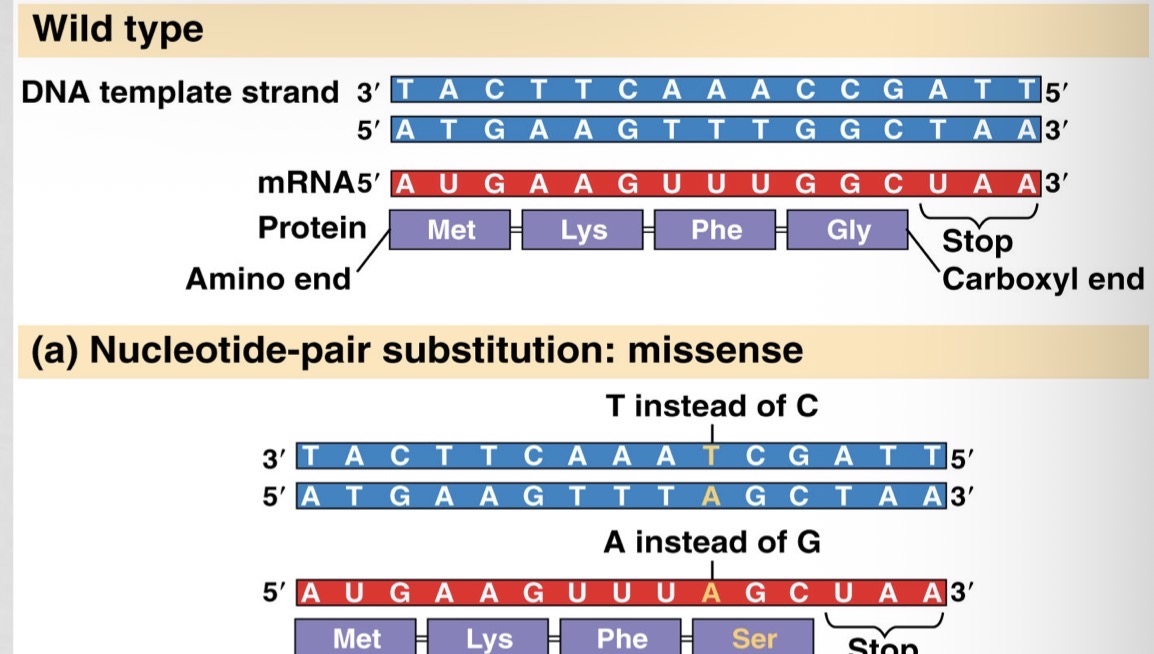
Mis-sense mutation
Add or delete 3 letters, different protein
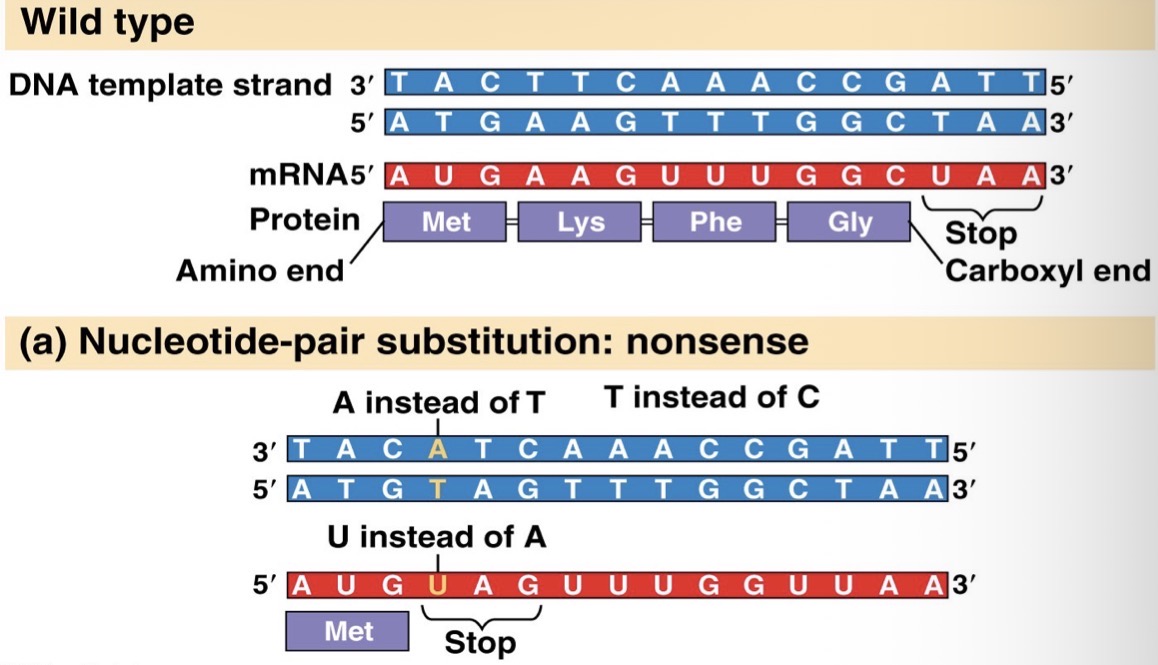
Nonsense mutations
No protein, really bad for cell, possible cancer
What are mutations?
A change in the DNA sequence that results in a change in the mRNA sequence
This may (or may not) result in a change in the amino acid produced and may/may not change the protein produced
What’s a point mutation? How could it have occurred?
A single base pair change occurs eg. T to C. This results in a single nucleotide polymorphism (difference) called SNP
• This may have resulted during DNA replication where an incorrect base was added and the polymerase enzyme did not detect it. Or it could be a mutation resulting from X-rays or UV light
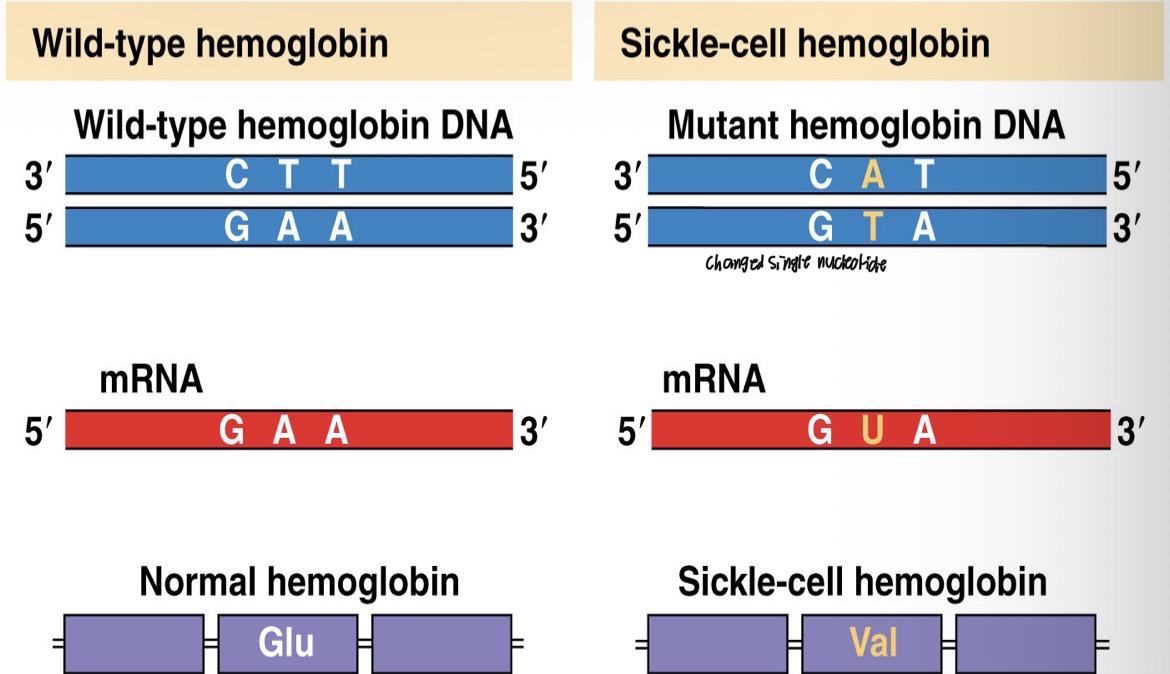
Importance of mutations
could result in devastating diseases in humans eg.
Parkinson’s, Alzheimer’s, Cancer, etc.
mutations can have beneficial roles by increasing genetic diversity (humans having less body hair compared to chimpanzees)
 Note
Note  Flashcards (30)