TAMU CLAS 251: Lecture 4-6 The Divine Condition / Olympian Gods
 Studied by 0 people
 Call with Kai
 Learn
Learn Practice Test
 Spaced Repetition
 Match
Match Flashcards
 Knowt Play
1/184

There's no tags or description
Looks like no tags are added yet.
Name | Mastery | Learn | Test | Matching | Spaced | Call with Kai |
|---|
No analytics yet
Send a link to your students to track their progress
185 Terms
Bronze Age ca. 3500–1200 BCE
Dark Ages ca. 1200–800/776 BCE
Population decline, poverty, lack of monumental architecture, and loss of long-distance trade.
Archaic Period 776–479 BCE
Classical Period 479–323 BCE
Hellenistic Period 323–31 BCE
What does “Pre-Indo-European Bronze Age Cultures in Greece” refer to?
Cultures that existed in Greece before Indo-European Greek-speaking peoples arrived.
What is Early Helladic culture?
The pre-Indo-European inhabitants of mainland Greece.
What do we know about Early Helladic religion?
Very little; it is mostly invisible archaeologically.
Why is Early Helladic religion important?
It likely formed the foundation for later Greek cults.
What is Cycladic culture?
The Bronze Age culture of the Aegean Islands.
What do Cycladic figurines suggest about religion?
A mother goddess may have been worshipped.
Where did Minoan culture flourish?
On the island of Crete.
What stands out about Minoan religion?
Goddesses seem more prominent than male deities.
What is meant by the “Minoan Civilization”?
The Bronze Age civilization of Crete.
Were the Minoans Indo-European?
No. They were a non-Indo-European civilization.
What kinds of writing systems did the Minoans use?
wo non-Greek scripts: Cretan hieroglyphic and Linear A: record-keeping (lists, inventories, offerings
Big idea of the Minoan Civilization
A highly developed Bronze Age culture with its own language and writing, separate from later Greek civilization.
What kind of social organization did early Indo-European cultures have?
Patriarchal (male-dominated).
What is meant by “tripartite organization of society”?
Society divided into priests/kings, warriors, and farmers.
What economic activities were most important to early Indo-Europeans?
Herding horses and cattle (pasturage), more than farming.
What was their lifestyle like?
Originally nomadic or semi-nomadic.
How are early Indo-Europeans traditionally characterized?
As highly warlike.
What basic religious actions did Indo-Europeans practice?
Prayer and libation (pouring liquid offerings)
What type of sacrifice was common?
Animal sacrifice
What major religious tradition did Indo-Europeans share?
Poetry about gods and heroes (e.g., Vedic poetry and Homeric epic).
Who did later Greeks blame for destroying the Mycenaean world?
The Dorians, invaders from the northwest associated with the sons of Heracles.
Did the Dorian migration likely occur?
Probably yes, but details are heavily debated.
Why is “Early Iron Age” often preferred over “Dark Ages”?
Because iron technology and alphabetic writing appear during this period.
Two major technological introductions of Dark Age/Early Iron Age period
Ironworking and alphabetic writing
what era was Hesiod from
Hesiod lived and worked during the Archaic Period
Where was Hesiod born?
Ascra in Boeotia, near Mount Helicon.
Who was Perses?
Hesiod’s brother, criticized in Works and Days.
How did Hesiod claim he became a poet?
The Muses commissioned him while he was tending flocks.
What does “theogony” mean?
An account of the origin of the gods.
What does “cosmogony” mean?
An account of the origin of the universe.
What kind of poem is the Theogony?
Both a theogony and a cosmogony.
What does the Theogony begin with?
haos (“chasm”).
What does the Theogony end with?
Zeus and his children.
Main goal of the Theogony
To present an organized and harmonious divine genealogy.
Alternate Theogony
Homeric passage - Who claims Oceanus and Tethys are the parents of the gods? Hera in Iliad 14.
What do Hittite, Babylonian, and Greek myths share?
A pattern of gods overthrowing earlier generations.
What is The Song of Kumarbi?
A Hurrian/Hittite poem about divine succession preserved on fragmentary cuneiform tablets.
What is the Enuma Elish?
A Babylonian creation epic recited at the New Year’s festival in honor of Marduk.
What type of story is the Enuma Elish?
Both a theogony (origin of gods) and cosmogony (origin of universe).
What do Mycenaean Linear B tablets show?
Many familiar Greek gods were already worshipped.
Why are the Dark Ages important for Greek religion?
They were a formative period with strong Near Eastern influence.
Pattern of divine succession in Hittite, Babylonian, and Greek myth
First being → Sky god → Overthrowing son → Final king
Hittite: Alalu → Anu → Kumarbi → Teshub
Babylonian: Apsu → Anu → Ea → Marduk
Greek: Chaos → Uranos → Cronus → Zeus
Enuma Elish — storyline (Babylonian creation myth)
Primordial waters Apsu (fresh) and Tiamat (salt) give rise to generations of gods.
Apsu becomes angry at the noisy younger gods and plans to destroy them.
The god Ea kills Apsu and imprisons his advisor Mummu.
Ea and Damkina have a son, Marduk.
Tiamat takes a new husband, Kingu, and prepares war against the younger gods.
Marduk defeats Tiamat, splits her body to form heaven and earth, and becomes king.
Kingu is executed, and humans are created from his blood.
The Song of Kumarbi — storyline (Hurrian/Hittite succession myth)
Alalu is king in heaven, but his cupbearer Anu overthrows him.
Kumarbi then overthrows Anu, castrates him, and swallows several gods.
Kumarbi believes he has swallowed his own son, but actually swallows a lump of basalt.
The storm-god Teshub, with help from Anu, eventually defeats and overthrows Kumarbi.
What happens in Hesiod’s account of divine allotments?
The gods urge Zeus to become king, and Zeus assigns each god their privileges and rights.
How is the universe divided among the gods in the Iliad?
When we cast lots, it fell to me to have my dwelling in the sea for evermore. Hades took the darkness of the realms under the earth, while air and sky and clouds were the portion that fell to Zeus. Earth and great Olympus, however, are the common property of all.”
How is the cosmos divided in the Atra-Hasis myth?
“They took the box of lots... They cast the lots. The gods made the division. Anu went up to the sky, and Enlil took the earth for his people. The bolt which bars the sea was assigned to far-sighted Enki.”
What are the four major divine generations in Hesiod’s Theogony?
Gaea & Uranos
Cronos & Rhea
Zeus & the Olympians
Offspring of Zeus
First divine generation in the Theogony
Gaea (Earth) and Uranos (Sky), plus Sea, Mountains, Darkness, Night, and their descendants.
Second divine generation in the Theogony
Cronos and Rhea, associated with Sun, Moon, Stars, Rivers, and Winds.
Third divine generation in the Theogony
Zeus and the Olympian gods.
Fourth divine generation in the Theogony
The many children of Zeus with different goddesses and mortal women.
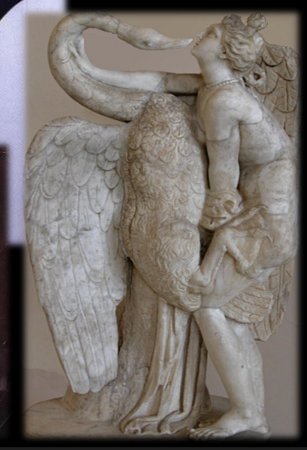
Leda and the swan
Zeus appears as a swan and mates with Leda → produces Helen of Troy and the Dioscuri: Castor + Polydeuce (in some versions) → connects Zeus to Trojan War lineage.
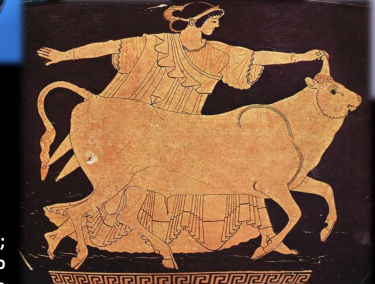
Europa and the bull
Zeus transforms into a bull and carries Europa to Crete → their union produces kings of Crete → explains origins of royal lineages and the name “Europe.”
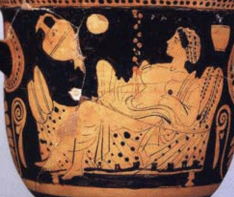
Danaë
Zeus impregnates Danaë as a shower of gold → produces Perseus → shows Zeus as father of heroic bloodlines.
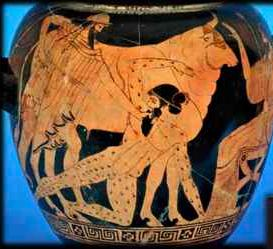
Io /Hermes slaying Argus Panoptes (Argos)
Zeus turns Io into a cow to hide her from Hera; Hera sets Argus Panoptes to guard her; Zeus sends Hermes to kill Argus → shows Zeus’s infidelity and use of deception and intermediaries.
Hermes kills Argus on Zeus’s orders to free Io → demonstrates Zeus’s authority over other gods and his ability to undo Hera’s punishments.
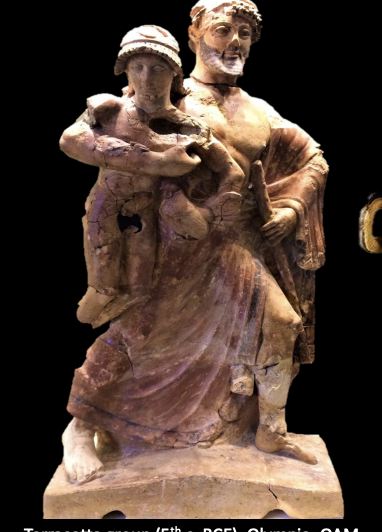
Zeus and Ganymede
Zeus abducts the beautiful Trojan prince in the form of an eagle and makes him cupbearer of the gods → shows Zeus’s power, desire, and ability to elevate mortals to divine status.
Zeus’ 1st wife
Metis
Metis
Titaness of intelligence, wisdom, and cunning
First wife of Zeus
Prophesied to bear a son stronger than Zeus → Zeus swallows Metis
Their daughter Athena is later born from Zeus’s head
Zeus’ 2nd wife
Themis
Themis
Titaness of divine law, order, and custom
Represents cosmic justice
Zeus + Themis =
Horae (Seasons/Order)
Control seasons and social order
Moirai (Fates)
Control destiny of gods and humans
Dike
Personification of justice
Eunomia
Personification of good governance and lawfulness
Zeus’ 3rd wife
Eurynome
Eurynome
Sea goddess/Oceanid
With Zeus produces the Graces
Zeus + Eurynome =
Charites (Graces)
Goddesses of beauty, charm, joy, and creativity
Zeus’ 4th wife
Mnemosyne (memory)
Mnemosyne (memory)
Personification of memory
Mother of the Muses
Zeus + Mnemosyne =
Muses
Inspire poetry, music, history, dance, and science
Zeus’ 5th wife
Dione
Dione
Minor goddess, sometimes paired with Zeus
In one tradition, mother of Aphrodite
Zeus + Dione =
Aphrodite
Goddess of love, desire, beauty
Zeus’ 6th wife
Hera
Hera
Zeus’s wife and sister
Goddess of marriage, queenship, and childbirth
Hera might have had Hephastios by herself
Which major Greek god has an undisputed Indo-European origin?
Zeus
What does the name “Zeus” linguistically connect to?
Latin Diespiter/Jupiter and Vedic Dyaus Pitar
What PIE root does the name Zeus come from?
dieu (“day,” “bright/clear sky”).
What was Zeus originally a god of?
The clear sky - a weather god
What kind of ruler is Zeus?
A patriarchal ruler over the Greek pantheon.
What natural forces does Zeus control?
Storms, weather, thunder, and lightning.
What moral principle does Zeus uphold?
Order and justice (dike).
What is xenia, and how is Zeus connected to it?
Ritualized guest-friendship; Zeus safeguards it.
Whom does Zeus protect socially?
Beggars and strangers.
Manifestations (epithets) of zeus
agoraios: presides over the agora, the political and commercial center of the city
Polieus: guardian of the city-state
boulaios: guardian of the council
herkeios: guardian of individual households
ktēsios: guardian of property
sōtēr: averter of crises
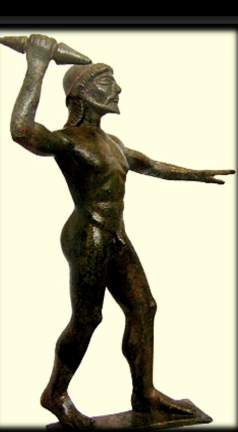
Iconography of Zeus
thunderbolt
eagle
bearded mature man
seated on throne
sceptor or staff
sky/cloud setting
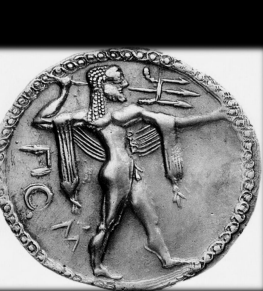
Iconography of Poseidon
trident
mature, bearded male
horse imagery
sea creatures
standing or striding pose
Who are Poseidon’s parents and siblings?
Son of Cronus and Rhea; brother of Zeus and Hades.
Who is Poseidon married to?
Amphitrite.
What are Poseidon’s main domains?
God of the sea, earthquakes, and horses.
What evidence shows Poseidon was worshipped in the Mycenaean period?
He is attested in Linear B tablets from Knossos and Pylos.
Which Mycenaean site was a major cult center for Poseidon?
Pylos
What is a proposed meaning of Poseidon’s name?
Possibly “Earth lord” (posei + da).
Poseidon and the walls of Troy
He helped build Troy’s walls for King Laomedon.
Poseidon and Athens
He competed with Athena to be patron deity of the city.
Poseidon and Minos
Poseidon punishes Minos for failing to honor him.
Poseidon in the Trojan War
He fights on behalf of the Greeks.
 Note
Note  Flashcards (24)