TEL - genetic variation and pedigree analysis
 View linked note
 Call Kai
 Learn
Learn Practice Test
 Spaced Repetition
 Match
Match Flashcards
 Knowt Play
1/42

Earn XP
Description and Tags
Name | Mastery | Learn | Test | Matching | Spaced | Call with Kai | Chat |
|---|
No analytics yet
Send a link to your students to track their progress
43 Terms
Dominant autosomal inheritance
A type of inheritance where a trait is expressed even if only one copy of the allele is present.
Recessive autosomal inheritance
A type of inheritance where a trait is expressed only when both copies of the allele are present.
Y-Chromosome linked inheritance
Inheritance pattern where genes are located only on the Y chromosome, requiring only one copy to express traits.
X-Chromosome linked dominance inheritance
A pattern where a trait is expressed if at least one X chromosome carries the dominant allele.
X-Chromosome linked recessive inheritance
A pattern where a trait is expressed when both X chromosomes carry the recessive allele in females, and when the single X chromosome in males carries the recessive allele.
Diploid
An organism or cell having two sets of chromosomes (2n), one from each parent.
Haploid
A cell that contains only one set of chromosomes (n), such as gametes.
Autosomal chromosomes
Chromosomes that are not sex chromosomes; in humans, there are 22 pairs.
Sex chromosomes
Chromosomes that determine the sex of an individual; in humans, these are X and Y.
Homologous chromosomes
A pair of chromosomes containing the same genes but may have different alleles.
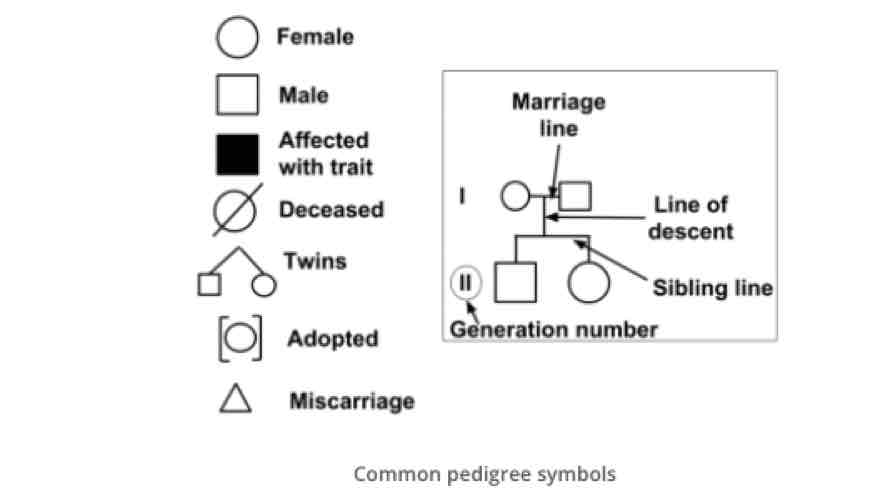
Pedigree analysis
A diagram that depicts family relationships and inheritance patterns of traits.
Dominant trait
A trait that appears in the phenotype when at least one dominant allele is present.
Recessive trait
A trait that only appears in the phenotype when two recessive alleles are present.
X-linked recessive traits
Traits that predominantly affect males because they have only one X chromosome.
MeCP2 gene
Gene associated with Rett syndrome located on the X chromosome.
Complete penetrance
Situation where all individuals with a mutant genotype display the phenotype.
Partial gene deletion
Missing pieces of a chromosome that can lead to genetic disorders.
Uniparental disomy
Condition where both copies of a chromosome come from one parent.
Genomic imprinting
An epigenetic phenomenon where certain genes are expressed in a parent-of-origin-specific manner.
UBE3A gene
Gene implicated in Angelman syndrome, located on chromosome 15.
Angelman syndrome
A genetic disorder characterized by delayed development, intellectual disability, and ataxia.
Phenotypic expression
Observable characteristics that result from the interaction of an individual's genotype with the environment.
Transcriptional repressor
A protein that inhibits the expression of one or more genes.
Nucleotide polymorphism
Variations at a single nucleotide position in the DNA sequence among individuals.
Polymerase Chain Reaction (PCR)
A technique used to amplify specific segments of DNA.
Hybridization techniques
Methods used to detect specific sequences of nucleic acids.
FISH (Fluorescent In Situ Hybridization)
Technique that uses fluorescent probes to detect specific DNA sequences.
DNA microarray technology
A tool used to detect gene expression or genetic mutations at high throughput.
Genome sequencing
Determining the complete DNA sequence of an organism's genome.
Ataxia-telangiectasia
A rare inherited disorder affecting the nervous and immune systems.
ATM gene
Gene linked to Ataxia-telangiectasia that helps in DNA repair.
Inheritance pattern
The manner in which a genetic trait or disorder is transmitted from parent to offspring.
Single nucleotide polymorphism (SNP)
A single base-pair variation in the DNA sequence.
Point mutation
A mutation in which a single nucleotide in DNA is changed.
Methylation
Addition of methyl groups to DNA that can regulate gene expression by silencing genes.
Heterozygous
Having two different alleles for a particular gene.
Homozygous
Having two identical alleles for a particular gene.
Dominant allele
An allele that can mask the expression of a recessive allele.
Recessive allele
An allele whose expression is only seen when paired with another recessive allele.
Malformation syndromes
Disorders caused by abnormal development of tissues and organs.
Transcription factor
Proteins that bind to specific DNA sequences to regulate gene expression.
Proteasome
A cellular structure that degrades unneeded or damaged proteins.
Gene therapy
A potential therapeutic approach aimed at correcting defective genes.