Lecture 1: Plant Reproduction
 Call Kai
 Learn
Learn Practice Test
 Spaced Repetition
 Match
Match Flashcards
 Knowt Play
1/21

There's no tags or description
Looks like no tags are added yet.
Name | Mastery | Learn | Test | Matching | Spaced | Call with Kai |
|---|
No analytics yet
Send a link to your students to track their progress
22 Terms
Prokaryotes
- Single-cellular
- No membrane-bound organelles
e.g. Bacteria, Archaea
Eukaryotes
- Mostly multicellular
- Membrane-bound organelles
e.g. Eukarya -> Plantae, Fungi, Animalia, Protista
Phylogenetic tree
- Based on DNA sequences of rRNA genes and other genes
- Most lineages consist solely or mainly of single-celled organisms
- Asterisks represent DNA from cellular organelles (mitochondria, chloroplasts)
- Eukarya is dominated by multicellular organisms
Endosymbiotic theory
- Mitochondria evolved before plastids through a sequence of events
- Ancestors of mitochondria were oxygen-using non-photosynthetic prokaryotes
- Ancestors of chloroplasts were photosynthetic prokaryotes
- Endosymbionts became organelles
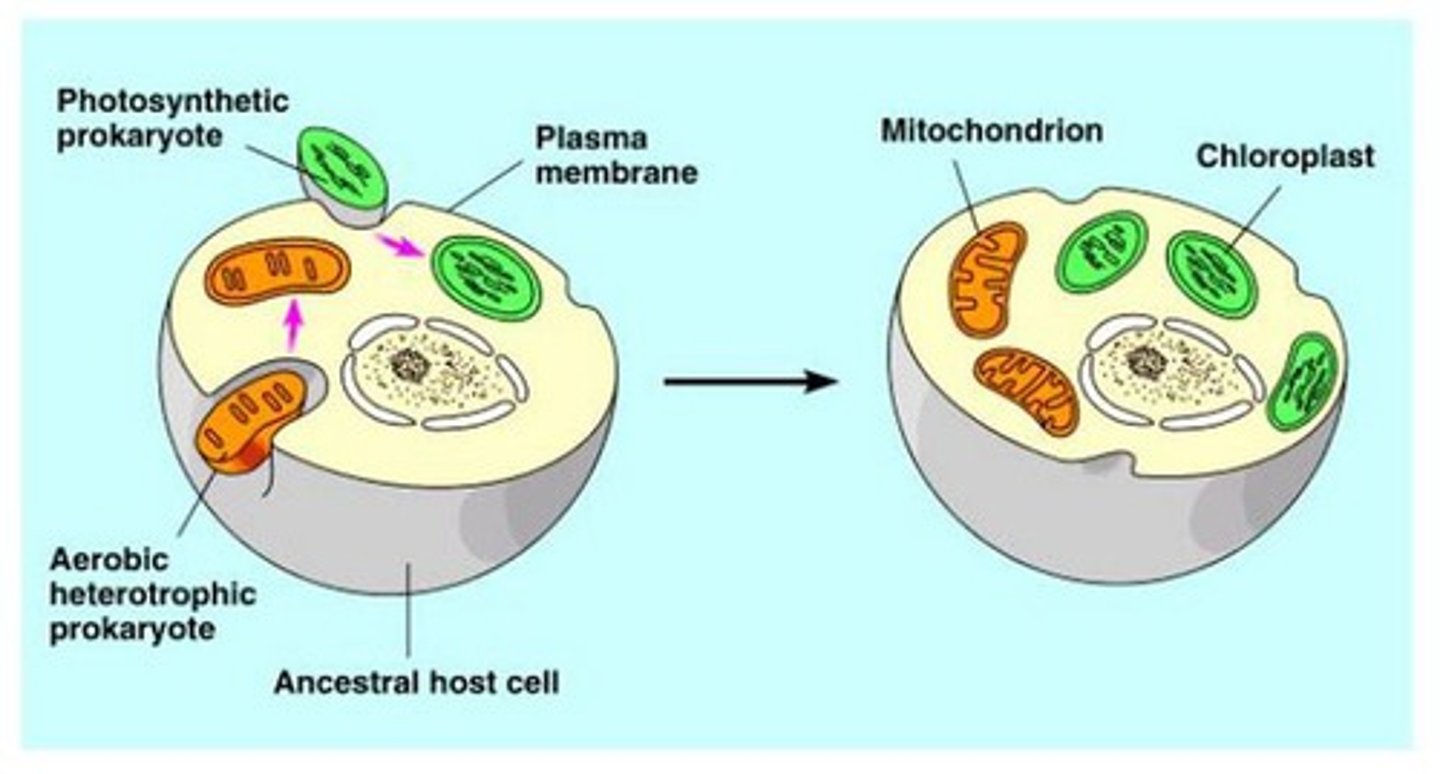
Evidence supporting endosymbiotic origin of mitochondria and plastids
- Inner membranes are similar to plasma membranes of prokaryotes
- Organelles transcribe and translate their own DNA
- Divison and DNA are similar in organelles and prokaryotes
- Their ribosomes are more similar to prokaryotic than eukaryotic ones
Why are plants important?
- Oxygen
- Food, drink, animal feed
- Pharmaceuticals
- Fiber (cotton, wood)
- Fossil fuels
- QOL
Linnaeus
Linnean hierarchical classification: DKPCOFGS
Domain
Kingdom
Phylum
Class
Order
Family
Genus
Species
Genera (genus pl.) are grouped into families
Name = genus + "aceae"
-"aceae" means plant family
e.g. Poaceae: Grass family
e.g. Asteraceae: Sunflower family
e.g. Brassicaceae: Mustard family
*DON'T MEMORIZE
Plant relationships and classification
- Organisms are given unique Latin names
- Allows for systematic accumulation of knowledge
- Important for trade and commerce
Latin binomials
Genus + species + Authority
- All italicized
- Genus capitalized
- Authority: First to describe and name organism
e.g. Chenopodium album L.
- Chenopodium: Genus
- album: Species
- L.: Carl Linnaeus
em.
- Em = Emendates = Amended
- e.g. Triticum aestivum L. em. Thell.
Species
- Can interbreed + produce fertile offspring without artificial intervention
Subspecies (spp.)
- Capable of interbreeding and producing fertile offspring
Cultivar (cv.)
- CULTIvated VARiety
- Recognized subpopulation cultivated by us
Exceptions: Intergenic hybrids
- Fertile progeny involving two genera
- Requires intervention:
- Embryo rescue
- Bridge-crossing, chromosome doubling
- Cell fusion
Nomenclature:
- New genus is a combined name of the two genera
- X is used to indicate genus cross
e.g. xHeucherella
- Cross of Coral bells + Foam flower = Foamy bells
Plant reproduction
We will focus on the phylum Magnoliophyta (angiosperms, flowering plants)
Angiosperms
- Angiosperm means "closed seeds"
- Unique features: (3Fs):
- Flowers
- Double fertilization
- Fruity
- Adapted to most environments in the world, except for extreme cold
- Make up ~90% of the plant kingdom
- Divided into monocots and dicots
Types of angiosperms
Monocots
- One cotyledon
- Flower parts in multiples of 3
- Parallel veins
- Primary root replaced by adventitious root (fibrous root system)
- Scattered vasculature, no secondary growth
- One pore (furrow) on pollen grain
Dicots
- Two cotyledons
- Flower parts in multiples of 5
- Network of veins
- Primary root can persist (tap root)
- Ring formation in vasculature, with secondary growth
- 3+ furrows on pollen grain
Life cycles alternate between
Diploid (2n) generation, and haploid (n) generation
Sporophyte generation (2n)
Most familiar plant parts
Produce haploid (n) spores through MEIOSIS
Spores grow into gametophytes
Gametophyte generation (n)
Some plants grow in this state
Produce haploid gametes through MITOSIS
Fusion of gametes (fertilization) produces diploid sporophyte

