OCR Gateway GCSE Physics: PAG 6 IV Characteristics
 Call Kai
 Learn
Learn Practice Test
 Spaced Repetition
 Match
Match Flashcards
 Knowt Play
1/18

Earn XP
Description and Tags
From PMT.
Name | Mastery | Learn | Test | Matching | Spaced | Call with Kai |
|---|
No analytics yet
Send a link to your students to track their progress
19 Terms
What kind of power supply should be used for this practical?
A variable voltage supply.
How else can voltage be varied?
Using a variable resistor.
How is current measured?
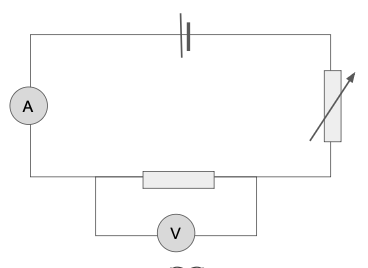
Using an ammeter wired in series.
How is voltage measured?
Using a voltmeter wired in parallel.
What would a circuit diagram for this procedure (Investigating the IV characteristics of circuit elements.) look like?
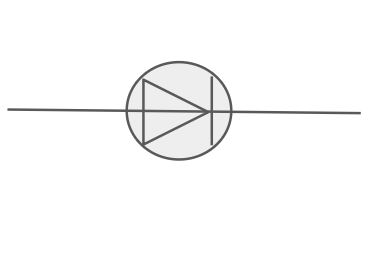
Draw the circuit symbol for a diode.
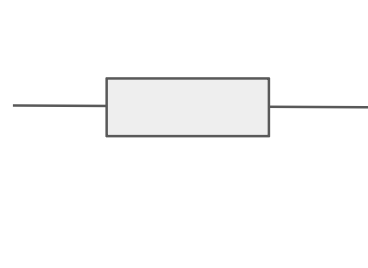
Draw the circuit symbol for a resistor.
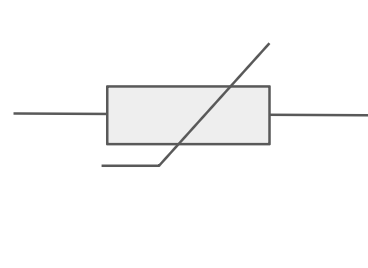
Draw the circuit symbol for a thermistor.
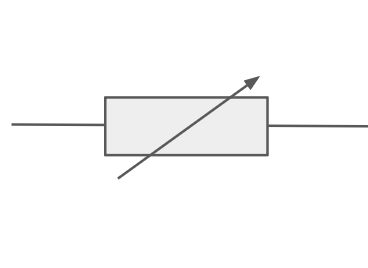
Draw the circuit symbol for a variable resistor.
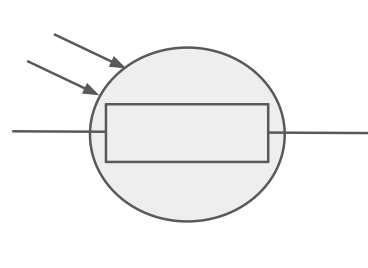
Draw the circuit symbol for an LDR.
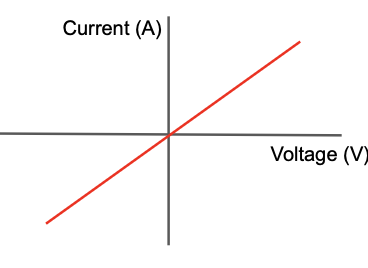
What is an ohmic conductor?
A conductor for which resistance is constant, meaning the conductor’s IV characteristic (graph of current against voltage) has a linear (straight line) gradient.
Draw the IV characteristic of an ohmic conductor.
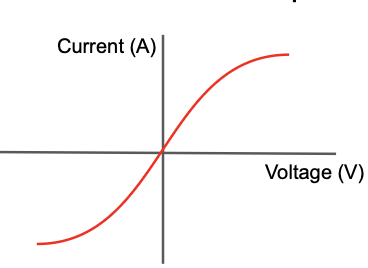
What would you expect the IV characteristic of a filament lamp to look like? Why?
When current flows, the filament produces heat. This increases the resistance of the filament (R=V/I).
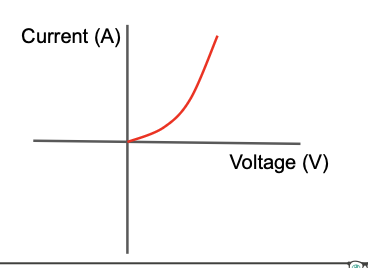
What would you expect the IV characteristic of a diode to look like? Why?
Current through a diode flows in one direction only, as it has a very high resistance in the opposite direction.
How does resistance change with temperature?
As temperature increases, ions and electrons have more kinetic energy. This results in more collisions between the stationary metal ions, making it more difficult for electrons to move through the wire and carry a charge. Therefore resistance increases with temperature.
How does increased resistance affect an IV characteristic?
The gradient becomes shallower (less steep).
How do you obtain negative current values?
Reverse the connections to the power supply.
Describe a method for this experiment.
● Set up the circuit with a variable voltage supply ● Set the EMF at 1V intervals from 0V to 6V and measure current and p.d. at every interval ● Reverse the connections and repeat for negative values ● Repeat three times and calculate mean current and p.d. ● Plot a graph of I against V ● Repeat for a range of components
What are the safety risks of this procedure?
● Risk of electrocution - ensure equipment is properly insulated and safe ● Some components (eg. filament lamp) may heat up so allow cooling time before handling

