Econ Exam 2
 Call Kai
 Learn
Learn Practice Test
 Spaced Repetition
 Match
Match Flashcards
 Knowt Play
1/362

There's no tags or description
Looks like no tags are added yet.
Name | Mastery | Learn | Test | Matching | Spaced | Call with Kai |
|---|
No analytics yet
Send a link to your students to track their progress
363 Terms
•The classical Keynesian model worked well to explain economic recessions before the.
Great Depression
the AD/LRAS Model =
the Keynesian Model
•Past recessions were based on supply disruptions with items from
POLE decreasing.
•items from POLE decreasing. caused past recessions
oPrices Rise
oGDP Falls
oUnemployment Rises
in the the Great Depression
oCPI Decreased 24%!
•The classical model (AD/LRAS) would not have this:
oCPI Decreased 24%! - •Keynesian model was born.
Keynesian Model:
Short Run Equilibrium
•Key Assumptions: Keynesian Model: Short Run Equilibrium
oSticky or Rigid Prices, §Markets may not be self-regulating.
§Sources of price rigidities (“sticky”)
–Union & other long-term contracts
–Menu costs
–Slow to adjust
§Markets may not be self-regulating., so
Marginal Benefit = Marginal Cost?
Keynesian Model: Short Run Equilibrium with No
Price Flexibility
Pure Classical Model=
Flexible Prices
Pure Keynesian Model
Rigid Prices
Long-Run View
LRAS determines output.
Short-Run View
Short-Run View
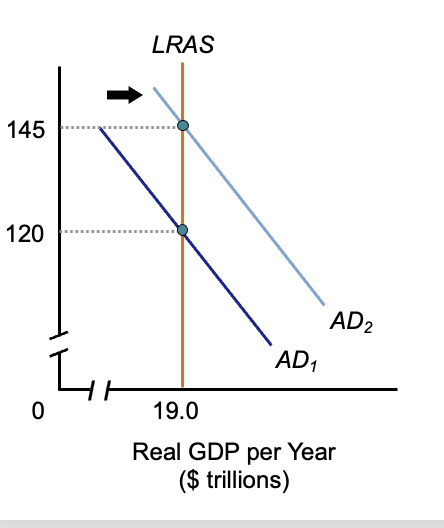
Classical versus Keynesian Models:
Fixed
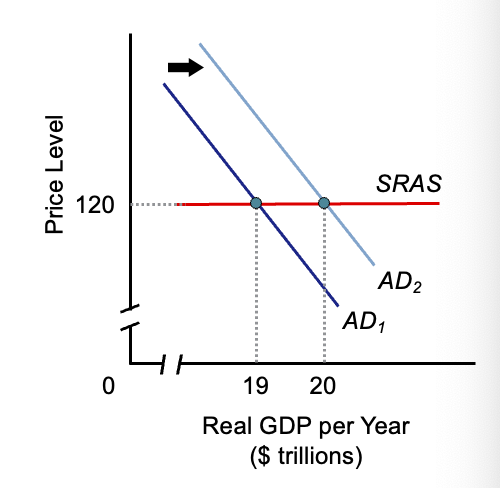
Classical versus Keynesian Models:
Flexible Prices
Prices _____because, the economy can only create goods and services based on the in the (AD/AS Model
rise in the long run , keys to long run growth.
If there is more demand for goods and services, eventually, firms___because they cannot sustainably continue to create more based on the ___
raise prices , level of POLE.
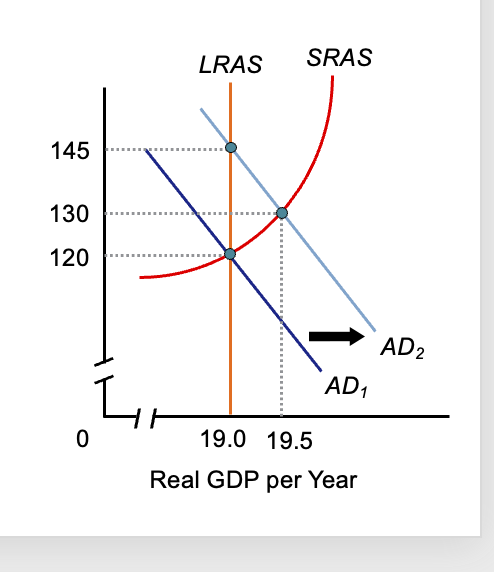
AD/AS model
•Suppose business investments fall in a nation. How does this impact the economy in the short run?
a)Prices decrease and real GDP decreases.
•Increases in Both Aggregate Supply Curves
oShifts Right
oShifts Right in Aggregate Supply Curves
§Discoveries of new raw materials
§Increased competition
§A reduction in international trade barriers
§Fewer regulatory impediments to business
§An increase in labor supplied
§Increased training and education
oShifts Right in Aggregate Supply Curves- §Discoveries of
new raw materials
Shifts Right in Aggregate Supply Curves- §Increased
competition
Shifts Right in Aggregate Supply Curves-§A reduction in
international trade barriers
Shifts Right in Aggregate Supply Curves-§§Fewer___ to business
regulatory impediments
Shifts Right in Aggregate Supply Curves-§An increase in
labor supplied
Shifts Right in Aggregate Supply Curves-§Increased ___ and __
training, education
•Magnitudes
oImportant
oNot Necessarily Same
•M___ Determinants of Long Run & Short Run Aggregate Supply
agnitudes
•Decrease in Short Run Aggregate Supply
oShifts Left
oShifts Left in Short Run Aggregate Supply
§Increased Inflationary Expectations
§Increase in Input Prices
§Increase in Input Prices
–Energy
»Oil, Gas, etc.
–Raw Materials
»Steel, Lumber, etc.
–Wages!
Shifts in ___ Only - Determinants of Long Run & Short Run Aggregate Supply
SRAS
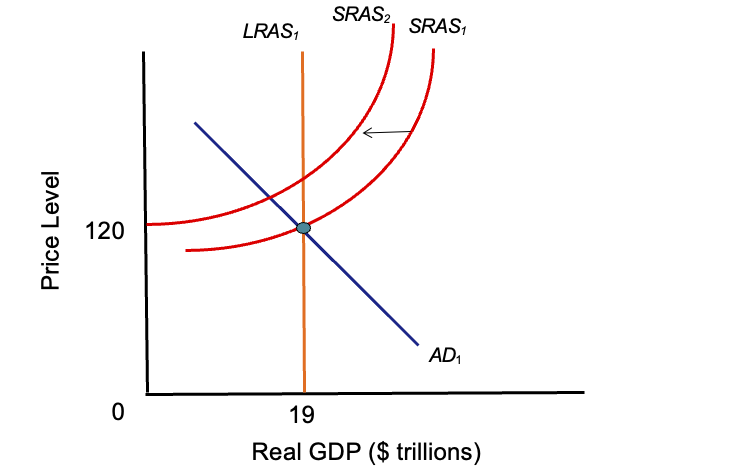
shifts in ___ only
SRAS
•Aggregate Demand Shock
oAny shock that causes the aggregate demand curve to shift inward or outward
•Aggregate Supply Shock
oAny shock that causes the aggregate supply curve to shift inward or outward
•Recessionary Gap means
oGDP < LRAS
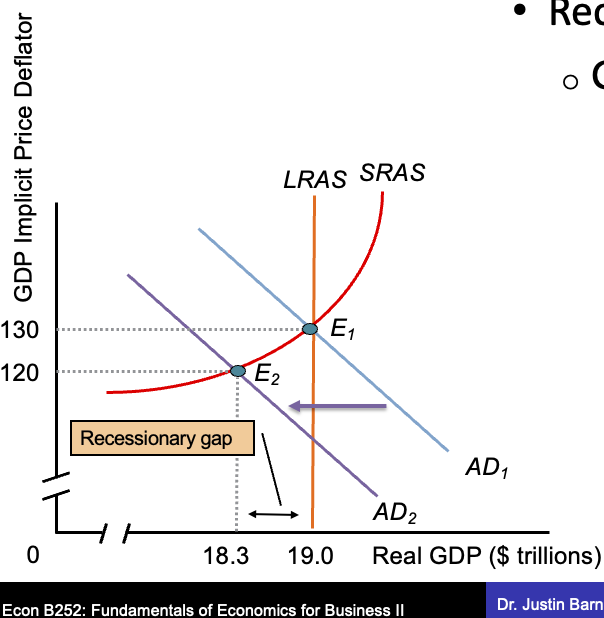
Recessionary Gap
•Suppose exports for a nation increase. How does this impact the economy in the short run?
a)Prices increase and real GDP increases.
Inflationary gap =
•GDP > LRAS
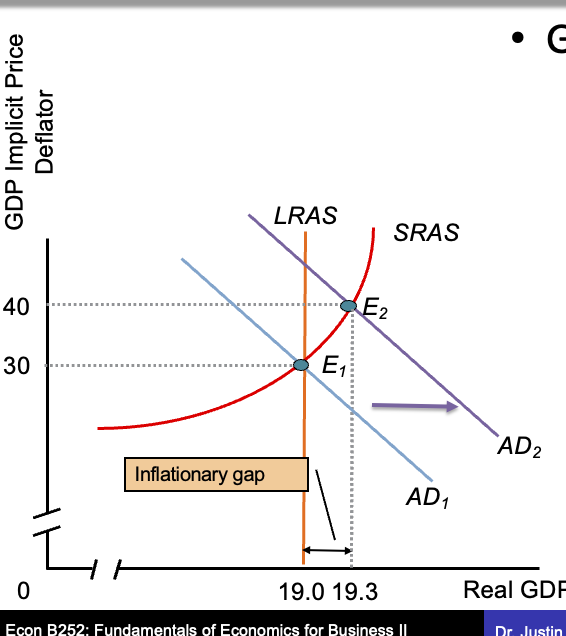
Inflationary Gap
•Suppose wages rise in an economy yet spending does not change. How does this impact the economy in the short run?
a)Prices increase and real GDP decreases.
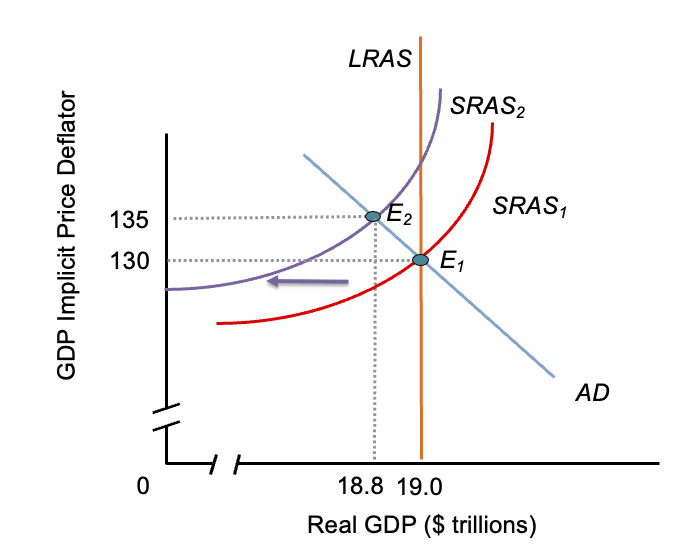
Changes in Short-Run & Long-Run Equilibrium: Two Gaps: Supply Shock
•Economy Correction deflation
“without changes in policy”
“without intervention”
•Economy Correction issues deflation
oInflation Expectations and/or input prices fall.
oSRAS Shifts Right to E3
oPrices fall more but GDP increases or returns to Potential GDP.
•Economy Correction idea deflation
Return to LRAS
•Economy Correction inflation
oInflation Expectations and/or input prices rise.
oSRAS Shifts Left to E3
oPrices rise and GDP falls back to potential.
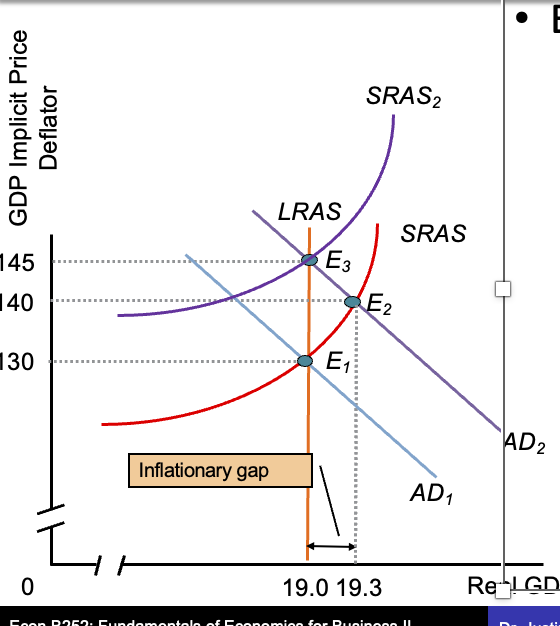
Inflationary gap economy correction
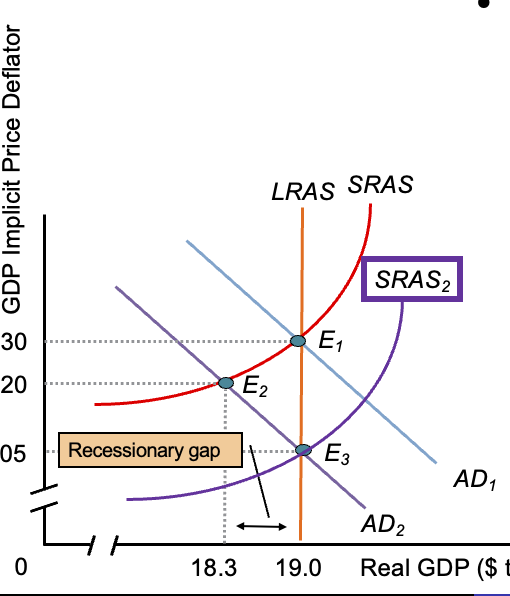
Recessionary gap economy correction
•What would cause the price level to fall and GDP to fall?
a)Aggregate Demand Decreasing
nBetween 2000 and 2001, the price level fell to ___ and real GDP fell to ___
109.7, $9.3 trillion.
nBetween 2000 and 2001, the price level fell to 109.7 and real GDP fell to $9.3 trillion: This result was due to a
leftward shift of the aggregate demand curve.
nBetween 2000 and 2001, the price level fell to 109.7 and real GDP fell to $9.3 trillion.: nDuring this time period, b___ explaining why the ___
business investment in equipment and software (I) fell, price level and real GDP decreased.
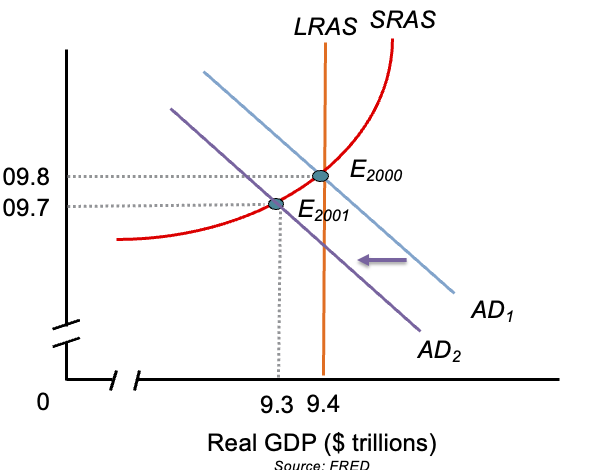
nBetween 2000 and 2001, the price level fell to 109.7 and real GDP fell to $9.3 trillion.
•What would cause the price level to increase and GDP to fall?
a)Aggregate Supply Decreasing
nBetween Q1 2007 and Q4 2008, the price level rose to ___ and real GDP fell to ___
90.8, $15.3 trillion.
nBetween Q1 2007 and Q4 2008, the price level rose to 90.8 and real GDP fell to $15.3 trillion: The result was due to a
leftward shift of the short run aggregate supply curve.
nBetween Q1 2007 and Q4 2008, the price level rose to 90.8 and real GDP fell to $15.3 trillion. Oil prices increased from $71.11 a barrel in July 2007 to ___a barrel in July 2008 explaining why the ___
$145.31 , price level increased, but real GDP fell.
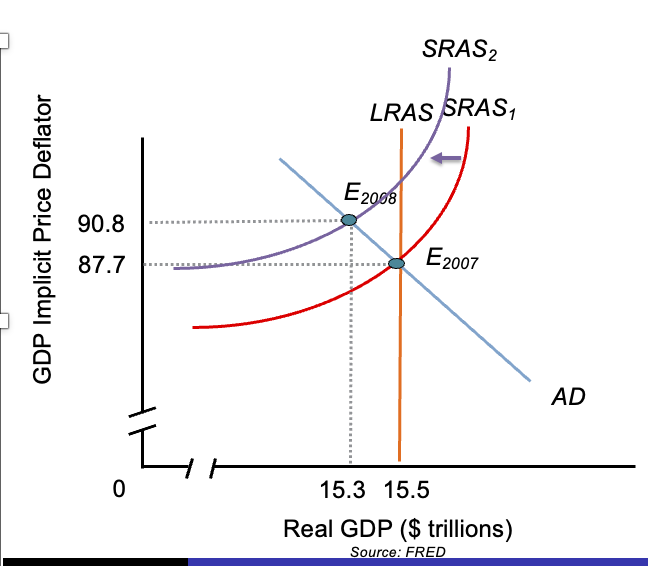
nBetween Q1 2007 and Q4 2008, the price level rose to 90.8 and real GDP fell to $15.3 trillion.
•The simple model can be
misleading
•The simple model can be misleading because
oNo long-run growth (real potential GDP)
oDeflation in model is too common.
•The simple model can be misleading - No
long-run growth (real potential GDP)
•The simple model can be misleading - oDeflation in model is
too common.
•New Assumptions: Complex Aggregate Demand and Aggregate Supply Model
o§Potential Real GDP Increases
§AD Increases
§SRAS Increases
§Potential Real GDP Increases
§AD Increases
§SRAS Increases in
oMost Years
•LRAS & SRAS Shift Right
oIncreases in POLE
•AD Shifts Right From Increases:
oIncome, Business Spending, Public Goods, International Growth, Money
•Prices and Output
oSRAS & AD in Short Run
§Relative Magnitudes
•AD Increase > SRAS Increase
oInflation
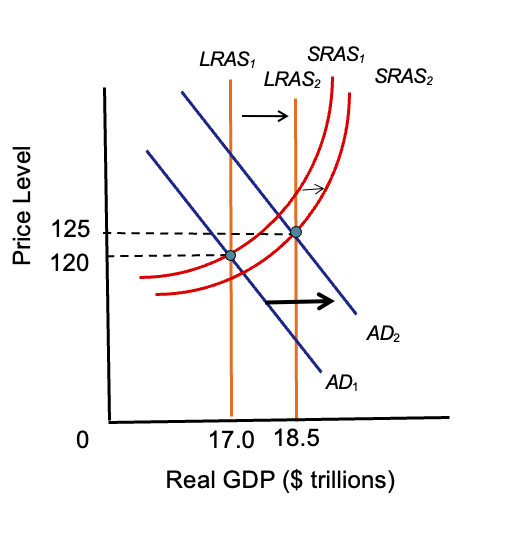
•Economic growth and employment with inflation
•If all three curves increase the same amount
•Economic growth and employment without inflation
•If all three curves increase the same amount
•Economic growth and employment without inflation
•Not very realistic
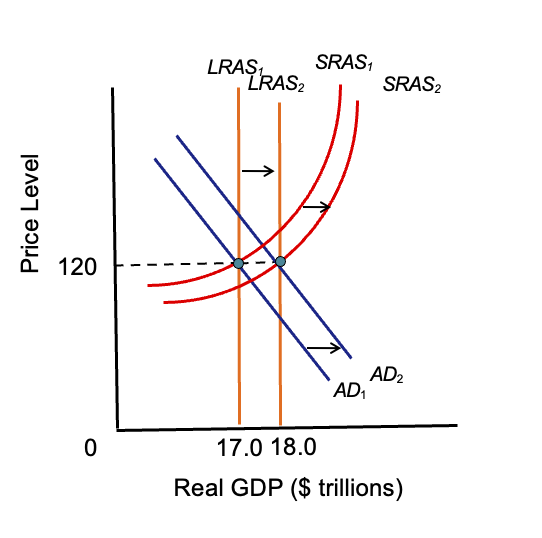
•If all three curves increase the same amount
•Economic growth and employment without inflation
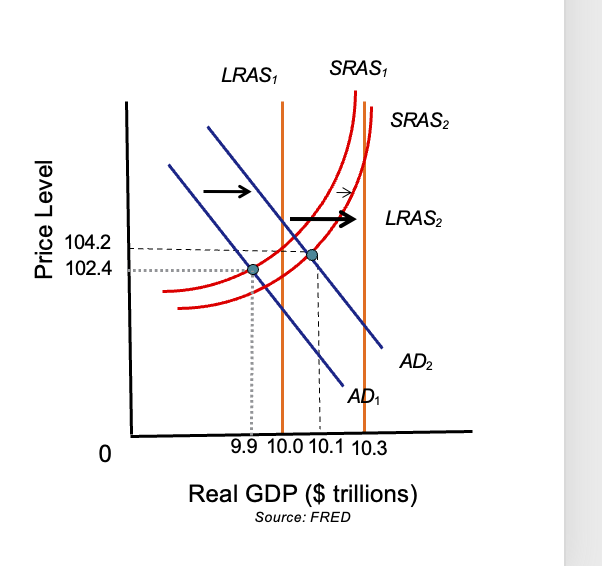
•If AD increases less than LRAS but more than SRAS
•Price level increases (from 102.4 to 104.2):
inflation
•Real GDP increases from $9.9 to $10.1
–But even further below potential
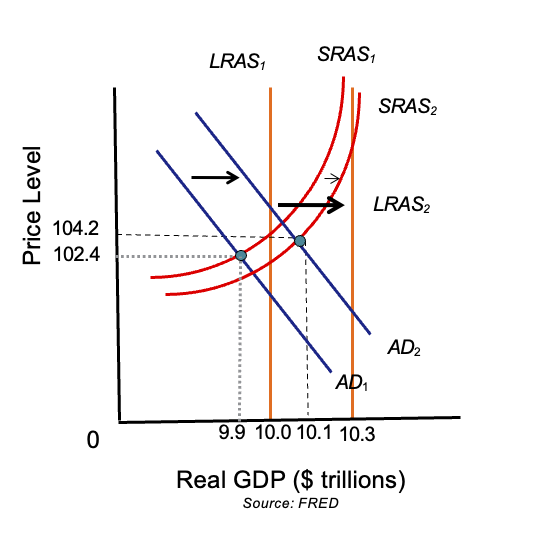
•If AD increases less than LRAS but more than SRAS
•Price level increases (from 102.4 to 104.2): inflation
•Real GDP increases from $9.9 to $10.1
–But even further below potential
•The dynamic model can illustrate
real world outcomes
•he dynamic model can illustrate real world outcomes
oLRAS & SRAS rise
oAD increases as well but not as much
•The dynamic model can illustrate real world outcomes
oLRAS & SRAS rise
oAD increases as well but not as much
oBigger recessionary gap, but with inflation & an increase in unemployment
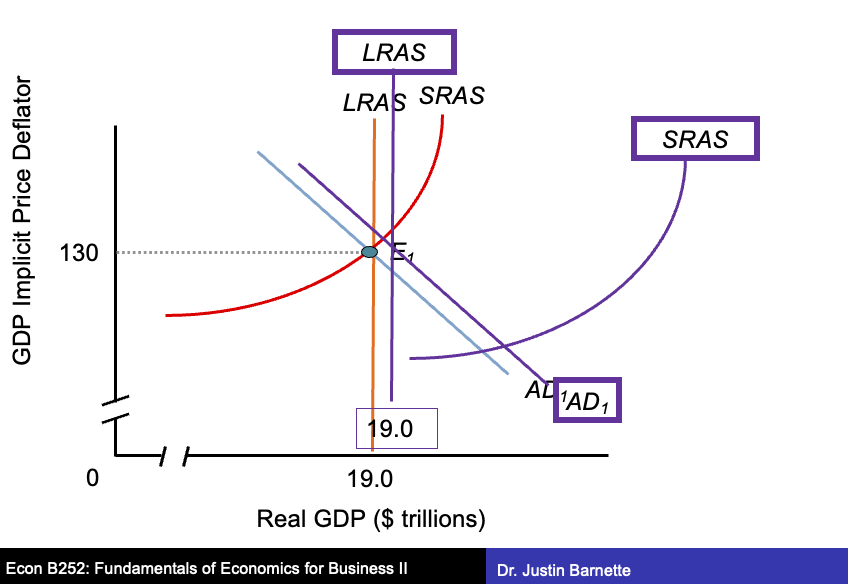
Changes in Short-Run & Long-Run Equilibrium: Two Gaps: Recessionary Gap
How does the economy naturally move back to the long run after being in a short run equilibrium that is away from potential GDP?
a)Expected inflation and/or input prices adjust.
oConsumption
§Spending on New Goods and Services
oSaving
§Income Not Used on Consumption
§Income Not Used on Consumption
–Broader than Money in Banks
–Savings at the household level also excludes new housing.
•What is the primary determinant of spending (or saving)?
Disposable Income
Disposable Income
oYd = Y – T
oYd = Y – T
§Y is GDP
§Leftover Income After Debts
§Leftover Income After Debts–On the macro level,
»GDP After Taxes
•Disposable Income is ___ or ___
oConsumed, Saved
•Disposable Income
oConsumed or Saved equation
§Yd = C + S
•Keynes was concerned with changes in
AD.
AD =
C + I + G + NX
•3 ways to look at C + I + G + NX
oTable Form (Less Focus)
oGraph Form (Less Focus)
oAlgebraic Form
•Consumption Function is
orelationship between consumption and disposable income
•Consumption Function equation
§Spending = Slope*(Disposable Income) + Constant
•Marginal Propensity to Consume (MPC)
oThe ratio of the change in consumption
to the change in disposable income
•Marginal Propensity to Consume (MPC) changes are
differences.

