7) Theories of romantic relationships: Rusbult's Investment Model
 Studied by 0 people
 Call with Kai
 Learn
Learn Practice Test
 Spaced Repetition
 Match
Match Flashcards
 Knowt Play
1/5

There's no tags or description
Looks like no tags are added yet.
Name | Mastery | Learn | Test | Matching | Spaced | Call with Kai |
|---|
No analytics yet
Send a link to your students to track their progress
6 Terms
Investment Model
is a development of social exchange theory (SET), two of these three factors - satisfaction and comparison with alternatives.
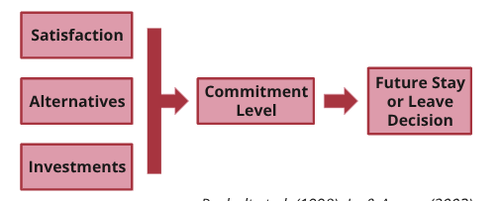
Rusbult et al, commitment depends on 3 factors:
Satisfaction
Comparison with alternatives
Investment
Factor 1: Satisfaction
The extent to which romantic partners feel the rewards of a relationship exceed the costs.
Is based on the concept of the comparison level (CL). A satisfying relationship is judged by comparing rewards and costs (e.g. conflicts, anxiety).
Each partner is generally satisfied if they are getting more out of the relationship than they expect based on previous experience and social norms.
With the relationship, positive rewards are relative to negative costs in the relationship
Also influenced by the extent to which the person’s needs are being fulfilled.
Factor 2: Comparison with alternative
A judgment that partners make concerning whether a relationship with a different partner would bring more rewards and fewer costs.
CLalt (in SET too) results in romantic partners asking themselves, ‘Could my needs be better met outside my current relationship? Are the alternatives more rewarding and less costly?’
Alternatives include not just relationships with other people, but the possibility of having no romantic relationship at all.
Absence of a better option maintains the relationship, but if needs are better fulfilled elsewhere, it will not proceed.
Attractive alternatives may not necessarily be other people; having no relationship may be better in some cases.
Factor 3: Investment
The resources associated with a romantic relationship which partners would lose if their relationship were to end
Ties that bind partners, resources, we would lose if the relationship were to end.
High investments creates a powerful pressure to stay in the relationship.
Rusbult said that there were 2 types:
Intrinsic investment → What we put directly into the relationship - can be tangible (e.g. money, possessions) or intangible (e.g. energy, emotion).
Extrinsic investment → resources brought to our lives through the relationship, e.g. mutual friends. Resources that previously did not feature in the relationship, but are now closely associated with it. Tangibles include possessions being brought together (e.g. car or a house) and intangibles (e.g. shared memories).
Commitment Levels
The likelihood of a relationship will persist, a key factor to sustain a relationship.
Maintain a relationship, commitment is affected by all 3 factors (alternatives, satisfaction, investment)
It is high in relationships with a high level of satisfaction, where investment is high, and alternatives are low and is low when satisfaction and investments are low, and quality of alternatives is high
 Note
Note  Flashcards (30)