Ch. 4: Sociological Positivism
 Studied by 0 people
 Call with Kai
 Learn
Learn Practice Test
 Spaced Repetition
 Match
Match Flashcards
 Knowt Play
 Podcast
1/36

There's no tags or description
Looks like no tags are added yet.
Name | Mastery | Learn | Test | Matching | Spaced | Call with Kai |
|---|
No analytics yet
Send a link to your students to track their progress
37 Terms
Strain Theory
Three Relevant Time Periods
19th century - middle of the 20th century: Rise of sociology.
Early 1920s - WW2: Tools of sociology were being turned to examine problems with a specifically modern character (effect of immigration on crime, economic position of society - unemployment + crime).
Also a period of mass oppression in certain countries (era of Hitler, Stalin).
Late 1940s - 1950s: Explain persistent crime rates even in the face of apparently good economic and social conditions.
Evolution of capitalism, moving from harsh world conditions to more stable conditions.
Sociology
A social science that examines the structure, organization, and culture of societies and their processes of social change and social interaction.
Strain Theory
Theory that crime is a social phenomenon. Based on a sociological understanding of individual and group behaviour, one that sees specific activity, such as crime, as somehow being related to and shaped by wider social processes and structures.
Rather than looking at aspects of personal psychology or individual biological traits, strain theory argues that crime is socially induced.
Person is a product of a specific kind of social order.
Wider societal forces and factors determine the activities and values of the offender, and the offender has few conscious choices regarding his or her available social options.
Strain Theory Features
Natural, violation of consensus.
Structure of opportunities, nature of social learning, youth subcultures.
Result of neighbourhood decay and disorganization and is a natural reaction to adverse social and environmental conditions.
Social strain (e.g. opportunity structure), learned behavior
Determined by social pathology.
Provide an opportunity to reduce strain, re-socialize the offender.
Expanding opportunity and fostering healthy peer-group activity.
Individual rehabilitation combined with social programs.
Consensus
A commonly agreed upon position, conclusion, or set of values; a term normally used in reference to public opinion.
Classical, biological and psychological also agree with the fact that there is a social consensus.
Strain Theory in Comparison to a Cell
A theory that assumes society is like an organism or mechanical system.
If all parts of the system work together there is harmony.
However, if one part of the organism does not work properly, strain occurs on the other parts of the system as well.
The system must find ways to adapt to the strain or it will lead to system transformation.
Emile Durkheim
One of the central figures in this process was French sociologist.
Was writing at the beginning of the twentieth century.
Durkheim presented an analysis of society and of social problems in a manner that demonstrated the close relationship between social structure (the organization of society) and the norms and values of society (social and cultural life).
Division of Labour
The division of roles, tasks, and duties within a household, workplace, or community.
Durkheim said that where you have an unhealthy division of labour (e.g., based on force rather than choice) or an unhealthy regulation of the collective conscience (e.g., norms that are not well established), there is greater likelihood of widespread crime, and the level of crime will be greater.
Societies vary in their ability to impose social regulation, and this is due in part to the nature of the division of labour.
Mechanical Solidarity
Refers to a state of community bonding or interdependency that rests on a similarity of beliefs and values, shared activities, and ties of kinship and co-operation.
In a society characterized by mechanical solidarity, the emphasis tends to be on rigid conformity and cultural homogeneity.
Tends to generate repressive justice, which reaffirms the common beliefs and values by distancing the deviant from the wider collective.
Durkheim’s basic concept in an analysis of a society.
Organic Solidarity
Refers to the state of interdependency created by the specialization of roles. Individuals and institutions become dependent on others in a complex division of labour.
The organic solidarity of industrial society is one in which people are linked though law and interdependence rather than similarity of life experience.
Tends to generate restitutive sanctions that aim to restore the social disruption by reintegrating the deviant back into the network of interdependencies.
Durkheim’s basic concept in an analysis of a society.
Egoism
An ethical theory that treats self-interest as the foundation of morality.
Dysfunctional societies can be characterized by an overemphasis on egoism, where value is placed on the unrestricted pursuit of individual desires.
Here, the norms of society itself can produce deviant behaviour.
Anomie
An absence, a breakdown, confusion, or a conflict in terms of the norms of society.
We have a state of normlessness in which society fails to impose norms that inhibit such behaviour.
For example a society or community at its breaking point, where rapid change has destroyed many of the values and norms.
Chicago School
Also referred to as the Chicago School, an approach that emphasizes the characteristics of population groups and the mapped locations of such groups relative to one another.
It views the social disorganization that characterizes delinquency areas as a major cause of crime and victimization.
Favouring the free-market economics.
Ecological Model
Also referred to as the Chicago School, an approach that emphasizes the characteristics of population groups and the mapped locations of such groups relative to one another.
To study the impact of urban growth, the lifestyles of residents, and the effects of social change on the city.
It views the social disorganization that characterizes delinquency areas as a major cause of crime and victimization.
Social Disorganization Theory
The theory that crime and other deviant behaviour is most likely to occur where social institutions are not able to direct and control groups of individuals.
Popularized by two Chicago sociologists, Clifford Shaw and Henry McKay.
Linked life in transitional slum areas to the inclination to commit crime.
Placed crime and delinquency within the context of the changing urban environment and ecological development of the city.
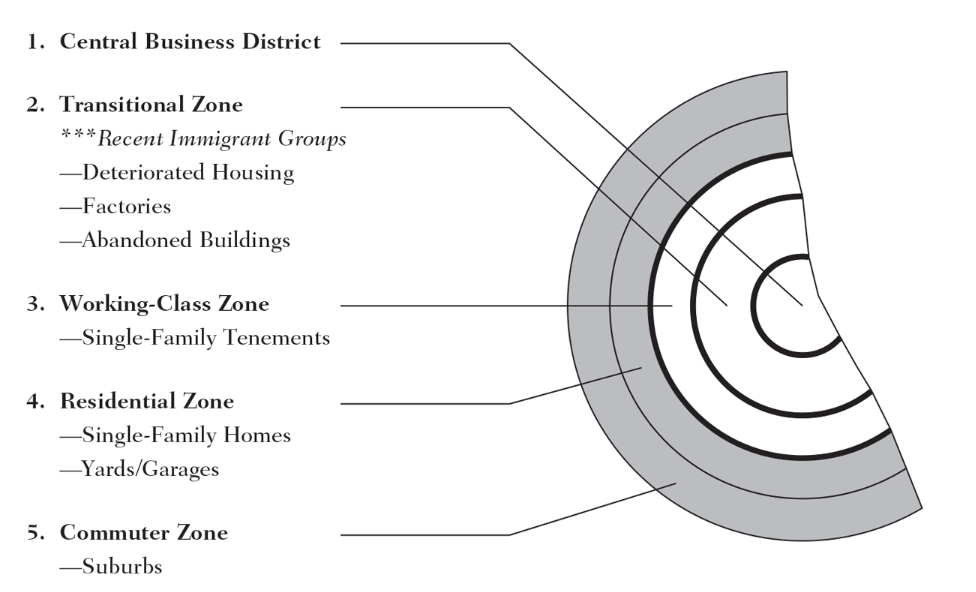
Concentric Circles (Zones)
Concentric circles were identified by the Chicago School as zones of development that impact crime and crime rates.
The Chicago School argued that urban social structures develop in concentric circles.
Under the concentric circle theory, urban growth spreads in a circular area around a central business district.
Series of five concentric zones, where there were significant and stable differences in crime rates between the zones.
Transition Zones
Zones that are characterized by frequent changes in population composition and high levels of social disorganization. Transition zones are typically located in inner cities.
New immigrant groups moved into the area, bringing with them divergent cultural and moral standards and the gradual industrialization of the area.
A breakdown in conventional neighbourhood traditions and institutions occurred, and the ability of the neighbourhood to enforce the moral standards of society was diminished.
A zone within the concentric circle.
Dilemma Facing Sociologists (and Criminologists) in the 1950s
While depressed economic conditions and overall diminished job opportunities seem to provide a reasonable explanation for some types of criminal activity, how are we to explain the incidence of crime in periods of economic growth?
Five Responses to Structure Opportunities
Conformism
Innovation
Ritualism
Retreatism
Rebellion
Conformism
Conformism: Those who accept the culturally defined goals (e.g., financial success) and the institutionalized means of attaining them (e.g., education).
Innovation
Those who accept the culturally defined goals but who lack the institutionalized means to attain them. They therefore resort to innovative means to attain the goals, such as turning to crime (e.g., robbing a bank).
Ritualism
Those who accept the culturally defined goals but who know they cannot attain them. Nevertheless, they continue pursuing institutional means (e.g., staying in school when no jobs are available), regardless of the outcome.
Retreatism
Those who reject both the culturally defined goals and the institutionalized means of attaining them. They retreat from society in varying ways (e.g., substance abuse).
Rebellion
Those who substitute their own cultural goals and institutionalized means in place of the conventional goals and means in society. They create their own goals and means of achieving them (e.g., ecologically sustainable hippie lifestyle).
Youth Subcultures
Work Sutherland and Cressy (1974)
Argued that crime was cultural through learned behaviour.
People in particular neighbourhoods or particular social situations learn about criminal behaviour by interacting with other people.
The most significant interaction occurs within intimate personal groups (peer groups).
Learning of Criminal Behavior Includes
(3 Elements)
Created by Sutherland and Cressy
Techniques of committing a crime (e.g., how to hotwire a stolen car);
Motives, drives, attitudes, and rationalizations associated with crime (e.g., stealing only Porsche cars because “the owners can afford it anyway”)
Definition of the legal code as favourable or unfavourable (e.g., regarding the legal code relating to car theft as unfavourable, since people have car insurance anyway).
Social Ecology
An approach to theorizing that attempts to link the structure and organization of any human community interactions to interactions with its localized environment.
Looks at how aspects of the physical and social environment at the local level influence patterns of offending and the fear of crime.
Use to try to explain the uneven distribution and impact of crime and to develop crime prevention and policing strategies that take into account characteristics of the local environment.
Community-Level Social Disorganization
(Neighborhood Effect)
Focus is on particular kinds of neighbourhoods, such as inner-city, marginalized communities. For example, persistent high crime among black youth is due to both structural and cultural factors.
Stress the importance of considering the impact of “neighbourhood effect” when it comes to crime.
The social status and crime rate of a neighbourhood have been shown to have an effect on a person’s chances of becoming involved in offending behaviour, regardless of their specific socio-economic status.
Reduces youths ability to be able to participate in activities normally (e.g. school, church, outdoor activities).
Environmental Criminological Theory
An emerging perspective that focuses on the importance of geographical location and architectural features as they are associated with the prevalence of criminal victimization.
Social disorganization theories have been applied in an attempt to create buildings and neighbourhoods that discourage criminal behaviours through design.
Associated with Oscar Newman.
Defensible Space
Related to Oscar Newman.
A concept that emerged from environmental criminology that suggests public spaces should, and can, be designed to create a sense of ownership in residents and users.
Believes that the type of design can make space easier to defend from potential criminal activity.
This can include the use of strategically placed lighting to discourage deviant activities or loitering, the use of play areas and benches to encourage people to go out in their neighbourhoods, etc.
Routine Activities Theory
3 Elements - MSA
A theory that claims occurrences of personal victimization are dependent on the “routine” of “daily activities” of people and are the outcome of three elements:
Motivated offenders: Addicts, people unemployed, delinquent youth.
Suitable targets: Unlocked cars or homes.
Absence of suitable guardians: Officers, cameras, homeowners.
Put forward by Lawrence E. Cohen and Marcus Felson. Argue that lifestyle changes can reduce the ability to become a victim.
Life Course Criminology
Two Elements - TT
A revised theory of social control.
Posit that crime is an evolving process that cannot be fully explained by either individual or environmental factors.
Relies on two concepts:
Trajectories: A pathway or line of development over the lifespan of the individual and can include such elements as work, career, and family pathways.
Transitions: Represent specific life events, such as leaving school, the birth of a child, a first job, or retirement.
Major Themes Associated with Life-Course Criminology
The first theme concerns itself with the social meanings of age throughout the life course.
Second explores the intergenerational transmission of social patterns.
Third additional theme focuses on the effects of major events, such as the Great Depression or World War II, and structural location (i.e., class or gender) on the life histories of individuals.
Criticism of Sociological Theory
Focuses mainly on working-class crime.
Assumes society’s goals are a shared consensus, not shaped by power.
Ignores structural inequality and how capitalism marginalizes people (into lower classes).
Oversimplifies the link between blocked opportunities and crime.
Fails to consider social bonds that can effect offending (school, family, peers)
Cannot explain why some people overcome poverty without offending.
Theorists Associated with Sociological Crime
Émile Durkheim: Considered the founder of sociological criminology.
Robert K. Merton: Developed strain theory.
Edwin Sutherland: Developed differential association theory.
 Note
Note  Flashcards (24)