Enzyme activity
 Call Kai
 Learn
Learn Practice Test
 Spaced Repetition
 Match
Match Flashcards
 Knowt Play
1/10

There's no tags or description
Looks like no tags are added yet.
Name | Mastery | Learn | Test | Matching | Spaced | Call with Kai |
|---|
No analytics yet
Send a link to your students to track their progress
11 Terms
What are enzymes
Biological catalyst which affect metabolism at a cellular and whole organism level, as a result affect structure and function of cells and whole organisms. They are globular proteins with a specific tertiary structure and their active site is specific to a substrate.
What bonds hold a enzymes tertiary structure together
Hydrogen, ionic and disulfide bonds
What does intracellular enzyme mean
These are enzymes which catalyse reactions within the cytoplasm of cells like catalase an respiratory enzymes or TET
What does extracellular enzyme mean
These are enzymes which catalyse reactions outside the cell like digestive enzymes such as amylase and trypsin
What extracellular enzyme is involved in starch digestion
Amylose which works in mouth and small intestine. It is in saliva, breaks down starch to maltose then swallowed in the small intestine and maltose broken down into glucose which can be absorbed
What extracellular enzyme is involved in break down of protein
Trypsin breaks down proteins into smaller enzymes. Other enzymes break down smaller peptides to amino acids.
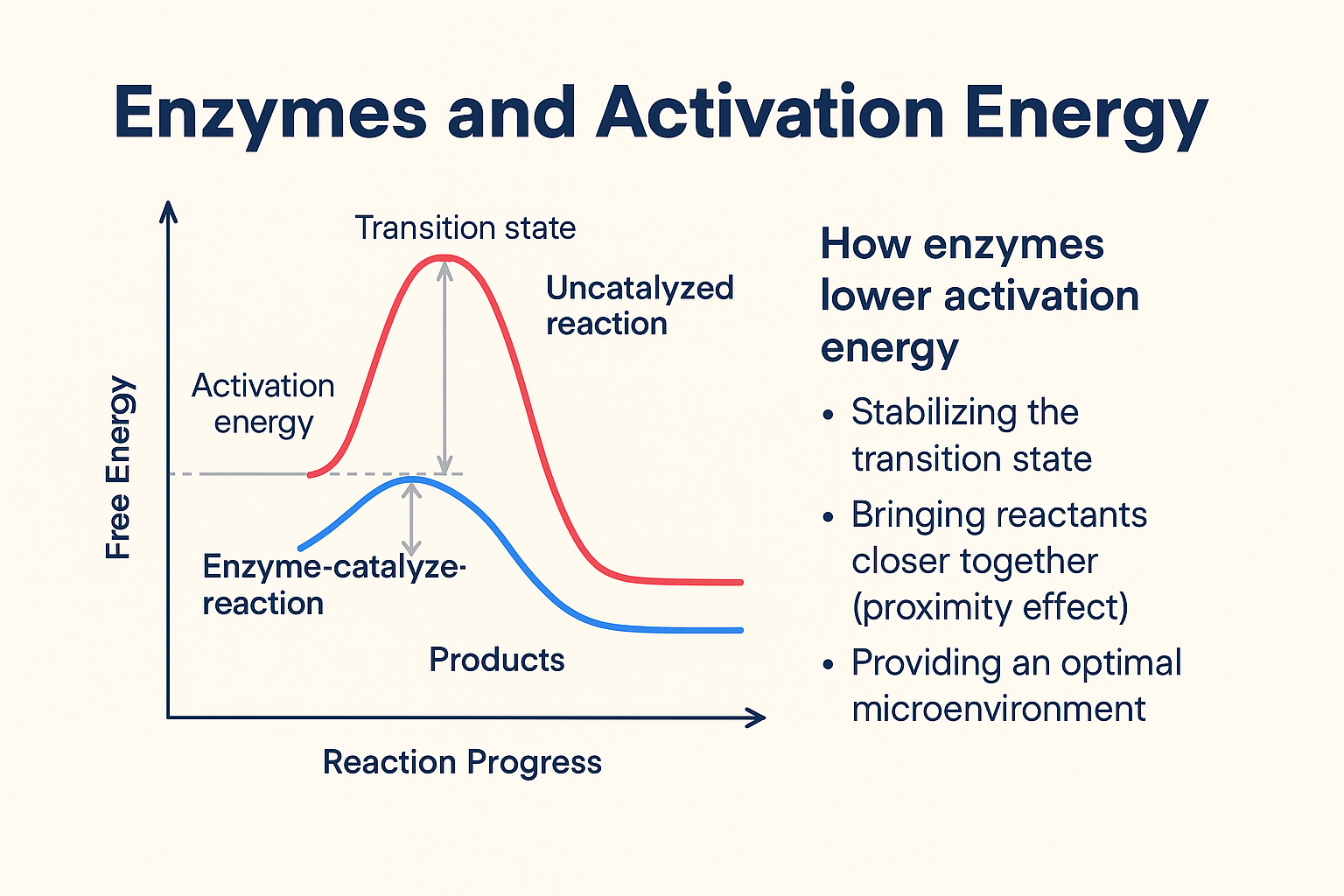
What does catalyst do to activation energy
Activation energy is energy required to initiate a reaction, enzymes lower activation which leads to faster rate of reaction by straining bonds in substrate
What is the lock and key hypothesis
Active site of an enzyme is a specific shape in which a substrate has a complimentary shape to fit into the active site
What is the induced-fit hypothesis
Active site of the enzyme undergoes conformational change so it can fit substrate and from enzyme-substrate complex. Active site returns to original shape once products leave. Lower AE more than lock and key
How does induced-fit mechanism lower activation energy
The active site changes so there is stronger temporary bonds between substrate and active site so bonds in substrate put under strain which lowers activation energy.
How can enzyme activity change as enzymes evolve from one enzyme
Enzymes can evolve into two different enzymes for greater control of reactions as the two different enzymes have active sites changed shaped so only complimentary for one substrate.

