Modernism to Postmodernism
 Studied by 1 person
 Call with Kai
 Learn
Learn Practice Test
 Spaced Repetition
 Match
Match Flashcards
 Knowt Play
1/8

Earn XP
Description and Tags
De Stij, Bauhaus, and Le Corbusier
Name | Mastery | Learn | Test | Matching | Spaced | Call with Kai |
|---|
No analytics yet
Send a link to your students to track their progress
9 Terms
Modernism
a 20th-century movement that rejected historical styles in favor of function, abstraction, new materials, and industrial logic, guided by the principle “form follows function.
Clean lines, no ornament
Use of steel, glass, concrete
Faith in progress and technology
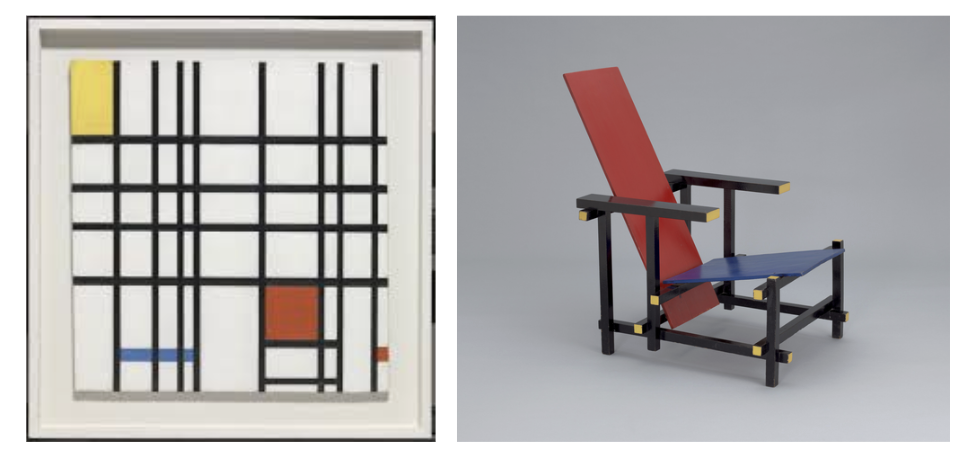
De Stijl
Horizontal & vertical lines
Primary colors + black/white
Universal order through abstraction
Piet Mondrian – Composition with Yellow, Blue and Red (1937–42)
Grid of black lines
Primary colors only
No representation
Gerrit Rietveld – Red/Blue Chair (1917)
Furniture as abstraction
Planes and primary colors
Painting principles applied to design
Art enters everyday life
The Bauhaus
A short-lived but enormously important and influential school of art and design in Germany.
Unified art, craft, and industry
Emphasis on functionality and mass production
Closed by Nazis in 1933
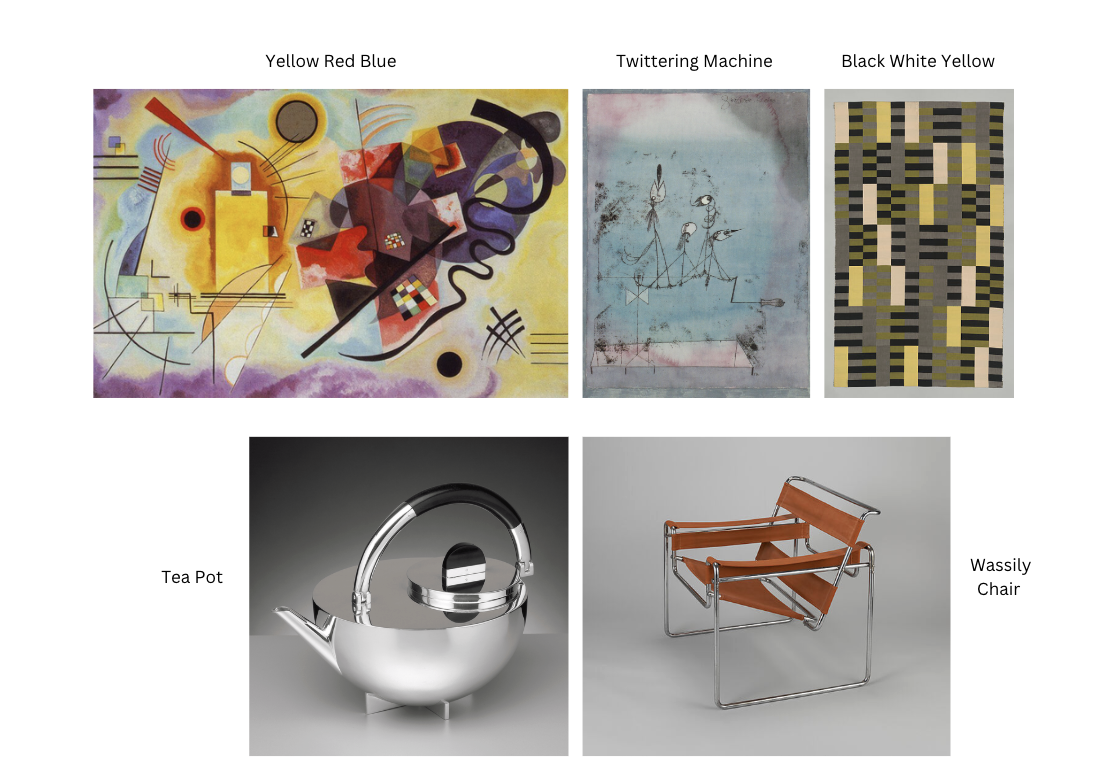
Artists & Designers at the Bauhaus (KEY WORKS)
Vasily Kandinsky – Yellow, Red, Blue (1925)
Expressionist Painting
Paul Klee – Twittering Machine (1922)
Childlike forms
Machine + fantasy
Humor within abstraction
Anni Albers – Black White Yellow (1926)
Textile as modern art
Geometry and rhythm
Functional design elevated
Marianne Brandt – Tea Pot (1924)
Industrial materials
Simple geometric form
Beauty + utility
Marcel Breuer – Wassily Chair (1925)
Tubular steel
Inspired by bicycles
Mass production design
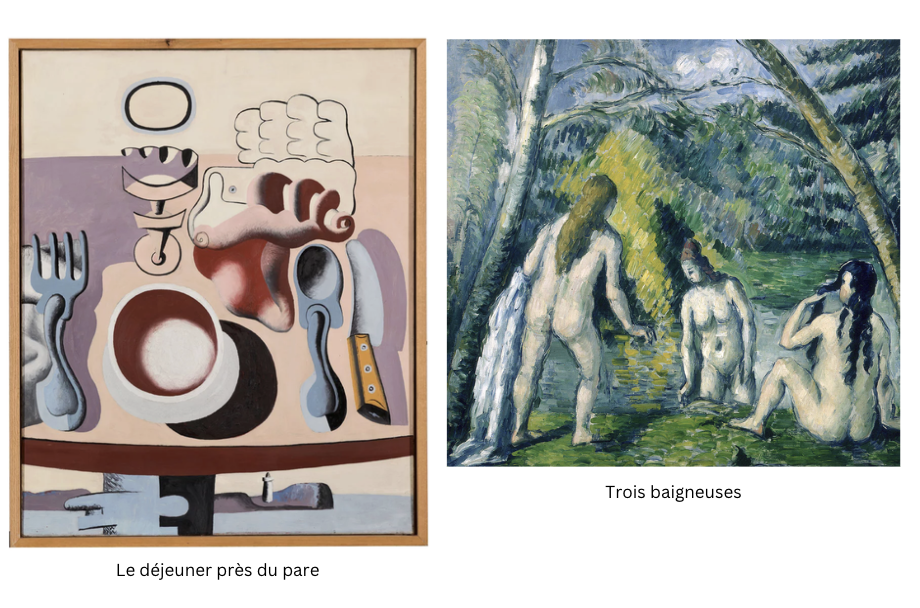
Le Corbusier
Swiss-French architect, theorist of Modernist architecture, author of Vers une architecture.
Purist Paintings
Le déjeuner près du pare
Trois baigneuses
Characteristics
Clean forms
Classical balance
Machine aesthetics
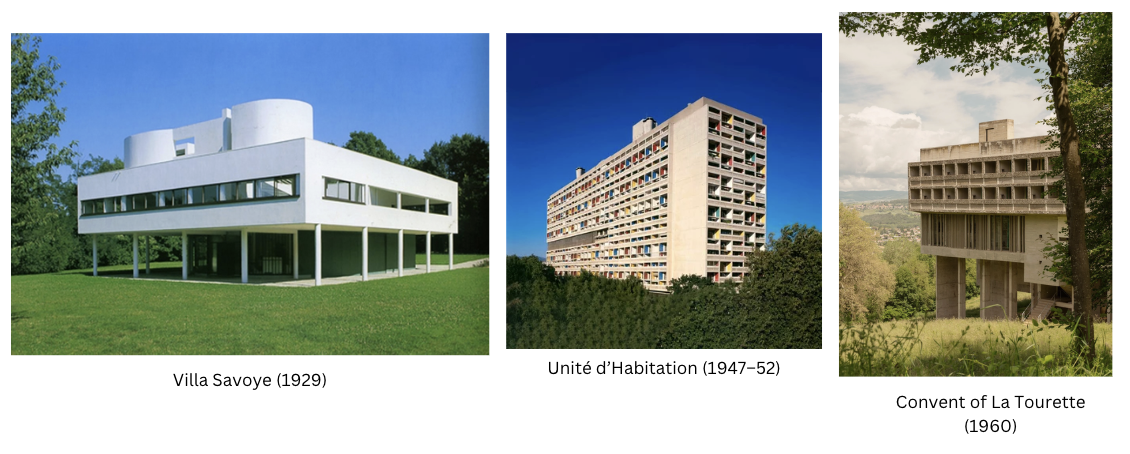
Architecture & Urban Planning - Le Cobusier
Le Corbusier – Villa Savoye (1929)
Five Points of Architecture
Pilotis, free plan, ribbon windows
House as “machine for living”
Unité d’Habitation (1947–52)
Vertical city
Modular housing
Social modernism
Convent of La Tourette (1960)
Brutalism
Raw concrete
Spiritual minimalism
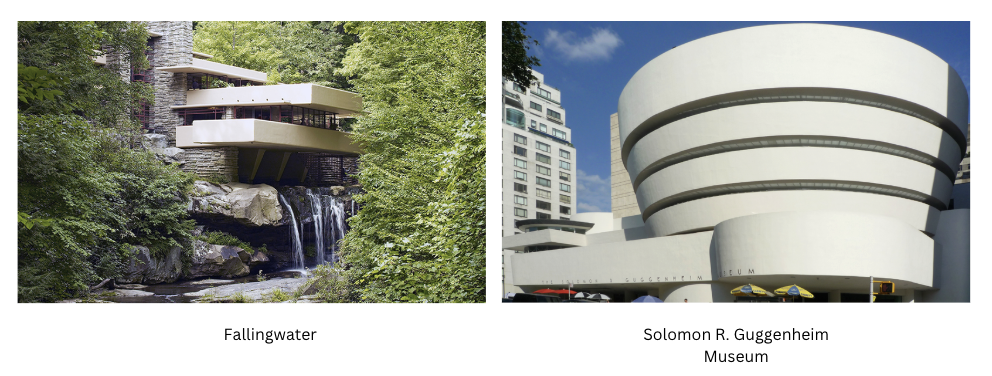
Frank Lloyd Wright
Frank Lloyd Wright – Fallingwater (1937)
Building integrated into nature
Human-centered modernism
Solomon R. Guggenheim Museum (1942–59)
Spiral ramp
Continuous viewing experience
Breaks traditional museum design
Postmodernism
Postmodernism rejects Modernist seriousness, embracing ornament, irony, historical reference, and playfulness.
Against pure function
Eclectic and symbolic
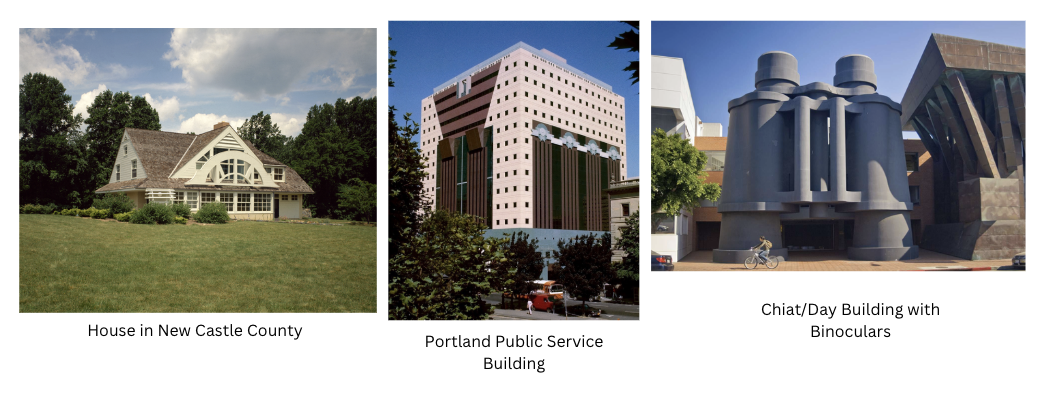
Key Works - Postmodernism
Robert Venturi – House in New Castle County (1978–83)
Historical references
Complexity over purity
Reaction against Villa Savoye
Michael Graves – Portland Public Service Building (1980–82)
Decorative façade
Color and symbolism
Anti-International Style
Frank Gehry – Chiat/Day Building with Binoculars (1991)
Architecture as sculpture
Humor and pop culture
Blurs art and building
 Note
Note  Flashcards (24)