PSY 654: Cognitive Psychology - Midterm 2 Review
 Call Kai
 Learn
Learn Practice Test
 Spaced Repetition
 Match
Match Flashcards
 Knowt Play
1/136

Earn XP
Description and Tags
Name | Mastery | Learn | Test | Matching | Spaced | Call with Kai | Chat |
|---|
No analytics yet
Send a link to your students to track their progress
137 Terms
Structure of long-term memory
many different kinds of long-term memory that the brain allows us to have
Process of long-term memory
moving things from short-term to long-term memory
How do we study the distinction between short and long-term memory?
using word lists
each word is a unique event you’re exposed to
how many mini-events can you remember?
Murdock (1962) Serial Position Curve
participants presented with 20 words, shown one at a time
asked to try to remember as many words as they can, in any order
when we take the average, these are the results:
we will always get this pattern of data
we remember the things we see first really well (primacy effect), and the ones we saw last really well (recency effect)

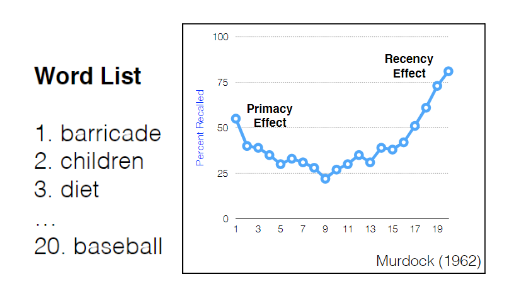
Primacy effect:
first things are remembered better
Recency effect:
last things are remembered better
What was thought as the reason for the primacy effect?
More time to think about the words presented first
Rundus (1971) Primacy Effect Study
similar to the Murdock (1962) study but had participants rehearse the words aloud
results:
words from the beginning of the list, which were more likely to be remembered, were rehearsed more often
concluded that the primacy effect occurs because rehearsing things many times probably does a good job at moving things into long-term memory
However, this does not explain why we remember the end of the list so well, even though we didn’t rehearse this at all
another system must be working to hold onto this information (short-term memory)

Glanzer and Cunitz (1966) Recency Effect Study
Similar to the Murdock (1962) study but run with a delay condition
after given the 20th word, participants were given a 30-second delay and had to count numbers backward in that time before asked to remember as many words as they can
results:
when you wipe out anything that might have been in short-term memory, the recency effect goes away
the primacy effect does not go away with the delay because rehearsal pushed it into long-term memory

What do the Murdock (1962), Rundus (1971), and Glanzer and Cunitz (1966) studies show us?
A distinction between two systems of memory: short-term and long-term memory

Where is the hippocampus?
It is buried in the medial temporal lobe
What type of memory is stored in the hippocampus?
episodic memory
What happens when there is damage to the hippocampus?
You would lose access to episodic memories but would still have access to other types of memory.
Patient HM: most famous amnesia case
Had intractable epileptic seizures that were impacting the quality of life
Scoville decided to cut out the part of the brain where the seizures were occurring
It did help with the seizures
However back then they did not the importance of certain parts of the brain for memory
HM’s hippocampus was affected by this surgery (some of it was removed)
amnesia: loss of episodic memory
Brenda Milner: studied HM and his memory post-surgery
used an implicit mirror-tracing task
asked HM to draw a star in between two stars with his non-dominant hand only by looking through the mirror
HM would get better on repeated attempts even though he had no memory of previously participating in the task
using this task, Milner found a distinction between declarative memory (“knowing that”) and procedural memory (“knowing how”)
Declarative memory
“knowing that”
things we can talk about: names, dates, facts, personal experiences
conscious memory
broken down into semantic and episodic memory
Procedural memory
“knowing how”
unconscious memory
e.g., riding a bike
motor system knows how to do it, not devoting any conscious resources
Semantic memory
general knowledge of the world
completely different from memories of our personal experiences
facts
i.e., names, facts about yourself
Episodic memory
memory of past experiences
specific events (exact moments: time and place)
ability to re-experience the past in our minds
Endel Tulving, studied patient KC
Patient KC: second most famous amnesia patient
In a motorcycle accident not wearing a helmet
Extensive brain damage including damage to both sides of the hippocampi
Knew a lot of things about himself (semantic memories) but could not relive anything that happened in his life (no memories of personal experiences)
Shows a distinction between semantic and episodic memory
Endel Tulving interview with KC
Asked him to define different words
Afterwards, presented him with another group of words (some that he asked him to define and some new words) and then asked him to recall which words were the ones he previously asked him to define
KC did a really good job at defining the words, but he struggled a lot to remember which words he was previously asked to define
typical cases of amnesia vs. portrayal in the media and popular culture
The most typical cases of amnesia are the loss of episodic memory and an inability to learn new things or make new memories
The media and pop. culture portray a fugue state
someone has no idea who they are but can still make new memories
the person dissociates themself from themself (not completely well understood)
this is very uncommon
Loss of episodic memories is extreme with amnesia cases, but…
…it is something we all experience over time
Petrican et al. (2010): Semanticization of Episodic Experiences
Participants were asked to recollect details about famous faces
They were able to recognize faces irrespective of the age of the celebrity
However, they were less likely to remember details about why they were famous with increasing age of the celebrity (the longer ago it was)
The older the celebrity the less they remember about that person

Our ability to remember episodic memories declines over time as a function of age, our semantic memory doesn’t decline with age, it actually gets better (more general knowledge)
Implicit Memory
the unconscious influence of memory on behavior
skills that we adopt
procedural memory
priming: exposure
preferences
Implicit memory - skills that we adopt
e.g., riding a bicycle
e.g., Patient HM, mirror tracing
Draw the star in between two stars with the wrong hand only looking through the mirror
HM was better at the task the more he tried even though he had no memory of doing it (because of his amnesia)
If someone had a skill before having amnesia, they would still have that skill even after
Implicit memory - priming: exposure
Reading times
brain is getting faster at faster, and it feels like you know it better but your brain is just working less and less each time because it has seen it before
Word-stem completion
shown an incomplete word and asked to complete it (i.e., base_ _ _ _ )
something you saw previously would influence your response
word stem study with amnesia patients
Control group and group of amnesia patients, both given a list of words
Both groups were asked to both recall the list of words from memory, and also given a word-stem completion to remember the words
Results: priming effect made them preform as well as the control group
Amnesia patients could not remember studying the words (recall), but were similarly influenced when completing a word-stem completion task that did not require them to consciously remember the list

Implicit memory - preferences
The more you are exposed to something the more you like it, even though we are not consciously aware of that fact
Companies know this and use it to their advantage
Imagining the future
Started to realize that memory might not only be about the past
Memory can extract details of your past experiences and recombine them to form these novel mental stimulations of things that have never happened before (imagining the future)
When we think about our future, we have vivid mental images, and that is our brain using details from our past
What evidence do we have that supports that we use memory to imagine the future?
brain damage
when you lack access to your memory, you cannot imagine your future
brain imaging
participants in an fMRI scanner and ask them to remember the past, and to imagine the future → the same network of regions in the brain are activated
development
The ability to remember specific things or imagine things doesn’t start until about 5 years of age
Starts to decline with decreasing age


Long-term memory processes: how do we get things into long-term memory?
encoding
retrieval
encoding/retrieval interactions
Encoding perspectives
Levels of Processing
Self-processing
Survival Processing
Visual Imagery
Generating Information
Retrieval Practice
Levels of Processing (encoding)
How you think about something when you are encoding will affect how you remember it
Craik and Tulving (1975) Levels of Processing Study (encoding)
Gave participants a list of words
Had them think about the words in certain ways, 2 conditons:
Superficial features of the word
Meaning of the word
Results:
when we think about meaning, instead of superficial things, we encode the information better
to get things into long-term memory we have to think about what they mean

Self-Processing (encoding)
Trying to relate things to ourselves helps us to encode memories
Rogers et al. (1977) Self-processing study (encoding)
gave participants lists of words to remember
had them think about the words in certain ways, 2 conditions:
meaning of the word
relation of word to self
results:
meaning-based processing is good form moving things into LTM
but, self-processing is even more effective for encoding memories

Survival Processing (encoding)
evolutionary perspective of encoding memories
why would have our memory systems evolved the way they did?
Nairne and Pandeirada (2010) Survival-processing study (encoding)
gave participants lists of words to remember
had them think about the words in certain ways, 2 conditons:
meaning of the word
survival on a stranded island: would this item help, how relative would it be to your survival
results:
thinking about survival encoded memories better than meaning-making
concluded that memory systems are geared toward the survival value of things
Problem with this conclusion:
you are thinking of yourself in a scenario, so is this just another example of self-processing?

What is the issue with the survival processing perspective of encoding? Why is there a problem with the conclusion that memory systems are geared towards survival from Nairne and Pandeirada’s (2010) study?
In that study, you’re thinking of yourself in the scenario of being stranded on an island, so this could just be another example of self-processing
Visual imagery
encoding memories using mental images
Paivio (1971) Visual imagery study (encoding)
gave participants pairs of words to remember later on
2 conditions:
participants were given 5 seconds to repeat the word pairs
participants asked to form a mental image to put these words together
results:
forming mental images helps us to remember what we are trying to commit to memory

Generating information (encoding)
creating information helps us remember
has important social implications
Jacoby (1978) Generating information study (encoding)
participants given list of word-pairs to remember
2 conditions:
read words pairs for a few seconds before you see the next pair
generate the second word
results:
When we actively generate the information rather than just reading it, we remember it better
When you’re having a conversation, you will remember the information that you spoke better than the person who was listening to you

Retrieval practice (encoding)
encoding memories by practicing retrieving information
Roediger and Karpicke (2006) retrieval practice study (encoding)
participants read passages
2 conditions:
asked to re-read
asked to test themselves
results:
re-reading is only useful with a short delay
retrieval is better for longer periods of times

Retrieval Cues, Tulving and Pearlstone (1966) Study
participants given list of words to remember
2 conditions
free recall: recall what you remember
cued recall: given a clue (e.g., some of the words in the list are related to ___)
results:
remember better when you are given cues
you actually have more in your memory, the cues allow you to remember more

Importance:
If you are asked to do free recall, and you can only remember a certain percentage, it might be concluded that you didn’t take away more, but when given cues, you can access more
Shows us a distinction between accessibility and availability
This data suggests that everything we have ever been exposed to might be in there, but we just don’t have the cues to access them
Theoretically there is no limit to long-term memory, there is a chance we are holding onto a lot of information
What is the importance of retrieval cues and the results of the Tulving and Pearlstone (1966) study?
Shows us a distinction between accessibility and availability
Accessibility: what we can think of in that moment
Availability: what may be in memory, but inaccessible due to the absence of appropriate cues
Theoretically, there is no limit to long-term memory, there is a chance we are holding onto a lot of information but we lack the cues to access them
3 examples of Encoding x Retrieval Interactions
encoding specificity
state-dependent memory
transfer appropriate processing
Each of these examples demonstrate the same principle but are slightly different
encoding specificity (encoding x retrieval)
match between encoding and retrieval with external context
Godden and Baddeley (1975) Encoding specificity study (encoding x retrieval)
participants given list of words to remember
participants varied in where they learned the words (on land or underwater) and where they took the test (on land or underwater)
4 conditions: (learning vs testing)
land and land
land and underwater
underwater and underwater
underwater and land
results:
participants who learned on land recalled better on land
participants who learned underwater recalled better underwater
Conclusion: The extent to which the external context overlaps between encoding and retrieval helps with memory.
remember better if external context matches during encoding and retrieval

State-dependent memory (encoding x retrieval)
match between encoding and retrieval with internal-mental state
Weingartner, Adefris, Eich, and colleagues (1976) State-dependent memory study (encoding x retrieval)
participants given a list of words to remember
participants varied in the state they learned (sober vs intoxicated) and in the state they were tested (sober vs intoxicated)
intoxication: alcohol, barely above the legal limit
4 conditions (learning vs testing)
sober and sober
sober and intoxicated
intoxicated and intoxicated
intoxicated and sober
results:
participants who learned sober, remembered better sober
participants who learned intoxicated, remembered better intoxicated
Conclusion: The extent to which the internal-mental state overlaps between encoding and retrieval helps with memory.
remember better if internal state matches during encoding and retrieval

Transfer-appropriate processing (encoding x retrieval)
match between encoding and retrieval with the process you’re engaging in
Morris, Bransford, and Franks (1977) transfer-appropriate processing study (encoding x retrieval)
similar to Craik and Tulving’s (1975) levels of processing study, but they look at a recall test and a rhyme test
participants given list of words to remember
participants vary in how they think about the word (superficial vs. meaning), and how they are tested (recall vs. rhyme)
4 conditions:
superficial and recall
superficial and rhyme
meaning and recall
meaning and rhyme
results:
if the test requires a superficial process, participants who thought about the superficial features of the word performed better
participants who thought about the meaning of the word performed better when given the recall test
Conclusion: The extent to which the process you’re engaging in overlaps between encoding and retrieval helps with memory.
remember better if the process matches during encoding and retrieval

Why can memory be hard to study?
We can’t be sure if what people remembered is accurate by just asking questions
That’s why we bring into the lab and do all sorts of experiments, so we can verify
However, studying how memory works in the real world is important too
What are the memories that tend to stick with us?
Important events that we have experienced in our lifetimes
How is autobiographical memory tested in labs?
Word paradigms
participants see a series of words one at a time, try to commit to memory
as you see each word, you’ll have time to use each word to evoke a specific memory from your past
e.g., tree —> think of a memory in your life involving a a tree
participants describe those memories in as much detail as possible and the data is analyzed
we can look at what it is about our past that we tend to remember
Autobiographical Memory over the Lifespan: Rubin et al. (1998) Reminiscence Bump
What are we going to remember about our lives when we look back at it?
participants aged 50-60 (adults 60+ are studied in different ways)
give participants cues and ask them to remember memories from their past (details, dates, etc.)
below is data from one 55 year old:
Uptick at the end (50+) because of the recency effect
The more important thing: the majority of events come from a time of our lives labeled the reminiscence bump (in our 20’s)
This is the time in our life that stands out that we have a lot of memories from
Across the 20’s (entire decade)
Very consistent and reliable pattern of data, even across cultures

Why does the reminiscence bump happen? 3 perspectives:
self-image hypothesis
cognitive hypothesis
cultural life script hypothesis
Reminiscence bump: Self-image hypothesis
“I am…”
If you ask older people to complete the sentence “I am”, answers are usually things that developed in their 20’s
Career, relationship status etc.
Our sense of identity is becoming crystallized in our 20’s
Reminiscence bump: cognitive hypothesis
From birth, the brain is very interested in novelty
When we get into our 20’s, there is a lot of things that are changing in our lives
Career, education, relationships etc.
Maybe we remember these things so well because the brain is really interested in all the novel things happening in our lives during that time
Indirect evidence:
Usually the bump occurs in the mid 20’s, but that will shift depending on life experiences
e.g., people who immigrate to a new country at a later age, experience a lot of novel experiences (new country, new language, new culture etc..), reminiscence bump shifts

Reminiscence bump: Cultural life script hypothesis
Before we ever experience anything, there are certain things we are taught that we are supposed to experience in our lifetimes
Data collected, typical responses of what are the most important events that a newborn is going to experience in life: they will go to university, fall in love, graduate, settle in a career, buy a home, get married, have children, retire
In every culture there are expectations of what we are supposed to experience/events we are supposed to accomplish
A lot of these things events fall between our 20’s and 30’s
We spend so much of our lives anticipating that time in our lives, and once we get there we are paying attention
The timeline/societal norms of these things can shift, cultures vary, so the bump can shift
Infantile amnesia
Once we are older, we do not remember things from before age 5, there are no memories there
If we do, it's usually because we are told stories, showed pictures and our minds create those memories around it
Some shift happens in our neurodevelopment that makes those memories inaccessible
Our brain wiring changes so fundamentally
Accuracy: Memory for exceptional events
emotional events
flashbulb memories
Memory for Emotional Events
we are more likely to remember things that are highly emotional
How are emotional events studied in lab settings?
Show people words or pictures that are either neutral or more likely to evoke an emotional response
The objects that evoke an emotional response tend to be better remembered

Why are we better at remembering things that are highly emotional?
The amygdala, located in the front of the hippocampus, is involved in emotional processing (positive and negative)
Whenever the amygdala senses that there is something we need to be worried about, it sends signals to other parts of the brain that we need to be vigilant
The hippocampus is closely connected to the amygdala, so the memory center is also getting that information
Neutral vs. emotional images bucket of ice study
Lab setting: neutral vs. emotionally arousing images
If you submerge someone’s hand in a bucket of ice, it gives a signal that there is something to be worried about, lots of activity in the amygdala
When people are studying images while experiencing that, their encoding of negatively arousing stimuli also seems to be better
Memory for the negative stimuli went up
key point of memory for emotional events
We tend to remember things that are emotionally evocative, and it is the interaction between the hippocampus and the amygdala that underlie that.
Can see this with both negative and positive experiences
Why do we tend to remember mostly positive experiences?
Overtime negative experiences lose their intensity, whereas positive experiences seem to maintain intensity
Thought to be an adaptive thing → “my life was pretty good”
Rimmele et al. (2011) emotional events study
How much do we remember in negatively valanced experiences?
participants studied images of different scenes (neutral vs. negative)
behind every image was a different colored border
results:
participants tended to remember more of the negatively emotional scenes than the more neutral scenes
participants were worse at remembering the border color details for the emotionally evocative scenes
This highlights that when they experienced something negatively valanced, they seem to focus on the source of that experience, and everything happening in the periphery is not paid as much attention to
When people go through a negative experience, they will remember central details very well, but not anything else
e.g., remember the weapon pointed at you, but not what the people who pointed the weapon at you looked like
This has a lot of implications for eye-witness details

Flashbulb memories
the memory of your personal circumstance that revolve around a major event that happened in the world
from Brown and Kulik (1977)
e.g., 9/11 memories (has been studied a lot)
From research around the world, 9/11 shows up as a flashbulb memory for people in many different countries, not just Americans and Canadians because of all the news coverage
Neisser and Harsch (1992) Challenger space shuttle explosion flashbulb memory study
Study of flashbulb memory originates from Neisser et al. (1992) around the challenger space shuttle explosion (1986)
In the United States especially, people who were old enough remember where they were when that happened
Shortly after this event, they asked students at their university where they were when it happened
They asked the same people the same question many years later
The same person gave these two answers years apart (below):

with flashbulb memories, people swear they know for sure where they were
The data shows that the accuracy of flashbulb memories are not actually as good as we think
Ost et al. (2002) Princess Diana flashbulb memory study
Princess Diana’s death (1997)
Asked participants if they remember details of the car chase, and the accident
44% remember seeing the car chase, however, in reality, the car chase was never shown on television or anywhere else
Even if we strongly believe that something is true, sometimes it might not be
Talarico and Rubin (2003) 9/11 flashbulb memory study

Left figure:
memory for details that people could come up with surrounding 9/11
Also gave a similar description of an event that happened on a day shortly after 9/11
Tested their memory of those memories over time
The level of detail goes down as a function for both the flashbulb memory and the everyday memory
Right figure:
Also asked how much they believe their memory is accurate
For everyday memories, they believed the accuracy went down
For flashbulb memories, they believed it maintained in accuracy
Are flashbulb memories accurate?
There's nothing special about flashbulb memories, the amount of details people remember decreases over time. People think their flashbulb memories are very accurate but they usually are not.
neuroimaging for lab-based memory vs. autobiographical memory (from a meta-analysis)

the blue regions tended to be active when trying to remember things in the lab context
the yellow regions tended to be active when remembering our own experiences
Key Point: there is some overlap, but by in large these two networks are pretty highly non-overlapping
this suggests that the brain is doing something different when we try to commit things to memory vs. when remembering our experiences
We are learning a lot about memory by studying it in a lab, but there’s probably a lot that we are overlooking and that is important to keep in mind
Exceptional Memory
there is a distinction between people with really good autobiographical memory and people with really good learning-based memory
some people have exceptional autobiographical memories and have trouble forgetting anything they have ever experienced
not exceptional at memorizing
some people have exceptional learning/lab-based memories
not exceptional at autobiographical memory
Hyperthymesia
exceptional autobiographical memory
these individuals tend to remember quite a lot and it is not clear how they do it
Exceptional lab-based memory
these individuals are using certain techniques to help them memorize stuff
Memory errors
constructive memory
modifying memory
eyewitness testimony
Memory is highly constructive
most of the memories we have are not accurate representations of what actually happened, but our brains best guess (errors in memory)
Six things that happen that speak to memory being constructive: PCGSSS
Perspective
Cultural Influences
General knowledge
Schematic knowledge
Script knowledge
Spreading activation
Perspective (constructive memory):
First-person memories (from your perspective) vs. third-person perspective memories (can see yourself in the memory)
If your memory is not from the first-person perspective, then it is completely fabricated
Your brain has created it’s best guess of what happened
It is constructed because you didn’t see it from that perspective
It fills in the details pretty well
Our brain does this all the time
We have two blind spots in our vision (where the optic nerve goes back to the brain we have no receptors) but we don’t see them because our brain fills in the details of its best guess of what’s happening
The same thing happens with memory, the brain is constructing
Cultural Influences (constructive memory): Frederick Bartlett (1932)
Evidence that cultural experiences can shape our memories
War of Ghosts
Studied this phenomenon with British undergrads
The story was about 2 indigenous individuals preparing to go out to battle
They read the story and were asked to remember as much as they could in much detail (write it down)
Results:
Parts of the narrative that did not fit their cultural expectations, they shifted it to what would be expected of their culture
Instead of hunting seals they wrote fish

Another example of how our brain is using what is the most likely thing from our experience that should be there.
General Knowledge (constructive memory)
Our general knowledge of how things work sometimes results in similar phenomena.
Pragmatic inferences:
Participants studied sentences like the one below
The next day they were given fragments of the sentence and were asked to fill in the details of what was missing
Participants would remember something different than what they were originally shown (remembering the inference they made instead of what was presented)
e.g., why is the baby staying awake all night? Babies usually cry all night (inference)
Remembered “the baby cried all night” instead of “the baby stayed awake all night”

Schematic Knowledge (constructive memory)
Our sense of what goes with what

When people are briefly flashed with this image and then asked to recall where the books were, most will say on the bookshelf
In reality, there are no books in the image
They constructed that in their mind because books typically go on bookshelves
Script Knowledge (constructive memory)
There are certain things we do in life that have a script, a step-by-step process
e.g., going to a restaurant: talk to the host, get sat, look at the menu, order, etc.
In a lab, when shown a narrative (like the one below), and then asked if a sentence was part of that narrative, people will say yes even if it wasn’t because it fits into the script

“Bill checked in with the dentist’s receptionist” fits into our script of going to the dentist
Spreading Activation (constructive memory)
In the organization of general knowledge in our minds, things that are highly related to each other seem to be stored next to each other.
When things are being activated, the activation spreads and can activate things related things that are nearby but that were not presented.
e.g., word list test:
participants were shown flash words related to each other (e.g., bed, blanket etc.)
after, they were given random math questions
Then participants were presented with words and asked if each word was in the original list that was presented
When doing this experiment in highly controlled settings, 80% of participants will say that the word sleep was on the list, even though it wasn’t
All of the words were related to each other, stored within the same network
The activation was spread so it felt like the word was there, but it wasn’t
The brain filled in the details
Loftus et al.’s (1978) Misinformation Paradigm
How easy is it to modify someone's memory about an event whether we intend to or not?
participants are shown an event
they are then exposed to a narrative that may or may not contain misleading information
studied this way because in real-life contexts when people witness a crime they may be interviewed or talk to others about it, in which suggestions are made about the event that did not happen
participants are given a memory test about the events
can the researchers impact how well they remember the original event?

Misinformation Effect (modifying memory): Loftus et al. (1978) Study
participants shown a slideshow of a red car approaching an intersection and an accident happening with another car on the road
participants are asked questions that may contain misleading information
concerning what happened, why the accident occurred
sometimes the details are changed
e.g., “did another car pass by the red car when it was stopped at the yield sign?”
it was a stop sign not a yield sign
participants given memory test:
shown images from the slideshow and asked if they saw these exact images before or not
researchers changed the image: replaced the stop sign with a yield sign
how likely are people to have a false memory of what they saw based on a simple suggestion
results: people are much more likely to misremember that information
more likely to report seeing a yield sign if asked about it

Suggestibility (modifying memory): Loftus and Palmer (1974) framing questions
e.g., participants estimated differently based on the severity of the word used in the question (smashed vs. bumped)
How fast was the car traveling when ____ into the other car?
smashed: 41 mph (speeding)
bumped: 34 mph (not speeding)
did you see any broken glass? (there was no broken glass)
smashed: 32%
bumped: 14%
The way you frame questions also matters.
What evidence do we have that the modification of memory through suggestibility can also occur for personal past experiences?
Studies with university students
ask university students for childhood photos from their family members
students told it is to study memories from their personal life experiences
researchers can manipulate photos and insert pictures of things they have never done
students can be convinced that they have actually done those things
they believe the researchers have received the photos from family members so they think they’re real
they come up with false memories to explain the fake photos
Why is suggestibility an issue for therapy?
Big debate in the 90’s between cognitive and clinical psychologists
Lots of evidence from cognitive psychology that memory is an easy thing to manipulate have to be careful about it
In a therapy context, people recover memories but sometimes they are the results of suggestions from the therapist
The therapist did not intend to create false memories
The more you imagine something, the more likely you are to think that it is real, or the more likely to misremember having experienced it
Key point of modifying memory
It is very easy to manipulate memory, whether you intend to or not
What are the issues with line-ups?
The way that PD’s run lineups is very bad in terms of what we know about how well people can identify a suspect in a crime, and how likely people are to misidentify someone as being guilty of a crime.
Eye-witness testimony is still relied on despite how bad memory can be (forget details, construct memories)
There are many cases where people have been put away for life based on eye-witness testimony that ended up being wrong
What are the four things that we should be doing with line-ups that often don’t happen:
Should inform the witness that the suspect may not be in the line-up
research shows that this can reduce the chances of a false identification
Should use fillers that are similar to the suspect
data shows that when fillers don’t look like the suspect, the chances of misidentification are much higher
if witnesses are not required to discriminate between smaller details, they’ll decide based more on the prominent feature
Should present individuals sequentially rather than simultaneously
data shows that people are less likely to misidentify when the suspects are brought out one at a time
Should use blind administrator
the administrator should not know who the suspect is because if they know they might lead the witness (overtly or even unconsciously)


How does the mind represent concepts?
definitions
prototypes
semantic networks
Definitions: how do we normally define a concept?
by listing common characteristics of that thing
e.g., birds
how would you define what a bird is?
hard to do without listing the features that are common to them
feathers, beak, two legs, can fly
some birds might fit that definition of a bird better than others (some birds can’t fly)
Prototypes:
a mental representation of a concept drawing upon our day-to-day lives giving us an average representation of that thing; a hypothetical psychological construct of how we mentally represent concepts
Statistical average of a concept in our brains
allow us to efficiently make sense of our worlds (lets us quickly categorize things)
e.g., birds
if we see something like a bird fly overhead, we identify it as a bird
don’t need to identify exactly what it is, we just map it onto the prototype we have of it
There is no evidence that something like a prototype exists, but there is some data that suggests that the brain does something like this