Self-report techniques: Questionnaires
 Studied by 0 people
 Call Kai
 Learn
Learn Practice Test
 Spaced Repetition
 Match
Match Flashcards
 Knowt Play
1/14

Earn XP
Description and Tags
Name | Mastery | Learn | Test | Matching | Spaced | Call with Kai |
|---|
No study sessions yet.
15 Terms
What are self-report techniques?
Methods of gathering data where participants provide information about themselves without interference from the researcher. The participant gives information to the researcher/provides details of own feelings/thoughts/behaviour.
What is a Questionnaire?
A type of self report technique which involves a pre-set list of written questions (or items) that the participant responds to, they provide information about their thoughts, feelings and behaviours. They’re predetermined i.e. structured (all the questions are set in advance).
How can questionnaires be distributed?
Online (email, social media), paper based (in person or by post), in person (school, work etc.)
What are open questions?
Doesn’t have a fixed range of answers so it allows respondents to answer in any way they wish. They can state their attitudes and opinions, recall their experiences and more in their own words. This is useful if you want to capture new ideas from your participants. Produces qualitative data.
What are closed questions?
AKA fixed response questions. Offer the respondent a closed set of responses which they can choose from so it produces numerical data. This is only useful if you have a thorough understanding of the range of possible responses so that you can appropriately develop the answer choices but not as useful if you want to capture new ideas or thoughts from the respondent. Produces qualitative data.
What are the 3 different types of closed questions that can be used in questionnaires?
Likert scales
Rating scales
Fixed choice option
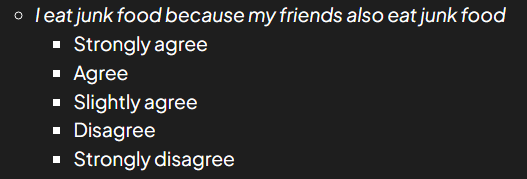
What is a Likert scale?
The respondent indicates their agreement or disagreement with a statement using a scale of usually 5 points. The scale ranges from strongly agree to strongly disagree.
What is a rating scale?
Works in a similar way to a Likert scale but gets respondents to identify a value that represents their strength of feeling about a particular topic.

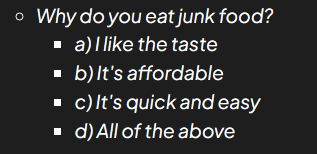
What is a fixed choice option?
Includes a list of possible options and respondents are required to indicate those that apply.
What are the strengths of questionnaires?
They’re a quick, easy and convenient method of gathering data
Large samples can be reached via the use of electronic survey tools
Large samples produce reliable results as any anomalous results are averaged by the overall trend of the data
Questionnaires use standardised questions which means that they can be replicated to check for reliability
What are the limitations of a questionnaire?
There’s a tendency for people to under-report negative and over-report positive aspects of themselves when completing a questionnaire
This means that questionnaires can lead to participants succumbing to social desirability bias
Any form of bias in research impairs the validity of the findings
Questionnaires tend to under-utilise open questions which limits their usefulness
This means that they can show the 'what' of behaviour (e.g. people become more cautious with age) but not the 'why' of that behaviour (e.g. why do people become more cautious with age?)
What are the strengths of closed questions?
Generate quantitative data which is easy to analyse and spot patterns/trends in
The data can be presented graphically and analysed statistically
Thus, reliability can be high, particularly if the questionnaire is distributed to a large sample
What are the limitations of closed questions?
The quantitative data obtained sacrifices the level of detail and insight required to understand reasons and explanations
This means that closed questions lack validity
What are the strengths of open questions?
It may ask participants to expand on the answers they give, allowing both researcher and participant to clarify, explain and qualify their comments
This means that open questions have good explanatory power and external validity
What are the limitations of open questions?
Difficult to analyse due to their subjective nature
The researcher must interpret meaning and intention from them which could give rise to a lack of consistency and objectivity
This means that open questions lack reliability