B1.2 - What happens in cells (& what do cells need?) - DNA
 Call Kai
 Learn
Learn Practice Test
 Spaced Repetition
 Match
Match Flashcards
 Knowt Play
1/40

There's no tags or description
Looks like no tags are added yet.
Name | Mastery | Learn | Test | Matching | Spaced | Call with Kai |
|---|
No analytics yet
Send a link to your students to track their progress
41 Terms
Define DNA(Deoxyribonucleic acid)
genetic material found in the nucleus of EU cells. It is a polymer made of two strands that coil around each other to form a double helix, and it carries the instructions for the development and functioning of an organism.
How many sections is the DNA strand split up into and what is each of these sections called:
46 Sections, with each section being a really tight coil of DNA called a chromosome
There’s 23 types of chromosomes (1 from each parent), each 23 types are called a pair
What is the 23rd pair of chromosomes represent in DNA?
23rd pair is the sex chromosomes (X,Y - Male) (X,X - Female)
Define a Gene:
Small section of DNA that codes for a particular type of protein
Gene codes for sequence of amino acids - when these amino acids combine they form a protein
DNA determines which proteins are produced by a cell, which determines the type of cell produced
How many types of amino acids in a human body
20
but they have so many combos that make 1000s of proteins
Define a Genome:
Entire set of genetic material in an organism
DNA is a polymer what is the name of the monomer it’s made of?
Nucleotides - Monomer
What is the composition of the Nucleotide?
A nucleotide is made of three parts:
• a phosphate group
• a sugar (deoxyribose)These 2 form the backbone of a strand of DNA
• a nitrogenous baseAll nucleotides have the same sugar and phosphate, but different bases.
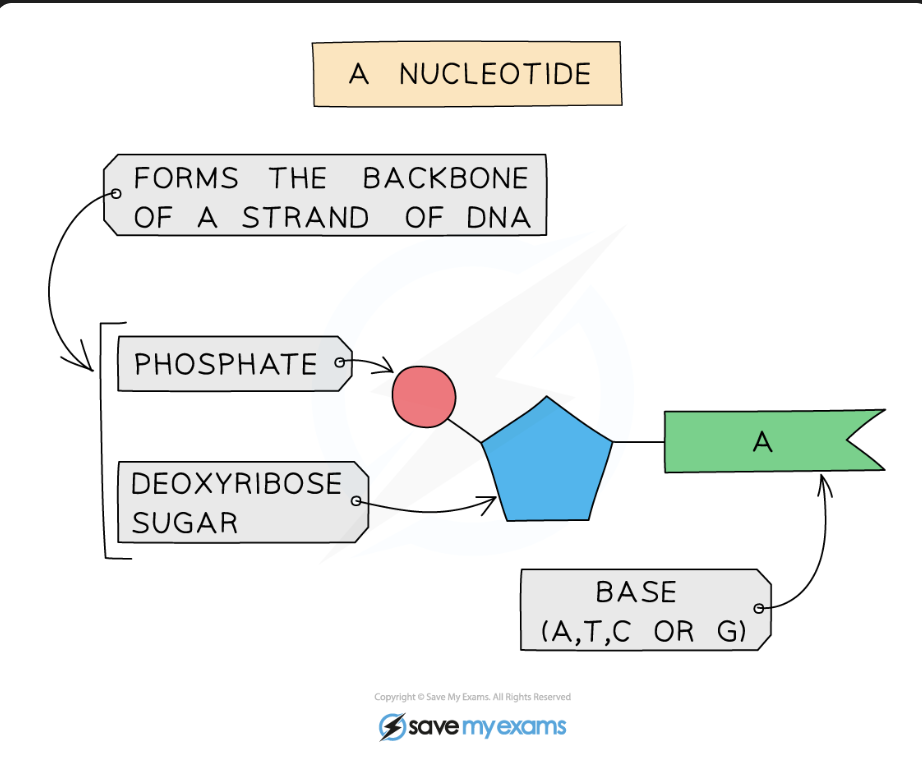
What are the 4 types of Bases in a Nucleotide? and their pairings?
Adenine - Thymine
Cytosine - Guanine
These pairs are complementary and ONLY complementary bases pair to each other
so there’s 4 types of nucleotides in DNA
How does one Nucleotide pair to another ?
The phosphate of 1 nucleotide bonds to the sugar of another nucleotide which repeats for 1000s of Nucleotides
This forms a sugar-phosphate backbone
Define a Genetic code:
Sequence of bases
Define a gene:
A particular sequence of bases that code for a protein
Define a Codon:
Group of 3 bases which is called a triplet (codon) and codes for a specific amino acid.
How does DNA code for proteins?
First the genetic code is read of as a series of triple codes (codons) which each form an amino acid
They Fold up to create a protein (by itself)
Each protein has a different sequence, which forms a unique shape that carries out a particular function.
Main uses of proteins:
Enzymes (Acts as a biological catalyst)
Hormones (Carry messages around the body)
What are the 2 main processes of Protein Synthesis?
Transcription
Translation
Define Transcription:
Transcription is when the DNA sequence of a gene is copied to make an mRNA molecule.
Define Translation:
Translation is when the mRNA code is used to assemble amino acids into a protein.
Why is transcription done ?
To make a protein, the gene must be read by ribosomes (but ribosomes are outside the nucleus)
DNA is too big so can’t leave the nucleus
So we need to copy a single gene - mRNA (copy of a single gene)
a single gene is small enough to leave the nucleus
Differences between DNA and mRNA
Much shorter than DNA (1 gene long)
Single strand (Not double stranded like DNA)
Instead of Thymine (T) base it contains Uracil (U)
The mRNA is complementary to the DNA gene that it is copied from
What is the process of Transcription ?
RNA polymerase binds to the DNA just before the gene.
The DNA strands separate, exposing the bases on the template strand.
RNA polymerase moves along the template strand and builds a complementary mRNA molecule (A→U, T→A, C→G, G→C).
Only a small section of DNA is unwound at a time; it rewinds behind the enzyme.
When the gene has been copied, RNA polymerase detaches and the mRNA molecule is released.
The mRNA leaves the nucleus and travels to a ribosome for translation.
What is the process of Translation?
The mRNA molecule attaches to a ribosome.
tRNA molecules bring specific amino acids to the ribosome.
Each tRNA has an anticodon that is complementary to a codon on the mRNA.
The correct tRNA binds to each codon, ensuring amino acids are added in the right order.
The ribosome joins the amino acids together, forming a growing polypeptide chain.
When the final codon is reached, the polypeptide chain is released and folds into a functional protein.
Different polypeptide chains fold differently forming different proteins
Define Ribosome function:
To assemble proteins from Amino Acids during Protein synthesis
What are enzymes?
Enzymes are biological catalysts that speed up chemical reactions without being changed or used up.
What is metabolism?
Metabolism is the sum of all chemical reactions in a cell or organism, including building molecules and breaking them down.
Why do cells need enzymes?
Enzymes allow reactions to happen quickly at a rate which can sustain life safe temperatures, preventing the need for high heat that would damage cells.
What is a substrate?
The substrate is the molecule an enzyme acts on, which is either broken apart or joined to another molecule.
What is the active site?
The active site is the specially shaped region of an enzyme where the substrate binds and the reaction occurs.
What is enzyme specificity?
Enzymes are specific because only substrates with a complementary shape can fit into their active site.
What is the Lock and Key Hypothesis?
The enzyme’s active site is the “lock” and the substrate is the “key.” Only the correctly shaped substrate fits, so only that reaction is catalysed.
What are the 3 factors affecting enzyme activity?
Temperature, pH, and substrate concentration.
How does temperature affect enzyme activity?
Higher temperature increases frequency of collisions since particle have a greater kinetic energy and hence the reaction rate until the optimum. Above this, enzymes denature as bonds break and the active site changes shape.
What is the optimum temperature?
The temperature at which an enzyme works fastest. In humans, this is about 37°C.
What is enzyme denaturation (temperature)?
High temperatures break bonds in the enzyme, changing the active site so the substrate no longer fits and the reaction stops.
How does pH affect enzyme activity?
If pH is too high or too low, bonds break and the active site changes shape, reducing activity. Extreme pH causes denaturation.
What is the optimum pH?
The pH at which an enzyme works best. Most human enzymes work at pH 7; stomach enzymes at pH 2
How does substrate concentration affect enzyme activity?
Increasing substrate concentration increases reaction rate because there’s more substrates available which means there’s a higher likelihood that the active sties will be filled due to the greater amount of substrate concentrations, until all active sites are full. After saturation, the rate cannot increase further.
What is the saturation point?
The point where all enzyme active sites are occupied, so adding more substrate does not increase the reaction rate.
What is the formula for rate of enzyme reaction? (rate is how fast an enzyme is working)
Rate = Change ÷ Time (change = substrate used or product formed).
Amylase catalyses the breakdown of starch into maltose. 15 grams of starch were added to a solution containing amylase. It took 2 hours for all the starch to be broken down. Calculate the rate of reaction.
= 7.5g/hr
How do you calculate rate from time taken? ( IF ONLY GIVE THE TIME)
If only time is given, rate = 1 ÷ Time.
ex:
If a reaction takes 5 seconds, the rate is:
1 ÷ 5 = 0.2 units per second
If it takes 20 seconds, the rate is:
1 ÷ 20 = 0.05 units per second (slower)
Practical : Effect of PH on rate of reaction of amylase:
ON THE PRACTICALS FC DECK (BUT HERE’S A REMINDER TO DO THAT DECK ELSE ADD THIS PRACTICAL TO THAT DECK IF NOT DONE YET)

